Results by title
137 books match the query 'Patients' and 7 start with s
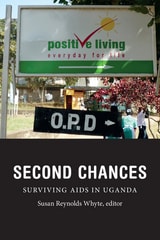
Second Chances
Surviving AIDS in UgandaSusan Reynolds Whyte, editor
Duke University Press, 2014
Contributors. Phoebe Kajubi, David Kyaddondo, Lotte Meinert, Hanne O. Mogensen, Godfrey Etyang Siu, Jenipher Twebaze, Michael A. Whyte, Susan Reynolds Whyte
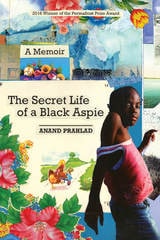
Secret Life of a Black Aspie
A MemoirAnand Prahlad
University of Alaska Press, 2017
For the first four years of his life, Prahlad didn’t speak. But his silence didn’t stop him from communicating—or communing—with the strange, numinous world he found around him. Ordinary household objects came to life; the spirits of long-dead slave children were his best friends. In his magical interior world, sensory experiences blurred, time disappeared, and memory was fluid. Ever so slowly, he emerged, learning to talk and evolving into an artist and educator. His journey takes readers across the United States during one of its most turbulent moments, and Prahlad experiences it all, from the heights of the Civil Rights Movement to West Coast hippie enclaves to a college town that continues to struggle with racism and its border state legacy.
Rooted in black folklore and cultural ambience, and offering new perspectives on autism and more, The Secret Life of a Black Aspie will inspire and delight readers and deepen our understanding of the marginal spaces of human existence.
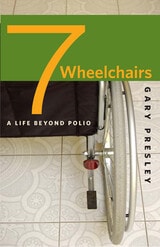
Seven Wheelchairs
A Life beyond PolioGary Presley
University of Iowa Press, 2008
Presley is no wheelchair hero, no inspiring figure preaching patience and gratitude. An army brat turned farm kid, newly arrived in a conservative rural community, he was immobilized before he could take the next step toward adulthood. Prevented, literally, from taking that next step, he became cranky and crabby, anxious and alienated, a rolling responsibility crippled not just by polio but by anger and depression, “a crip all over, starting with the brain.” Slowly, however, despite the limitations of navigating in a world before the Americans with Disabilities Act, he builds an independent life.
Now, almost fifty years later, having worn out wheelchair after wheelchair, survived post-polio syndrome, and married the woman of his dreams, Gary has redefined himself as Gimp, more ready to act out than to speak up, ironic, perceptive, still cranky and intolerant but more accepting, more able to find joy in his family and his newfound religion. Despite the fact that he detests pity, can spot condescension from miles away, and refuses to play the role of noble victim, he writes in a way that elicits sympathy and understanding and laughter. By giving his readers the unromantic truth about life in a wheelchair, he escapes stereotypes about people with disabilities and moves toward a place where every individual is irreplaceable.
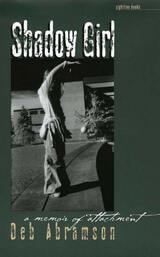
Shadow Girl
A Memoir Of AttachmentDeb Abramson
University of Iowa Press, 2002
In this psychological portrait of a family bound together by the uneasy permutations of love, Abramson relies not on sensationalist narrative but on a collection of the many small moments that glitter along the bumpy path of her life. Now and then she provides a broader, connecting perspective by stepping out of her story to reflect on the meaning of it all from the standpoint of the insightful, healed person she has managed—against all odds—to become.
Rich in metaphor and intimate detail, this is a lyrical story about moving from isolation toward connection, about seeing childhood not as a crippling refuge but as a point of departure, about discovering that it is possible to “have your shadows as well as your light.”
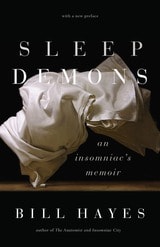
Sleep Demons
An Insomniac’s MemoirBill Hayes
University of Chicago Press, 2018
An acclaimed journalist and memoirist—and partner of the late neurologist Oliver Sacks—Hayes has been plagued by insomnia his entire life. The science and mythology of sleep and sleeplessness form the backbone to Hayes’s narrative of his personal battles with sleep and how they colored his waking life, as he threads stories of fugitive sleep through memories of growing up in the closet, coming out to his Irish Catholic family, watching his friends fall ill during the early years of the AIDS crisis in San Francisco, and finding a lover. An erudite blend of science and personal narrative, Sleep Demons offers a poignant introduction to the topics for which Hayes has since become famous, including art, eros, city life, the history of medical science, and queer identity.
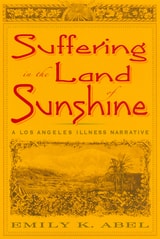
Suffering in the Land of Sunshine
A Los Angeles Illness NarrativeAbel, Emily K.
Rutgers University Press, 2006
The history of medicine is much more than the story of doctors, nurses, and hospitals. Seeking to understand the patient’s perspective, historians scour the archives, searching for rare personal accounts. Bringing together a trove of more than 400 family letters by Charles Dwight Willard, Suffering in the Land of Sunshine provides a unique window into the experience of sickness.
A Los Angeles civic leader at the turn of the twentieth century, Willard is well known to historians of the West, but exclusively for his public life as a booster and reformer. Willard’s evocative story offers fresh insights into several critical issues, including how concepts of gender, class, and race shape patients’ representations of their illness, how expectations of cure affect the illness experience, how different cultures constrain the coping strategies of the sick, and why robust health is such an exalted value in certain societies.
Symmetry
Marc Straus
Northwestern University Press, 2000