Results by title
1066 books match the query 'Political' and 56 start with s
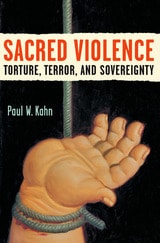
Sacred Violence
Torture, Terror, and SovereigntyPaul W. Kahn
University of Michigan Press, 2008
In Sacred Violence, the distinguished political and legal theorist Paul W. Kahn investigates the reasons for the resort to violence characteristic of premodern states. In a startling argument, he contends that law will never offer an adequate account of political violence. Instead, we must turn to political theology, which reveals that torture and terror are, essentially, forms of sacrifice. Kahn forces us to acknowledge what we don't want to see: that we remain deeply committed to a violent politics beyond law.
Paul W. Kahn is Robert W. Winner Professor of Law and the Humanities at Yale Law School and Director of the Orville H. Schell, Jr. Center for International Human Rights.
Cover Illustration: "Abu Ghraib 67, 2005" by Fernando Botero. Courtesy of the artist and the American University Museum.

Salvador Allende
Revolutionary Democrat: Revolutionarvy DemocratVictor Figueroa Clark
Pluto Press, 2013
This is a political biography of one of the 20th century’s most emblematic left-wing figures - Salvador Allende, who was president of Chile until he was ousted by General Pinochet in a US-supported coup in 1973.
Victor Figueroa Clark guides us through Allende's life and political project, answering some of the most frequently asked questions. Was he a revolutionary or a reformist? A bureaucrat or inspirational democrat? Clark argues that Allende and the Popular Unity Party created a unique fusion which was both revolutionary and democratic.
The process led by Allende was a symbol of hope for the left during his short time in power. Forty years on, and with left governments back in power across Latin America, this book looks back at the man and the process in order to draw vital lessons for the left in Latin America and around the world today.
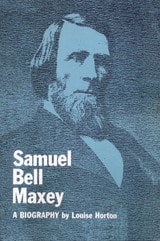
Samuel Bell Maxey
A BiographyBy Louise Horton
University of Texas Press, 1974
Samuel Bell Maxey was an important political figure in nineteenth-century Texas, but no previous book-length study of his life and career has been published. Louise Horton has utilized his private papers as well as numerous other sources in preparing this biography, which includes many of Maxey's own comments on his contemporaries. The letters also provide new information on the development of railroads across the Southwest.
An emigrant from Kentucky, Samuel Bell Maxey practiced law in North Texas, raised a regiment at the beginning of the Civil War, returned to Texas to defend the Indian Territory during 1863-1865, and was elected on his first candidacy to be the first Democratic senator from Texas after the Civil War. After two years in office he became Texas's senior senator and held that position until defeated by John H. Reagan in 1887. Maxey's term of office spanned the turbulent period immediately following Reconstruction, and a great deal of his influence derived from his moderation. He was concerned that the breach caused by the Civil War be healed. He was influential among Republican congressmen from the North and aided substanially in Texas's regaining its status in the Union. Louise Horton's biography of Maxey emphasizes the contribution he made to the state and the nation and fills a gap in the history of the post-Civil War period.
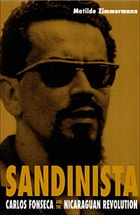
Sandinista
Carlos Fonseca and the Nicaraguan RevolutionMatilde Zimmermann
Duke University Press, 2000
Sandinista is the first English-language biography of Carlos Fonseca Amador, the legendary leader of the Sandinista National Liberation Front of Nicaragua (the FSLN) and the most important and influential figure of the post–1959 revolutionary generation in Latin America. Fonseca, killed in battle in 1976, was the undisputed intellectual and strategic leader of the FSLN. In a groundbreaking and fast-paced narrative that draws on a rich archive of previously unpublished Fonseca writings, Matilde Zimmermann sheds new light on central themes in his ideology as well as on internal disputes, ideological shifts, and personalities of the FSLN.
The first researcher ever to be allowed access to Fonseca’s unpublished writings (collected by the Institute for the Study of Sandinism in the early 1980s and now in the hands of the Nicaraguan Army), Zimmermann also obtained personal interviews with Fonseca’s friends, family members, fellow combatants, and political enemies. Unlike previous scholars, Zimmermann sees the Cuban revolution as the crucial turning point in Fonseca’s political evolution. Furthermore, while others have argued that he rejected Marxism in favor of a more pragmatic nationalism, Zimmermann shows how Fonseca’s political writings remained committed to both socialist revolution and national liberation from U.S. imperialism and followed the ideas of both Che Guevara and the earlier Nicaraguan leader Augusto César Sandino. She further argues that his philosophy embracing the experiences of the nation’s workers and peasants was central to the FSLN’s initial platform and charismatic appeal.
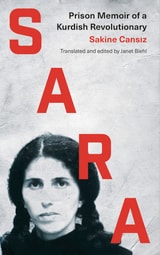
Sara
Prison Memoir of a Kurdish RevolutionarySakine Cansiz
Pluto Press, 2019

Savage Anomaly
The Power of Spinoza’s Metaphysics and PoliticsAntonio Negri
University of Minnesota Press, 1999
A fresh take on this critical philosopher.
In this essential rereading of Spinoza’s (1632-1677) philosophical and political writings, Negri positions this thinker within the historical context of the development of the modern state and its attendant political economy. Through a close examination of Spinoza, Negri reveals him as unique among his contemporaries for his nondialectical approach to social organization in a bourgeois age.
Scotland and America in the Age of Paine
Ronald Lyndsey Crawford
Aberdeen University Press, 2022

Second-Place Mo
Morris Udall ’76 and the Twilight of Democratic LiberalismJon Krampner
Michigan State University Press, 2027
Second-Place Mo examines the rightward drift of the Democratic Party that began in earnest with Jimmy Carter’s defeat of Morris “Mo” Udall for the Democratic presidential nomination in 1976—a turning point that set the party toward a free-market economy and away from economic liberalism.
The candidacy of Mo Udall, a congressman from Arizona, was the first time in almost a century that a member of the House of Representatives had a chance to become president; it also promised a continuation of the Democrats’ tradition of New Deal liberalism, which had been the party’s guiding star since the 1930s. But the Udall campaign was rocked by events beyond its control, its own mistakes, and the whirlwind candidacy of Jimmy Carter, who went on to win the nomination and the presidency.
Mo Udall chalked up eight second-place primary finishes without a victory. His candidacy was memorable for his dogged persistence, sunny good humor, and unabashed liberalism. This book chronicles a Democratic primary filled with memorable candidates, including the militarist and arch-Zionist Scoop Jackson; the newly minted more-populist-than-thou Fred Harris; the Hamlet-like figures of Birch Bayh and Hubert Humphrey; the fading, injured apostle of the Confederate South, George Wallace; the affable yet ineffective Kennedy in-law, Sargent Shriver; the anti-abortion housewife from Long Island, Ellen McCormack; and others. All are vividly brought to life—including Jimmy Carter, a thrower of sharp elbows before he became the beloved, humanitarian former president—set against the backdrop of Udall’s doomed effort.
Second-Place Mo examines why Udall’s 1976 campaign failed and what lessons his near misses hold for contemporary politics. Along the way, it recovers a figure whose principled liberalism and self-deprecating humor offer an instructive contrast to the politics of our own moment.

Secret Signs
T. J. Waters
Gallaudet University Press, 2010
Former golf pro Amy Kellen, recently widowed and the mother of a three-year-old daughter, hoped that her new job as a video relay service interpreter for deaf clients would bring stability into her life. She also wished to stay close to the Deaf community that meant so much to her late husband, who was deaf. Little did she know, however, that her new profession would cause her to witness the vicious killing of a deaf client during a video call. In this way author T. J. Waters thrusts Amy into a murder mystery that catches her up in intersecting worlds of intrigue—Internet scams, burglaries, and presidential politics—all connected through the rich Deaf community in Washington, DC.
During the investigation, Amy meets local detective Mike Seer and Secret Service agent Heath Rasco. Despite Seer’s insistence, she refuses to violate her professional ethics and discuss the content of the fatal call. Agent Rasco, who is hard of hearing, admires her commitment to her deaf clients. Amy admits her own attraction to the agent, but her first concern is to learn more about how her client, a respected deaf political strategist, was killed. Her pursuit causes her to witness two more murders and discover a third. She also finds herself and her daughter the targets of assassins. Secret Signs brings these extraordinary elements together in an electrifying combination that promises to surprise and satisfy.
Secular Powers
Humility in Modern Political ThoughtJulie E. Cooper
University of Chicago Press, 2013
Contemporary understandings of secularism, Cooper contends, have been shaped by a limited understanding of it as a shift from vulnerability to power. But the works of the foundational thinkers of secularism tell a different story. Analyzing the writings of Hobbes, Spinoza, and Rousseau at the moment of secularity’s inception, she shows that all three understood that acknowledging one’s limitations was a condition of successful self-rule. And while all three invited humans to collectively build and sustain a political world, their invitations did not amount to self-deification. Cooper establishes that secular politics as originally conceived does not require a choice between power and vulnerability. Rather, it challenges us—today as then—to reconcile them both as essential components of our humanity.
Selected Writings on Race and Difference
Stuart Hall
Duke University Press, 2021
Self-Determination without Nationalism
A Theory of Postnational SovereigntyOmar Dahbour
Temple University Press, 2014
How do groups—be they religious or ethnic—achieve sovereignty in a postnationalist world? In Self-Determination without Nationalism, noted philosopher Omar Dahbour insists that the existing ethics of international relations, dominated by the rival notions of liberal nationalism and political cosmopolitanism, no longer suffice.
Dahbour notes that political communities are an ethically desirable and historically inevitable feature of collective life. The ethical principles that govern them, however—especially self-determination and sovereignty—require reformulation in light of globalization and the economic and environmental challenges of the twenty-first century.
Arguing that nation-states violate the principle of self-determination, Dahbour then develops a detailed new theory of self-determination that he calls "ecosovereignty.” Ecosovereignty defines political community in a way that can protect and further the rights of indigenous peoples as well as the needs of ecological regions for a sustainable form of development and security from environmental destruction.
In the series Global Ethics and Politics, edited by Carol Gould.
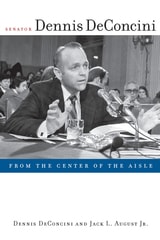
Senator Dennis DeConcini
From the Center of the AisleDennis DeConcini and Jack L. August, Jr.
University of Arizona Press, 2006
A vigilant centrist, who got results by building coalitions on both sides of the aisle, Senator DeConcini’s approach was not bound to strict party alliances but was deeply rooted in the independent political environment of Arizona. During his career, he sponsored legislation limiting the sale of assault weapons, which provoked the National Rifle Association. He confounded Democratic Party regulars by supporting Clarence Thomas during the controversial confirmation hearings and again split with his party in his support for William Rehnquist’s nomination to Chief Justice. In 1980 he voted for Ronald Reagan, but in 1993 he cast the swing vote for President Bill Clinton’s tax bill, which was strongly opposed by Republicans in Arizona.
This political memoir will be of interest to anyone concerned with the inner workings of the U.S. Senate or Arizona politics and offers relevant insights into today’s political climate.
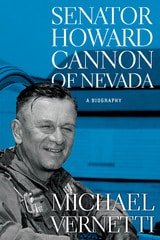
Senator Howard Cannon of Nevada
A BiographyMichael Vernetti
University of Nevada Press, 2015
Born to a devout Mormon family in a small farming community in southwest Utah, Cannon served in the Army Air Force during World War II and emerged from the war as a hero. Soon he was part of the postwar migration of ambitious, adventurous Americans to the booming desert city of Las Vegas, where he practiced law and entered local politics. In 1958 he was elected to the U.S. Senate and joined a group of influential young Democratic senators who were to play a major role in shaping the country’s future. His service on the Aeronautical and Space Sciences Committee and the Armed Services Committee led to major changes in the air travel industry, including deregulation, and to increased support for national military preparedness.
Senator Leahy
A Life in ScenesPhilip Baruth
University Press of New England, 2017

Shakespeare's Reformation
Christian Humanism and the Death of GodNalin Ranasinghe
St. Augustine's Press, 2022
"I will try to claim that Shakespeare offers an esoteric vindication of the human soul itself, not merely poetry, against the looming backdrop of the Counter-Reformation in Europe and the Puritan perversion of English Anglicanism. Neither the Scholasticism of the former nor the fundamentalism of the latter had any sympathy for the claims of men like Bottom or the Bastard to see beyond the confines of scripture and sacred social structures. While poetry could indulge in metaphysical fantasy, it could not take on the status quo without the assistance of more learned allies; this Shakespeare seems to do by his re-telling of Classical and English history. As disingenuous as Bottom (or Erasmus) in this artful use of ignorance and folly to conceal his serious goals, Shakespeare is thus tying poetry to history and giving us an alternate, if playful, account of Western Civilization."
Shifting Obsessions
Three Essays on the Politics of AnticorruptionAryeh Neier
Central European University Press, 2004
Simone Weil and the Politics of Self-Denial
Athanasios Moulakis & Translated by Ruth Hein
University of Missouri Press, 1998
Simone Weil and the Politics of Self-Denial delivers what no other book on Weil has—a comprehensive study of her political thought. In this examination of the development of her thought, Athanasios Moulakis offers a philosophical understanding of politics that reaches beyond current affairs and ideological advocacy.
Simone Weil—philosopher, activist, mystic—unites a profound reflection on the human condition with a consistent and courageous existential and intellectual honesty manifest in the moving testimony of her life and her death. Moulakis examines Weil's political thought as an integral part of a lived philosophy, in which analysis and doctrine are inseparable from the articulation of an intensely personal, ultimately religious experience.
Because it is impossible to distinguish Weil's life from her thought, her writings cannot be understood properly without linking them to her life and character. By situating Weil's political thought within the context of the intellectual climate of her time, Moulakis connects it also to her epistemology, her cosmology, and her personal experience.
Simone Weil and the Politics of Self-Denial presents the unfolding of Weil's philosophical life against the backdrop of the political and social conditions of the last days of the Third French Republic, the Spanish Civil War, and the rise and clash of totalitarian ideologies. The ideological climate of the age—of which Weil herself was not quite free—was indeed the major "obstacle" in the struggle against which she fashioned her critical, intellectual, and moral tools.
Weil has been categorized a number of ways: as a saint and a near convert to Roman Catholicism, as a social critic, or as an analytic philosopher. Moulakis examines all aspects of Weil's thought in the indissoluble unity in which she lived them. This thorough investigation pursues the particular intellectual affiliations and the social and political experiential stimuli of Weil's work while simultaneously teasing out the timeless themes that her own timely analysis was intended to reveal.
Simone de Beauvoir’s Political Thinking
Edited by Lori Jo Marso and Patricia Moynagh
University of Illinois Press, 2006
By exploring the life and work of the influential feminist thinker Simone de Beauvoir, this book shows how each of us lives within political and social structures that we can--and must--play a part in transforming. It argues that Beauvoir’s careful examination of her own existence can also be understood as a dynamic method for political thinking.
As the contributors illustrate, Beauvoir's political thinking proceeds from the bottom up, using examples from individual lives as the basis for understanding and transforming our collective existence. For example, she embraced her responsibility as a French citizen as making her complicit in the French war against Algeria. Here, she sees her role as an oppressor. In other contexts, she looks to the lives of individual women, including herself, to understand the dimensions of gender inequality.
This volume’s six tightly connected essays home in on the individual’s relationship to community, and how one’s freedom interacts with the freedom of other people. Here, Beauvoir is read as neither a liberal nor a communitarian. The authors focus on her call for individuals to realize their freedom while remaining consistent with ethical obligations to the community. Beauvoir's account of her own life and the lives of others is interpreted as a method to understand individuals in relations to others, and as within structures of personal, material, and political oppression. Beauvoir's political thinking makes it clear that we cannot avoid political action. To do nothing in the face of oppression denies freedom to everyone, including oneself.
Skepticism, Individuality, and Freedom
The Reluctant Liberalism Of Richard FlathmanBonnie Honig
University of Minnesota Press, 2002
Major thinkers grapple with the challenge of this renowned liberal thinker.
As one of liberal theory’s most important gadflies, Richard Flathman has during the past four decades produced a significant body of work that is iconoclastic, idiosyncratic, and increasingly influential. Flathman criticizes liberal theory’s role in justifying a politics of governance that has drifted substantially from liberalism’s central commitments to individuality and freedom. It is this challenge, and its implications for the future of liberal theory, that brings together the diverse and distinguished authors of this volume. Topics include the relationships between theory and practice, skepticism and knowledge, individuality and egoism, negative and positive freedom, Hobbes and liberalism, as well as the uneasy connections among liberalism, feminism, and democratic politics.
Contributors: Ronald Beiner, U of Toronto; Jane Bennett, Goucher; William E. Connolly, Johns Hopkins; Peter Digeser, U of California, Santa Barbara; Richard Friedman, SUNY, Buffalo; Nancy J. Hirschmann, Cornell; George Kateb, Princeton; Patrick Neal, U of Vermont; Anne Norton, U of Pennsylvania; Richard Tuck, Harvard; Jeremy J. Waldron, Columbia; Linda Zerilli, Northwestern.Slavoj Zizek
A Critical IntroductionIan Parker
Pluto Press, 2004
'This is not simply the best critical introduction to Zizek – in a much more radical sense, this is the only critical introduction to Zizek. Parker's study is much more than an important contribution to the ongoing debate: it redefines its very terms.' Yannis Stavrakakis, author of 'Lacan and the Political'
'A sharp, clear and radical analysis.' Christian Ingo Lenz Dunker, Professor of Psychoanalytic Theory and Lacanian Psychoanalyst, Sao Paulo, Brazil.
Since the publication of his first book in English in 1989, Slavoj Zizek has quickly become one of the most widely read and contentious intellectuals alive today. With dazzling wit and tremendous creativity he has produced innovative and challenging explorations of Lacan, Hegel and Marx, and used his insights to exhilarating effect in analyses of popular culture.
While Zizek is always engaging, he is also elusive and even contradictory. It can be very hard to finally determine where he stands on a particular issue. Is Zizek Marxist or Post-Marxist? How seriously should we take his recent turn to Christianity?
Slavoj Zizek: A Critical Introduction shows the reader a clear path through the twists and turns of Zizek's writings. Ian Parker takes Zizek's treatment of Hegel, Lacan and Marx in turn and outlines and assesses Zizek's interpretation and extension of these thinkers' theories. While Parker is never hastily dismissive of Zizek's innovations, he remains critical throughout, aware that the energy of Zizek's writing can be bewitching and beguiling as well as engaging and profound.

Slices and Lumps
Division and Aggregation in Law and LifeLee Anne Fennell
University of Chicago Press, 2019
Lee Anne Fennell explores how both types of challenges—carving out useful slices and assembling useful lumps—surface in myriad contexts, from hot button issues like conservation and eminent domain to developments in the sharing economy to personal struggles over work, money, time, diet, and exercise. Yet the significance of configuration is often overlooked, leading to missed opportunities for improving our lives. With a technology-fueled entrepreneurial explosion underway that is dividing goods, services, and jobs in novel ways, and as urbanization and environmental threats raise the stakes for assembling resources and cooperation, this is an especially exciting and crucial time to confront questions of slicing and lumping. The future of the city, the workplace, the marketplace, and the environment all turn on matters of configuration, as do the prospects for more effective legal doctrines, for better management of finances and health, and more. This book reveals configuration’s power and potential—as a unifying concept and as a focus of public and private innovation.
Snarl
In Defense of Stalled Traffic and Faulty NetworksRuth A. Miller
University of Michigan Press, 2014
Ruth A. Miller excavates a centuries-old history of nonhuman and nonbiological constitutional engagement and outlines a robust mechanical democracy that challenges existing theories of liberal and human political participation. Drawing on an eclectic set of legal, political, and automotive texts from France, Turkey, and the United States, she proposes a radical mechanical re-articulation of three of the most basic principles of democracy: vitality, mobility, and liberty.
Rather than defending a grand theory of materialist or posthumanist politics, or addressing abstract concepts or “things” writ large, Miller invites readers into a self-contained history of constitutionalism situated in a focused discussion of automobile traffic congestion in Paris, Istanbul, and Boston. Within the mechanical public sphere created by automotive space, Snarl finds a model of democratic politics that transforms our most fundamental assumptions about the nature, and constitutional potential, of life, movement, and freedom.
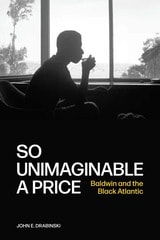
So Unimaginable a Price
Baldwin and the Black AtlanticJohn E. Drabinski
Northwestern University Press, 2026
James Baldwin’s nonfiction offers some of the most important and challenging thinking on the experience of race, history, and memory in the Black Atlantic world. Yet much of the scholarly literature on Baldwin’s writing reads his work from inside the sociocultural context of the United States, alongside key interlocutors like Richard Wright, Ralph Ellison, and Lorraine Hansberry. So Unimaginable a Price: Baldwin and the Black Atlantic shifts the critical frame, examining Baldwin’s work as part of a midcentury moment across the wider Atlantic world and tying his reflections to those of thinkers in the Caribbean and Africa to underscore the widening sense, as well as the particularity, of his critical claims. Who is Baldwin to the Atlantic world? And who, then, is Baldwin to the United States? John E. Drabinski recasts Baldwin as a Black Atlantic writer whose unique qualities as a thinker are enhanced by their similarities and differences with fellow writers of liberation in the global Black world.

Soapy
A Biography of G. Mennen WilliamsThomas J. Noer
University of Michigan Press, 2005
---George McGovern
"Soapy Williams had a deep talent not only to compel but on occasion to repel."
---John Kenneth Galbraith
"Thomas Noer has written a model biography of a fascinating political figure. He brings Williams to life with all his contradictions, old-fashioned qualities, and admirable idealism."
---Robert Divine, George W. Littlefield Professor Emeritus in American History, University of Texas
"G. Mennen 'Soapy' Williams was not only a giant in the 20th century history of the Michigan Democratic Party, the history of the state of Michigan and our nation-he was a giant ahead of his time. Throughout his long and extremely distinguished career as Governor of Michigan, Assistant Secretary of State for African Affairs and Chief Justice of the Michigan Supreme Court, Soapy maintained an unwavering commitment to equality, justice and civil rights for all people."
---Senator Carl Levin
In this first complete biography of G. Mennen "Soapy" Williams, author Thomas Noer brings to life the story of one of the most controversial and colorful politicians in twentieth-century American politics and a giant in the Michigan Democratic Party.
In 1948, winning a stunning upset, Williams became Michigan's second Democratic governor since the Civil War and was reelected five times. He served under Kennedy and Johnson as Assistant Secretary of State for Africa, briefly held the post of U.S. Ambassador to the Philippines, and was a member of the Michigan Supreme Court from 1970 to 1986, serving as Chief Justice in his last term.
Sporting his instantly recognizable trademark green and white polka-dot bow tie, Williams was a flamboyant character. He was also known for his energetic campaign style: he could say "hello" in seventeen languages, would shake hands with as many as five thousand factory workers a day, and made seemingly endless diplomatic trips to Africa. All of this captured the attention of the media and the public and made Williams into a celebrity.
Beneath his showy public persona, however, Williams also made important contributions to American diplomatic and political history. He built an unrivaled political machine in Michigan, bringing organized labor, African Americans, and ethnic groups into a new coalition; influenced the shift in American policy toward support for African independence; and wrote landmark decisions as a jurist on the Michigan Supreme Court.
The fascinating story of a complex and complicated man, Soapy will introduce one of the great American political figures of the twentieth century to a new generation of readers.

Social Contract, Discourse on the Virtue Most Necessary for a Hero, Political Fragments, and Geneva Manuscript
Jean-Jacques Rousseau
Dartmouth College Press, 1994
Social Theory Now
Edited by Claudio E. Benzecry, Monika Krause, and Isaac Ariail Reed
University of Chicago Press, 2017
The book provides a strategic window onto social theory based on current research, examining trends in classical traditions and the cutting edge of more recent approaches. From distinctive theoretical positions, contributors address questions about how social order is accomplished; the role of materiality, practice, and meaning; as well as the conditions for the knowledge of the social world. The theoretical traditions presented include cultural sociology, microsociologies, world-system theory and post-colonial theory, gender and feminism, actor network and network theory, systems theory, field theory, rational choice, poststructuralism, pragmatism, and the sociology of conventions. Each chapter introduces a tradition and presents an agenda for further theoretical development. Social Theory Now is an essential tool for sociologists. It will be central to the discussion and teaching of contemporary social theory for years to come.
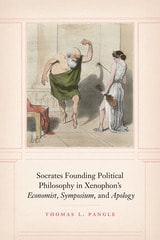
Socrates Founding Political Philosophy in Xenophon's "Economist", "Symposium", and "Apology"
Thomas L. Pangle
University of Chicago Press, 2020
Unlike the Socrates of Plato, Xenophon’s Socrates is more complicated and human, an individual working out the problem of what it means to live well and virtuously. While the Memorabilia defends Socrates by stressing his likeness to conventionally respectable gentlemen, Xenophon’s remaining Socratic texts offer a more nuanced characterization by highlighting how Socrates also diverges from conventions of gentlemanliness in his virtues, behaviors, and peculiar views of quotidian life and governmental rule. One question threads through the three writings: Which way of life best promotes human existence, politics, and economics—that of the Socratic political philosopher with his philosophic virtues or that of the gentleman with his familial, civic, and moral virtues? In uncovering the nuances of Xenophon’s approach to the issue in the Economist, Symposium, and Apology, Pangle’s book cements the significance of these writings for the field and their value for shaping a fuller conception of just who Socrates was and what he taught.
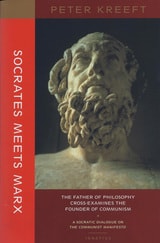
Socrates Meets Marx
The Father of Philosophy Cross-examines the Founder of CommunismPeter Kreeft
St. Augustine's Press, 2003
Humorous, frank, and insightful, this book challenges the reader to step in and take hold of what is right and to cast away what is wrong. Topics covered included such varied subjects as private property, the individual, the Three Philosophies of Man, women, individualism, and more. A wonderful introduction to philosophy for the neophyte, and a joy for the experienced student of thought.
“Imagine two of the most influential thinkers of all time, and two of the most diametrically opposed, thrust together in a no holds barred debate about some of the most important questions: Does man move the world or is he only a puppet of forces beyond his control? Is there a human nature or only market forces? Is Communism the liberator of mankind or a deadly scourge? In Peter Kreeft’s Socrates Meets Marx, the father of philosophy cross examines the founder of communism using the Communist Manifesto, details from the life of Marx himself, and the witnesses of history as evidence to be considered for judgment. If only every edition of the Communist Manifesto would have been bound together with a copy of this book, the world would be a much saner place.” – Christopher Kaczor, author of Proportionalism and the Natural Law Tradition
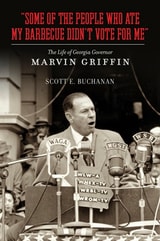
Some of the People Who Ate My Barbecue Didn't Vote for Me
The Life of Georgia Governor Marvin GriffinScott E. Buchanan
Vanderbilt University Press, 2011
.
In "Some of the People Who Ate My Barbecue Didn't Vote for Me," Scott Buchanan portrays Marvin Griffin as a Yellow Dog Democrat struggling against inevitable change. Griffin was viewed by many as a charismatic voice of resistance in the Georgia and the South in the wake of Brown v. Board of Education. He combined a staunch segregationist approach with economically progressive policies, assisting in Georgia's transformation from an agrarian economy to a more industrialized one.
Ironically, it was these efforts and the larger shift in politics that doomed Griffin's career, ensuring his administration would last only one term. In many ways, Griffin stands as a clear dividing line between the Old South and the New.
Someone Speaks Your Name
Luis García Montero
Swan Isle Press, 2022
It’s the summer of 1963 and León Egea, a cocky nineteen-year-old student and aspiring author, has just finished his first year studying literature at the University of Granada and is starting a summer job as an encyclopedia salesman. León, infuriated by the injustices in Spanish society under the Franco dictatorship, comes to find that literature can speak the truth when the reality is clouded.
In this coming-of-age novel by renowned Spanish writer Luis García Montero, León discovers that, under the repressive Franco dictatorship, people, places, and events are not always what they seem. But literature, words, and names open paths to discovery, both personal and political. Through lyrical fast-paced narrative, Someone Speaks Your Name explores literature as a foundation for understanding human relationships, national character, discrete differences between right and wrong, and for pursuing the path forward. As León’s professor tells him: “Learning to write is learning to see.”
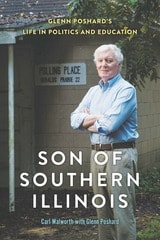
Son of Southern Illinois
Glenn Poshard’s Life in Politics and EducationCarl Walworth with Glenn Poshard
Southern Illinois University Press, 2023
A life of principles, service, and faith
This first biography of Glenn Poshard traces the life of a young man who rose from rural poverty in Southern Illinois to become a United States congressman and president of the Southern Illinois University system. This profound portrait unveils a life and career dedicated to making higher education affordable and improving the quality of life for the community of Southern Illinois.
Beginning with his childhood in a two-room home near Herald, Illinois and the early, tragic loss of his sister, this biography navigates Poshard’s service in the military, his time as a state senator and United States congressman, his run for governor, his years at Southern Illinois University, and the establishment of the Poshard Foundation for Abused Children. Intimacies of his personal life are disclosed, such as his struggles with and treatment for depression, his passion for education, and the lasting bonds he formed with his teachers. His unpopular decision to refuse PAC donations is also highlighted, along with the work that went into sponsoring the Illinois Wilderness Act, and his relationship with civil rights activist John Lewis. Glenn Poshard’s efforts for the Wilderness Act designated Southern Illinois’s famous Garden of the Gods as a National Wilderness Preservation System, which continues to attract visitors from around the world.
Poshard’s path from poverty was riddled with hardship, but his perseverance and family values ultimately allowed for longstanding personal and civic growth. From an admirable work ethic to a steadfast commitment to problem-solving, this biography illuminates the life and accomplishments of an impressive and generous leader.
Sonoran Strongman
Ignacio Pesqueira and His TimesRodolfo F. Acuña
University of Arizona Press, 1974
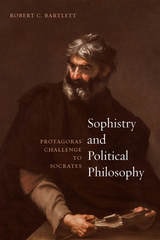
Sophistry and Political Philosophy
Protagoras' Challenge to SocratesRobert C. Bartlett
University of Chicago Press, 2016
With Sophistry and Political Philosophy, Robert C. Bartlett provides the first close reading of Plato’s two-part presentation of Protagoras. In the “Protagoras,” Plato sets out the sophist’s moral and political teachings, while the “Theaetetus,” offers a distillation of his theoretical and epistemological arguments. Taken together, the two dialogues demonstrate that Protagoras is attracted to one aspect of conventional morality—the nobility of courage, which in turn is connected to piety. This insight leads Bartlett to a consideration of the similarities and differences in the relationship of political philosophy and sophistry to pious faith. Bartlett’s superb exegesis offers a significant tool for understanding the history of philosophy, but, in tracing Socrates’s response to Protagoras’ teachings, Bartlett also builds toward a richer understanding of both ancient sophistry and what Socrates meant by “political philosophy.”
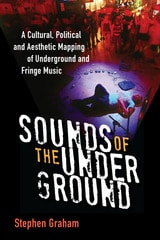
Sounds of the Underground
A Cultural, Political and Aesthetic Mapping of Underground and Fringe MusicStephen Graham
University of Michigan Press, 2016
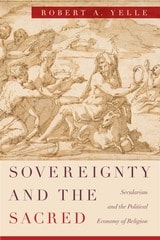
Sovereignty and the Sacred
Secularism and the Political Economy of ReligionRobert A. Yelle
University of Chicago Press, 2018
Developing this close analogy between two elemental domains of society, Sovereignty and the Sacred offers a new theory of religion while suggesting alternative ways of organizing our political and economic life. By rethinking the transcendent foundations and liberating potential of both religion and politics, Yelle points to more hopeful and ethical modes of collective life based on egalitarianism and popular sovereignty. Deliberately countering the narrowness of currently dominant economic, political, and legal theories, he demonstrates the potential of a revived history of religions to contribute to a rethinking of the foundations of our political and social order.
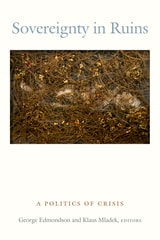
Sovereignty in Ruins
A Politics of CrisisGeorge Edmondson and Kalus Mladek, editors
Duke University Press, 2017
Contributors. Judith Butler, George Edmondson, Roberto Esposito, Carlo Galli, Klaus Mladek, Alberto Moreiras, Andrew Norris, Eric L. Santner, Adam Sitze, Carsten Strathausen, Rei Terada, Cary Wolfe
Sovereignty, Inc.
Three Inquiries in Politics and EnjoymentWilliam Mazzarella, Eric L. Santner, and Aaron Schuster
University of Chicago Press, 2020
Drawing on anthropology, political theory, philosophy, psychoanalysis, and theater, William Mazzarella, Eric L. Santner, and Aaron Schuster show how politics in the age of Trump functions by mobilizing a contradictory and convoluted enjoyment, an explosive mixture of drives and fantasies that eludes existing portraits of our era. The current political moment turns out to be not so much exceptional as exceptionally revealing of the constitutive tension between enjoyment and economy that has always been a key component of the social order. Santner analyzes the collective dream-work that sustains a new sort of authoritarian charisma or mana, a mana-facturing process that keeps us riveted to an excessively carnal incorporation of sovereignty. Mazzarella examines the contemporary merger of consumer brand and political brand and the cross-contamination of politics and economics, warning against all too easy laments about the corruption of politics by marketing. Schuster, focusing on the extreme theatricality and self-satirical comedy of the present, shows how authority reasserts itself at the very moment of distrust and disillusionment in the system, profiting off its supposed decline. A dazzling diagnostic of our present, Sovereignty, Inc., forces us to come to terms with our complicity in Trump’s political presence and will immediately take its place in discussions of contemporary politics.
Space and Pluralism
Can Contemporary Cities Be Places of Tolerance?Stefano Moroni
Central European University Press, 2016
Speaker Jim Wright
Power, Scandal, and the Birth of Modern PoliticsBy J. Brooks Flippen
University of Texas Press, 2018
Honorable Mention, Ramirez Family Award for Most Significant Scholarly Book, Texas Institute of Letters, 2019
Jim Wright made his mark on virtually every major public policy issue in the later twentieth century—energy, education, taxes, transportation, environmental protection, civil rights, criminal justice, and foreign relations, among them. He played a significant role in peace initiatives in Central America and in the Camp David Accords, and he was the first American politician to speak live on Soviet television. A Democrat representing Texas’s twelfth district (Fort Worth), Wright served in the US House of Representatives from the Eisenhower administration to the presidency of George H. W. Bush, including twelve years (1977–1989) as majority leader and speaker. His long congressional ascension and sudden fall in a highly partisan ethics scandal spearheaded by Newt Gingrich mirrored the evolution of Congress as an institution.
Speaker Jim Wright traces the congressman’s long life and career in a highly readable narrative grounded in extensive interviews with Wright and access to his personal diaries. A skilled connector who bridged the conservative and liberal wings of the Democratic party while forging alliances with Republicans to pass legislation, Wright ultimately fell victim to a new era of political infighting, as well as to his own hubris and mistakes. J. Brooks Flippen shows how Wright’s career shaped the political culture of Congress, from its internal rules and power structure to its growing partisanship, even as those new dynamics eventually contributed to his political demise. To understand Jim Wright in all his complexity is to understand the story of modern American politics.
Spinoza and the Politics of Renaturalization
Hasana Sharp
University of Chicago Press, 2011
St. Thomas Aquinas and the Natural Law Tradition
Contemporary PerspectivesJohn Goyette
Catholic University of America Press, 2004
Stalin
An Unknown PortraitMiklós Kun
Central European University Press, 2003
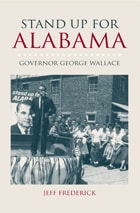
Stand Up for Alabama
Governor George WallaceJeffrey Frederick
University of Alabama Press, 2007
Reassessing the Political Legacy of Alabama's Most Influential Governor.
Whereas other studies have focused on George Wallace’s career as a national figure, Stand Up for Alabama provides a detailed, comprehensive, and analytical study of Wallace’s political life that emphasizes his activities and their impact within the state of Alabama. Jeff Frederick answers two fundamental questions: What was George Wallace’s impact on the state of Alabama? Why did Alabamians continue to embrace him over a twenty-five year period? Using a variety of sources to document the state’s performance in areas including mental health, education, conservation, prisons, and industrial development, Frederick answers question number one. He cites comparisons between Alabama and both peer states in the South and national averages. Wallace’s policies improved the state, but only in relation to Alabama’s past, not in relation to peer states in the region or national averages. As a result, energy was expended but little progress was made.
To answer the second question, Frederick uses the words of Alabamians themselves through oral history, correspondence, letters to the editor, and other sources. Alabamians, white and eventually black, supported Wallace because race was but one of his appeals. Stand Up for Alabama shows that Wallace connected to Alabamians at a gut level, reminding them of their history and memory, championing their causes on the stump, and soothing their concerns about their place in the region and the nation.
Jeff Frederick examines the development of policy during the Wallace administrations and documents relationships with his constituents in ways that go beyond racial politics. He also analyzes the connections between Wallace’s career and Alabamians’ understanding of their history, sense of morality, and class system. “Stand up for Alabama” was the governor’s campaign slogan.
Standing at the Water's Edge
Bob Straub's Battle for the Soul of OregonCharles K. Johnson
Oregon State University Press, 2012
A man of intelligence, drive, creativity, and fascinating contradictions, Straub overcame personal challenges and inevitable comparisons to his charismatic predecessor and friendly Republican rival, Tom McCall, to have a lasting impact on Oregon and the nation. Charles Johnson shares insights into Straub’s significant legacy, focusing on his leading role in the state’s financial and environmental issues and his influence on McCall. Johnson also reveals much of Straub’s warm personal story, along with his secret struggles, including his battle with depression while Governor.
Standing at the Water’s Edge offers rich descriptions of other intriguing political figures of the time as well, capturing the flavor of what has been called Oregon’s political “golden age” of the sixties and seventies—created in part by the symbiotic relationship between Straub and McCall—and describing how and why it ended.
Standing at the Water’s Edge is an essential addition to the literature about Oregon’s political leaders for historians, political scientists, and general readers interested in Oregon history.
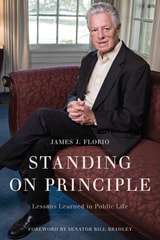
Standing on Principle
Lessons Learned in Public LifeFlorio, James J
Rutgers University Press, 2018
This political memoir tells the remarkable story of how Florio, a high school dropout who left to join the Navy as a teenager, went on to become an attorney, a state assemblyman, a congressman, and a governor. A passionate defender of the environment, Florio played a crucial role in the enactment of 1980s-era Superfund laws, which helped to clean up toxic waste sites in New Jersey and around the country. As governor, he fought for the groundbreaking Clean Water Enforcement Act. But his reforms quite literally came at a cost, as he raised New Jersey sales taxes and income taxes to balance the state budget. Florio reflects upon the challenges of meeting the state’s budgetary needs while keeping his tax-averse constituents happy.
Standing on Principle reveals a politician who has never been afraid to take a progressive stand—including a firm stance against semiautomatic weapons that led gun lobbyists to bankroll his opponent. His story is sure to inspire readers from New Jersey and across the nation.
Published in cooperation with the Center on the American Governor, Eagleton Institute of Politics, Rutgers University

State of Exception
Giorgio Agamben
University of Chicago Press, 2004
The sequel to Agamben's Homo Sacer: Sovereign Power and Bare Life, State of Exception is the first book to theorize the state of exception in historical and philosophical context. In Agamben's view, the majority of legal scholars and policymakers in Europe as well as the United States have wrongly rejected the necessity of such a theory, claiming instead that the state of exception is a pragmatic question. Agamben argues here that the state of exception, which was meant to be a provisional measure, became in the course of the twentieth century a normal paradigm of government. Writing nothing less than the history of the state of exception in its various national contexts throughout Western Europe and the United States, Agamben uses the work of Carl Schmitt as a foil for his reflections as well as that of Derrida, Benjamin, and Arendt.
In this highly topical book, Agamben ultimately arrives at original ideas about the future of democracy and casts a new light on the hidden relationship that ties law to violence.

Statelessness
On Almost Not ExistingTony C. Brown
University of Minnesota Press, 2022
A pathbreaking new genealogy of statelessness
Just as the modern state and the citizenship associated with it are commonly thought of as a European invention, so too is citizenship’s negation in the form of twentieth-century diaspora and statelessness. Statelessness sets forth a new genealogy, suggesting that Europe first encountered mass statelessness neither inside its own borders nor during the twentieth century, as Hannah Arendt so influentially claimed, but outside of itself—in the New World, several hundred years earlier.
Through close readings of political philosophers from Hobbes to Rousseau to Kant, Tony C. Brown argues that statelessness became a central problem for political thought early on, with far-reaching implications for thinking both on the state and on being human. What Europeans thought they saw among the “savages” of the Americas was life without political order, life less than human. Lacking almost everything those deemed clearly human had achieved, the stateless existed in a radically precarious, almost inhuman privation.
And yet this existence also raised the unsettling possibility that state-based existence may not be inevitable, necessary, or even ideal. This possibility, as Brown shows, prompts the response—as defensive as it was aggressive—that we call Enlightenment political philosophy, which arguably still orders much thinking on being stateless today, including our discourses concerning migrants and Indigenous peoples.
Stateswomen
A Centennial History of Arkansas Women Legislators, 1922-2022Lindsley Armstrong Smith
University of Arkansas Press, 2022
The first comprehensive study dedicated to these trailblazing Arkansas legislators, Stateswomen will surely inspire history buffs, community-minded citizens, and political hopefuls alike.
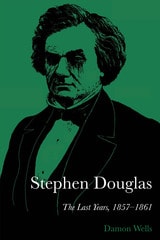
Stephen Douglas
The Last Years, 1857–1861By Damon Wells
University of Texas Press, 1971
Stephen Douglas and the old Union lived out their last years together. It was the most critical time in the life of both the Illinois senator and his country. During most of the period 1857–1861 the American nation could still choose between adjustment of its sectional differences and civil war, and the man they called the Little Giant seemed the one statesman most likely to lead the country onto a course of compromise and reconciliation.
But Douglas’ intense involvement with the American political scene—his great accomplishments in enacting the Compromises of 1850 and 1854, and his victory in the senatorial campaign of 1858—tended at times to disguise a growing alienation from the mainstream of American political life. By 1857 that alienation had reached acute proportions. In part, Douglas fell victim to his own virtues. He sought to be a nationalist in an age of sectionalism; he preached the value of compromise when most Americans questioned its worth.
In other respects, Douglas’ political failures are less excusable. His attempt to convert an apparently amoral attitude toward slavery into a principle—popular sovereignty—found him dismissed by antislavery citizens as immoral and by proslavery citizens as unreliable. For too long, Douglas, professing to “care not” about the future of slavery, overlooked how much Americans could care once their consciences had been aroused or their way of life supposedly threatened.
Douglas failed to win the presidential campaign of 1860 largely because he could satisfy neither the proponents nor the enemies of slavery. Yet if the last years of Douglas’ life were marred by failure, he was not ultimately the tragic figure some historians have suggested. During the campaign of 1860 a profound change began to take place in Stephen Douglas. The outmoded nationalism he had preached for so long began to give way to Unionism. In his eventual support of Lincoln and his defense of the Union, Douglas at last found a policy worthy of his great talents.
Damon Wells first became interested in Stephen Douglas in 1959 after seeing a Broadway dramatization of the Lincoln-Douglas Debates. Later, his studies convinced him that playwright and historian alike were often unfair to Douglas. If Lincoln was to be a hero, then Douglas had to be cast as a villain.
This study fills the need for a fresh and dispassionate look at Douglas and provides a fairer assessment than can be reached by simply endorsing contradictory views of apologists and critics. It places particular emphasis on the Little Giant’s struggle with President James Buchanan, the debates with Lincoln, the presidential campaign of 1860, Douglas’ complex relationship with the South, and a careful analysis of the elusive and at times exasperating principle of popular sovereignty.