Results by title
102 books match the query 'Poor' and 8 start with s
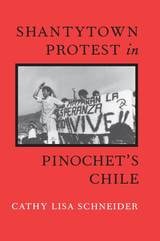
Shantytown Protest in Pinochet's Chile
Cathy Lisa Schneider
Temple University Press, 1995

Shaping the Discourse on Space
Charity and Its Wards in Nineteenth-Century San Juan, Puerto RicoBy Teresita Martínez-Vergne
University of Texas Press, 1999
As an inchoate middle class emerged in Puerto Rico in the early nineteenth century, its members sought to control not only public space, but also the people, activities, and even attitudes that filled it. Their instruments were the San Juan town council and the Casa de Beneficencia, a state-run charitable establishment charged with responsibility for the poor.
In this book, Teresita Martínez-Vergne explores how municipal officials and the Casa de Beneficencia shaped the discourse on public and private space and thereby marginalized the worthy poor and vagrants, "liberated" Africans, indigent and unruly women, and destitute children. Drawing on extensive and innovative archival research, she shows that the men who comprised the San Juan ayuntamiento and the board of charity regulated the public discourse on topics such as education, religious orthodoxy, hygiene, and family life, thereby establishing norms for "correct" social behavior and chastising the "deviant" lifestyles of the working poor.
This research clarifies the ways in which San Juan's middle class defined itself in the midst of rapid social and economic change. It also offers new insights into notions of citizenship and the process of nation-building in the Caribbean.
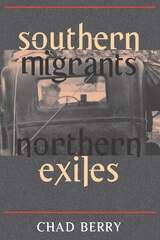
Southern Migrants, Northern Exiles
Chad Berry
University of Illinois Press, 2000
Southern out-migration drew millions of southern workers to the steel mills, automobile factories, and even agricultural fields and orchards of Ohio, Indiana, Michigan, and Illinois. Through vivid oral histories, Chad Berry explores the conflict between migrants' economic success and their "spiritual exile" in the North. He documents the tension between factory owners who welcomed cheap, naive southern laborers and local "native" workers who greeted migrants with suspicion and hostility. He examines the phenomenon of "shuttle migration," in which migrants came north to work during the winter and returned home to plant spring crops on their southern farms. He also explores the impact of southern traditions--especially the southern evangelical church and "hillbilly" music--brought north by migrants.
Berry argues that in spite of being scorned by midwesterners for violence, fecundity, intoxication, laziness, and squalor, the vast majority of southern whites who moved to the Midwest found the economic prosperity they were seeking. By allowing southern migrants to assess their own experiences and tell their own stories, Southern Migrants, Northern Exiles refutes persistent stereotypes about migrants' clannishness, life-style, work ethic, and success in the North.

Strange Future
Pessimism and the 1992 Los Angeles RiotsMin Hyoung Song
Duke University Press, 2005
Song considers works that address the riots and often the traumatic place of the Korean American community within them: the independent documentary Sa-I-Gu (Korean for April 29, the date the riots began), Chang-rae Lee’s novel Native Speaker, the commercial film Strange Days, and the experimental drama of Anna Deavere Smith, among many others. He describes how cultural producers have used the riots to examine the narrative of national decline, manipulating language and visual elements, borrowing and refashioning familiar tropes, and, perhaps most significantly, repeatedly turning to metaphors of bodily suffering to convey a sense of an unraveling social fabric. Song argues that these aesthetic experiments offer ways of revisiting the traumas of the past in order to imagine more survivable futures.
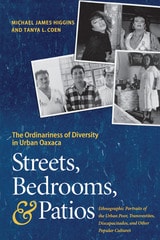
Streets, Bedrooms, and Patios
The Ordinariness of Diversity in Urban OaxacaBy Michael James Higgins and Tanya L. Coen
University of Texas Press, 2000
Diversity characterizes the people of Oaxaca, Mexico. Within this city of half a million, residents are rising against traditional barriers of race and class, defining new gender roles, and expanding access for the disabled. In this rich ethnography of the city, Michael Higgins and Tanya Coen explore how these activities fit into the ordinary daily lives of the people of Oaxaca.
Higgins and Coen focus their attention on groups that are often marginalized—the urban poor, transvestite and female prostitutes, discapacitados (the physically challenged), gays and lesbians, and artists and intellectuals. Blending portraits of and comments by group members with their own ethnographic observations, the authors reveal how such issues as racism, sexism, sexuality, spirituality, and class struggle play out in the people's daily lives and in grassroots political activism. By doing so, they translate the abstract concepts of social action and identity formation into the actual lived experiences of real people.
Striving to Save
Creating Policies for Financial Security of Low-Income FamiliesMargaret Sherrard Sherraden and Amanda Moore McBride
University of Michigan Press, 2010
---Tom Shapiro, Brandeis University
book provides an essential corrective to the unidimensional view of poor households as unable and unwilling to save."
---Michael Barr, University of Michigan
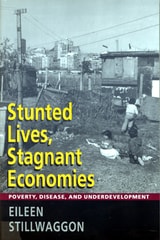
Stunted Lives, Stagnant Economies
Poverty, Disease, and UnderdevelopmentStillwaggon, Eileen
Rutgers University Press, 1998
This is a fascinating, lively, and well-written book. The author has a clear message which she states at the beginning, namely, that health is primarily an economic, not a medical problem, and she follows that to the end.Keith Griffin, University of California, Riverside
Houses made of rags and flattened soda cans, filthy water that breeds disease, counterfeit medicines, no access to decent medical care how can children growing up in such an environment become productive workers contributing to a developing economy?
Stunted Lives, Stagnant Economies describes in vivid detail the living conditions of the poor in developing countries and the diseases and injuries that result from this environment of need. Most of the diseases that affect the poor cholera, summer diarrhea, tuberculosis, lice, worms, leprosy result from the poverty of their environment. Poverty also determines the availability and effectiveness of the medical response. Using Argentina as a case study, Eileen Stillwaggon argues that making good health available to everyone is not a scientific problem but an economic one.
The debt crisis of the 1980s and the subsequent structural adjustment policies adopted by most developing countries exacerbated the problems faced by the poor. What kind of future can a nation build when the health of the majority of the population its workforceÑis at risk or compromised because social services have been reduced? Without adequate health care and social services, people cannot live up to their potential, and the spiral of poverty continues. But there are ways to fight this cycle of poverty.
Sustainability for the Forgotten
Gary E. Machlis
University of Utah Press, 2024
Sustainability for the Forgotten is an incendiary book that confronts the history, policies, and practices of sustainability. It interrogates the usefulness of current sustainability approaches for the poorest of the poor, the chronic underclass, victims of natural disasters, refugees, the oppressed, and asks, how can we do better? With examples that range from the coffeelands of El Salvador to the coal country of American Appalachia, from the streets of Detroit to refugee camps in Greece and the upscale metro centers of the affluent, sustainability is examined with a critical eye and with an emphasis on insuring that the forgotten are heard.
At once well-researched and passionate, wide-ranging and sharply focused, Sustainability for the Forgotten is unlike any other book on the sustainability movement. Written with a distinctive voice that is reasoned, unflinching, and often poetic, the book challenges the sustainability movement to follow "a just and necessary path." The result is a provocative statement on the future of sustainability and a call to action that is ultimately hopeful.