Results by title
74 books match the query 'Puerto Rico' and 8 start with s
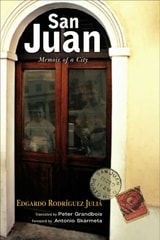
San Juan
Memoir of a CityEdgardo Rodriguez Julia; Translated by Peter Grandbois
University of Wisconsin Press, 2007
In the allusive cityscape he recreates, Rodríguez Juliá invokes the ghosts of his childhood, of San Juan's elder literati, and of characters from his own novels. On the most tangible level, the city is a place of cabarets and cockfighting clubs, flâneurs and beach bums, smoke-filled bars and honking automobiles. Poised between a colonial past and a commercial future, the San Juan he portrays feels at times perilously close to the pitfalls of modernization. Tenement houses and fading mansions yield to strip malls and Tastee Freezes; asphalt hems in jacarandas and palm trees. "In Puerto Rico," he muses, "life is not simply cruel, it is also busy erasing our tracks." Through this book—available here in English for the first time—Rodríguez Juliá resists that erasure, thoughtfully etching a palimpsest that preserves images of the city where he grew up and rejoicing in the one where he still lives.
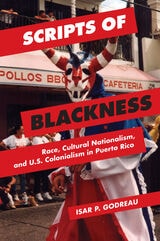
Scripts of Blackness
Race, Cultural Nationalism, and U.S. Colonialism in Puerto RicoIsar P. Godreau
University of Illinois Press, 2015
Based on an ethnographic study of the barrio of San Antón in the city of Ponce, Scripts of Blackness examines institutional and local representations of blackness as developing from a power-laden process that is inherently selective and political, not neutral or natural. Godreau traces the presumed benevolence or triviality of slavery in Puerto Rico, the favoring of a Spanish colonial whiteness (under a hispanophile discourse), and the insistence on a harmonious race mixture as discourses that thrive on a presumed contrast with the United States that also characterize Puerto Rico as morally superior. In so doing, she outlines the debates, social hierarchies, and colonial discourses that inform the racialization of San Antón and its residents as black.
Mining ethnographic materials and anthropological and historical research, Scripts of Blackness provides powerful insights into the critical political, economic, and historical context behind the strategic deployment of blackness, whiteness, and racial mixture.
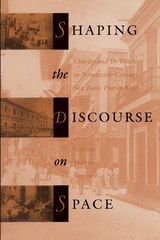
Shaping the Discourse on Space
Charity and Its Wards in Nineteenth-Century San Juan, Puerto RicoBy Teresita Martínez-Vergne
University of Texas Press, 1999
As an inchoate middle class emerged in Puerto Rico in the early nineteenth century, its members sought to control not only public space, but also the people, activities, and even attitudes that filled it. Their instruments were the San Juan town council and the Casa de Beneficencia, a state-run charitable establishment charged with responsibility for the poor.
In this book, Teresita Martínez-Vergne explores how municipal officials and the Casa de Beneficencia shaped the discourse on public and private space and thereby marginalized the worthy poor and vagrants, "liberated" Africans, indigent and unruly women, and destitute children. Drawing on extensive and innovative archival research, she shows that the men who comprised the San Juan ayuntamiento and the board of charity regulated the public discourse on topics such as education, religious orthodoxy, hygiene, and family life, thereby establishing norms for "correct" social behavior and chastising the "deviant" lifestyles of the working poor.
This research clarifies the ways in which San Juan's middle class defined itself in the midst of rapid social and economic change. It also offers new insights into notions of citizenship and the process of nation-building in the Caribbean.

Simone
A NovelEduardo Lalo
University of Chicago Press, 2015
A tale of alienation, love, suspense, imagination, and literature set on the streets of San Juan, Puerto Rico, Simone tells the story of a self-educated Chinese immigrant student courting (and stalking) a disillusioned, unnamed writer who is struggling to make a name for himself in a place that is not exactly a hotbed of literary fame. By turns solipsistic and political, romantic and dark, Simone begins with the writer’s frustrated, satiric observations on his native city and the banal life of the university where he teaches—forces utterly at odds with the sensuality of his writing. But, as mysterious messages and literary clues begin to appear—scrawled on sidewalks and walls, inside volumes set out in bookstores, left on his answering machine and under his windshield wiper—Simone progresses into a cat-and-mouse game between the writer and his mystery stalker. When the eponymous Simone’s identity is at last revealed, the writer finds in the life of this Chinese immigrant a plight not unlike his own. Traumatized and lonely, the pair moves towards bittersweet collaborations in passion, grief, and art.

Sponsored Identities
Cultural Politics in Puerto RicoArlene Davila
Temple University Press, 1997
Author Arlene Davila focuses on the Institute for Puerto Rican Culture, the government institution charged with defining authenticated views of national identity since the 1950s, and on popular festival organizers to illuminate contestations over appropriate representations of culture in the increasingly mass-mediated context of contemporary Puerto Rico. She examines the creation of an essentialist view of nationhood based on a peasant culture and a "unifying" Hispanic heritage, and the ways in which grassroots organizations challenge and reconfigure definitions of national identity through their own activities and representations.
Davila pays particular attention to the increasing prominence of corporate sponsorship in determining what is distinguished as authentic "Puerto Rican culture" and discusses the politicization of culture as a discourse to debate and legitimize conflicting claims from selling commercial product to advocating divergent status options for the island. In so doing, Davila illuminates the prospects for cultural identities in an increasingly transnational context by showing the growth of cultural nationalism to be intrinsically connected to forms of political action directed to the realm of culture and cultural politics. This in-depth examination also makes clear that despite contemporary concerns with "authenticity," commercialism is an inescapable aspect of all cultural expression on the island.
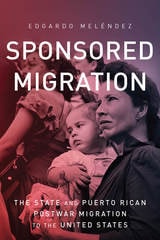
Sponsored Migration
The State and Puerto Rican Postwar Migration to the United StatesEdgardo Meléndez
The Ohio State University Press, 2017
Sponsored Migration places Puerto Rico’s migration policy in its historical context, examining the central role the Puerto Rican government played in encouraging and organizing migration during the postwar period. Meléndez sheds an important new light on the many ways in which the government intervened in the movement of its people: attempting to provide labor to U.S. agriculture, incorporating migrants into places like New York City, seeking to expand the island’s air transportation infrastructure, and even promoting migration in the public school system. One of the first scholars to explore this topic in depth, Meléndez illuminates how migration influenced U.S. and Puerto Rican relations from 1898 onward.

Sugar and Slavery in Puerto Rico
The Plantation Economy of Ponce, 1800–1850Francisco A. Scarano
University of Wisconsin Press, 1984
This important study of Ponce, a major sugar-producing district in Puerto Rico, examines in detail the processes by which a predominantly peasant economy an society was transformed into a plantation system. Scarano’s work, one of the first full investigations into Puerto Rico’s nineteenth-century economic history, dispels the long-held belief that slavery was an inconsequential factor in this society; indeed, he finds that the new plantation system was fully dependent on African slave labor, and that the initial stimuli for economic change came from immigrants.
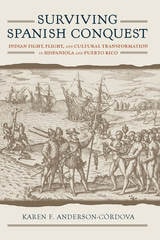
Surviving Spanish Conquest
Indian Fight, Flight, and Cultural Transformation in Hispaniola and Puerto RicoKaren F. Anderson-Córdova
University of Alabama Press, 2017
In Surviving Spanish Conquest: Indian Fight, Flight, and Cultural Transformation in Hispaniola and Puerto Rico, Karen F. Anderson-Córdova draws on archaeological, historical, and ethnohistorical sources to elucidate the impacts of sixteenth-century Spanish conquest and colonization on indigenous peoples in the Greater Antilles. Moving beyond the conventional narratives of the quick demise of the native populations because of forced labor and the spread of Old World diseases, this book shows the complexity of the initial exchange between the Old and New Worlds and examines the myriad ways the indigenous peoples responded to Spanish colonization.
Focusing on Hispaniola and Puerto Rico, the first Caribbean islands to be conquered and colonized by the Spanish, Anderson-Córdova explains Indian sociocultural transformation within the context of two specific processes, out-migration and in-migration, highlighting how population shifts contributed to the diversification of peoples. For example, as the growing presence of “foreign” Indians from other areas of the Caribbean complicated the variety of responses by Indian groups, her investigation reveals that Indians who were subjected to slavery, or the “encomienda system,” accommodated and absorbed many Spanish customs, yet resumed their own rituals when allowed to return to their villages. Other Indians fled in response to the arrival of the Spanish.
The culmination of years of research, Surviving Spanish Conquest deftly incorporates archaeological investigations at contact sites copious use of archival materials, and anthropological assessments of the contact period in the Caribbean. Ultimately, understanding the processes of Indian-Spanish interaction in the Caribbean enhances comprehension of colonization in many other parts of the world. Anderson-Córdova concludes with a discussion regarding the resurgence of interest in the Taíno people and their culture, especially of individuals who self-identify as Taíno. This volume provides a wealth of insight to historians, anthropologists, archaeologists, and those interested in early cultures in contact.