Results by title
119 books match the query 'Race in literature' and 11 start with s

Sapphic Primitivism
Productions of Race, Class, and Sexuality in Key Works of Modern FictionHackett, Robin
Rutgers University Press, 2003
In this book, Robin Hackett examines portrayals of race, class, and sexuality in modernist texts by white women to argue for the existence of a literary device that she calls “Sapphic primitivism.” The works vary widely in their form and content and include Olive Schreiner’s proto-modernist exploration of New Womanhood, The Story of an African Farm; Virginia Woolf’s high modernist “play-poem,” The Waves; Sylvia Townsend Warner’s historical novel, Summer Will Show; and Willa Cather’s Southern pastoral, Sapphira and the Slave Girl. In each, blackness and working-class culture are figured to represent sexual autonomy, including lesbianism, for white women. Sapphic primitivism exposes the ways several classes of identification were intertwined with the development of homosexual identities at the turn of the century. Sapphic primitivism is not, however, a means of disguising lesbian content. Rather, it is an aesthetic displacement device that simultaneously exposes lesbianism and exploits modern, primitivist modes of self-representation. Hackett’s revelations of the mutual interests of those who study early twentieth-century constructions of race and sexuality and twenty-first-century feminists doing anti-racist and queer work are a major contribution to literary studies and identity theory.

Scarring the Black Body
Race and Representation in African American LiteratureCarol E. Henderson
University of Missouri Press, 2002

Shakin' Up Race and Gender
Intercultural Connections in Puerto Rican, African American, and Chicano Narratives and Culture (1965–1995)By Marta E. Sánchez
University of Texas Press, 2006
The second phase of the civil rights movement (1965-1973) was a pivotal period in the development of ethnic groups in the United States. In the years since then, new generations have asked new questions to cast light on this watershed era. No longer is it productive to consider only the differences between ethnic groups; we must also study them in relation to one another and to U.S. mainstream society.
In "Shakin' Up" Race and Gender, Marta E. Sánchez creates an intercultural frame to study the historical and cultural connections among Puerto Ricans, African Americans, and Chicanos/as since the 1960s. Her frame opens up the black/white binary that dominated the 1960s and 1970s. It reveals the hidden yet real ties that connected ethnics of color and "white" ethnics in a shared intercultural history. By using key literary works published during this time, Sánchez reassesses and refutes the unflattering portrayals of ethnics by three leading intellectuals (Octavio Paz, Daniel Patrick Moynihan, and Oscar Lewis) who wrote about Chicanos, African Americans, and Puerto Ricans. She links their implicit misogyny to the trope of La Malinche from Chicano culture and shows how specific characteristics of this trope—enslavement, alleged betrayal, and cultural negotiation—are also present in African American and Puerto Rican cultures. Sánchez employs the trope to restore the agency denied to these groups. Intercultural contact—encounters between peoples of distinct ethnic groups—is the theme of this book.
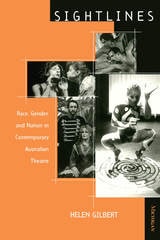
Sightlines
Race, Gender, and Nation in Contemporary Australian TheatreHelen Gilbert
University of Michigan Press, 1998

Signifying Without Specifying
Racial Discourse in the Age of ObamaLi, Stephanie
Rutgers University Press, 2011
On the campaign trail, Barack Obama faced a difficult task—rallying African American voters while resisting his opponents’ attempts to frame him as “too black” to govern the nation as a whole. Obama’s solution was to employ what Toni Morrison calls “race-specific, race-free language,” avoiding open discussions of racial issues while using terms and references that carried a specific cultural resonance for African American voters.
Stephanie Li argues that American politicians and writers are using a new kind of language to speak about race. Challenging the notion that we have moved into a “post-racial” era, she suggests that we are in an uneasy moment where American public discourse demands that race be seen, but not heard. Analyzing contemporary political speech with nuanced readings of works by such authors as Toni Morrison, Jhumpa Lahiri, and Colson Whitehead, Li investigates how Americans of color have negotiated these tensions, inventing new ways to signal racial affiliations without violating taboos against open discussions of race.

Spain's Long Shadow
The Black Legend, Off-Whiteness, and Anglo-American EmpireMaría DeGuzmán
University of Minnesota Press, 2005
England and the Netherlands, Spain’s imperial rivals of the sixteenth and seventeenth centuries, imagined Spain as a land of cruel and degenerate barbarians of la leyenda negra (the Black Legend), in league with the powers of “blackest darkness” and driven by “dark motives.” In Spain’s Long Shadow, María DeGuzmán explores how this convenient demonization made its way into American culture—and proved essential to the construction of whiteness. DeGuzmán’s work reaches from the late eighteenth century—in the wake of the American Revolution—to the present. Surveying a broad range of texts and images, from Poe’s “William Wilson” and John Singer Sargent’s El Jaleo to Richard Wright’s Pagan Spain and Kathy Acker’s Don Quixote, Spain’s Long Shadow shows how the creation of Anglo-American ethnicity as specifically American has depended on the casting of Spain as a colonial alter ego. The symbolic power of Spain in the American imagination, DeGuzmán argues, is not just a legacy of that nation’s colonial presence in the Americas; it lives on as well in the “blackness” of Spain and Spaniards—in the assigning of people of Spanish origin to an “off-white” racial category that reserves the designation of white for Anglo-Americans. By demonstrating how the Anglo-American imagination needs Spain and Spaniards as figures of attraction and repulsion, DeGuzmán makes a compelling and illuminating case for treating Spain as the imperial alter ego of the United States. Cross-cultural and interdisciplinary, ambitious in its chronological sweep, and elegant in its interpretation of literary and visual works, DeGuzmán’s book leads us to a powerful new understanding of the nature—and history—of American ethnicity.
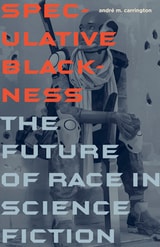
Speculative Blackness
The Future of Race in Science FictionAndré M. Carrington
University of Minnesota Press, 2016
In Speculative Blackness, André M. Carrington analyzes the highly racialized genre of speculative fiction—including science fiction, fantasy, and utopian works, along with their fan cultures—to illustrate the relationship between genre conventions in media and the meanings ascribed to blackness in the popular imagination.
Carrington’s argument about authorship, fandom, and race in a genre that has been both marginalized and celebrated offers a black perspective on iconic works of science fiction. He examines the career of actor Nichelle Nichols, who portrayed the character Uhura in the original Star Trek television series and later became a recruiter for NASA, and the spin-off series Star Trek: Deep Space Nine, set on a space station commanded by a black captain. He recovers a pivotal but overlooked moment in 1950s science fiction fandom in which readers and writers of fanzines confronted issues of race by dealing with a fictitious black fan writer and questioning the relevance of race to his ostensible contributions to the 'zines. Carrington mines the productions of Marvel comics and the black-owned comics publisher Milestone Media, particularly the representations of black sexuality in its flagship title, Icon. He also interrogates online fan fiction about black British women in Buffy the Vampire Slayer and the Harry Potter series.
Throughout this nuanced analysis, Carrington theorizes the relationship between race and genre in cultural production, revealing new understandings of the significance of blackness in twentieth-century American literature and culture.

Split-Gut Song
Jean Toomer and the Poetics of ModernityKaren Jackson Ford
University of Alabama Press, 2005
Reclaiming Jean Toomer as a radical innovator of African American modernist poetics.
In Split-Gut Song, Karen Jackson Ford looks at what it means to be African American, free, and creative by analyzing Jean Toomer's main body of work, specifically, his groundbreaking creation Cane. When first published in 1923, this pivotal work of modernism was widely hailed as inaugurating a truly artistic African American literary tradition. Yet Toomer's experiments in literary form are consistently read in terms of political radicalism—protest and uplift—rather than literary radicalism.
Ford contextualizes Toomer's poetry, letters, and essays in the literary culture of his period and, through close readings of the poems, shows how they negotiate formal experimentation (imagism, fragmentation, dialect) and traditional African American forms (slave songs, field hollers, call-and-response sermons, lyric poetry). At the heart of Toomer's work is the paradox that poetry is both the saving grace of African American culture and that poetry cannot survive modernity. This contradiction, Ford argues, structures Cane, wherein traditional lyric poetry first flourishes, then falters, then falls silent.
The Toomer that Ford discovers in Split-Gut Song is a complicated, contradictory poet who brings his vexed experience and ideas of racial identity to both conventional lyric and experimental forms. Although Toomer has been labelled a political radical, Ford argues that politics is peripheral in his experimental, stream-of-consciousness work. Rather Toomer exhibits a literary radicalism as he struggles to articulate his perplexed understanding of race and art in 20th-century America.

Staging Blackness
Representations of Race in German-Speaking Drama and TheaterPriscilla Dionne Layne and Lily Tonger-Erk, Editors
University of Michigan Press, 2024
Written by scholars and theater professionals with a wide variety of historical and theoretical expertise, the chapters seek to explore the connections between the German discourse on national theater and emerging ideas about race, analyze how dramaturges deal with older representations of Blackness in current productions, and discuss the contributions Black German playwrights and dramaturges have made to this discourse. Historians question how these plays were staged in their time, while cultural studies scholars contemplate how to interpret the function of race in these plays and how they can continue to be staged today.

Standards of Value
Money, Race, and Literature in AmericaGermana, Michael
University of Iowa Press, 2010
In Standards of Value, Michael Germana reveals how tectonic shifts in U.S. monetary policy—from the Coinage Act of 1834 to the abolition of the domestic gold standard in 1933–34—correspond to strategic changes by American writers who renegotiated the value of racial difference. Populating the pages of this bold and innovative study are authors as varied as Harriet Beecher Stowe, George Washington Cable, Charles Chesnutt, James Weldon Johnson, Nella Larsen, Jessie Redmon Fauset, and Ralph Ellison—all of whom drew analogies between the form Americans thought the nation's money should take and the form they thought race relations and the nation should take.
A cultural history of race organized around and enmeshed within the theories of literary and monetary value, Standards of Value also recovers a rhetorical tradition in American culture whose echoes can be found in the visual and lyrical grammars of hip hop, the paintings of John W. Jones and Michael Ray Charles, the cinematography of Spike Lee, and many other contemporary forms and texts.
This reconsideration of American literature and cultural history has implications for how we value literary texts and how we read shifting standards of value. In vivid prose, Germana explains why dollars and cents appear where black and white bodies meet in American novels, how U.S. monetary policy gave these symbols their cultural currency, and why it matters for scholars of literary and cultural studies.

Street Players
Black Pulp Fiction and the Making of a Literary UndergroundKinohi Nishikawa
University of Chicago Press, 2018
Kinohi Nishikawa contends that black pulp fiction was built on white readers’ fears of the feminization of society—and the appeal of black masculinity as a way to counter it. In essence, it was the original form of blaxploitation: a strategy of mass-marketing race to suit the reactionary fantasies of a white audience. But while chauvinism and misogyny remained troubling yet constitutive aspects of this literature, from 1973 onward, Holloway House moved away from publishing sleaze for a white audience to publishing solely for black readers. The standard account of this literary phenomenon is based almost entirely on where this literature ended up: in the hands of black, male, working-class readers. When it closed, Holloway House was synonymous with genre fiction written by black authors for black readers—a field of cultural production that Nishikawa terms the black literary underground. But as Street Players demonstrates, this cultural authenticity had to be created, promoted, and in some cases made up, and there is a story of exploitation at the heart of black pulp fiction’s origins that cannot be ignored.