Results by title
145 books match the query 'Refugees' and 12 start with s
Safe Third Countries
Extending the EU Asylum and Immigration Policies to Central and Eastern EuropeSandra Lavenex
Central European University Press, 1999
The refugee issue has always been controversial and Lavenex's analyses add fuel to an already heated debate. She analyses the various bi- and multilateral processes by which the countries of Central and Eastern Europe (CEECs) are being gradually incorporated into a restrictive refugee regime established among the EU member states, in which the CEECs serve as "gate-keepers" for refugees and immigrants heading towards Western Europe.
At a time when many transition countries are trying to enter the EU, Lavenex highlights the CEECs consent to adapt to Western European policies aimed at fighting illegal immigration and reducing the numbers of asylum seekers as a political bargaining tool in exchange for future membership in the EU. She also argues that the regime undermines the values of international refugee protection and diffuses states' responsibilities by establishing a system of negative redistribution for the handling of asylum claims.
Safe Third Countries is the first comprehensive study on the extension of the emergent European refugee regime and highlights, in an innovative manner, the complex entanglement of domestic policies, European integration and international relations.
Schooling for Refugee Children
A Social Justice Perspective Informed by Children from SyriaEleanore Hargreaves, Brian Lally, Bassel Akar, Jumana Al-Waeli, and Jasmine Costello
University College London, 2024
Schooling for Refugee Children is a collaboration between five authors who explore their interactions with refugee children displaced from Syria to the Lebanese borders and London. Through a program of carefully tailored research activities, the authors analyze the children’s representations of their journeys and current circumstances, particularly focusing on questions of ongoing schooling in the face of displacement. The children’s experiences are expressed through their own words and drawings, disrupting the stereotype of children as receivers rather than empowered actors, and challenging traditional solutions for improving schooling. Throughout, the children are eloquent about their schooling in the context of displacement. Their views and illustrations depict a keen awareness of social justice issues, including the distribution of wealth, recognition of status, and representation of voice. In this way, the book brings to light important representations of some empowering experiences lived through by refugee children from Syria, as well as their thoughts on what has helped their learning and what can be done better. The children’s need for care and a sense of belonging in their schools and their new communities is given particular emphasis throughout the book, represented by one child, who simply requested, “Add some more love!”
Schooling for Refugee Children is invaluable for educators, policymakers, and anyone interested in refugee education and social justice. By centering the voices of refugee children, the book sheds light on their unique perspectives and needs, challenging conventional approaches to improving schooling for displaced populations.
Shelter on the Journey
Humanitarianism, Human Rights, and MigrationPriscilla Solano
Temple University Press, 2024
Solano, who volunteered at shelters in Mexico, chronicles the activity in three of the nearly 100 shelters along a unique humanitarian trail that many Central Americans take to reach the United States. She outlines the constraints faced by these sites and their potential to create social transformation and considers how and why migration security is currently framed and managed as both a criminal and humanitarian issue.
Shelter on the Journey explores the politics of the shelters, their social world, and the dynamics of charity and solidarity, as well as the need for humanitarian assistance and advocacy for dignified and free transit migration.
Standing in the Need
Culture, Comfort, and Coming Home After KatrinaBy Katherine E. Browne
University of Texas Press, 2015
Standing in the Need presents an intimate account of an African American family’s ordeal after Hurricane Katrina. Before the storm struck, this family of one hundred fifty members lived in the bayou communities of St. Bernard Parish just outside New Orleans. Rooted there like the wild red iris of the coastal wetlands, the family had gathered for generations to cook and share homemade seafood meals, savor conversation, and refresh their interconnected lives.
In this lively narrative, Katherine Browne weaves together voices and experiences from eight years of post-Katrina research. Her story documents the heartbreaking struggles to remake life after everyone in the family faced ruin. Cast against a recovery landscape managed by outsiders, the efforts of family members to help themselves could get no traction; outsiders undermined any sense of their control over the process. In the end, the insights of the story offer hope. Written for a broad audience and supported by an array of photographs and graphics, Standing in the Need offers readers an inside view of life at its most vulnerable.
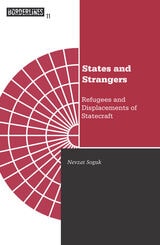
States And Strangers
Refugees And Displacements Of StatecraftNevzat Soguk
University of Minnesota Press, 1999
Looks at the role of refugees in international relations.
Refugees may flee their country, but can they escape the confining, defining logic of all the voices that speak for them? As refugees multiply in our troubled world, more and more scholars, studies, and pundits focus on their plight. Most of these analyses, says Nevzat Soguk, start from a model that shares the assumptions manifested in traditional definitions of citizen, nation, and state. Within this hierarchy, he argues, a refugee has no place to go. States and Strangers questions this paradigm, particularly its vision of the territoriality of life.
A radical retheorization of the refugee from a Foucauldian perspective, the book views the international refugee regime not as a simple tertiary response, arising from the practice of states regarding refugee problems, but as itself an aspect of the regimentation of statecraft. The attendant discourse negates the multiplicity of refugee events and experience; by assigning the refugee an identity-someone without the citizen’s grounding within a territorial space-the state renders him voiceless and deprives him of representation and protection. States and Strangers asks how this happens and how it can be avoided.Using historical, archival research and interpretive strategies drawn from a genealogical approach, Soguk considers the role of the refugee in the emergence and maintenance of the sovereign territorial state from the late seventeenth century to contemporary times. ISBN 0-8166-3166-2 Cloth/jacket £00.00 $62.95x340 Pages 5 7/8 x 9 MarchBorderlines Series, volume 11Translation inquiries: University of Minnesota Press
Steel Helmet and Mortarboard
An Academic in Uncle Sam's ArmyFrancis H. Heller
University of Missouri Press, 2009
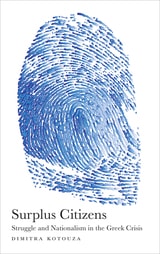
Surplus Citizens
Struggle and Nationalism in the Greek CrisisDimitra Kotouza
Pluto Press, 2018

Survival
Dislocation and Repair in BurmaFrançois Robinne
National University of Singapore Press, 2027
Captures the tenuous reality of daily life for those in and outside Burma.
In the wake of the military coup of February 2021, a new and unsettling reality has emerged in Burma. Unlike previous uprisings, this time the junta's reach extends beyond marginalized groups and ethnic territories to target the entire spectrum of civil society—urban and rural, young and old, across all groups, faiths, and social classes. The "Spring Revolution" sees Generation Z not only resisting authoritarian rule but also striving to forge a new societal vision.
In the face of totalitarian desocialization, a complex dance of dislocation and repair unfolds, within, outside, and along Burma's international borders. Survival takes a multi-sited approach to explore these dynamics: we hear from asylum seekers in France, the undocumented in Thailand, resistance leaders in constant motion, and, through the medium of the handphone, from within Burma. The result that emerges is a compelling picture of the individual struggle in an unforgiving situation, of interest to anyone who seeks a grounded understanding of the conflict—and what might emerge from it. Highly engaged yet academically rigorous, this compelling book also opens new spaces for understanding the complications of migration in today’s world.
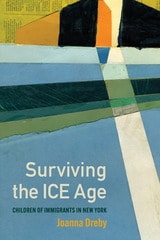
Surviving the ICE Age
Children of Immigrants in New YorkJoanna Dreby
Russell Sage Foundation, 2025
Dreby shows that a restrictive approach to immigration creates problems over time and across generations. These issues occur regardless of one’s citizenship status and go beyond deportations. Despite having pride in their heritage, her interviewees did not talk much about immigration. She refers to this unwillingness—and at times, inability—to speak about immigration as silencing. Silencing in a community or family is often intended to protect children, but this can leave them with little information about their backgrounds and status, leading to fear and anxiety instead. Self-silencing often resulted from traumatic experiences tied to enforcement episodes, which sometimes took the form of memory loss or emotional withholding. Dreby finds that experiences with the immigration system that disrupted relationships in a child’s household arising from family separations, moves, or changing roles in the family had especially long-term effects, causing, at times, ongoing mental health issues. Even the risk of immigration involvement left some young adults feeling vulnerable and undermined their sense of safety and security as U.S. citizens.
Dreby also highlights stories that offer hope. Young adults developed strategies to persevere, and children who grew up in communities and families that openly talked about migration felt empowered and fared much better, especially when they had access to resources, such as adequate food and shelter, mental health services, and community support. Dreby calls for policies and practices to mitigate the harms of restrictive migratory control on children’s wellbeing, such avoiding the arrest of parents in front of children and ensuring that U.S. citizen children’s interests are considered in immigration court without their direct involvement.
Surviving the ICE Age details the generational harms caused by U.S. immigration policy and offers suggestions for a better way forward.
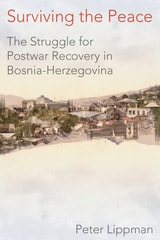
Surviving the Peace
The Struggle for Postwar Recovery in Bosnia-HerzegovinaPeter Lippman
Vanderbilt University Press, 2019
Essential reading for students of the former Yugoslavia and anyone interested in postwar or post-genocide studies, Surviving the Peace is an instant classic of long-form reporting, an impossible accomplishment without a lifetime of dedication to a place and people.
Peter Lippman's website is http://survivingthepeace.org/.
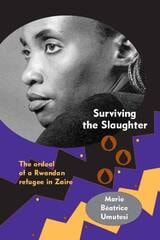
Surviving the Slaughter
The Ordeal of a Rwandan Refugee in ZaireMarie Beatrice Umutesi; Foreword by Catharine Newbury
University of Wisconsin Press, 2004
Though the world was stunned by the horrific massacres of Tutsi by the Hutu majority in Rwanda beginning in April 1994, there has been little coverage of the reprisals that occurred after the Tutsi gained political power. During this time hundreds of thousands of Hutu were systematically hunted and killed.
Surviving the Slaughter: The Ordeal of a Rwandan Refugee in Zaire is the eyewitness account of Marie Béatrice Umutesi. She tells of life in the refugee camps in Zaire and her flight across 2000 kilometers on foot. During this forced march, far from the world’s cameras, many Hutu refugees were trampled and murdered. Others died from hunger, exhaustion, and sickness, or simply vanished, ignored by the international community and betrayed by humanitarian organizations. Amidst this brutality, day-to-day suffering, and desperate survival, Umutesi managed to organize the camps to improve the quality of life for women and children.
In this first-hand account of inexplicable brutality, day-to-day suffering, and survival, Marie Béatrice Umutesi sheds light on a backlash of violence that targeted the Hutu refugees of Rwanda after the victory of the Rwandan Patriotic Front in 1994. Umutesi’s documentation of the flight and terror of these years provides the world a veritable account of a history that is still widely unknown. After translations from its original French into three other languages, this important book is available in English for the first time. It is more than a testimony to the lives and humanity lost; it is a call for those politicians, military personnel, and humanitarian organizations responsible for the atrocious crimes—and the devastating silence—to be held accountable.
“Umutesi’s tale, told with honesty and eloquence, is a tribute to the human spirit, a searing indictment of the agents who perpetrated these horrors, and a reproach to those who turned away.”—Catharine Newbury, African Studies Review
“Restores a human dimension that has been lacking in the history of the genocide and massacres in Rwanda.”—Danielle de Lame, African Studies Review
“A vivid account of the grueling nightmare experienced by tens of thousands of Rwandan civilians whom the world had deliberately forsaken. . . . An outstanding call for justice.”—Aloys Habimama, African Studies Review
“A towering work. . . . An epic for our times, a tale to ponder for the lessons it conveys, testimony so powerful and moving that it reaches an unintended literary greatness.”—Jan Vansina, African Studies Review
“Of all the current books and films ten years after the Rwandan genocide, none is more effective than Surviving the Slaughter . . . . This book carries one along, often as if running with the refugees.”—Anne Serafin, Multicultural Review
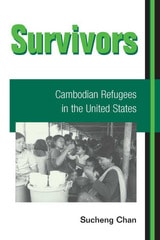
Survivors
CAMBODIAN REFUGEES IN THE UNITED STATESSucheng Chan
University of Illinois Press, 2004
Unparalleled in scope, Survivors begins with the Cambodians' experiences under the brutal Khmer Rouge regime, following them through escape to refugee camps in Thailand and finally to the United States, where they try to build new lives in the wake of massive trauma. Their struggle becomes primarily economic as they continue to negotiate new cultures and deal with rapidly changing gender and intergenerational relations within their own families. Poverty, crime, and racial discrimination all have an impact on their experiences in America, and each is examined in depth.
Although written as a history, this is a thoroughly multidisciplinary study, and Chan makes use of research from anthropology, sociology, psychology, medicine, social work, linguistics and education. She also captures the perspective of individual Cambodians. Drawing on interviews with more than fifty community leaders, a hundred government officials, and staff members in volunteer agencies, Survivors synthesizes the literature on Cambodian refugees, many of whom come from varying socioeconomic backgrounds.
A major scholarly achievement, Survivors is unique in the Asian American canon for its memorable presentation of cutting-edge research and its interpretation of both sides of the immigration process.