Results by title
201 books match the query 'Regional Studies' and 15 start with s
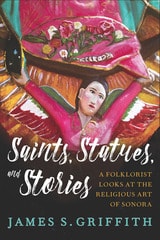
Saints, Statues, and Stories
A Folklorist Looks at the Religious Art of SonoraJames S. Griffith
University of Arizona Press, 2019
So describes well-known and beloved folklorist James S. Griffith as he takes us back through the decades to a town in northern Sonora where a statue is saved—and in so doing, a community is saved as well.
In Saints, Statues, and Stories Griffith shares stories of nearly sixty years of traveling through Sonora. As we have come to expect through these journeys, “Big Jim”—as he is affectionately known by many—offers nothing less than the living traditions of Catholic communities. Themes of saints as agents of protection or community action are common throughout Sonora: a saint coming out of the church to protect the village, a statue having a say in where it resides and paying social calls to other communities, or a beloved image rescued from destruction and then revered on a private altar. A patron saint saves a village from outside attackers in one story—a story that has at least ten parallels in Sonora’s former mission communities. Details may vary, but the general narrative remains the same: when hostile nonbelievers attack the village, the patron saint of the church foils them.
Griffith uncovers the meanings behind the devotional uses of religious art from a variety of perspectives—from artist to audience, preservationist to community member. The religious artworks transcend art objects, Griffith believes, and function as ways of communicating between this world and the next. Setting the stage with a brief geography, Griffith introduces us to roadside shrines, artists, fiestas, saints, and miracles. Full-color images add to the pleasure of this delightful journey through the churches and towns of Sonora.

Sea of Lentils
Hilda Otano Benitez
University of Massachusetts Press, 1990

Seattle Sports
Play, Identity, and Pursuit in the Emerald CityTerry Anne Scott
University of Arkansas Press, 2020
Seattle Sports: Play, Identity, and Pursuit in the Emerald City, edited by Terry Anne Scott, explores the vast and varied history of sports in this city where diversity and social progress are reflected in and reinforced by play. The work gathered here covers Seattle’s professional sports culture as well as many of the city’s lesser-known figures and sports milestones. Fresh, nuanced takes on the Seattle Mariners, Supersonics, and Seahawks are joined by essays on gay softball leagues, city court basketball, athletics in local Japanese American communities during the interwar years, ultimate, the fierce women of roller derby, and much more. Together, these essays create a vivid portrait of Seattle fans, who, in supporting their teams—often in rain, sometimes in the midst of seismic activity—check the country’s implicit racial bias by rallying behind outspoken local sporting heroes.
Settling the Boom
The Sites and Subjects of Bakken OilMary E. Thomas
University of Minnesota Press, 2023
Examines how settler colonial and sexist infrastructures and narratives order a resource boom
Over the past decade, new oil plays have unsettled U.S. energy landscapes and imaginaries. Settling the Boom studies how the disruptive forces of an oil boom in the northern Great Plains are contained through the extension of settler temporalities, reassertions of heteropatriarchy, and the tethering of life to the volatility of oil and its cruel optimisms.
This collection reveals the results of sustained research in Williston, North Dakota, the epicenter of the “Bakken Boom.” While the boom brought a rapid influx of capital and workers, the book questions simple timelines of before and after. Instead, Settling the Boom demonstrates how the unsettling forces of an oil play resolve through normative narratives and material and affective infrastructures that support settler colonialism’s violent extension and its gendered orders of time and space. Considering a wide range of evidence, from urban and regional policy, interviews with city officials, media, photography, and film, these essays analyze the ongoing material, aesthetic, and narrative ways of life and land in the Bakken.
Contributors: Morgan Adamson, Macalester College; Kai Bosworth, Virginia Commonwealth U; Thomas S. Davis, Ohio State U; Jessica Lehman, Durham U.
Seven Aunts
Staci Lola Drouillard
University of Minnesota Press, 2022
Part memoir, part cultural history, these memories of seven aunts holding home and family together tell a crucial, often overlooked story of women of the twentieth century
They were German and English, Anishinaabe and French, born in the north woods and Midwestern farm country. They moved again and again, and they fought for each other when men turned mean, when money ran out, when babies—and there were so many—added more trouble but even more love. These are the aunties: Faye, who lived in California, and Lila, who lived just down the street; Doreen, who took on the bullies taunting her “mixed-blood” brothers and sisters; Gloria, who raised six children (no thanks to all of her “stupid husbands”); Betty, who left a marriage of indenture to a misogynistic southerner to find love and acceptance with a Norwegian logger; and Carol and Diane, who broke the warped molds of their own upbringing.
From the fabric of these women’s lives, Staci Lola Drouillard stitches a colorful quilt, its brightly patterned pieces as different as her aunties, yet alike in their warmth and spirit and resilience, their persistence in speaking for their generation. Seven Aunts is an inspired patchwork of memoir and reminiscence, poetry, testimony, love letters, and family lore.
In this multifaceted, unconventional portrait, Drouillard summons ways of life largely lost to history, even as the possibilities created by these women live on. Unfolding against a personal view of the settler invasion of the Midwest by men who farmed and logged, fished and hunted and mined, it reveals the true heart and soul of that history: the lives of the women who held together family, home, and community—women who defied expectations and overwhelming odds to make a place in the world for the next generation.
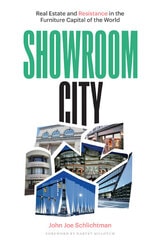
Showroom City
Real Estate and Resistance in the Furniture Capital of the WorldJohn Joe Schlichtman
University of Minnesota Press, 2022
A unique and engaging account of local urban decision-making within the globalizing world
High Point, North Carolina, is known as the “Furniture Capital of the World.” Once a manufacturing stronghold, most of its furniture factories have closed over the past forty years, with production shipped off to low-wage countries. Yet as manufacturing left, the city tightened its hold on a biannual global exposition that serves as the world’s furniture fashion runway. At the High Point Market, visitors from more than one hundred nations traverse twelve million square feet of meticulous design. Downtown buildings—once courthouses, movie theaters, post offices, and gas stations—are now chic showroom spaces, even as many sit empty between each exposition.
In Showroom City, John Joe Schlichtman applies an ethnographic lens to the global exposition’s relationship with High Point after it defeated rival Chicago in the 1960s and established itself as the world’s dominant furniture center. In recent decades, following trends in global finance, private equity firms were increasingly behind downtown High Point’s real estate transactions, coordinated by buyers far removed from the region. Then, in one massive transaction in 2011, a firm funded by Bain Capital purchased every major showroom building, and the majority of downtown real estate was under one owner.
Showroom City is a story of exclusionary growth and unchecked development, of a city flailing to fill the void left by its dwindling factories. But beyond that Schlichtman engages the general lessons behind both High Point’s deindustrialization and its stunning reinvention as a furniture fashion, merchandising, and design node. With great nuance, he delves deeply to reveal how power operates locally and how citizens may affirm, exploit, influence, and resist the takeover of their community.
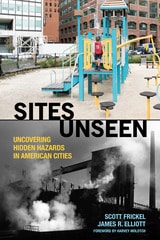
Sites Unseen
Uncovering Hidden Hazards in American CitiesScott Frickel
Russell Sage Foundation, 2018
From a dive bar in New Orleans to a leafy residential street in Minneapolis, many establishments and homes in cities across the nation share a troubling and largely invisible past: they were once sites of industrial manufacturers, such as plastics factories or machine shops, that likely left behind carcinogens and other hazardous industrial byproducts. In Sites Unseen, sociologists Scott Frickel and James Elliott uncover the hidden histories of these sites to show how they are regularly produced and reincorporated into urban landscapes with limited or no regulatory oversight. By revealing this legacy of our industrial past, Sites Unseen spotlights how city-making has become an ongoing process of social and environmental transformation and risk containment.
To demonstrate these dynamics, Frickel and Elliott investigate four very different cities—New Orleans, Minneapolis, Philadelphia, and Portland, Oregon. Using original data assembled and mapped for thousands of former manufacturers’ locations dating back to the 1950s, they find that more than 90 percent of such sites have now been converted to urban amenities such as parks, homes, and storefronts with almost no environmental review. And because manufacturers tend to open plants on new, non-industrial lots rather than on lots previously occupied by other manufacturers, associated hazards continue to spread relatively unabated. As they do, residential turnover driven by gentrification and the rising costs of urban living further obscure these sites from residents and regulatory agencies alike.
Frickel and Elliott show that these hidden processes have serious consequences for city-dwellers. While minority and working class neighborhoods are still more likely to attract hazardous manufacturers, rapid turnover in cities means that whites and middle-income groups also face increased risk. Since government agencies prioritize managing polluted sites that are highly visible or politically expedient, many former manufacturing sites that now have other uses remain invisible. To address these oversights, the authors advocate creating new municipal databases that identify previously undocumented manufacturing sites as potential environmental hazards. They also suggest that legislation limiting urban sprawl might reduce the flow of hazardous materials beyond certain boundaries.
A wide-ranging synthesis of urban and environmental scholarship, Sites Unseen shows that creating sustainable cities requires deep engagement with industrial history as well as with the social and regulatory processes that continue to remake urban areas through time.
A Volume in the American Sociological Association's Rose Series in Sociology.
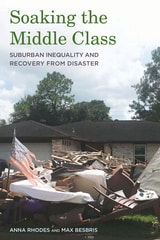
Soaking the Middle Class
Suburban Inequality and Recovery from DisasterAnna Rhodes
Russell Sage Foundation, 2022
In 2017, Hurricane Harvey dropped record-breaking rainfall in Southeast Texas resulting in more than $125 billion in direct damages. Rhodes and Besbris followed 59 flooded households in Friendswood, Texas, for two years after the storm to better understand the recovery process in a well-resourced, majority-White, middle-class suburban community. As such, Friendswood should have been highly resilient to storms like Harvey, yet Rhodes and Besbris find that the recovery process exacerbated often-invisible economic inequality between neighbors. Two years after Harvey, some households were in better financial positions than they were before the storm, while others still had incomplete repairs, were burdened with large new debts, and possessed few resources to draw on should another disaster occur.
Rhodes and Besbris find that recovery policies were significant drivers of inequality, with flood insurance playing a key role in the divergent recovery outcomes within Friendswood. Households with flood insurance prior to Harvey tended to have higher incomes than those that did not. These households received high insurance payouts, enabling them to replace belongings, hire contractors, and purchase supplies. Households without coverage could apply for FEMA assistance, which offered considerably lower payouts, and for government loans, which would put them into debt. Households without coverage found themselves exhausting their financial resources, including retirement savings, to cover repairs, which put them in even more financially precarious positions than they were before the flood.
The vast majority of Friendswood residents chose to repair and return to their homes after Hurricane Harvey. Even this devastating flood did not alter their plans for long-term residential stability, and the structure of recovery policies only further oriented homeowners towards returning to their homes. Prior to Harvey, many Friendswood households relied on flood damage from previous storms to judge their vulnerability and considered themselves at low risk. After Harvey, many found it difficult to assess their level of risk for future flooding. Without strong guidance from federal agencies or the local government on how to best evaluate risk, many residents ended up returning to potentially unsafe places.
As climate-related disasters become more severe, Soaking the Middle Class illustrates how inequality in the United States will continue to grow if recovery policies are not fundamentally changed.
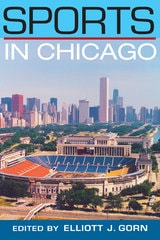
Sports in Chicago
Edited by Elliott Gorn
University of Illinois Press, 2007
Chicago teams have won the World Series, Super Bowl, multiple Stanley Cups, and a string of National Basketball Association titles. But amateur sports also play a large role in the city's athletic traditions, especially in schools and youth leagues that allow people from across the city to add to Chicago sports history.
In Sports and Chicago, an all-star roster of experts focuses on multiple aspects of Chicago sports, including long looks at amateur boxing, the impact of gender and ethnicity in sports, the politics of horse racing and stadium building, the lasting scandal of the Black Sox, and the once-perpetual heartbreak of the Cubs. Illustrated with forty photographs, the collection encourages historians and sports fans alike to appreciate the long-standing importance of sports in the Windy City.
Contributors: Peter Alter, Robin F. Bachin, Larry Bennett, Linda J. Borish, Gerald Gems, Elliott J. Gorn, Richard Kimball, Gabe Logan, Daniel A. Nathan, Timothy Neary, Steven A. Riess, John Russick, Timothy Spears, Costas Spirou, and Loïc Wacquant.
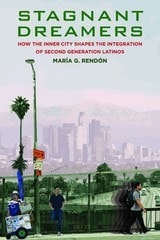
Stagnant Dreamers
How the Inner City Shapes the Integration of the Second GenerationMaria G. Rendon
Russell Sage Foundation, 2019
Winner of the 2020 Robert E. Park Award for Best Book from the Community and Urban Sociology Section of the American Sociological Association
Winner of the 2020 Distinguished Contribution to Research Award from the Latino/a Section of the American Sociological Association
Honorable Mention for the 2020 Thomas and Znaniecki Award from the International Migration Section of the American Sociological Association
A quarter of young adults in the U.S. today are the children of immigrants, and Latinos are the largest minority group. In Stagnant Dreamers, sociologist and social policy expert María Rendón follows 42 young men from two high-poverty Los Angeles neighborhoods as they transition into adulthood. Based on in-depth interviews and ethnographic observations with them and their immigrant parents, Stagnant Dreamers describes the challenges they face coming of age in the inner city and accessing higher education and good jobs, and demonstrates how family-based social ties and community institutions can serve as buffers against neighborhood violence, chronic poverty, incarceration, and other negative outcomes.
Neighborhoods in East and South Central Los Angeles were sites of acute gang violence that peaked in the 1990s, shattering any romantic notions of American life held by the immigrant parents. Yet, Rendón finds that their children are generally optimistic about their life chances and determined to make good on their parents’ sacrifices. Most are strongly oriented towards work. But despite high rates of employment, most earn modest wages and rely on kinship networks for labor market connections. Those who made social connections outside of their family and neighborhood contexts, more often found higher quality jobs. However, a middle-class lifestyle remains elusive for most, even for college graduates.
Rendón debunks fears of downward assimilation among second-generation Latinos, noting that most of her subjects were employed and many had gone on to college. She questions the ability of institutions of higher education to fully integrate low-income students of color. She shares the story of one Ivy League college graduate who finds himself working in the same low-wage jobs as his parents and peers who did not attend college. Ironically, students who leave their neighborhoods to pursue higher education are often the most exposed to racism, discrimination, and classism.
Rendón demonstrates the importance of social supports in helping second-generation immigrant youth succeed. To further the integration of second-generation Latinos, she suggests investing in community organizations, combating criminalization of Latino youth, and fully integrating them into higher education institutions. Stagnant Dreamers presents a realistic yet hopeful account of how the Latino second generation is attempting to realize its vision of the American dream.
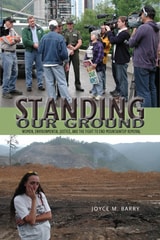
Standing Our Ground
Women, Environmental Justice, and the Fight to End Mountaintop RemovalJoyce M. Barry
Ohio University Press, 2012
Standing Our Ground: Women, Environmental Justice, and the Fight to End Mountaintop Removal examines women’s efforts to end mountaintop removal coal mining in West Virginia. Mountaintop removal coal mining, which involves demolishing the tops of hills and mountains to provide access to coal seams, is one of the most significant environmental threats in Appalachia, where it is most commonly practiced.
The Appalachian women featured in Barry’s book have firsthand experience with the negative impacts of Big Coal in West Virginia. Through their work in organizations such as the Coal River Mountain Watch and the Ohio Valley Environmental Coalition, they fight to save their mountain communities by promoting the development of alternative energy resources. Barry’s engaging and original work reveals how women’s tireless organizing efforts have made mountaintop removal a global political and environmental issue and laid the groundwork for a robust environmental justice movement in central Appalachia.
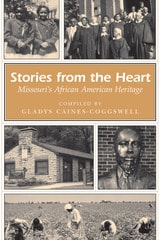
Stories from the Heart
Missouri's African American HeritageCompiled by Gladys Caines-Coggswell
University of Missouri Press, 2009
All along the river, from the front porches of Hannibal to the neighborhoods of St. Louis to the cotton fields of the Bootheel and west to Kansas City, stories are being told.
This collection of family stories and traditional tales brings to print down-home stories about all walks of African American life. Passed down from grandparents and great-grandparents, they have been lovingly gathered by Gladys Caines Coggswell as she visited Missouri communities and participated in storytelling events over the last two decades. These stories bring to life characters with uncommon courage, strength, will, and wit as they offer insight into African American experiences throughout the state’s history.
Often profound, always entertaining, some of these stories hark back to times barely remembered. Many tell of ordinary folks who achieved victories in the face of overwhelming odds. They range from recollections of KKK activities—recalling a Klan leader who owned property on which a black family lived as “the man who was always so nice to us”—to remembered differences between country and city schools and black schoolchildren introduced to Dick and Jane and Little Black Sambo. Stories from the Bootheel shed light on family life, sharecropping, and the mechanization of cotton culture, which in one instance led to a massive migration of rats as the first mechanical cotton pickers came in.
As memorable as the stories are the people who tell them, such as the author’s own “Uncle Pete” reporting on a duck epidemic or Evelyn Pulliam of Kennett telling of her resourceful neighbors in North Lilburn. Loretta Washington remembers sitting on her little wooden stool beside her great-grandmother’s rocking chair on the front porch in Wardell, mesmerized by stories—and the time when rocking chair and little wooden stool were moved inside and the stories stopped. Marlene Rhodes writes of her mother’s hero, Odie, St. Louis “Entrepreneur and English gentleman.”
Whether sharing previously unknown stories from St. Louis or betraying the secret of “Why Dogs Chase Cats,” this book is a rich repository of African American life. And if some of these tales seem unusual, the people remembering them will be the first to tell you: that’s the way it was. Coggswell preserves them for posterity and along with them an important slice of Missouri history.
Studying Appalachian Studies
Making the Path by WalkingEdited by Chad Berry, Phillip J. Obermiller, and Shaunna L. Scott
University of Illinois Press, 2015
Essayists argue for Appalachian Studies' integration with kindred fields like African American studies, women's studies, and Southern studies, and they urge those involved in the field to globalize the perspective of Appalachian Studies; to commit to continued applied, participatory action, and community-based research; to embrace more fully the field's capacity for bringing about social justice; to advocate for a more accurate understanding of Appalachia and its people; and to understand and overcome the obstacles interdisciplinary studies face in the social and institutional construction of knowledge.
Contributors: Chris Baker, Chad Berry, Donald Edward Davis, Amanda Fickey, Chris Green, Erica Abrams Locklear, Phillip J. Obermiller, Douglas Reichert Powell, Michael Samers, Shaunna L. Scott, and Barbara Ellen Smith.
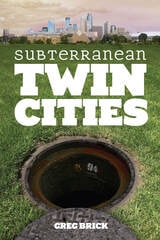
Subterranean Twin Cities
Greg Brick
University of Minnesota Press, 2009
We tend to send things underground that we are not interested in ever seeing again. Sewage. Garbage. In the past, we have used the underground to age such provisions as cheese and beer. In Subterranean Twin Cities, geologist, historian, and urban speleologist Greg Brick takes us on an adventurous, educational, and—thankfully—sanitary tour beneath the streets and into the myriad tunnels, caves, and industrial spaces that make up the Twin Cities’ fascinating and surprisingly vast underground landscape.
In this groundbreaking tour, the first of its kind of the Twin Cities, Brick mines the stories that lie below the city surface. Beginning with an accessible history on the geology of the area—including the giant cone-shaped mollusk Endoceras, whose thirteen-foot-long fossils are found in the Mississippi gorge—Brick guides us into a series of astounding firsthand expeditions. We follow him into St. Paul’s historic Carver’s Cave, with its stories of sunken treasure; through the many caves constructed for brewing, cheese ripening, and mushroom farming; and into the world of nineteenth-century show caves for tourists. We even find ourselves in the “Shangri-la” of urban caves: the extensive Schiek’s Cave seventy-five feet beneath the busy streets of downtown Minneapolis.
From spending the onset of Y2K in Carver’s Cave (just in case) to long hours wading in underground rivers, Brick proves himself a knowledgeable, wry, and daring guide. Subterranean Twin Cities shines a headlamp (with extra batteries, of course) into the captivating labyrinths beneath the Twin Cities and reminds us that what we see aboveground is really only half of the story.
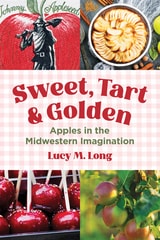
Sweet, Tart, and Golden
Apples in the Midwestern ImaginationLucy M. Long
University of Illinois Press, 2026
Lively and surprising, Sweet, Tart, and Golden blends food history with on-the-ground exploration to tell the multifaceted story of the apple.