Results by title
88 books match the query 'Religion and politics' and 5 start with s
Scriptures, Shrines, Scapegoats, and World Politics
Religious Sources of Conflict and Cooperation in the Modern EraZeev Maoz and Errol A. Henderson
University of Michigan Press, 2021
The effect of religious factors on politics has been a key issue since the end of the Cold War and the subsequent rise of religious terrorism. However, the systematic investigations of these topics have focused primarily on the effects of religion on domestic and international conflict. Scriptures, Shrines, Scapegoats, and World Politics offers a comprehensive evaluation of the role of religion in international relations, broadening the scope of investigation to such topics as the relationship between religion and cooperation, religion and conflict, and the relationship between religion and the quality of life. Religion is often manipulated by political elites to advance their principal goal of political survival. Zeev Maoz and Errol A. Henderson find that no specific religion is either consistently more bellicose or consistently more cooperative than other religions. However, religious similarity between states tends to reduce the propensity of conflict and increase the opportunity for security cooperation. The authors find a significant relationship between secularism and human security.
Secularism and Its Ambiguities
Four Case StudiesCarlo Ginzburg
Central European University Press, 2023
In the best micro-historical tradition, Carlo Ginzburg, himself one of the founders and icons of this genre of historiography, dissects four moments of European intellectual history. This book relives the experience that participants in the Natalie Zemon Davis Lecture Series at the Budapest campus of Central European University had in 2019 listening to Ginzburg's eloquent and engaging discourses. For the purposes of this volume he has re-edited and completed the leporello of cases charged with the inherent ambiguity between secularism and religions.
Secularism is often identified with rejection or at least distancing from the sacred. However, if one assumes that secularism also appropriates and reworks the sacred, its ambiguities come to the fore. The dilemma accompanies the reception of La Boétie's Servitude volontaire between 1574 and today. Before Walter Benjamin, the lesser-known 19th-century Léon de Laborde defended the profanity of reproducing the arts. The tension around the secular pervades the case of the College de Sociologie (Paris, 1937-1939), an attempt to analyze the ideological components of fascism. The fourth lecture approaches a much-discussed contemporary phenomenon – fake news – from a long-term perspective. To what extent are some disturbing features of the world we live in the result of a long, tortuous, unpredictable trajectory?
Securing the Sacred
Religion, National Security, and the Western StateRobert M. Bosco
University of Michigan Press, 2014
Despite significant theoretical distinctions between securitization on the domestic and the international levels, he finds that the outcome of addressing religion within the context of security hinges upon partnerships. Whereas states may harness the power of international allies, they cannot often find analogous domestic allies; therefore, states that attempt to securitize religion at home are more vulnerable to counterattack and more likely to abandon their efforts. Securing the Sacred makes a significant contribution to the fields of political theory, international relations, Islamic studies, and security/military studies.
Sovereignty and the Sacred
Secularism and the Political Economy of ReligionRobert A. Yelle
University of Chicago Press, 2018
Developing this close analogy between two elemental domains of society, Sovereignty and the Sacred offers a new theory of religion while suggesting alternative ways of organizing our political and economic life. By rethinking the transcendent foundations and liberating potential of both religion and politics, Yelle points to more hopeful and ethical modes of collective life based on egalitarianism and popular sovereignty. Deliberately countering the narrowness of currently dominant economic, political, and legal theories, he demonstrates the potential of a revived history of religions to contribute to a rethinking of the foundations of our political and social order.
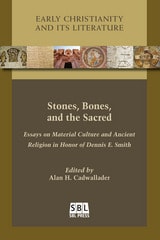
Stones, Bones, and the Sacred
Essays on Material Culture and Ancient Religion in Honor of Dennis E.Alan H. Cadwallader
SBL Press, 2016
A crucial text for any university course on the interaction of archaeology and the Bible
The world of early Christians was not a world lived in texts; it was a world saturated with material reality and concerns: what, where and when to eat or drink; how to present oneself in the space of bodily life and that of death; how to move from one place to another; what impacted status or the adjudication of legal charges. All these and more controlled so much of life in the ancient world. The Christians were not immune from the impact of these realities. Sometimes they absorbed their surrounds; sometimes they quite explicitly rejected the material practices bearing in on them; frequently they modified the practice and the rationale to create a significant Christian alternative. The collection of essays in this volume come from a range of international scholars who, for all their different interests and critical commitments, are yet united in treasuring research into the Greek and Roman worlds in which Christians sought to make their way. They offer these essays in honor of one who has made a lifetime's work in mining ancient material culture to extract nuggets of insight into early Christian dining practices: Dennis E. Smith.
Features
- Rich examples of method in the utilization of ancient material culture for biblical interpretation.
- Thirteen essays with a response from Dennis E. Smith
- Maps, diagrams, and plates