Results by title
598 books match the query 'Religious' and 46 start with s

SIGN BROKEN, MESSAGE INSIDE
PoemsSusanna Schantz
University of Massachusetts Press, 2027
A debut collection of poems that question authority with wit and clarity
“Words lead on to words” is both provocation and method in SIGN BROKEN, MESSAGE INSIDE, Susanna Schantz’s debut collection rooted in examining the roadside church signs near her South Carolina home. These poems are at turns humorous and polemical, a deft call-and-response, taking the lure and scold of these marquees as prompts for close reading and reinvention. From the local, she sketches a portrait of the national, offering an “orison / from the republic of readers,” and asking with one illuminated placard, “what will our words be like today?”
Treating church signs as a public language—communal, persuasive, sometimes backhanded—these poems expose the friction between proclamation and reception, between belonging and exclusion. They press on questions of gender and agency in faith and civic life: what role women are meant to play in the church, and what might happen if a woman were to “sail beyond this place on her / own wings and a prayer.” Formally alive, Schantz’s lines stretch, scatter, and rearrange across the page, their shapes mirroring a refusal to be contained by the cramped wit of the marquee. Her diction is tactile and bodily, reconnecting language to sensation: “fall[ing] to one’s knees / not in surrender, but / simply to luxuriate / in the cool mud.” Elsewhere, a more bristling music rises: “alphabets of tick bytes / and sacramental snaps / Climbing into our avatars / we thread our way in.” The poems’ bold sounds and rhythms echo the urgency of the signs themselves even as they reclaim their message.
“She has seen signs, and wonders,” the epigraph promises; this book delivers both. In Schantz’s hands, the roadside semaphore becomes a threshold and a mirror, inviting readers to decide: When is it enough to observe, and when must we answer back?
Sacred Attunement
A Jewish TheologyMichael Fishbane
University of Chicago Press, 2008
The first part of the book regrounds theology in this setting and opens up new pathways through nature, art, and the theological dimension as a whole. In the second section, Fishbane introduces his hermeneutical theology—one grounded in the interpretation of scripture as a distinctly Jewish practice. The third section focuses on modes of self-cultivation for awakening and sustaining a covenant theology. The final section takes up questions of scripture, authority, belief, despair, and obligation as theological topics in their own right.
The first full-scale Jewish theology in America since Abraham J. Heschel’s God in Search of Man and the first comprehensive Jewish philosophical theology since Franz Rosenzweig’s Star of Redemption, Sacred Attunement is a work of uncommon personal integrity and originality from one of the most distinguished scholars of Judaica in our time.
Sacred Music from the Cathedral at Trent
Trent, Museo Provinciale d'Arte, Codex 1375 (olim 88)Edited by Rebecca L. Gerber
University of Chicago Press, 2007
Often called the musical equivalent of the Dead Sea Scrolls, the Trent codices have dramatically broadened our understanding of Renaissance music. Much has been written about this collection of fifteenth-century music manuscripts, most of which were discovered in the Cathedral at Trent, but none of the seven codices--generally called Trent 87 through Trent 93--has ever been published in its entirety. Thus Rebecca Gerber’s edition of Trent 88, which took more than a decade to prepare, will be the first to appear. As such, this volume is a landmark in the publication of early music.
Trent 88 comprises an extensive anthology of 145 compositions tailored to the ceremonial and daily religious services of the period. The international scope of the collection is both impressive and significant: early English, French, German, and Spanish mass cycles appear alongside simple hymns and Magnificats. Music by renowned composers—including Guillaume Du Fay, Johannes Ockeghem, Johannes Cornago, and John Bedingham—is joined here by an even larger repertory of anonymous compositions with great aesthetic and historical value. Edited to accommodate both scholars and performers, and augmented with Gerber’s expert introduction, this volume will significantly deepen existing knowledge of a crucial period in the history of music.
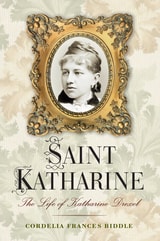
Saint Katharine
The Life of Katharine DrexelCordelia Frances Biddle
Westholme Publishing, 2015
When Katharine Drexel was born in 1858, her grandfather, financier Francis Martin Drexel, had a fortune so vast he was able to provide a loan of sixty million dollars to the Union’s cause during the Civil War. Her uncle and mentor, Anthony, established Drexel University to provide instruction to the working class regardless of race, religion, or gender. Her stepmother was Emma Bouvier whose brother, John, became the great-grandfather of Jacqueline Bouvier Kennedy Onassis. Katharine Drexel’s family were American royalty. As a Philadelphia socialite, “Kitty,” as she was often called, adored formal balls and teas, rowing regattas, and sailing races. She was beautiful, intelligent, and high-spirited. But when her stepmother died in 1883, and her father two years later, a sense of desolation nearly overwhelmed her. She was twenty-seven and in possession of a staggering inheritance. Approached for aid by the Catholic Indian Missions, she surprised her family by giving generously of money and time. It was during this period of acute self-examination that she journeyed to Rome for a private audience with Pope Leo XIII. With characteristic energy and fervor, she detailed the plight of the Native Americans, and begged for additional missionaries to serve them. His reply astonished her. “Why not, my child, yourself become a missionary?”
In Saint Katharine: The Life of Katharine Drexel, Cordelia Frances Biddle recounts the extraordinary story of a Gilded Age luminary who became a selfless worker for the welfare and rights of America’s poorest persons. After years of supporting efforts on behalf of African Americans and American Indians, Katharine finally decided to follow her inner voice and profess vows. The act made headlines. Like her father and grandfather, she was a shrewd businessperson; she retained her financial autonomy and established her own order, the Sisters of the Blessed Sacrament. Until her death in 1955, she devoted herself and her inheritance to building much-needed schools in the South and Southwest, despite threats from the Ku Klux Klan and others. Pragmatic, sometimes willful, ardent, and a charismatic leader, Katharine Drexel was an indefatigable champion of justice and parity. When illness incapacitated her in later years, divine radiance was said to emanate from her, a radiance that led to her canonization on October 1, 2000.
Saint Thomas Aquinas, Volume 2
Spiritual MasterJean-Pierre Torrell
Catholic University of America Press, 1996
Saint Thomas Aquinas
The Person and His WorkJean-Pierre Torrell, OP
Catholic University of America Press, 2022
Saints Without Halos
The Human Side of Mormon HistoryLeonard J Arrington
Signature Books, 1981
Saints
Faith without BordersEdited by Françoise Meltzer and Jas Elsner
University of Chicago Press, 2011
While the modern world has largely dismissed the figure of the saint as a throwback, we remain fascinated by excess, marginality, transgression, and porous subjectivity—categories that define the saint. In this collection, Françoise Meltzer and Jas Elsner bring together top scholars from across the humanities to reconsider our denial of saintliness and examine how modernity returns to the lure of saintly grace, energy, and charisma.
Sallie Martin, Mother of Gospel Music
Kay Norton
University of Illinois Press, 2026
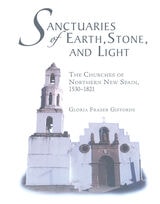
Sanctuaries of Earth, Stone, and Light
The Churches of Northern New Spain, 1530-1821Gloria Fraser Giffords
University of Arizona Press, 2007
Giffords has a remarkable eye for detail and for images both grand and diminutive. Because so many of the buildings she examines have been destroyed, she sleuthed through historical records in several countries, and she discovered that the architecture and material culture of northern New Spain reveal the influences of five continents. As she examines objects as large as churches or as small as ornamental ceramic tile she illuminates the sometimes subtle, sometimes striking influences of the religious, social, and artistic traditions of Europe (from the beginning of the Christian era through the nineteenth century), of the Muslim countries ringing the Mediterranean (from the seventh through the fifteenth centuries), and of Northern New Spain’s indigenous peoples (whose art influenced the designs of occupying Europeans).
Sanctuaries of Earth, Stone, and Light is a pathbreaking book, featuring 200 stunning photographs and over 300 illustrations ranging from ceremonial garments to detailed floor plans of the churches.
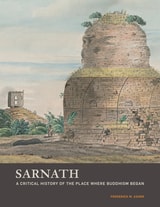
Sarnath
A Critical History of the Place Where Buddhism BeganFrederick M Asher
J. Paul Getty Trust, The, 2020
Sarnath has long been regarded as the place where the Buddha preached his first sermon and established the Buddhist monastic order. Excavations at Sarnath have yielded the foundations of temples and monastic dwellings, two Buddhist reliquary mounds (stupas), and some of the most important sculptures in the history of Indian art. This volume offers the first critical examination of the historic site.
Frederick M. Asher provides a longue durée (long-term) analysis of Sarnath—including the plunder, excavation, and display of antiquities and the Archaeological Survey of India’s presentation—and considers what lies beyond the fenced-in excavated area. His analytical history of Sarnath’s architectural and sculptural remains contains a significant study of the site’s sculptures, their uneven production, and their global distribution. Asher also examines modern Sarnath, which is a living establishment replete with new temples and monasteries that constitute a Buddhist presence on the outskirts of Varanasi, the most sacred Hindu city.
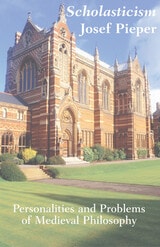
Scholasticism
Personalities & Problems Medieval PhilosophyJosef Pieper
St. Augustine's Press, 2001
The account is broken by the gradual replacement of the synthesis of faith and reason that had been achieved in the early Middle Ages by a new one that made use of Aristotle. Pieper gives a thorough and lively account of the struggle between Aristotelians and anti-Aristotelians, and the famous condemnations that put the effort of Saint Thomas Aquinas at risk. But the Summa theologiae is regarded by Pieper as the unique achievement of the period.
If the early centuries, the medieval period, can be seen as moving toward the thirteenth and Thomas's unique achievement, subsequent centuries saw the decline of scholasticism and theappearance of harbingers of modern philosophy.
The book closes with Pieper's thoughts on the permanent philosophical and theological significance of scholasticism and the Middle Ages. Once again, wearing his learning lightly, writing with a clarity that delights, Josef Pieper has taken the field from stuffier and more extended accounts.
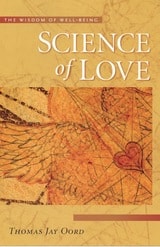
Science Of Love
Wisdom Of Well BeingThomas Oord
Templeton Press, 2004
We all know the saying, "Love can change the world." When science looks at love, it considers cosmology, sociobiology, evolutionary psychology, neurology, sex and romance, and the role of emotions as each relates to love. It also explores religious, ethical, and philosophical issues, such as virtue, creation ex nihilo, progress, divine action, agape, values, religious practices, pacifism, sexuality, friendship, freedom, and marriage. All affect the ways in which people understand each other and interact with one another. In this book, Oord explores these varied dimensions of love, illuminating the love-science symbiosis for both scholars and general readers.
His definition of love is "to act intentionally, in sympathetic response to others (including God), to promote overall well-being. Love acts are influenced by previous actions and executed in the hope of attaining a high degree of good for all." He begins his study with an exploration of the role love plays in all major world religions: Hinduism, Buddhism, Confucianism, Judaism, Islam, and Christianity. He explains how divine love in action can be viewed as consonant with the big bang theory and the continual creation of the universe.
He looks at pacifism and concludes that nonviolence is not always the most loving thing (sometimes violence must be used to rescue victims or prevent holocausts). He explores the animal kingdom to see how creatures work together with the Creator to make the world a better place. And he analyzes the fundamentals of love, the basic characteristics of existence that must be present for love to be expressed. He concludes with the important argument that progress can best be made when religion and science work together to both understand and promote love.
Seat of Wisdom
An Introduction to Philosophy in the Catholic TraditionJames M. Jacobs
Catholic University of America Press, 2021
Secret Body
Erotic and Esoteric Currents in the History of ReligionsJeffrey J. Kripal
University of Chicago Press, 2017
Kripal tells his story, biographically, historically and politically contextualizing each of the six books of his Chicago corpus, from Kali’s Child to Mutants and Mystics, all the while answering his censors and critics and exploring new implications of his thought. In the process, he begins to sketch out a speculative “new comparativism” in twenty theses. The result is a new vision for the study of religion, one that takes in the best of the past, engages with outside critiques from the sciences and the humanities, and begins to blaze a new positive path forward. A major work decades in the making, Secret Body will become a landmark in the study of religion.
Secular Days, Sacred Moments
The America Columns of Robert ColesRobert Coles
Michigan State University Press, 2013
Seeing Silence
Mark C. Taylor
University of Chicago Press, 2020
“To hear silence is to find stillness in the midst of the restlessness that makes creative life possible and the inescapability of death acceptable.” So writes Mark C. Taylor in his latest book, a philosophy of silence for our nervous, chattering age. How do we find silence—and more importantly, how do we understand it—amid the incessant buzz of the networks that enmesh us? Have we forgotten how to listen to each other, to recognize the virtues of modesty and reticence, and to appreciate the resonance of silence? Are we less prepared than ever for the ultimate silence that awaits us all?
Taylor wants us to pause long enough to hear what is not said and to attend to what remains unsayable. In his account, our way to hearing silence is, paradoxically, to see it. He explores the many variations of silence by considering the work of leading modern and postmodern visual artists, including Barnett Newman, Ad Reinhardt, James Turrell, and Anish Kapoor. Developing the insights of philosophers, theologians, writers, and composers, Taylor weaves a rich narrative modeled on the Stations of the Cross. His chapter titles suggest our positions toward silence: Without. Before. From. Beyond. Against. Within. Between. Toward. Around. With. In. Recasting Hegel’s phenomenology of spirit and Kierkegaard’s stages on life’s way, Taylor translates the traditional Via Dolorosa into a Nietzschean Via Jubilosa that affirms light in the midst of darkness.
Seeing Silence is a thoughtful meditation that invites readers to linger long enough to see silence, and, in this way, perhaps to hear once again the wordless Word that once was named “God.”
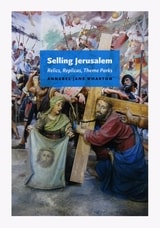
Selling Jerusalem
Relics, Replicas, Theme ParksAnnabel Jane Wharton
University of Chicago Press, 2006
From relics of the True Cross and Templar replicas of the Holy Sepulchre to Franciscan recreations of the Passion to nineteenth-century mass-produced prints and contemporary theme parks, Wharton describes the evolving forms by which the city has been possessed in the West. She also maps those changing embodiments of the Holy City against shifts in the western market. From the gift-and-barter economy of the early Middle Ages to contemporary globalization, both money and the representations of Jerusalem have become progressively incorporeal, abstract, illusionistic, and virtual.
Selling Jerusalem offers a penetrating introduction to the explosive combination of piety and capital at work in religious objects and global politics. It is sure to interest students and scholars of art history, economic history, popular culture, religion, and architecture, as well as those who want to better understand Jerusalem’s problematic place in history.
Seven Ways of Looking at Pointless Suffering
What Philosophy Can Tell Us about the Hardest Mystery of AllScott Samuelson
University of Chicago Press, 2018
It’s right there in the Book of Job: “Man is born unto trouble as the sparks fly upward.” Suffering is an inescapable part of the human condition—which leads to a question that has proved just as inescapable throughout the centuries: Why? Why do we suffer? Why do people die young? Is there any point to our pain, physical or emotional? Do horrors like hurricanes have meaning?
In Seven Ways of Looking at Pointless Suffering, Scott Samuelson tackles that hardest question of all. To do so, he travels through the history of philosophy and religion, but he also attends closely to the real world we live in. While always taking the question of suffering seriously, Samuelson is just as likely to draw lessons from Bugs Bunny as from Confucius, from his time teaching philosophy to prisoners as from Hannah Arendt’s attempts to come to terms with the Holocaust. He guides us through the arguments people have offered to answer this fundamental question, explores the many ways that we have tried to minimize or eliminate suffering, and examines people’s attempts to find ways to live with pointless suffering. Ultimately, Samuelson shows, to be fully human means to acknowledge a mysterious paradox: we must simultaneously accept suffering and oppose it. And understanding that is itself a step towards acceptance.
Wholly accessible, and thoroughly thought-provoking, Seven Ways of Looking at Pointless Suffering is a masterpiece of philosophy, returning the field to its roots—helping us see new ways to understand, explain, and live in our world, fully alive to both its light and its darkness.
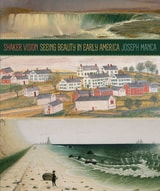
Shaker Vision
Seeing Beauty in Early AmericaJoseph Manca
University of Massachusetts Press, 2019
In Shaker Vision, Joseph Manca explores original texts, especially diaries and travel journals, and material culture to demonstrate that Shakers enjoyed a remarkably deep experience of the visual world. Shakers shared tastes with mainstream Americans and often employed a similar aesthetic vocabulary, but all within a belief system that made them distinct. In addition to their well-known ascetic architecture, furniture, and handicraft styles, they expressed themselves through ornate and detailed spiritual art and in vivid, visionary experiences. Based on firsthand accounts of the believers themselves, this richly illustrated volume will dramatically change how we assess the visual world of this uniquely American religious sect.
Shakespeare and Interpretation, or What You Will
Brayton Polka
University of Delaware Press, 2011
Brayton Polka takes both a textual and theoretical approach to seven plays of Shakespeare: Macbeth, Othello, Twelfth Night, All’s Well That Ends Well, Julius Caesar, Troilus and Cressida, and Hamlet. He calls upon the Bible and the ideas of major European thinkers, above all, Kierkegaard and Spinoza, to argue that the concept of interpretation that underlies both Shakespeare’s plays and our own lives as moderns is the golden rule of the Bible: the command to love your neighbor as yourself. What you will (the alternative title of Twelfth Night ) thus captures the idea that interpretation is the very act by which we constitute our lives. For it is only in willing what others will—in loving relationships—that we enact a concept of interpretation that is adequate to our lives.
Polka argues that it is the aim of Shakespeare, when representing the ancient world in plays like Julius Caesar and Troilus and Cressida, and also in his long narrative poem “The Rape of Lucrece,” to dramatize the fundamental differences between ancient (pagan) values and modern (biblical) values or between what he articulates as contradiction and paradox. The ancients are fatally destroyed by the contradictions of their lives of which they remain ignorant. In contrast, we moderns in the biblical tradition, like those who figure in Shakespeare’s other works, are responsible for addressing and overcoming the contradictions of our lives through living the interpretive paradox of “what you will,” of treating all human beings as our neighbor. Shakespeare’s comedies and tragedies, notwithstanding their dramatically different form, share this interpretive framework of paradox. As the author shows in his book, texts without interpretation are blind and interpretation without texts is empty.
Published by University of Delaware Press. Distributed worldwide by Rutgers University Press.
Shared Mission
Religious Education in the Catholic Tradition, Revised EditionLeonardo Franchi
Catholic University of America Press, 2023
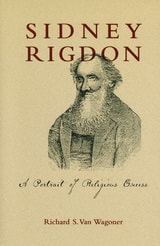
Sidney Rigdon
A Portrait of Religious ExcessRichard S. Van Wagoner
Signature Books, 2006
In the late 1820s a fiery young minister in western Ohio converted nearly 1,000 proselytes to the Reformed Baptist Movement. As these schismatics organized themselves into the new Disciples of Christ church, the Reverend Sidney Rigdon was already aligning himself with another, more radical movement, the Latter-day Saints, where he quickly became the LDS prophet’s principal advisor and spokesman. He served Joseph Smith loyally for the next fourteen years, even through a brief spat over the prophet’s romantic interest in his teenage daughter.
Next to Smith, Rigdon was the most influential early Mormon. He imported Reformed Baptist teachings into Latter-day Saint theology, wrote the canonized Lectures on Faith, championed communalism and isolationism, and delivered many of the most significant early sermons, including the famous Salt Sermon and the Ohio temple dedicatory address.
Following Smith’s death, Rigdon parted company with Brigham Young to lead his own group of some 500 secessionists Mormons in Pennsylvania. Rigdon’s following gradually dwindled, as the one-time orator took to wandering the streets, taunting indifferent passersby with God’s word. He was later recruited by another Mormon faction. Although he refused to meet with them, he agreed to be their prophet and send revelations by mail. Before long he had directed them to settle far-off Iowa and Manitoba, among other things. At his death, his followers numbered in the hundreds, and today they number about 10,000, mostly in Pennsylvania.
“Rigdon is a biographer’s dream,” writes Richard Van Wagoner. Intellectually gifted, manic-depressive, an eloquent orator and social innovator but a chronic indigent, Rigdon aspired to altruism but demanded advantage and deference. When he lost prominence, his early attainments were virtually written out of the historical record.
Correcting this void, Van Wagoner has woven the psychology of religious incontinence into the larger fabric of social history. In doing so, he reminds readers of the significance of this nearly-forgotten founding member of the LDS First Presidency. Nearly ten million members in over one hundred churches trace their heritage to Joseph Smith. Many are unaware of the importance of Rigdon’s contributions to their inherited theology.
Sikh Kirtan and Its Journeys
Instruments, Theories, TechnologiesGurminder Kaur Bhogal
University of Chicago Press, 2025
Kirtan—the sung expression of sacred verses—spans the Indian subcontinent, but it plays a unique role in the Sikh faith. In Sikh Kirtan and ItsJourneys, musicologist Gurminder Kaur Bhogal introduces the devotional tradition of kirtan, examining it alongside the writings of holy figures, the Sikh Gurus and Bhagats, and its practice among musicians. The long-established tradition of kirtan originated in a canon of instruments and songs, each of which produces a singular spiritual and worldly effect when kirtan is sung. However, the realities of colonization and migration have necessitated changes to these canonical practices. Bhogal offers a deep exploration of the traditions that gave rise to kirtan and a robust portrait of the many transformations kirtan has undergone, particularly in the wide-ranging Sikh diaspora, dedicating special attention to marginal kirtan players such as women and innovators developing digital techniques and styles. A practicing kirtaniya, Bhogal has spent her life studying and performing this music, steeped in the histories and controversies her book describes.
Through a rigorous explanation of the traditions and evolutions of kirtan, Bhogal ultimately shows that kirtan is fluid, multi-faceted, and ever-changing because it reflects the shifting spiritual needs and musical tastes of devotees and practitioners across the world. Moreover, wherever kirtan is offered and received, it heightens corporeal vibrations between practitioners and devotees to motivate a sense of social purpose, social responsibility, and selfless service.
Silencing the Drum
Religious Racism and Afro-Brazilian Sacred MusicDanielle N. Boaz and Umi Vaughan
Amherst College Press, 2024
Silencing the Drum exposes the profound struggle of Afro-Brazilian sacred music against escalating intolerance. Danielle N. Boaz and Umi Vaughan blend legal scholarship with ethnomusicology, offering a compelling narrative rooted in interviews with religious leaders, musicians, and activists across Brazil. This multidisciplinary exploration examines the relentless attacks against the practitioners of Afro-Brazilian religions—from discriminatory noise complaints in Bahia to vigilante violence in Rio de Janeiro.
The volume integrates multimedia elements including musical samples to vividly illustrate the struggles and resilience of Afro-Brazilian communities in the face of discrimination. As Silencing the Drum confronts the larger global issues of racism and religious freedom, it provides essential insights for scholars, activists, and anyone passionate about human rights and cultural preservation.
Sing Them Over Again to Me
Hymns and Hymnbooks in AmericaEdited by Mark A. Noll and Edith L. Blumhofer
University of Alabama Press, 2006
Hymns and hymnbooks as American historical and cultural icons.
This work is a study of the importance of Protestant hymns in defining America and American religion. It explores the underappreciated influence of hymns in shaping many spheres of personal and corporate life as well as the value of hymns for studying religious life. Distinguishing features of this volume are studies of the most popular hymns (“Amazing Grace,” “O, For a Thousand Tongues to Sing,” “All Hail the Power of Jesus’ Name”), with attention to the ability of such hymns to reveal, as they are altered and adapted, shifts in American popular religion. The book also focuses attention on the role hymns play in changing attitudes about race, class, gender, economic life, politics, and society.
Singing the Land
Hebrew Music and Early Zionism in AmericaEli Sperling
University of Michigan Press, 2024
Exploring the history, events, contexts, and tensions that comprised what may be termed the ‘Zionization’ of American Jewry during the first half of the twentieth century, Eli Sperling analyzes primary sources within the historical contexts of Zionist national development and American Jewish life. Singing the Land offers insights into how and why musical frameworks were central to catalyzing American Jewry’s support of the Zionist cause by the 1940s, parallel to firm commitments to their American locale and national identities. The proliferation of this widespread American Jewish-Zionist embrace was achieved through a variety of educational, religious, economic, and political efforts, and Hebrew music was a thread consistent among them all.
Singing the Lord's Song in a Strange Land
Hymnody in the History of North American ProtestantismEdith L. Blumhofer
University of Alabama Press, 2008
Music and song are important parts of worship, and hymns have long played a central role in Protestant cultural history. This book explores the ways in which Protestants have used and continue to use hymns to clarify their identity and define their relationship with America and to Christianity. Representing seven groups—Baptists, Presbyterians, Lutherans, Mennonites, Holiness, Hispanics, and Evangelicals—the nine essays reveal how hymns have helped immigrants to establish new identities, contributed to the body of worship resources, and sustained ethnic identity.
Individual essays address the music of the Old-Fashioned Revival Hour, America’s longest running and most successful independent radio program; singing among Swedish evangelicals in America; the German hymn tradition as transformed by Mennonite immigrants; the ways hymnody reinforces themes of the Wesleyan holiness movement; the history of Mercer’s Cluster (1810), a southern hymnal that gave voice to slaves, women, and native Americans; and the Presbyterian hymnal tradition in Canada formed by Scottish immigrants.
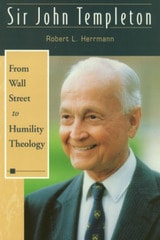
Sir John Templeton
From Wall Street To HumilityRobert L. Hermann
Templeton Press, 1998
The biography of the "Wizard of Wall Street" who has dedicated his life to advancing the scientific study of spiritual realities has been revised and updated. Sir John Templeton was an inspiring and motivational force both through his personal example and through the foundation that bears his name and is dedicated to his mission.
This volume reviews the life of this man of vision, from his childhood in rural Tennessee, to his education at Yale and Oxford, to his legendary years on Wall Street, the birth of his children, and the development and growth of "humility theology science." Interwoven with the stories and facts are the roots of his faith and the values that he credits for his financial success and are the catalyst for his lifelong mission.
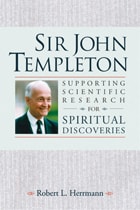
Sir John Templeton
Supporting Scientific Research For Spiritual DiscoveriesRobert Herrmann
Templeton Press, 2004
Slavery and the Catholic Church in the United States
Historical StudiesDavid J. Endres
Catholic University of America Press, 2023
Soluble Fish
Mary Jo Firth Gillett
Southern Illinois University Press, 2007
Soluble Fish transports readers to a place of discovery, exploring issues of borders, familial and love relationships, and other aspects of being human. Mary Jo Firth Gillett layers her poems in rich metaphor as she searches for meaning in everyday life. Contemplating a range of topics from teaching poetry to watching her father filet a fish, Gillett’s humorous and playful collection celebrates language and life.
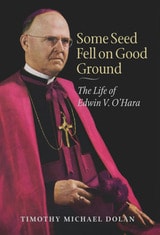
Some Seed Fell on Good Ground
The Life of Edwin V. O'HaraTimothy Michael Dolan
Catholic University of America Press, 2012
Soul Matters
Plato and Platonists on the Nature of the SoulSara Ahbel-Rappe
SBL Press, 2023
Platonic discourses concerning the soul are incredibly rich and multitiered. Plato's own diverse and disparate arguments and images offer competing accounts of how we are to understand the nature of the soul. Consequently, it should come as no surprise that the accounts of Platonists who engage Plato’s dialogues are often riddled with questions. This volume takes up the theories of well-known philosophers and theologians, including Plato, Plotinus, Proclus, the emperor Julian, and Origen, as well as lesser-known but equally important figures in a collection of essays on topics such as transmigration of the soul, the nature of the Platonist enlightenment experience, soul and gender, pagan ritual practices, Christian and pagan differences about the soul, mental health and illness, and many other topics. Contributors include Crystal Addey, Sara Ahbel-Rappe, Dirk Baltzly, Robert Berchman, Jay Bregman, Luc Brisson, Kevin Corrigan, John Dillon, John F. Finamore, Lloyd P. Gerson, Dorian Gieseler Greenbaum, Elizabeth Hill, Sarah Klitenic Wear, Danielle A. Layne, Ilaria L. E. Ramelli, Gregory Shaw, Svetla Slaveva-Griffine, Suzanne Stern-Gillet, Harold Tarrant, Van Tu, and John D. Turner.
Speaking the Incomprehensible God
Thomas Aquinas on the Interplay of Positive and Negative TheologyGregory P. Rocca O.P.
Catholic University of America Press, 2004
Spinoza and the Cunning of Imagination
Eugene Garver
University of Chicago Press, 2018
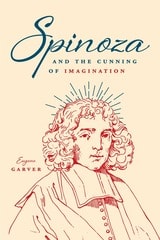
Spinoza initially presents imagination as an inadequate and confused way of thinking, always inferior to ideas that adequately represent things as they are. It would seem to follow that one ought to purge the mind of imaginative ideas and replace them with rational ideas as soon as possible, but as Garver shows, the Ethics don’t allow for this ultimate ethical act until one has cultivated a powerful imagination. This is, for Garver, “the cunning of imagination.” The simple plot of progress becomes, because of the imagination, a complex journey full of reversals and discoveries. For Garver, the “cunning” of the imagination resides in our ability to use imagination to rise above it.
Spinoza's Modernity
Mendelssohn, Lessing, and HeineWilli Goetschel
University of Wisconsin Press, 2004
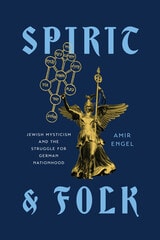
Spirit and Folk
Jewish Mysticism and the Struggle for German NationhoodAmir Engel
University of Chicago Press, 2027
A study of the twentieth-century construction of a Jewish mystical tradition by German Jewish intellectuals.
For most of European history, the notion of Jewish spirituality was unthinkable—buried beneath a pervasive desire to understand Judaism as uniquely material and Christianity as uniquely spiritual. In Spirit and Folk, Amir Engel tells the story of how a group of Jewish intellectuals, seeking greater involvement in political life, worked to invent a mystical tradition for Judaism amid the existential crises of twentieth-century Germany.
Beginning with Martin Buber in 1900 and ending with Gershom Scholem in 1942, Engel traces the rich debate among thinkers both well-known and forgotten about the need to imagine and construct a uniquely Jewish mystical tradition from historical religious sources. This quest and the tradition that emerged, Engel argues, developed in response to one of the most volatile questions of the last century: can Jews be Germans? The invention of Jewish spirituality, Engel shows, was not only a religious innovation but also a political gambit—a demand to be accepted as equal contributors to the German national project.
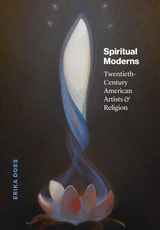
Spiritual Moderns
Twentieth-Century American Artists and ReligionErika Doss
University of Chicago Press, 2022
Andy Warhol is one of the best-known American artists of the twentieth century. He was also an observant Catholic who carried a rosary, went to mass regularly, kept a Bible by his bedside, and depicted religious subjects throughout his career. Warhol was a spiritual modern: a modern artist who appropriated religious images, beliefs, and practices to create a distinctive style of American art.
Spiritual Moderns centers on four American artists who were both modern and religious. Joseph Cornell, who showed with the Surrealists, was a member of the Church of Christ, Scientist. Mark Tobey created pioneering works of Abstract Expressionism and was a follower of the Bahá’í Faith. Agnes Pelton was a Symbolist painter who embraced metaphysical movements including New Thought, Theosophy, and Agni Yoga. And Warhol, a leading figure in Pop art, was a lifelong Catholic. Working with biographical materials, social history, affect theory, and the tools of art history, Doss traces the linked subjects of art and religion and proposes a revised interpretation of American modernism.
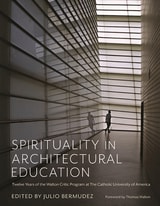
Spirituality in Architectural Education
Twelve Years of the Walton Critic Program at The Catholic University of AmericaJulio Bermudez
Catholic University of America Press, 2021
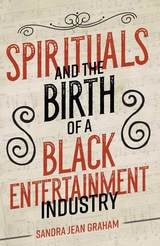
Spirituals and the Birth of a Black Entertainment Industry
Sandra Jean Graham
University of Illinois Press, 2018
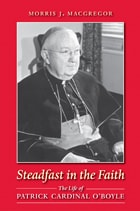
Steadfast in the Faith
The Life of Patrick Cardinal O'BoyleMorris J. MacGregor
Catholic University of America Press, 2006
Subjectivity, Objectivity, and Intersubjectivity
A New Paradigm for Religion and ScienceJoseph A. Bracken
Templeton Press, 2009
During the Middle Ages, philosophers and theologians argued over the extramental reality of universal forms or essences. In the early modern period, the relation between subjectivity and objectivity, the individual self and knowledge of the outside world, was a rich subject of debate. Today, there is considerable argument about the relation between spontaneity and determinism within the evolutionary process, whether a principle of spontaneous self-organization as well as natural selection is at work in the aggregation of molecules into cells and the development of primitive forms of life into complex organisms. In Subjectivity, Objectivity and Intersubjectivity, Joseph A. Bracken proposes that what is ultimately at stake here is the age-old problem of the relationship between the One and the Many, universality and particularity on different levels of existence and activity within nature.
Summa metaphysicae ad mentem Sancti Thomae
Essays in Honor of John F. WippelTherese Scarpelli Cory
Catholic University of America Press, 2023
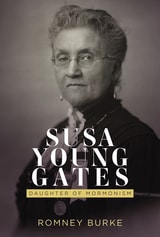
Susa Young Gates
Daughter of MormonismRomney Burke
Signature Books, 2022
After divorcing her first husband, Alma Dunford, the trauma associated with that union was such that she steadfastly refused to mention it ever again. She also lost some of her children over the course of her life and was unable to reconcile her older sister’s departure from the LDS Church and conversion to Catholicism. Yet despite her trials, Susa found fulfillment in her faith through service, as a prolific writer—co-authoring with her daughter Leah Dunford Widtsoe the 1930 biography of her father, Life Story of Brigham Young, founding the Young Women’s Journal in 1889, the Relief Society Magazine in 1915, and in her associations with such prominent women’s advocates such as Susan B. Anthony.
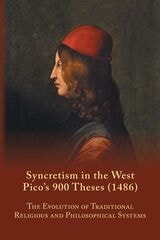
Syncretism in the West
Pico's 900 Theses (1486) With Text, Translation, and CommentaryEdited by S. A. Farmer
Arizona Center for Medieval and Renaissance Studies, 2016
This is the 2016 paperback printing of the 2008 edition of the popular text, translation, and commentary by S. A. Farmer. (The 2008 edition was a revised edition of the 1998 original publication).
Published by ACMRS (Arizona Center for Medieval and Renaissance Studies) in Tempe, Arizona as part of the MRTS (Medieval and Renaissance Texts and Studies) Series, this book -- previously available only in hardcover and otherwise out-of-print since 2014 -- is now available in its entirety in paperback format.