Results by title
131 books match the query 'Republic of South Africa' and 13 start with s
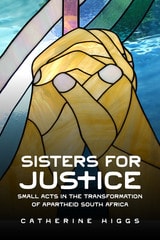
Sisters for Justice
Small Acts in the Transformation of Apartheid South AfricaCatherine Higgs
University of Wisconsin Press, 2025
Based on extensive oral history interviews with white and Black sisters as well as deep archival research, this groundbreaking book reveals a largely untold story, nested within the broader literature of women’s activism in South Africa. The result is a new perspective that expands and intensifies our understanding of a dramatic period during which individual actions, in the aggregate, contributed to social change.
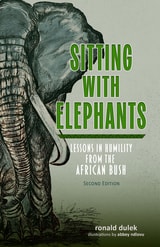
Sitting with Elephants
Lessons in Humility from the African Bush, Enhanced and Expanded Second EditionRonald Dulek, Illustrations by Abbey Ndlovu
University of Alabama Press, 2026
A professor of communication and strategy reveals deep lessons from life in the African bush.
Sitting with Elephants is a heartfelt memoir that follows a middle-aged American professor and his wife as they trade suburban life for a remote bush house in South Africa. What begins as a spontaneous decision becomes a life-changing experience—one shaped by lions at the backdoor, baboons in the rafters, and above all, a herd of elephants who frequent their yard like neighbors.
Told through a series of emails to their adult children and brought to life by vivid illustrations from Abbey Ndlovu, Ronald Dulek’s narrative explores the profound lessons nature teaches: patience, humility, and deep respect for the wild. As the couple learns to communicate with elephants and navigate the rhythms of bush life, they also reflect on the unexpected beauty of slowing down and embracing the unknown.
Blending lighthearted anecdotes with moments of quiet insight, Sitting with Elephants invites readers into a story of transformation—both personal and environmental. This second edition includes expanded content with new stories and reflections, offering a deeper look into the couple’s unforgettable time in the African bush.
Slavery, Emancipation and Colonial Rule in South Africa
Wayne Dooling
Ohio University Press, 2008
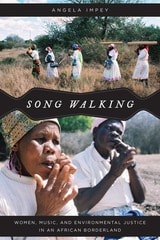
Song Walking
Women, Music, and Environmental Justice in an African BorderlandAngela Impey
University of Chicago Press, 2018
This book links ethnomusicological research to larger themes of international development, environmental conservation, gender, and local economic access to resources. By demonstrating that development processes are essentially cultural processes and revealing how music fits within this frame, Song Walking testifies to the affective, spatial, and economic dimensions of place, while contributing to a more inclusive and culturally apposite alignment between land and environmental policies and local needs and practices.
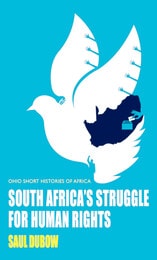
South Africa’s Struggle for Human Rights
Saul Dubow
Ohio University Press, 2012
The human rights movement in South Africa’s transition to a postapartheid democracy has been widely celebrated as a triumph for global human rights. It was a key aspect of the political transition, often referred to as a miracle, which brought majority rule and democracy to South Africa. The country’s new constitution, its Truth and Reconciliation Commission, and the moral authority of Nelson Mandela stand as exemplary proof of this achievement. Yet, less than a generation after the achievement of freedom, the status of human rights and constitutionalism in South Africa is uncertain. In government the ANC has displayed an inconsistent attitude to the protection, and advancement, of hard-won freedoms and rights, and it is not at all clear that a broader civic and political consciousness of the importance of rights is rooting itself more widely in popular culture.
South Africa’s Suspended Revolution
Hopes and ProspectsAdam Habib
Ohio University Press, 2013
South Africa’s Suspended Revolution tells the story of South Africa’s democratic transition and the prospects for the country to develop a truly inclusive political system. Beginning with an account of the transition in the leadership of the African National Congress from Thabo Mbeki to Jacob Zuma, the book then broadens its lens to examine the relationship of South Africa’s political elite to its citizens. It also examines the evolution of economic and social policies through the democratic transition, as well as the development of a postapartheid business community and a foreign policy designed to re-engage South Africa with the world community.
Written by one of South Africa’s leading scholars and political commentators, the book combines historical and contemporary analysis with strategies for an alternative political agenda. Adam Habib connects the lessons of the South African experience with theories of democratic transition, social change, and conflict resolution. Political leaders, scholars, students, and activists will all find material here to deepen their understanding of the challenges and opportunities of contemporary South Africa.
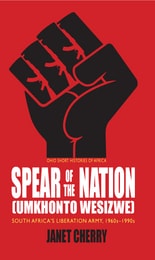
Spear of the Nation
Umkhonto weSizwe: South Africa’s Liberation Army, 1960s–1990sJanet Cherry
Ohio University Press, 2011
Umkhonto weSizwe, Spear of the Nation, was arguably the last of the great liberation armies of the twentieth century—but it never got to “march triumphant into Pretoria.” MK—as it was known—was the armed wing of the African National Congress, South Africa’s liberation movement, that challenged the South African apartheid government. A small group of revolutionaries committed to the seizure of power, MK discovered its principal members engaged in negotiated settlement with the enemy and was disbanded soon after.
The history of MK is one of paradox and contradiction, of successes and failures. In this short study, which draws widely on the personal experiences of—and commentary by—MK soldiers, Janet Cherry offers a new and nuanced account of the Spear of the Nation. She presents in broad outline the various stages of MK’s thirty-year history, considers the difficult strategic and moral problems the revolutionary army faced, and argues that its operations are likely to be remembered as a just war conducted with considerable restraint.
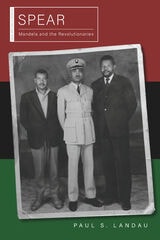
Spear
Mandela and the RevolutionariesPaul S. Landau
Ohio University Press, 2022
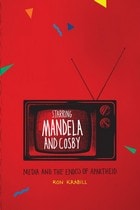
Starring Mandela and Cosby
Media and the End(s) of ApartheidRon Krabill
University of Chicago Press, 2010
During the worst years of apartheid, the most popular show on television in South Africa—among both Black and White South Africans—was The Cosby Show. Why did people living under a system built on the idea that Black people were inferior and threatening flock to a show that portrayed African Americans as comfortably mainstream? Starring Mandela and Cosby takes up this paradox, revealing the surprising impact of television on racial politics.
The South African government maintained a ban on television until 1976, and according to Ron Krabill, they were right to be wary of its potential power. The medium, he contends, created a shared space for communication in a deeply divided nation that seemed destined for civil war along racial lines. At a time when it was illegal to publish images of Nelson Mandela, Bill Cosby became the most recognizable Black man in the country, and, Krabill argues, his presence in the living rooms of white South Africans helped lay the groundwork for Mandela’s release and ascension to power.
Weaving together South Africa’s political history and a social history of television, Krabill challenges conventional understandings of globalization, offering up new insights into the relationship between politics and the media.
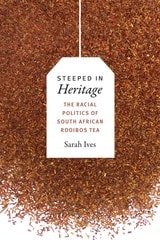
Steeped in Heritage
The Racial Politics of South African Rooibos TeaSarah Ives
Duke University Press, 2017
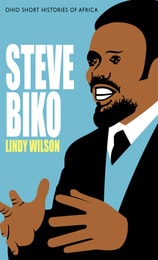
Steve Biko
Lindy Wilson
Ohio University Press, 2011
Steve Biko inspired a generation of black South Africans to claim their true identity and refuse to be a part of their own oppression. Through his example, he demonstrated fearlessness and self-esteem, and he led a black student movement countrywide that challenged and thwarted the culture of fear perpetuated by the apartheid regime. He paid the highest price with his life. The brutal circumstances of his death shocked the world and helped isolate his oppressors.
This short biography of Biko shows how fundamental he was to the reawakening and transformation of South Africa in the second half of the twentieth century—and just how relevant he remains. Biko’s understanding of black consciousness as a weapon of change could not be more relevant today to “restore people to their full humanity.”
As an important historical study, this book’s main sources were unique interviews done in 1989—before the end of apartheid—by the author with Biko’s acquaintances, many of whom have since died.
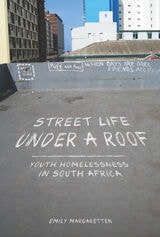
Street Life under a Roof
Youth Homelessness in South AfricaEmily Margaretten
University of Illinois Press, 2015
In Street Life under a Roof, Emily Margaretten draws on ten years of up-close fieldwork to explore the distinct cultural universe of the Point Place community. Margaretten's sensitive investigations reveal how young men and women draw on customary notions of respect and support to forge an ethos of connection and care that allows them to live far richer lives than ordinarily assumed. Her discussion of gender dynamics highlights terms like nakana--to care about or take notice of another--that young women and men use to construct "outside" and "inside" boyfriends and girlfriends and to communicate notions of trust. Margaretten exposes the structures of inequality at a local, regional, and global level that contribute to socioeconomic and political dislocation. But she also challenges the idea that Point Place's marginalized residents need "rehabilitation." As she argues, these young men and women want love, secure homes, and the means to provide for their dependents--in short, the same hopes and aspirations mirrored across South African society.
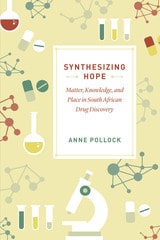
Synthesizing Hope
Matter, Knowledge, and Place in South African Drug DiscoveryAnne Pollock
University of Chicago Press, 2019
Consideration of this case exposes the limitations of global health frameworks that implicitly posit rich countries as the only sites of knowledge production. Analysis of iThemba identifies the problems inherent in global north/south divides at the same time as it highlights what is at stake in who makes knowledge and where. It also provides a concrete example for consideration of the contexts and practices of postcolonial science, its constraints, and its promise.
Synthesizing Hope explores the many legacies that create conditions of possibility for South African drug discovery, especially the specific form of settler colonialism characterized by apartheid and resource extraction. Paying attention to the infrastructures and laboratory processes of drug discovery underscores the materiality of pharmaceuticals from the perspective of their makers, and tracing the intellectual and material infrastructures of South African drug discovery contributes new insights about larger social, political, and economic orders.