Results by title
53 books match the query 'Secondary' and 5 start with s
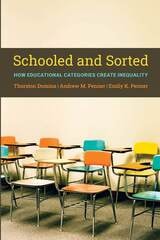
Schooled and Sorted
How Educational Categories Create InequalityThurston Domina
Russell Sage Foundation, 2023
We tend to view education primarily as a way to teach students skills and knowledge that they will draw upon as they move into their adult lives. However, schools do more than educate students—they also place students into categories, such as kindergartner, English language learner, or honor roll student. In Schooled & Sorted, Thurston Domina, Andrew M. Penner, and Emily K. Penner, explore processes of educational categorization in order to explain the complex relationship between education and social inequality—and to identify strategies that can help build more just educational systems.
Some educational categories have broadly egalitarian consequences. Indeed, Domina, Penner, and Penner argue that when societies enroll young people in school, making them students, they mark them as individuals who are worthy of rights. But other educational categories reinforce powerful social categories—including race, gender, and class—and ultimately reproduce social and economic inequality in society. Elite colleges, tracked high schools, and elementary school gifted programs provide not only different educational experiences, but also create merit and inequality by sorting students into categories that are defined by the students who are excluded.
Schooled & Sorted highlights that many of the decisions that define educational categories occur in school-based committee meetings and other relatively local settings. The local nature of these decisions provides many opportunities to define educational categories differently, and for school communities to bring about change.
Schooled & Sorted is an illuminating investigation into the ways sorting within schools translates into inequality in the larger world. While some educational categorization may be unavoidable, the authors suggest ways to build a more equitable system—and thus a more equitable society.
[more]
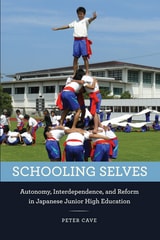
Schooling Selves
Autonomy, Interdependence, and Reform in Japanese Junior High EducationPeter Cave
University of Chicago Press, 2016
Balancing the development of autonomy with that of social interdependence is a crucial aim of education in any society, but nowhere has it been more hotly debated than in Japan, where controversial education reforms over the past twenty years have attempted to reconcile the two goals. In this book, Peter Cave explores these reforms as they have played out at the junior high level, the most intense pressure point in the Japanese system, a time when students prepare for the high school entrance exams that will largely determine their educational trajectories and future livelihoods.
Cave examines the implementation of “relaxed education” reforms that attempted to promote individual autonomy and free thinking in Japanese classrooms. As he shows, however, these policies were eventually transformed by educators and school administrators into curricula and approaches that actually promoted social integration over individuality, an effect opposite to the reforms’ intended purpose. With vivid detail, he offers the voices of teachers, students, and parents to show what happens when national education policies run up against long-held beliefs and practices, and what their complex and conflicted interactions say about the production of self and community in education. The result is a fascinating analysis of a turbulent era in Japanese education that offers lessons for educational practitioners in any country.
Cave examines the implementation of “relaxed education” reforms that attempted to promote individual autonomy and free thinking in Japanese classrooms. As he shows, however, these policies were eventually transformed by educators and school administrators into curricula and approaches that actually promoted social integration over individuality, an effect opposite to the reforms’ intended purpose. With vivid detail, he offers the voices of teachers, students, and parents to show what happens when national education policies run up against long-held beliefs and practices, and what their complex and conflicted interactions say about the production of self and community in education. The result is a fascinating analysis of a turbulent era in Japanese education that offers lessons for educational practitioners in any country.
[more]
Schooling, Democracy, and the Quest for Wisdom
Partnerships and the Moral Dimensions of TeachingRobert V. Bullough Jr. and John R. Rosenberg
Rutgers University Press, 2018
Winner of 2019 Society of Professors of Education Outstanding Book Award and 2019 Critics Choice Book Award from AESA
In response to growing concern in the 1980s about the quality of public education across the United States, a tremendous amount of energy was expended by organizations such as the Holmes Group and the Carnegie Forum to organize professional development schools (PDS) or “partner schools” for teacher education. On the surface, the concept of partnering is simple; however, the practice is very costly, complex, and difficult. In Schooling, Democracy, and the Quest for Wisdom, Robert V. Bullough, Jr. and John R. Rosenberg examine the concept of partnering through various lenses and they address what they think are the major issues that need to be, but rarely are, discussed by thousands of educators in the U.S. who are involved and invested in university-public school partnerships. Ultimately, they assert that the conversation around partnering needs re-centering (most especially on the purposes of public education), refreshing, and re-theorizing.
In response to growing concern in the 1980s about the quality of public education across the United States, a tremendous amount of energy was expended by organizations such as the Holmes Group and the Carnegie Forum to organize professional development schools (PDS) or “partner schools” for teacher education. On the surface, the concept of partnering is simple; however, the practice is very costly, complex, and difficult. In Schooling, Democracy, and the Quest for Wisdom, Robert V. Bullough, Jr. and John R. Rosenberg examine the concept of partnering through various lenses and they address what they think are the major issues that need to be, but rarely are, discussed by thousands of educators in the U.S. who are involved and invested in university-public school partnerships. Ultimately, they assert that the conversation around partnering needs re-centering (most especially on the purposes of public education), refreshing, and re-theorizing.
[more]
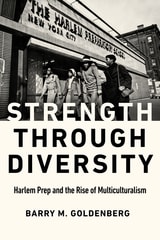
Strength through Diversity
Harlem Prep and the Rise of MulticulturalismBarry M. Goldenberg
Rutgers University Press, 2025
For nearly seven years, from 1967 to 1974, many hundreds of bright, college-going youth—most of whom had previously been labeled as high school “dropouts”—would proudly celebrate their graduation from Harlem Prep, a small educational experiment that grew to become a nationally renowned, cherished community institution in the iconic Black neighborhood of Harlem. Operating in a repurposed supermarket that used blackboards as classroom dividers, the school’s unique multicultural philosophy inspired all who stepped foot inside. This philosophy, exemplified by the school’s motto of “unity through diversity,” shaped the school’s ethos, fostered student achievement, and, most of all, made Harlem Prep distinct from any other educational institution, past or present. In Strength through Diversity, Barry M. Goldenberg shares the history of this one-of-a-kind multicultural institution from its rise to its apex and decline, revealing the collective stories of hope, struggle, and love from administrators, teachers, community members, and students. Using history as a blueprint, Goldenberg illustrates the untapped potential of multicultural education in the ongoing quest for educational equity.
strengththroughdiversity.com
strengththroughdiversity.com
[more]

Summers Off?
A History of U.S. Teachers' Other Three MonthsChristine A. Ogren
Rutgers University Press, 2026
Since the nine-month school year became common in the United States during the 1880s, schoolteachers have never really had summers off. Administrators instructed them to rest, as well as to study and travel, in the interest of creating a compliant workforce. Teachers, however, adapted administrators’ directives to pursue their own version of professionalization and to ensure their financial well-being. Summers Off explores teachers’ summer experiences between the 1880s and 1930s in institutes and association meetings; sessions at teachers colleges, Black colleges, and prestigious universities; work for wages or their family; tourism in the U.S. and Europe; and activities intended to be restful. This heretofore untold history reveals how teachers utilized the geographical and psychological distance from the classroom that summer provided, to enhance not only their teaching skills but also their professional and intellectual independence, their membership in the middle class, and, in the cases of women and Black teachers, their defiance of gender and race hierarchies.
[more]