Results by title
546 books match the query 'Semiotics & Theory' and 41 start with s
Saying I No More
Subjectivity and Consciousness in the Prose of Samuel BeckettDaniel Katz
Northwestern University Press, 1999
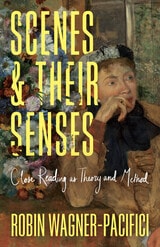
Scenes and Their Senses
Close Reading as Theory and MethodRobin Wagner-Pacifici
University of Chicago Press, 0
Makes the case for close readings of small scenes appearing in works of literature, scholarship, film, and visual art, showing how close attention to details can reveal the meaningful sociological action that often occurs on the margins.
Why do certain images, stories, and scenes impress upon us so strongly, inviting us to linger over the nuances of their meaning? In Scenes and Their Senses, sociologist Robin Wagner-Pacifici seeks to uncover the deeper meaning behind twenty “scenes” that have captured her theoretical imagination over her lifetime. Some of these come from classics of sociological theory or literature—Geertz, Habermas, Lévi-Strauss, Zola—and some are more contemporary, including the films Good Will Hunting and Luis Buñuel’s The Phantom ofLiberty. She seeks here to understand each scene less as examples of a given condition or conundrum and more as worlds in themselves.
As Wagner-Pacifici shows, close attention to the forms and flows of these minor, often quiet scenes reveals how meaningful action occurs in what might appear to be the margins or interstices of the bigger, noisier story being told. Providing an entry point to larger social conditions, relations, and change, the scenes analyzed here evoke sociological themes of belonging and exile, strength and weakness, cleanliness and pollution, reality and fantasy, courage and cowardice, and vision and obscurity, among others. As an ethnography of texts recalled from previous readings and revisited by the author, the scenes highlight the role of memory in sense-making. Furthermore, the activation of the scenes as a focused point of sustained contemplation functions as a remarkable bridge between method and theory.
Secondhand China
Spain, the East, and the Politics of TranslationCarles Prado-Fonts
Northwestern University Press, 2022
Uncovering an eclectic and surprising archive, Prado-Fonts draws on diverse cultural artifacts from popular literature, journalism, and early cinema to offer a rich account of how China was seen across the West between 1880 and 1930. Enrique Gaspar, Luis de Oteyza, Vicente Blasco Ibáñez, and lesser-known authors writing in Spanish and Catalan put themselves in dialogue with Leo Tolstoy, John Dewey, W. Somerset Maugham, Bertrand Russell, Pearl Buck, and André Malraux, as well as stereotypical figures from popular culture like Fu Manchu and Charlie Chan. Throughout, Prado-Fonts exposes translation as a technology of cultural hegemony and China as an appealing object for representation. A timely contribution to our understanding of how we create and consume knowledge about the world, Secondhand China is essential reading for scholars and students of Orientalism, postcolonial studies, translation studies, comparative literature, and cultural studies.
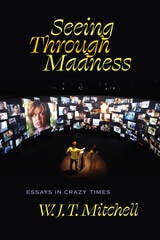
Seeing Through Madness
Essays in Crazy TimesW. J. T. Mitchell
University of Chicago Press, 2027
An insightful reconsideration of our historical moment seen through the lens of madness.
In Seeing Through Madness, W. J. T. Mitchell pursues the idea of “putting madness to work” by transforming it from an individual affliction—an illness to be treated—into a critical framework for understanding the human condition. The human species is now a danger to itself and others—the very definition of mental disorder in most societies. Therefore, it is time, Mitchell argues, for a fundamental reconsideration of madness, not only as a subject in media and the arts but more fundamentally as a “critical optic” on our historical moment. It is time to see through madness in all its variations, to see by means of it as a template for understanding, and to see it through to some form of wisdom.
While drawing a sense of urgency from Mitchell’s conviction that the whole world is experiencing a widespread political madness, the book specifically focuses on American psychoses and collective disorders, not least the country’s delusional exceptionalism.
Incisive, eclectic, and occasionally enraged, Mitchell’s essays are the guide we need to see us through crazy times.
Seeing to See
The Non-Teleological Poetics of Dickinson and ThoreauDaniel A. Nelson
University of Massachusetts Press, 2025
Seeing to See focuses on two American authors who are notoriously hard to classify: Emily Dickinson and Henry David Thoreau. Dickinson proves challenging due to her short and obscure poems and Thoreau due to his insistence on capturing even the most seemingly mundane information. Daniel A. Nelson uncovers evidence that the works of these authors are often intentionally and painstakingly without aim or purpose. He argues that in their texts there is in fact an avoidance of teleological structures of writing and thinking, whereby a thing’s—or a word’s, or a text’s—value hinges on its relation to the world or other contexts.
In Nelson’s reading, Thoreau and Dickinson seem to be able to set aside all thought of distinct personal and professional goals, through which readers typically try to make an overarching sense out of, and to derive some form of profit from, disparate experiences, events, actions, and feelings. Further, both authors seem to be able to get outside of the worldview according to which the value and meaning of something, be it a natural object, a word, or an experience, is a function of its participation in a larger system. Examples of such systems include an ecosystem, taxonomic system, or syntactic system; a writer’s career, or life, or philosophy; even a single poem or journal entry. In the absence of such connections to broader categorical spheres, both writers force readers to contemplate the ineffable, constantly changing relation between words and the natural world. This contemporary reading of two iconic writers reframes their work and how readers think of nature, accepting, as these authors did, the potential freedom of the unknown.
Seeming Human
Artificial Intelligence and Victorian Realist CharacterMegan Ward
The Ohio State University Press, 2018
In Seeming Human, Megan Ward contends that mid-twentieth-century versions of artificial intelligence (AI) offer a theory of verisimilitude omitted by traditional histories of character, which often focus on the development of interiority and the shift from “flat” to “round” characters in the Victorian era. Instead, by reading character through AI, Megan Ward’s Seeming Human argues that routinization, predictability, automation, and even flatness are all features of realist characters.
Early artificial intelligence movements such as cybernetics, information theory, and the Turing test define ways of seeming—rather than being—human. Using these theories of verisimilitude to read Victorian novelists such as Elizabeth Gaskell, Margaret Oliphant, Anthony Trollope, Thomas Hardy, and Henry James, Seeming Human argues that mechanicity has been perceived as anti-realist because it is the element that we least want to identify as human. Because AI produces human-like intelligence, it makes clear that we must actually turn to machines in order to understand what makes realist characters seem so human.
Selective Affinities
Literature and New Critical TheoryRita Felski
University of Chicago Press, 2026
Rita Felski’s new work brings literary studies into conversation with more affirmative and democratic forms of critical theory.
Literary critics associate the phrase “Frankfurt School” with early twentieth-century thinkers like Adorno or Benjamin, but contemporary German critical theory remains largely unknown. In this new book, Rita Felski draws on the work of a group of important philosophers and social theorists to offer fresh readings of literary texts by Robert Walser, Didier Eribon, Zadie Smith, Magda Szabo, John Williams, and Dionne Brand.
Through five key concepts derived from her reading of German theory—disclosure, recognition, self-realization, lifeworld, and resonance—Felski asks how these literary texts articulate the relationship between intellectuals and others. Contrary to critical theories that discount everyday experience, new German thought reveals the ethical, existential, and political richness of such experience. Through this framework, Felski shows that literature, theory, and experience are not opposed but mutually constitutive.
Sensory Experiments
Psychophysics, Race, and the Aesthetics of FeelingErica Fretwell
Duke University Press, 2020
Sentient Flesh
Thinking in Disorder, Poiesis in BlackR. A. Judy
Duke University Press, 2020
Sex, or the Unbearable
Lauren Berlant and Lee Edelman
Duke University Press, 2014
Through virtuoso interpretations of works of cinema, photography, critical theory, and literature, including Lydia Davis's story "Break It Down" (reprinted in full here), Berlant and Edelman explore what it means to live with negativity, with those divisions that may be irreparable. Together, they consider how such negativity affects politics, theory, and intimately felt encounters. But where their critical approaches differ, neither hesitates to voice disagreement. Their very discussion—punctuated with moments of frustration, misconstruction, anxiety, aggression, recognition, exhilaration, and inspiration—enacts both the difficulty and the potential of encounter, the subject of this unusual exchange between two eminent critics and close friends.
Sexual Hegemony
Statecraft, Sodomy, and Capital in the Rise of the World SystemChristopher Chitty
Duke University Press, 2020
Sexuality and Form
Caravaggio, Marlowe, and BaconGraham Hammill
University of Chicago Press, 2000
Sexuality, Disability, and Aging
Queer Temporalities of the PhallusJane Gallop
Duke University Press, 2019
Shadows of the Enlightenment
Tragic Drama during Europe’s Age of ReasonEdited by Blair Hoxby
The Ohio State University Press, 2022
Shakespeare and Contemporary Fiction
Theorizing Foundling and Lyric PlotsBarbara L. Estrin
University of Delaware Press, 2012
In the first book to use fiction as theory, Barbara L. Estrin reverses chronological direction, beginning with contemporary novels to arrive at a re-visioned Shakespeare, uncovering a telling difference in the stories that script us and that influence our political unconscious in ways that have never been explored in literary-critical interpretations. Describing the animus against foreign blood, central to the dynamic of the foundling and lyric plots that form the nexus of her study, Estrin describes how late modern writers change those plots. Reading backward through the theoretical lens of their revisions allows us to rethink the Shakespeare we thought we knew. That innovative methodology, in turn, encourages us to read forward again with different tellings, ones that challenge the mythological homogeneity of the traditional classifications and that suggest new formulaic paradigms.
With close readings of four contemporary novels and three Shakespeare plays, Estrin identifies the cultural walls that contribute to political gate-keeping as she chronicles the connection between plot variations and gender revisionism in the work of Caryl Phillips, Liz Jensen, Anne Michaels, and W.G. Sebald, as well as two film-makers (Mona Hatoum and Mieke Bal) who demonstrate an understanding that mythical repercussions prove dangerous in the twentieth and twenty-first centuries even as they suggest how the heritage shaping their work, and to which they are themselves drawn, in turn proposes an alternative Shakespeare, one who frees us to ask other questions: At the time that the nation state was beginning to coalesce, what does Shakespeare’s frequent use of the foundling plot and his significant variations portend? How does his infusion of a revised lyric dynamic in The Merchant of Venice, Othello and The Winter’s Tale change our reading of plays where the two plots coalesce as they do in the contemporary novels that shape Estrin’s late modern interpretations? All the works in this study share the underlying premise that the connection between cultural origins and political destinies is reciprocal and that it is necessary and possible to transform the constructs—in memory and imagination—that continue to shape our lives.
Published by University of Delaware Press. Distributed worldwide by Rutgers University Press.
Shaming into Brown
Somatic Transactions of Race in Latina/o LiteratureStephanie Fetta
The Ohio State University Press, 2018
In Shaming into Brown: Somatic Transactions of Race in Latina/o Literature, Stephanie Fetta asserts that our bodies are fundamental to how we live and how we make meaning. Anchored by two psychoanalytic theories, bioenergetic analysis developed by Alexander Lowen and affect theory put forth by Silvan Tomkins, Fetta examines Latinx fiction to draw attention to the cultural role of the intelligent, emotional, and communicative body—the soma—in relation to shame. She argues that we bring the soma—the physical, emotive, and social register of our subjectivity—to the text as we do to our lives,proposing that the power of racialization operates at the level of somatic expression and reception through habituated, socially cued behaviors that are not readily subject to intentional control.
Fetta examines shame beyond individual experiences, looking at literary renderings of the cultural practice of racial shaming that are deeply embedded into our laws, hiring practices, marketing strategies, and more. Grounding her analysis in the works of Gloria Anzaldúa and Cherríe Moraga, Shaming into Brown focuses on exposing the underpinnings of racialized shame and does so through analyzing “scenes of racialization” in prominent works by authors such as Junot Díaz, Sandra Cisneros, and Oscar Zeta Acosta.
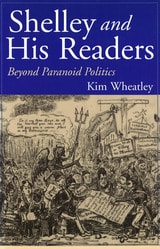
Shelley and His Readers
Beyond Paranoid PoliticsKim Wheatley
University of Missouri Press, 1999
In Shelley and His Readers, the first full-length critical analysis of the dialogue between Shelley's poetry and its contemporary reviewers, Kim Wheatley argues that Shelley's idealism can be recovered through the study of his poetry's reception. Incorporating extensive research in major early-nineteenth-century British periodicals, Wheatley integrates a reception-based methodology with careful textual analysis to demonstrate that the early reception of Shelley's work registers the immediate impact of the poet's increasingly idealistic passion for reforming the world.
Wheatley examines Shelley's poetry within the context of Romantic-era "paranoid politics," a simultaneously empowering and disabling dynamic in which the reviewers employ a heightened language of defensiveness and persecution that paints their adversaries as Satanic rebels against orthodoxy. This "paranoid style" displays a preoccupation with the efficacy of the printed word and singles out radical writers such as Shelley as sources of social contamination.
Using Shelley's Queen Mab to illustrate his early radicalism, Wheatley demonstrates that the poet, like his contemporary reviewers, is caught up in paranoid rhetoric. Failing to challenge the assumptions underlying the paranoid style-conspiracy and contagion-in this poem Shelley takes merely a defiant, oppositional stance. However, Shelley's later poems, exemplified by Prometheus Unbound and Adonais, circumvent the reviewers' rhetoric through their boldly experimental language, a process registered by the reviewers' own responses. These less explicitly political poems transcend the dynamics of cultural paranoia by shifting to an apolitical conception of the aesthetic. In collaboration with its early readers, Shelley's poetry thus moves momentarily beyond paranoid politics.
The final chapter of this study argues that the posthumous reception of Adonais uniquely replicates the elegiac moves and complex idealism of the poem, concluding with a discussion of how the Shelley circle aestheticized the poet after his death.
Shelley and His Readers offers a new approach to the question of how to recuperate Romantic idealism in the face of challenges from both deconstructive and historicist criticism. Its innovative use of reception-based analysis will make this book invaluable not only to specialists of the Romantic period but also to anyone interested in new developments in literary criticism.
Short Story Theories
Charles E. May
Ohio University Press, 1977
The essays range from discussions by Poe to comments by John Cheever. Frank O’Connor describes the short story as depicting “an intense awareness of human loneliness,” and Nadine Gordimer suggests that the story is more suitable than the novel in rendering the fragmentary modern experience. Eudora Welty sees the story as something “wrapped in an atmosphere” of its own; Randall Jarrell speaks of the mythic basis of the genre. Elizabeth Bowen and Alberto Moravia discuss thematic and structural distinctions between the novel and the story.
The collection also includes discussions of various types of stories, as satiric and lyric, critical surveys of the development of the modern short story, and the status of the form at the present time. An excellent annotated bibliography is also included, which describes 135 books and articles on the short story, evaluating their contribution to a unified theory of the form.
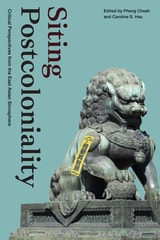
Siting Postcoloniality
Critical Perspectives from the East Asian SinospherePheng Cheah and Caroline Hau, editors
Duke University Press, 2023
Contributors. Pheng Cheah, Dai Jinhua, Caroline S. Hau, Elaine Yee Lin Ho, Wendy Larson, Liao Ping-hui, Lin Pei-yin, Lo Kwai-Cheung, Lui Tai-lok, Pang Laikwan, Lisa Rofel, David Der-wei Wang, Erebus Wong, Robert J. C. Young
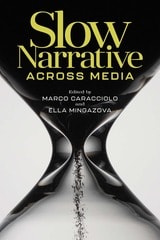
Slow Narrative across Media
Edited by Marco Caracciolo and Ella Mingazova
The Ohio State University Press, 2024
Slowness is frequently seen as a response to modernity’s cult of speed and efficiency, and its influence in contemporary culture can be felt in artistic trends such as “slow cinema” or “slow TV.” Despite the popularity of these labels, however, slowness remains undertheorized in contemporary narrative scholarship. What makes a narrative slow, and what conceptual and analytical tools are best suited to account for this slowness? Is slowness a feature of certain narratives, an experiential response to these narratives, or both? How is narrative slowness related to the pace and rhythm of plot, and how does it carry cultural significance?
Slow Narrative across Media illuminates the concept of slow narrative and demonstrates how it manifests across media forms: from short stories to novel cycles, to comics, to music, to experimental film. Led by editors Marco Caracciolo and Ella Mingazova, contributors draw on cognitive and rhetorical approaches to narrative as well as on econarratology to bring into focus both the media-specific ways in which narrative evokes slowness and the usefulness of a transmedial approach to this phenomenon.
Contributors:
Jan Baetens, Raphaël Baroni, Lars Bernaerts, Marco Caracciolo, Karin Kukkonen, Ella Mingazova, Peggy Phelan, Greice Schneider, Roy Sommer, Carolien Van Nerom, Gary Weissman
So Much Wasted
Hunger, Performance, and the Morbidity of ResistancePatrick Anderson
Duke University Press, 2010
Social Semiotics As Praxis
Text, Social Meaning Making, and Nabokov’s AdaPaul J. Thibault
University of Minnesota Press, 1991
In Social Semiotics as Praxis, Paul J. Thibault rescues semiotics from terminal formalism by recognizing that the object of a semiotic inquiry is necessarily the way in which human beings, individually and collectively, make sense of their lives. Focusing on Vladimir Nabokov’s Ada, he develops a conception of social semiotics that is a form of both social action and political praxis.
Thibault’s principal intellectual sources are, among others, Bakhtin, Volosinov, Derrida, Foucault, Gramsci, Habermas, and Halliday. Thibault combines the work of Halliday in particular with is own theories of semiotics to explore the dynamics of quoting and reporting speech and to develop a critique of the categories of “self” and “representation.” Thibault accounts for the meaningful relationships constructed among texts and elaborates on the two main themes of relational levels in texts and the dynamics of contextualization to give voice to a unifying discourse for talking about social meaning making.
Soft Matter
The Poetics of Weakness in Late Soviet SocialismJulia Vaingurt
Northwestern University Press, 2025
Identifies and examines a poetics of weakness in Soviet underground literature
Artists of the late Soviet era sought new, nonconformist ways of approaching literary fiction, arriving at weakness as a crucial principle of narrative and character formation. Julia Vaingurt argues that this counter-discourse of strategic weakness constituted both an aesthetic strategy and an ethical code, affording like-minded authors a feeling of recognition and commonality and uniting an international community of artists in resistance to the divisiveness of their worlds. Soft Matter: The Poetics of Weakness in Late Soviet Socialism explores the cultivation of weak subjectivity through modes such as gender subversion, queer holy foolishness, intoxication, madness, and writing disorders like graphomania and writer’s block. Identifying the poetics of weakness as formative for Soviet underground literature of the 1960s and ’70s, Vaingurt also traces the inheritance of a far older tradition within Russian culture of salutary weakness. As democratic deliberation continues to be under threat around the world, alternatives to the ubiquitous politics of force are an aesthetic, ethical, and ideological imperative.
Something Speaks to Me
Where Criticism BeginsMichel Chaouli
University of Chicago Press, 2024
Criticism begins when we put down a book to tell someone about it. It is what we do when we face a work or event that bowls us over and makes us scramble for a response. As Michel Chaouli argues, criticism involves three moments: Something speaks to me. I must tell you about it. But I don’t know how. The heart of criticism, no matter its form, lies in these surges of thoughts and feelings. Criticism arises from the fundamental need to share what overwhelms us.
We tend to associate criticism with scholarship and journalism. But Chaouli is not describing professional criticism, but what he calls “poetic criticism”—a staging ground for surprise, dread, delight, comprehension, and incomprehension. Written in the mode of a philosophical essay, Something Speaks to Me draws on a wide range of writers, artists, and thinkers, from Kant and Schlegel to Merleau-Ponty, Bachelard, Barthes, and Cavell. Reflecting on these dimensions of poetic experience, Something Speaks to Me is less concerned with joining academic debates than communicating the urgency of criticism.
Sound Objects
James A. Steintrager and Rey Chow, editors
Duke University Press, 2019
Contributors. Georgina Born, Michael Bull, Michel Chion, Rey Chow, John Dack, Veit Erlmann, Brian Kane, Jairo Moreno, John Mowitt, Pooja Rangan, Gavin Steingo, James A. Steintrager, Jonathan Sterne, David Toop
Specters of the Atlantic
Finance Capital, Slavery, and the Philosophy of HistoryIan Baucom
Duke University Press, 2005
Baucom contends that the massacre and the trials that followed it bring to light an Atlantic cycle of capital accumulation based on speculative finance, an economic cycle that has not yet run its course. The extraordinarily abstract nature of today’s finance capital is the late-eighteenth-century system intensified. Yet, as Baucom highlights, since the late 1700s, this rapacious speculative culture has had detractors. He traces the emergence and development of a counter-discourse he calls melancholy realism through abolitionist and human-rights texts, British romantic poetry, Scottish moral philosophy, and the work of late-twentieth-century literary theorists. In revealing how the Zong tragedy resonates within contemporary financial systems and human-rights discourses, Baucom puts forth a deeply compelling, utterly original theory of history: one that insists that an eighteenth-century atrocity is not past but present within the future we now inhabit.
Speculative Formalism
Literature, Theory, and the Critical PresentTom Eyers
Northwestern University Press, 2017
Through a combination of philosophical reflection and close rhetorical readings, Eyers explores the possibilities and limits of deconstructive approaches to the literary, the impact of the “digital humanities” on theory, and the prospects for a formalist approach to “world literature.” The book includes sustained close readings of Baudelaire, Mallarmé, Yeats, and Wallace Stevens, as well as Alain Badiou, Paul de Man, and Fredric Jameson.
Speech Begins after Death
Michel Foucault
University of Minnesota Press, 2016
In 1968, Michel Foucault agreed to a series of interviews with critic Claude Bonnefoy, which were to be published in book form. Bonnefoy wanted a dialogue with Foucault about his relationship to writing rather than about the content of his books. The project was abandoned, but a transcript of the initial interview survived and is now being published for the first time in English. In this brief and lively exchange, Foucault reflects on how he approached the written word throughout his life, from his school days to his discovery of the pleasure of writing.
Wide ranging, characteristically insightful, and unexpectedly autobiographical, the discussion is revelatory of Foucault’s intellectual development, his aims as a writer, his clinical methodology (“let’s say I’m a diagnostician”), and his interest in other authors, including Raymond Roussel and Antonin Artaud. Foucault discloses, in ways he never had previously, details about his home life, his family history, and the profound sense of obligation he feels to the act of writing. In his Introduction, Philippe Artières investigates Foucault’s engagement in various forms of oral discourse—lectures, speeches, debates, press conferences, and interviews—and their place in his work.
Speech Begins after Death shows Foucault adopting a new language, an innovative autobiographical communication that is neither conversation nor monologue, and is one of his most personal statements about his life and writing.
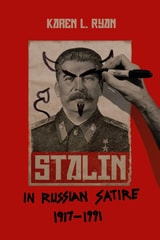
Stalin in Russian Satire, 1917–1991
Karen L. Ryan
University of Wisconsin Press, 2009
Examining works from the 1917 Revolution to the fall of the Soviet Union in 1991, Karen L. Ryan reveals how satirical treatments of Stalin often emphasize his otherness, distancing him from Russian culture. Some satirists portray Stalin as a madman. Others show him as feminized, animal-like, monstrous, or diabolical. Stalin has also appeared as the unquiet dead, a spirit that keeps returning to haunt the collective memory of the nation. While many writers seem anxious to exorcise Stalin from the body politic, for others he illuminates the self in disturbing ways. To what degree Stalin was and is “in us” is a central question of all these works. Although less visible than public trials, policy shifts, or statements of apology, Russian satire has subtly yet insistently participated in the protracted process of de-Stalinization.
Stanley Cavell and Literary Skepticism
Michael Fischer
University of Chicago Press, 1989
Throughout his study, Fischer focuses on skepticism, a central concern of Cavell's multifaceted work. Cavell, following J. L. Austin and Wittgenstein, does not refute the radical epistemological questioning of Descartes, Hume, and others, but rather characterizes skepticism as a significant human possibility or temptation. As presented by Fischer, Cavell's accounts of both external-world and other-minds skepticism share significant affinities with deconstruction, a connection overlooked by contemporary literary theorists.
Fischer follows Cavell's lead in examining how different genres address the problems raised by skepticism and goes on to show how Cavell draws on American and English romanticism in fashioning a response to it. He concludes by analyzing Cavell's remarks about current critical theory, focusing on Cavell's uneasiness with some of the conclusions reached by its practitioners. Fischer shows that Cavell's insights, grounded in powerful analyses of Descartes, Hume, and Wittgenstein, permit a fresh view of Derrida, Miller, de Man, and Fish. The result is not only a revealing characterization of deconstruction but a much-needed and insightful introduction to Cavell's rich but difficult oeuvre.
Statistical Panic
Cultural Politics and Poetics of the EmotionsKathleen Woodward
Duke University Press, 2009
Referring discreetly to her own experience, Woodward examines the interpenetration of social structures and subjectivity, considering how psychological emotions are social phenomena, with feminist anger, racial shame, old-age depression, and sympathy for non-human cyborgs (including robots) as key cases in point. She discusses how emerging institutional and discursive structures engender “new” affects that in turn can help us understand our changing world if we are attentive to them—the “statistical panic” produced by the risk society, with its numerical portents of disease and mortality; the rage prompted by impenetrable and bloated bureaucracies; the brutal shame experienced by those caught in the crossfire of the media; and the conservative compassion that is not an emotion at all, only an empty political slogan.
The orbit of Statistical Panic is wide, drawing in feminist theory, critical phenomenology, and recent theories of the emotions. But at its heart are stories. As an antidote to the vacuous dramas of media culture, with its mock emotions and scattershot sensations, Woodward turns to the autobiographical narrative. Stories of illness—by Joan Didion, Yvonne Rainer, Paul Monette, and Alice Wexler, among others—receive special attention, with the inexhaustible emotion of grief framing the book as a whole.

Stolen Life
Fred Moten
Duke University Press, 2018
In Stolen Life—the second volume in his landmark trilogy consent not to be a single being—Fred Moten undertakes an expansive exploration of blackness as it relates to black life and the collective refusal of social death. The essays resist categorization, moving from Moten's opening meditation on Kant, Olaudah Equiano, and the conditions of black thought through discussions of academic freedom, writing and pedagogy, non-neurotypicality, and uncritical notions of freedom. Moten also models black study as a form of social life through an engagement with Fanon, Hartman, and Spillers and plumbs the distinction between blackness and black people in readings of Du Bois and Nahum Chandler. The force and creativity of Moten's criticism resonate throughout, reminding us not only of his importance as a thinker, but of the continued necessity of interrogating blackness as a form of sociality.

Stone
An Ecology of the InhumanJeffrey Jerome Cohen
University of Minnesota Press, 2015
Stone maps the force, vivacity, and stories within our most mundane matter, stone. For too long stone has served as an unexamined metaphor for the “really real”: blunt factuality, nature’s curt rebuke. Yet, medieval writers knew that stones drop with fire from the sky, emerge through the subterranean lovemaking of the elements, tumble along riverbeds from Eden, partner with the masons who build worlds with them. Such motion suggests an ecological enmeshment and an almost creaturely mineral life.
Although geological time can leave us reeling, Jeffrey Jerome Cohen argues that stone’s endurance is also an invitation to apprehend the world in other than human terms. Never truly inert, stone poses a profound challenge to modernity’s disenchantments. Its agency undermines the human desire to be separate from the environment, a bifurcation that renders nature “out there,” a mere resource for recreation, consumption, and exploitation.
Written with great verve and elegance, this pioneering work is notable not only for interweaving the medieval and the modern but also as a major contribution to ecotheory. Comprising chapters organized by concept —“Geophilia,” “Time,” “Force,” and “Soul”—Cohen seamlessly brings together a wide range of topics including stone’s potential to transport humans into nonanthropocentric scales of place and time, the “petrification” of certain cultures, the messages fossils bear, the architecture of Bordeaux and Montparnasse, Yucca Mountain and nuclear waste disposal, the ability of stone to communicate across millennia in structures like Stonehenge, and debates over whether stones reproduce and have souls.
Showing that what is often assumed to be the most lifeless of substances is, in its own time, restless and forever in motion, Stone fittingly concludes by taking us to Iceland⎯a land that, writes the author, “reminds us that stone like water is alive, that stone like water is transient.”

Strange Gourmets
Sophistication, Theory, and the NovelJoseph Litvak
Duke University Press, 1997
Though commonly thought of as a kind of worldliness at its best and an elitist snobbery at its worst, sophistication, Litvak reminds us, remains tied to its earlier, if forgotten, meaning of "perversion"—a perversion whose avatars are the homosexual and the intellectual. Proceeding with his investigations from a specifically gay academic perspective, Litvak presents thoroughly inventive readings of novels by Austen, Thackeray, and Proust, and of theoretical works by Adorno and Barthes, each text epitomizing sophistication in one of its more familiar modes. Among the issues he explores are the ways in which these texts teach sophistication, the embarrassment that sophistication causes the sophisticated, and how the class politics of sophistication are inseparable from its sexual politics. Helping gay, queer, feminist, and other provocative critics to make the most of their bad publicity, Litvak mindfully celebrates sophistication’s economy of taste and pleasure.
Strung Together
The Cultural Currency of String Theory as a Scientific ImaginarySean Miller
University of Michigan Press, 2013
In Strung Together: The Cultural Currency of String Theory as a Scientific Imaginary, Sean Miller examines the cultural currency of string theory, both as part of scientific discourse and beyond it. He demonstrates that the imaginative component of string theory is both integral and indispensable to it as a scientific discourse. While mathematical arguments provide precise prompts for physical intervention in the world, the imaginary that supplements mathematical argument within string theory technical discourse allows theorists to imagine themselves interacting with the cosmos as an abstract space in such a way that strings and branes as phenomena become substantiated and legitimized. And it is precisely this sort of imaginary—which Miller calls a scientific imaginary—duly substantiated and acculturated, that survives the move from string theory technical discourse to popularizations and ultimately to popular and literary discourses. In effect, a string theory imaginary legitimizes the science itself and helps to facilitate a virtual domestication of a cosmos that was heretofore remote, alien, and incomprehensible.
Study Without Ends
Aesthetic Education in Neoliberal Latin AmericaD. Bret Leraul
Northwestern University Press, 2026
Calls for aesthetic education to unite cultural practices of radical imagination with everyday practices of care
While Latin America was neoliberalism’s laboratory, Argentina and Chile have been crucibles for its cultural logics. In this book, D. Bret Leraul examines the rise of neoliberal culture in the Southern Cone through the educational infrastructures that disseminate and reproduce it. Leraul draws on literature and criticism, the history of higher education, and examples of recent social movements to propose a theory of cultural production for social transformation.
Study Without Ends charts the cultural consequences of introducing a neoliberal rationality into the region’s higher education landscape. The university’s increasing centrality within the literary institution and the rise of theoretical prose fiction suggest that poetics today is less about crafting literary works than instructing readers. At the same time, despite efforts to reduce education to human capital investment, it remains a process of personal and social transformation, as recent activism by Chilean students and Argentinean unemployed workers shows. In response to the compounding crises of social reproduction represented by the informal work and precarious livelihoods of people rendered surplus populations, and inspired by the decommodified labor of students, artists, women, and the unemployed, Leraul calls for a materialist aesthetic education that unites artistic culture’s practices of radical imagination and everyday culture’s practices of care.
Substrate
The Poetics of Paper and the Textility of LiteratureCraig Dworkin
University of Chicago Press, 0
A study of the signifying potential of paper, the foundational material for literary texts in the modern era.
For ease of reading, the paper of a printed page must recede far enough into the background to make ink legible. Yet paper—the primary substrate for literary texts—has its own signifying potential, its own poetics. Craig Dworkin shows that looking at the page, rather than through its illusory withdrawal, can unlock interpretive insights that readers would otherwise miss. What often seems incidental can prove to be as semantically important as the words of the text themselves.
Substrate argues that the material affordances of paper in general—its pliability, fibrous weave, and capacity to fold, tear, crumple, and shuffle—variously inform the poetics of William Blake, Stéphane Mallarmé, Jen Bervin, and Susan Howe. For all four of these poets, the qualities of paper serve as models for structuring the language of their poems in innovative ways. Dworkin further shows how each poet in turn engages paper at another level by incorporating it within the thematic ambit of key poems. The full meaning of these poems is thus inextricable from their printing. Substrate is a brilliant inquiry in poetics and the logic of media more generally.
Summa Technologiae
Stanislaw Lem
University of Minnesota Press, 2014
The Polish writer Stanislaw Lem is best known to English-speaking readers as the author of the 1961 science fiction novel Solaris, adapted into a meditative film by Andrei Tarkovsky in 1972 and remade in 2002 by Steven Soderbergh. Throughout his writings, comprising dozens of science fiction novels and short stories, Lem offered deeply philosophical and bitingly satirical reflections on the limitations of both science and humanity.
In Summa Technologiae—his major work of nonfiction, first published in 1964 and now available in English for the first time—Lem produced an engaging and caustically logical philosophical treatise about human and nonhuman life in its past, present, and future forms. After five decades Summa Technologiae has lost none of its intellectual or critical significance. Indeed, many of Lem’s conjectures about future technologies have now come true: from artificial intelligence, bionics, and nanotechnology to the dangers of information overload, the concept underlying Internet search engines, and the idea of virtual reality. More important for its continued relevance, however, is Lem’s rigorous investigation into the parallel development of biological and technical evolution and his conclusion that technology will outlive humanity.
Preceding Richard Dawkins’s understanding of evolution as a blind watchmaker by more than two decades, Lem posits evolution as opportunistic, shortsighted, extravagant, and illogical. Strikingly original and still timely, Summa Technologiae resonates with a wide range of contemporary debates about information and new media, the life sciences, and the emerging relationship between technology and humanity.
Surprised by Shame
Dostoevsky's Liars and Narrative ExposureDeborah A. Martinsen
The Ohio State University Press, 2003
In Surprised by Shame, Deborah A. Martinsen combines shame studies and literary criticism. She begins with a discussion of shame dynamics, including the tendency of those who witness shame to feel shame themselves. Because Dostoevsky identified shame as a fundamental source of lying, Martinsen focuses on scenes when liars are exposed. She argues that by making readers witness such scandal scenes, Dostoevsky surprises them with shame, thereby collapsing the distance between readers and characters and viscerally involving them in his message of human interconnection.
Treating Dostoevsky’s liars as case studies, Surprised by Shame discusses varieties of shame and shamelessness; it also illustrates how Dostoevsky uses lying to indicate and expose subconscious processes. In addition, Martinsen demonstrates how Dostoevsky plucks shame from the realm of character trait and plot motive and embeds it in the narrative dynamics of The Idiot, Demons, and The Brothers Karamazov, thereby plunging readers into fictional experience and ethically transforming them.
By focusing on shame, this book uncovers new perspectives on Dostoevsky as writer and psychologist. By exposing how shame dynamics implicate readers in texts’ ethical actions, it enriches understanding of his tremendous influence on twentieth-century thinkers and writers. Finally, reading Dostoevsky as a prophet of shame-begotten violence reveals his universal relevance in a twenty-first century already scarred by acts of violence.
Suture and Narrative
Deep Intersubjectivity in Fiction and FilmGeorge Butte
The Ohio State University Press, 2017
Suture and Narrative: Deep Intersubjectivity in Fiction and Film by George Butte offers a new phenomenological understanding of how fiction and film narratives use particular techniques to create and represent the experience of community. Butte turns to the concept of suture from Lacanian film theory and to the work of Merleau-Ponty to contribute a deeper and broader approach to intersubjectivity for the field of narrative theory.
Butte’s approach allows for narratives that represent insight as well as blindness, love, and loss, locating these connections and disconnections in narratological techniques that capture the crisscrossing of perspectives, such as those in fiction’s free indirect discourse and in the oblique angle of film’s shot/reverse shot convention. Butte studies the implications of this chiasmus in the novels and film adaptations of later Henry James works, Barrie’s Peter Pan tales and film adaptations, and the films Silence of the Lambsand Nothing But a Man. Suture’s story in the twentieth century, according to Butte, is a story of the loss of immediacy and community. Yet in concluding this, Butte finds optimism in the Coen brothers’ Raising Arizona as well as in Why Be Happy When You Could Be Normal? by Jeanette Winterson and Marc Webb’s film (500) Days of Summer.
Sylvia Wynter
On Being Human as PraxisKatherine McKittrick, ed.
Duke University Press, 2015