322 books match the query 'Social Policy' and 26 start with s

cover of Seaway to the Future: American Social Visions and the Construction of the Panama Canal

Seaway to the Future

American Social Visions and the Construction of the Panama Canal

Alexander Missal

University of Wisconsin Press, 2008

Realizing the century-old dream of a passage to India, the building of the Panama Canal was an engineering feat of colossal dimensions, a construction site filled not only with mud and water but with interpretations, meanings, and social visions. Alexander Missal’s Seaway to the Future unfolds a cultural history of the Panama Canal project, revealed in the texts and images of the era’s policymakers and commentators. Observing its creation, journalists, travel writers, and officials interpreted the Canal and its environs as a perfect society under an efficient, authoritarian management featuring innovations in technology, work, health, and consumption. For their middle-class audience in the United States, the writers depicted a foreign yet familiar place, a showcase for the future—images reinforced in the exhibits of the 1915 Panama-Pacific International Exposition that celebrated the Canal’s completion. Through these depictions, the building of the Panama Canal became a powerful symbol in a broader search for order as Americans looked to the modern age with both anxiety and anticipation.
            Like most utopian visions, this one aspired to perfection at the price of exclusion. Overlooking the West Indian laborers who built the Canal, its admirers praised the white elite that supervised and administered it. Inspired by the masculine ideal personified by President Theodore Roosevelt, writers depicted the Canal Zone as an emphatically male enterprise and Chief Engineer George W. Goethals as the emblem of a new type of social leader, the engineer-soldier, the benevolent despot. Examining these and other images of the Panama Canal project, Seaway to the Future shows how they reflected popular attitudes toward an evolving modern world and, no less important, helped shape those perceptions.

Best Books for Regional Special Interests, selected by the American Association of School Librarians, and Best Books for General Audiences, selected by the Public Library Association

“Provide[s] a useful vantage on the world bequeathed to us by the forces that set out to put America astride the globe nearly a century ago.”—Chris Rasmussen, Bookforum
[more]
cover of Sentencing without Guidelines

Sentencing without Guidelines

Rhys Hester

Temple University Press, 2024

Sentencing matters. Reform initiatives hope to impart more uniformity and fairness in sentencing. Tough-on-crime laws like “three strikes” and mandatory minimum provisions deprive judges of sentencing discretion. While sentencing guidelines have been adopted by approximately 20 states since the early 1980s, many judges operate without guidelines.

Sentencing without Guidelines is Rhys Hester’s deep dive into how South Carolina, which never passed sentencing guideline legislation, nonetheless created meaningful punishment reform. It achieved uniformity in sentencing with a traveling circuit of judges, informal norms among judges, and the unique phenomenon of the “Plea Judge” to manage cases.

Hester examines how prior convictions, race, and geographical differences impact sentences to explain why individuals get the criminal sentences they do. He also explores how legal reform mechanisms can influence punishment goals and policy. Sentencing without Guidelines shows the benefits and drawbacks South Carolina experienced as it met sentencing reform goals. These lessons can be translated into policy for other jurisdictions.
[more]
cover of Separate Societies

Separate Societies

William Goldsmith

Temple University Press, 1992
Paul Davidoff Award, Association of Collegiate Schools of Planning, 1993 "A passionately argued, provocative book that takes us back to the long neglected emphasis on the cities that was so distinctive a part of the original War On Poverty. But now, at issue is the city of the 21st century." --Eugene Smolensky "Economic and political forces no longer combat poverty--they generate poverty!" exclaim William Goldsmith and Edward Blakely in their report on the plight of American's urban poor. Focusing on the reality of separation--social segmentation, economic inequality, and geographic isolation--the authors examine the presence and persistence of urban poverty, the transformation of national industry into a global economy, and the dilemmas of local reform. Goldsmith and Blakely document the appalling conditions of poor and minority people in central cities, examining those conditions in relation to inequalities in the national distributions of income and wealth. They analyze the connections between the structure and movement of the new global economy and the problems of the poorest Americans. They demonstrate how globalized markets and production arrangements have worsened the opportunities facing most American cities and workers. Noting that neither economic growth nor public subsidy has solved the problems of the poor, Goldsmith and Blakely propose that the very separation that exacerbates poverty be used to motive restructure. The authors maintain that when those in power locally respond to the pressure exerted by those suffering from inequality and isolation, community-level institutions will be restructured. These multi-local coalitions of small businesses and neighborhood organizations need to press for reallocation of federal resources in favor of domestic needs and redirection of the national economic favor of workers and common citizens. "This is a major work that will influence debate on the issue of American urban poverty into the next century. The authors argue that the recent upsurge in urban poverty has been generated by a particular set of American political responses to changes in the international and national economies, exacerbated by a long process of federally subsidized suburbanization and by racial discrimination. The difference [from Wilson's the Truly Disadvantaged] is that Goldsmith and Blakely's policy recommendations are more comprehensive and have a greater focus on strategies 'from the bottom up.'" --Joe T. Darden, Dean of Urban Affairs Programs, Michigan State University "Goldsmith and Blakely present a vivid, factually accurate account of the post-1970s rise in inequality, underemployment, poverty, and collapsing societal infrastructures. Having outlined the dimensions of national disaster, they do not give up hope. Rather, they advocate the improved industrial policy, expanded opportunity for education, and increased family support.... Their provocative optimism, although guarded, is a refreshing challenge, much needed in this period of pessimism and cynicism." --Robin M. Williams, Jr., Henry Scarborough Professor of Social Science, Emeritus, Cornell University
[more]
cover of Separate Societies: Poverty and Inequality in U.S. Cities

Separate Societies

Poverty and Inequality in U.S. Cities

Authored by William W. Goldsmith and Edward J. Blakely with a foreword by President Bill Clinton

Temple University Press, 2010

“Economic and political forces no longer combat poverty—they generate poverty!" exclaim William Goldsmith and Edward Blakely in their report on the plight of American's urban poor. In this revised and updated edition of their 1992 book Separate Societies,the authors present a compelling examination of the damaging divisions that isolate poor city minority residents from the middle-class suburban majority. They pay special attention to how the needs of the permanently poor have been unmet through the alternating years of promises and neglect, and propose a progressive turn away from 30 years of conservative policies.

Separate Societies vividly documents how the urban working class has been pushed out of industrial jobs through global economic restructuring, and how the Wall Street meltdown has aggravated underemployment, depleted public services, and sharpened racial and class inequalities.

The authors insist that the current U.S. approach puts Americans out of work and lowers the standard of living for all. As such, Goldsmith and Blakely urge the Obama administration to create better urban policy and foster better metropolitan management to effectively and efficiently promote equality.
[more]
cover of Skepticism and Freedom: A Modern Case for Classical Liberalism

Skepticism and Freedom

A Modern Case for Classical Liberalism

Richard A. Epstein

University of Chicago Press, 2003

With this book, Richard A. Epstein provides a spirited and systematic defense of classical liberalism against the critiques mounted against it over the past thirty years. One of the most distinguished and provocative legal scholars writing today, Epstein here explains his controversial ideas in what will quickly come to be considered one of his cornerstone works.

He begins by laying out his own vision of the key principles of classical liberalism: respect for the autonomy of the individual, a strong system of private property rights, the voluntary exchange of labor and possessions, and prohibitions against force or fraud. Nonetheless, he not only recognizes but insists that state coercion is crucial to safeguarding these principles of private ordering and supplying the social infrastructure on which they depend. Within this framework, Epstein then shows why limited government is much to be preferred over the modern interventionist welfare state.

Many of the modern attacks on the classical liberal system seek to undermine the moral, conceptual, cognitive, and psychological foundations on which it rests. Epstein rises to this challenge by carefully rebutting each of these objections in turn. For instance, Epstein demonstrates how our inability to judge the preferences of others means we should respect their liberty of choice regarding their own lives. And he points out the flaws in behavioral economic arguments which, overlooking strong evolutionary pressures, claim that individual preferences are unstable and that people are unable to adopt rational means to achieve their own ends. Freedom, Epstein ultimately shows, depends upon a skepticism that rightly shuns making judgments about what is best for individuals, but that also avoids the relativistic trap that all judgments about our political institutions have equal worth.

A brilliant defense of classical liberalism, Skepticism and Freedom will rightly be seen as an intellectual landmark.
[more]
cover of Skin Color, Power, and Politics in America

Skin Color, Power, and Politics in America

Mara Cecilia Ostfeld

Russell Sage Foundation, 2022

A person’s skin color affects their life experiences including income, educational attainment, health outcomes, exposure to discrimination, interactions with the criminal justice system and one’s sense of ethnoracial group belonging. But, do these disparate experiences affect the relationship between skin color and political views? In Skin Color, Power, and Politics in America, political scientists Mara Ostfeld and Nicole Yadon explore the relationship between skin color and political views in the U.S. among Latino, Black, and White Americans. They examine how skin color influences an individual’s politics and whether a person’s political views influence how they assess their own skin color.
 
Ostfeld and Yadon surveyed over 1,300 people about their political views, including party affiliation, their opinions on welfare, and the importance of speaking English in the U.S. The authors created a matrix grounded in their “Roots of Race” framework, which predicts the relationship between skin color and political attitudes for each ethnoracial group based on the blurriness of the group’s boundaries and historical levels of privilege. They draw upon three distinct measures of skin color to conceptualize the relationship between skin color and political views: “Machine-Rated Skin Color,” measured with a light-reflectance meter; “Self-Assessed Skin Color,” using the Yadon-Ostfeld Skin Color Scale; and “Skin Color Discrepancy,” the difference between one’s Machine-Rated and Self-Assessed Skin Color. 
 
Ostfeld and Yadon examine patterns that emerge among these measures, and their relationships with life experiences and political stances. Among Latinos, a group with relatively blurry group boundaries and low levels of historical privilege, the authors find a robust relationship between political views and Self-Assessed Skin Color. Latinos who overestimate the lightness of their skin color are more likely to hold conservative views on current racialized political issues, such as policing. Latinos who overestimate the darkness of their skin color, on the other hand, are more likely to hold liberal political views. As America’s major political parties remain divided on issues of race, this suggests that for Latinos, self-reported skin color is used as a means of aligning oneself with valued political coalitions. 
 
African Americans, another group with low levels of historical privilege but with more clearly defined group boundaries, demonstrated no significant relationship between skin color and political attitudes. Thus, the lived experiences associated with being African American appeared to supersede the differences in life experiences due to skin color.
 
Whites, a group with more historical privilege and increasingly blurry group boundaries, showed a clear relationship between machine-assessed skin color and attitudes on political issues. Those with darker Machine-Rated Skin Color are more likely to hold conservative views, suggesting that they are responding to the threat of losing their privilege in a multicultural society.
 
At a time when the U.S. is both more diverse and politically divided, Skin Color, Power, and Politics in Americais a timely account of the ways in which skin color and politics are intertwined.
 
 
[more]
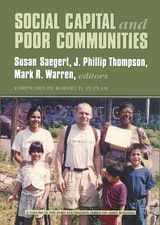
cover of Social Capital and Poor Communities

Social Capital and Poor Communities

Susan Saegert

Russell Sage Foundation, 2001
Neighborhood support groups have always played a key role in helping the poor survive, but combating poverty requires more than simply meeting the needs of day-to-day subsistence. Social Capital and Poor Communities shows the significant achievements that can be made through collective strategies, which empower the poor to become active partners in revitalizing their neighborhoods. Trust and cooperation among residents and local organizations such as churches, small businesses, and unions form the basis of social capital, which provides access to resources that would otherwise be out of reach to poor families. Social Capital and Poor Communities examines civic initiatives that have built affordable housing, fostered small businesses, promoted neighborhood safety, and increased political participation. At the core of each initiative lie local institutions—church congregations, parent-teacher groups, tenant associations, and community improvement alliances. The contributors explore how such groups build networks of leaders and followers and how the social power they cultivate can be successfully transferred from smaller goals to broader political advocacy. For example, community-based groups often become platforms for leaders hoping to run for local office. Church-based groups and interfaith organizations can lobby for affordable housing, job training programs, and school improvement. Social Capital and Poor Communities convincingly demonstrates why building social capital is so important in enabling the poor to seek greater access to financial resources and public services. As the contributors make clear, this task is neither automatic nor easy. The book's frank discussions of both successes and failures illustrate the pitfalls—conflicts of interest, resistance from power elites, and racial exclusion—that can threaten even the most promising initiatives. The impressive evidence in this volume offers valuable insights into how goal formation, leadership, and cooperation can be effectively cultivated, resulting in a remarkable force for change and a rich public life even for those communities mired in seemingly hopeless poverty. A Volume in the Ford Foundation Series on Asset Building
[more]
cover of Social Capital in the City: Community and Civic Life in Philadelphia

Social Capital in the City

Community and Civic Life in Philadelphia

edited by Richardson Dilworth

Temple University Press, 2006
Much of today's heated academic discussion about "social capital" is either theoretical in nature or revolves around national survey data, neither of which adequately explains the specific social networks that actually sustain life in cities. This is the first book about social capital that both spans a broad range of social contexts and time periods and focuses on a single city, Philadelphia. Contributors examine such subjects as voter behavior, education, neighborhood life, church participation, park advocacy, and political activism. The wide scope of the book reflects its concern for comprehending the uniqueness and diversity of urban social networks.Moving beyond typical definitions, the original essays collected here utilize case studies to demonstrate how social capital is nested in larger structures of power and cannot be appreciated without an understanding of context. Arguing that urban society is "social capital writ large," contributors complicate and deepen our knowledge of a crucial concept and its fruitful applications.
[more]
cover of Social Justice: Theories, Issues, and Movements (Revised and Expanded Edition)

Social Justice

Theories, Issues, and Movements (Revised and Expanded Edition)

Loretta Capeheart

Rutgers University Press, 2020

An eye for an eye, the balance of the scales – for centuries, these and other traditional concepts exemplified the public’s perception of justice. Today, popular culture, including television shows like Law and Order, informs the public’s vision. But do age-old symbols, portrayals in the media, and existing systems truly represent justice in all of its nuanced forms, or do we need to think beyond these notions? The second edition of Social Justice: Theories, Issues, and Movements responds to the need for a comprehensive introduction to these issues.
 
Theories of social justice are presented in an accessible fashion to encourage engagement of students, activists, and scholars with these important lines of inquiry. Issues are analyzed utilizing various theories for furthering engagement in possibilities. Struggles for justice -- from legal cases to on the ground movements -- are presented for historical context and to inform the way forward.
 
[more]
cover of Social Logic Of Politics: Personal Networs As Contexts

Social Logic Of Politics

Personal Networs As Contexts

edited by Alan S. Zuckerman

Temple University Press, 2005
Using classic theories and methodologies, this collection maintains that individuals make political choices by taking into account the views, preferences, evaluations, and actions of other people who comprise their social networks. These include family members, friends, neighbors, and workmates, among others. The volume re-establishes the research of the Columbia School of Electoral Sociology from several decades ago, and contrasts it with rational choice theory and the Michigan School of Electoral Analysis. Written by political scientists with a range of interests, this volume returns the social logic of politics to the heart of political science.
[more]
cover of Social Movements and Political Power: Emerging Forms of Radicalism in the West

Social Movements and Political Power

Emerging Forms of Radicalism in the West

Carl Boggs

Temple University Press, 1989

[more]
cover of Social Policy and Welfare: A Clear Guide

Social Policy and Welfare

A Clear Guide

Tom Burden

Pluto Press, 1998

[more]
cover of Social Programs that Work

Social Programs that Work

Jonathan Crane

Russell Sage Foundation, 1998
Many Americans seem convinced that government programs designed to help the poor have failed. Social Programs That Work shows that this is not true. Many programs have demonstrably improved the lives of people trapped at the bottom of the social and economic ladder. Social Programs That Work provides an in-depth look at some of the nation's best interventions over the past few decades, and considers their potential for national expansion. Examined here are programs designed to improve children's reading skills, curb juvenile delinquency and substance abuse, and move people off welfare into the workforce. Each contributor discusses the design and implementation of a particular program, and assesses how well particular goals were met. Among the critical issues addressed: Are good results permanent, or do they fade over time? Can they be replicated successfully under varied conditions? Are programs cost effective, and if so are the benefits seen immediately or only over the long term? How can public support be garnered for a large upfront investment whose returns may not be apparent for years? Some programs discussed in this volume were implemented only on a small, experimental scale, prompting discussion of their viability at the national level. An important concern for social policy is whether one-shot programs can lead to permanent results. Early interventions may be extremely effective at reducing future criminal behavior, as shown by the results of the High/Scope Perry preschool program. Evidence from the Life Skills Training Program suggests that a combination of initial intervention and occasional booster sessions can be an inexpensive and successful approach to reducing adolescent substance abuse. Social Programs That Work also acknowledges that simply placing welfare recipients in jobs isn't enough; they will also need long-term support to maintain those jobs. The successes and failures of social policy over the last thirty-five years have given us valuable feedback about the design of successful social policy. Social Programs That Work represents a landmark attempt to use social science criteria to identify and strengthen the programs most likely to make a real difference in addressing the nation's social ills.
[more]
cover of Social Science and Policy-Making: A Search for Relevance in the Twentieth Century

Social Science and Policy-Making

A Search for Relevance in the Twentieth Century

David L. Featherman and Maris A. Vinovskis, Editors

University of Michigan Press, 2001
This collection of essays examines how the social sciences in America were developed as a means of social reform and later, especially after World War II, as a tool in federal policymaking and policy analysis. It also uses arenas of policymaking, such as early childhood education and welfare and its reform, as case studies in which social research was used, in policy decisions or in setting and evaluating policy goals. The book is written to aid students of public policy to appreciate the complex relationship of information--principally, of social science research--to policymaking at the federal level.
David L. Featherman is Professor of Sociology and Psychology, Director and Senior Research Scientist, Institute for Social Research, University of Michigan. Maris A. Vinovskis is Bentley Professor of History, Senior Research Scientist, Institute for Social Research, Faculty member, School of Public Policy, University of Michigan.
[more]
cover of Social Science for What?: Philanthropy and the Social Question in a World Turned Rightside Up

Social Science for What?

Philanthropy and the Social Question in a World Turned Rightside Up

Alice O'Connor

Russell Sage Foundation, 2007
Much like today, the early twentieth century was a period of rising economic inequality and political polarization in America. But it was also an era of progressive reform—a time when the Russell Sage Foundation and other philanthropic organizations were established to promote social science as a way to solve the crises of industrial capitalism. In Social Science for What? Alice O'Connor relates the history of philanthropic social science, exploring its successes and challenges over the years, and asking how these foundations might continue to promote progressive social change in our own politically divided era. The philanthropic foundations established in the early 1900s focused on research which, while intended to be objective, was also politically engaged. In addition to funding social science research, in its early years the Russell Sage Foundation also supported social work and advocated reforms on issues from child welfare to predatory lending. This reformist agenda shaped the foundation's research priorities and methods. The Foundation's landmark Pittsburgh Survey of wage labor, conducted in 1907-1908, involved not only social scientists but leaders of charities, social workers, and progressive activists, and was designed not simply to answer empirical questions, but to reframe the public discourse about industrial labor. After World War II, many philanthropic foundations disengaged from political struggles and shifted their funding toward more value-neutral, academic social inquiry, in the belief that disinterested research would yield more effective public policies. Consequently, these foundations were caught off guard in the 1970s and 1980s by the emergence of a network of right-wing foundations, which was successful in promoting an openly ideological agenda. In order to counter the political in-roads made by conservative organizations, O'Connor argues that progressive philanthropic research foundations should look to the example of their founders. While continuing to support the social science research that has contributed so much to American society over the past 100 years, they should be more direct about the values that motivate their research.  In this way, they will help foster a more democratic dialogue on important social issues by using empirical knowledge to engage fundamentally ethical concerns about rising inequality. O'Connor's message is timely: public-interest social science faces unprecedented challenges in this era of cultural warfare, as both liberalism and science itself have come under assault. Social Science for What? is a thought-provoking critique of the role of social science in improving society and an indispensable guide to how progressives can reassert their voice in the national political debate. A Volume in the Russell Sage Foundation's Centennial Series
[more]
cover of Social Science, Social Policy, and the Law

Social Science, Social Policy, and the Law

Patricia Ewick

Russell Sage Foundation, 1999

Social science has been an important influence on legal thought since the legal realists of the1930s began to argue that laws should be socially workable as well as legally valid. With the expansion of legal rights in the 1960s, the law and social science were bound together by an optimistic belief that legal interventions, if fully informed by social science, could become an effective instrument of social improvement. Legal justice, it was hoped, could translate directly into social justice. Though this optimism has receded in both disciplines, social science and the law have remained intimately connected. Social Science, Social Policy, and the Law maps out this new relationship, applying social science to particular legal issues and reflecting upon the role of social science in legal thought. Several case studies illustrate the way that the law is embedded within the tangled interests and incentives that drive the social world. One study examines the entrepreneurialism that has shaped our systems of punishment from the colonial practice of deportation to today's privatized jails. Another case shows how many of those who do not qualify for legal aid cannot afford an effective legal defense with the consequence that economic inequality leads to inequality before the law. Two other studies look at the mixed results of legal regulation: the failure of legal safeguards to stop NASA's fatal 1986 Challenger launch decision, and the complicated effects of regulations to curb conflicts of interest in law firms. These two cases demonstrate that the law's effectiveness can depend, not only on how it is drafted, but also on how well it harmonizes with pre-existing social norms and patterns of self-regulation. The contributors to this volume share the belief that social science can and should influence legal policymaking. Empirical research is necessary to offset anecdotal evidence and untested assertions. But research that is acceptable to the academy may not stand up in court, and, as a result, social science does not always get a sympathetic hearing from legal decision makers. The relationship between social science and the law will always be complex; this volume takes a lead in showing how it can nonetheless be productive.
[more]
cover of Social Trust in the Nordic World

Social Trust in the Nordic World

Gert Tinggaard Svendsen and Christian Bjørnskov

University of Wisconsin Press, 2023

Study after study has shown that Scandinavia is the most trusting region in the world. Danes in particular trust other people and organizations—including strangers, businesses, governments, law enforcement, and media—more than the citizens of any other country. And countries with deep pools of social trust are populated by individuals who cooperate with each other in ways that allow public and private institutions to function more efficiently and cheaply.

Is the Nordic countries’ high level of social trust just as important for creating prosperity and happiness within a population as other, more tangible economic factors? If so, where does this stock of social trust in Scandinavia come from? Does it help to explain the development of the universal welfare states and their surprisingly high business competitiveness? Can other nations learn from the region and apply that knowledge to settings where social trust levels are low or in danger of being eroded?

Social trust has proven economic value, and Gert Tinggaard Svendsen warns that its benefits should never be taken for granted. Trust can dissolve and vanish quickly, and once gone, it is very difficult to rebuild. Governments and corporations are gradually increasing their control over people’s public and private lives, with predictably worrying results. When people feel taken advantage of or lied to, public confidence evaporates. Since strong social cohesion drives long-term prosperity, Nordic exceptionalism on maintaining and restoring trust offers valuable lessons.
[more]
cover of Somalis in the Twin Cities and Columbus: Immigrant Incorporation in New Destinations

Somalis in the Twin Cities and Columbus

Immigrant Incorporation in New Destinations

Stephanie Chambers

Temple University Press, 2017

In the early 1990s, Somali refugees arrived in Minneapolis and St. Paul, Minnesota. Later in the decade, an additional influx of immigrants arrived in a second destination of Columbus, Ohio. These refugees found low-skill jobs in warehouses and food processing plants and struggled as social “outsiders,” often facing discrimination based on their religious traditions, dress, and misconceptions that they are terrorists. The immigrant youth also lacked access to quality educational opportunities.

In Somalis in the Twin Cities and Columbus, Stefanie Chambers provides a cogent analysis of these refugees in Midwestern cities where new immigrant communities are growing. Her comparative study uses qualitative and quantitative data to assess the political, economic, and social variations between these urban areas. Chambers examines how culture and history influenced the incorporation of Somali immigrants in the U.S., and recommends policy changes that can advance rather than impede incorporation. 

Her robust investigation provides a better understanding of the reasons these refugees establish roots in these areas, as well as how these resettled immigrants struggle to thrive.
[more]
cover of Stable Condition: Elites' Limited Influence on Health Care Attitudes

Stable Condition

Elites' Limited Influence on Health Care Attitudes

Daniel J. Hopkins

Russell Sage Foundation, 2023

The Affordable Care Act (ACA), the sweeping health care reform enacted by the Obama Administration in 2010, continues to be a contentious policy at the center of highly polarized political debates. Both before and after the law’s passage, political elites on both sides of the issue attempted to sway public opinion through two traditional approaches: messaging and policymaking itself.  They operated under the assumption that the public’s personal experiences toward the law would make them more favorable. Yet these tried-and-true methods have had limited influence on public attitudes toward the ACA. Public opinion towards the ACA remained stable from 2010 to 2016, with more Americans opposing the law than supporting it. It was only after Donald Trump was elected in 2016 and the prospect of the law being repealed became a reality that public opinion swung in favor of the ACA. If traditional methods of influencing public opinion had little impact on attitudes towards the ACA, what did? In Stable Condition, political scientist Daniel J. Hopkins draws on survey data from 2009 to 2020 to assess how a variety of factors such as personal experience, political messaging, and partisanship did or did not affect public opinion on the ACA.
 
Hopkins finds that although personal experience with the ACA’s Medicaid expansion increased favorability among low-income Americans, it did not have a broader overall impact on public opinion. Personal experience with the Health Insurance Marketplace did not increase wider support for the ACA either. Due to the complex nature of the law, users of the Marketplace often did not realize they were benefiting from the ACA. Therefore, perceptions of the Marketplace were shaped by high-profile issues with the enrollment website and opposition to the individual mandate. These experiences ultimately offset one another, resulting in little discernable change in public opinion overall. Hopkins argues that political polarization was also responsible for elite’s limited influence and that public opinion on the ACA was largely determined by partisanship and political affiliation. Americans quickly aligned with their party’s stance on the law and were resistant to changing their beliefs despite the efforts of political elites. 
 
Stable Condition is an illuminating examination of the limits of elites’ influence and the forces that shaped public opinion about the Affordable Care Act.

 
[more]
cover of State of Translation: Turkey in Interlingual Relations

State of Translation

Turkey in Interlingual Relations

Einar Wigen

University of Michigan Press, 2018

International politics often requires two or more languages. The resulting interlingual relations mean translation, either by interpreters who are quite literally in the middle of conversations, or by bilingual statesmen who negotiate internationally in one language and then legitimize domestically in another. Since no two languages are the same, what can be argued in one language may be impossible in another. Political concepts can thus be significantly reformulated in the translation process. State of Translation examines this phenomenon using the case of how 19th-century Ottoman and later Turkish statesmen struggled to reconcile their arguments in external languages (French, then English) with those in their internal language (Ottoman, later Turkish), and in the process further entangled them. Einar Wigen shows how this process structured social relations between the Ottoman state and its interlocutors, both domestically and internationally, and shaped the dynamics of Turkish relations with Europe.
[more]
cover of Still a Hollow Hope: State Power and the Second Amendment

Still a Hollow Hope

State Power and the Second Amendment

Anthony D. Cooling

University of Michigan Press, 2022

The U.S. Supreme Court increasingly matters in American political life when those across the political spectrum look at the Court for relief from policies they oppose and as another venue for advancing their own policy agendas. However, the evidence is mounting, to include this book in a big way, that courts are more of a sideshow to the culture war. While court decisions, especially Supreme Court decisions, do have importance, the decisions emanating from the Court reflect social, cultural, and political change that occurred long prior to their decision ever being made.

This book tests how much political and social change has been made primarily through Gerald Rosenberg’s framework from his seminal work, The Hollow Hope: Can Courts Bring About Social Change, but it also utilizes Daniel Elazar’s Political Culture Theory to explain state level variations in political and social change. The findings indicate that while courts are not powerless institutions, reformers will not have success unless supported by the public and the elected branches, and most specifically, that preexisting state culture is a determining factor in the amount of change courts make. In short, federalism still matters.
[more]
cover of Street-Level Bureaucracy, 30th Anniversary Edition: Dilemmas of the Individual in Public Service

Street-Level Bureaucracy, 30th Anniversary Edition

Dilemmas of the Individual in Public Service

Michael Lipsky

Russell Sage Foundation, 2010
First published in 1980, Street-Level Bureaucracy received critical acclaim for its insightful study of how public service workers, in effect, function as policy decision makers, as they wield their considerable discretion in the day-to-day implementation of public programs. Three decades later, the need to bolster the availability and effectiveness of healthcare, social services, education, and law enforcement is as urgent as ever. In this thirtieth anniversary expanded edition, Michael Lipsky revisits the territory he mapped out in the first edition to reflect on significant policy developments over the last several decades. Despite the difficulties of managing these front-line workers, he shows how street-level bureaucracies can be and regularly are brought into line with public purposes. Street-level bureaucrats—from teachers and police officers to social workers and legal-aid lawyers—interact directly with the public and so represent the frontlines of government policy. In Street-Level Bureaucracy, Lipsky argues that these relatively low-level public service employees labor under huge caseloads, ambiguous agency goals, and inadequate resources. When combined with substantial discretionary authority and the requirement to interpret policy on a case-by-case basis, the difference between government policy in theory and policy in practice can be substantial and troubling. The core dilemma of street-level bureaucrats is that they are supposed to help people or make decisions about them on the basis of individual cases, yet the structure of their jobs makes this impossible. Instead, they are forced to adopt practices such as rationing resources, screening applicants for qualities their organizations favor, "rubberstamping" applications, and routinizing client interactions by imposing the uniformities of mass processing on situations requiring human responsiveness. Occasionally, such strategies work out in favor of the client. But the cumulative effect of street-level decisions made on the basis of routines and simplifications about clients can reroute the intended direction of policy, undermining citizens' expectations of evenhanded treatment. This seminal, award-winning study tells a cautionary tale of how decisions made by overburdened workers translate into ad-hoc policy adaptations that impact peoples' lives and life opportunities. Lipsky maintains, however, that these problems are not insurmountable. Over the years, public managers have developed ways to bring street-level performance more in line with agency goals. This expanded edition of Street-Level Bureaucracy underscores that, despite its challenging nature, street-level work can be made to conform to higher expectations of public service.
[more]
cover of Succeeding Generations: On the Effects of Investments in Children

Succeeding Generations

On the Effects of Investments in Children

Robert Haveman

Russell Sage Foundation, 1994
Drawn from an extensive two-decade longitudinal survey of American families, Succeeding Generations traces a representative group of America's children from their early years through young adulthood. It evaluates the many background factors that are most influential in determining how much education children will obtain, whether or not they will become teen parents, and how economically active they will be when they reach their twenties. Succeeding Generations demonstrates how our children's future has been placed at risk by social and economic conditions such as fractured families, a troubled economy, rising poverty rates, and neighborhood erosion. The authors also pinpoint some significant causes of children's later success, emphasizing the importance of parents' education and, despite the apparent loss of time spent with children, the generally positive influence of maternal employment. Haveman and Wolfe supplement their research with a comprehensive review of the many debates among economists, sociologists, developmental psychologists, and other experts on how best to improve the lot of America's children. "A state-of-the-art investigation of the determinants of children's success in the United States....Clearly written, highly readable, and compelling."—Contemporary Sociology "Haveman and Wolfe are professors of economics who bring sophisticated statistical and econometric techniques to the analysis of the economic and educational success of children as they progress into young adulthood."—Choice "This study is one of the most comprehensive of its kind, in part because the researchers collected detailed information about a wide range of children each year for more than two decades." —Wisconsin State Journal "The research at the core of this book addresses critically important questions in social science...an important contribution to the literature." —Robert Plotnick, University of Washington
[more]
cover of Suing the Tobacco and Lead Pigment Industries: Government Litigation as Public Health Prescription

Suing the Tobacco and Lead Pigment Industries

Government Litigation as Public Health Prescription

Donald G. Gifford

University of Michigan Press, 2010

"The topic, how tort law evolved over time into a system that allowed, for a moment at least, a parens patriae form of massive litigation against corporations, is exceedingly interesting and important. Gifford's treatment of this topic is highly informative, engaging, insightful, very current, and wise."
---David Owen, Carolina Distinguished Professor of Law, and Director of Tort Law Studies, University of South Carolina

 
In Suing the Tobacco and Lead Pigment Industries, legal scholar Donald G. Gifford recounts the transformation of tort litigation in response to the challenge posed by victims of 21st-century public health crises who seek compensation from the product manufacturers. Class action litigation promised a strategy for documenting collective harm, but an increasingly conservative judicial and political climate limited this strategy. Then, in 1995, Mississippi attorney general Mike Moore initiated a parens patriae action on behalf of the state against cigarette manufacturers. Forty-five other states soon filed public product liability actions, seeking both compensation for the funds spent on public health crises and the regulation of harmful products.
 
Gifford finds that courts, through their refusal to expand traditional tort claims, have resisted litigation as a solution to product-caused public health problems. Even if the government were to prevail, the remedy in such litigation is unlikely to be effective. Gifford warns, furthermore, that by shifting the powers to regulate products and to remediate public health problems from the legislature to the state attorney general, parens patriae litigation raises concerns about the appropriate allocation of powers among the branches of government.
 
Donald G. Gifford is the Edward M. Robertson Research Professor of Law at the University of Maryland School of Law.
[more]
cover of Sustainability of Microstates: The Case of North Cyprus

Sustainability of Microstates

The Case of North Cyprus

Ozay Mehmet

University of Utah Press, 2009

Utah Series in Middle East Studies

This interdisciplinary study discusses the development, economics, and politics of North Cyprus, a divided state since 1960 when sovereignty was surrendered by the British to both Greek and Turkish Cypriots.  Mehmet works to demonstrate that, as a microstate with an area of just 3,442 square kilometers, North Cyprus possesses certain inherent comparative economic advantages in the service sectors that enable it to be sustainable in today's rapidly globalizing and competitive economic world.

Mehmet bases his arguments for the potential sustainability of North Cyprus on the concept of economic rationalism, in which participating parties work to optimize their own self-interest.  In an ethnic conflict like that of North Cyprus, the logic of optimization demands a rational, free, and objective balancing of competing interests to reach an agreed solution.  The economic rationalist approach sharply contrasts with the highly emotional political, historical, cultural, and legal approaches that have thus far dominated the study and discussion of the Cyprus problem, approaches that have largely resulted in a protracted conflict.

While recognizing the negative forces of ethnic tension and the very real possibility of a continued divided Cyprus state, Sustainability of Microstates nevertheless remains hopeful, designed to unleash the forces of convergence that may be deduced from economic rationalism, and unwavering in its conviction of the ultimate sustainability of North Cyprus.

[more]
cover of Sustaining the Borderlands in the Age of NAFTA: Development, Politics, and Participation on the US-Mexico Border

Sustaining the Borderlands in the Age of NAFTA

Development, Politics, and Participation on the US-Mexico Border

Suzanne Simon

Vanderbilt University Press, 2014

Sustaining the Borderlands in the Age of NAFTA provides the only book-length study of the impact on residents of the US-Mexico border of NAFTA's Environmental and Labor Side Accords, which required each state to enforce labor and environmental regulations. Through field research in Matamoros, Tamaulipas, anthropologist Suzanne Simon tests the premise that the side accords would encourage Mexican grassroots democratization. The effectiveness of the side accords was tied to transparency and accountability and practically bound to opportunities for Mexican border populations to participate in the side accord petitioning and civil society input mechanisms. Simon conducted sixteen months of fieldwork with both a group of environmental activists and a group of those fighting for labor justice in Mexico. Both of these groups became enmeshed in the types of cross-border advocacy networks and coalition building efforts that are typical of the NAFTA era.


Although the key to the side accords' anticipated success lay in their ostensibly generous encouragement of a participatory politics and sustainable development opportunities, Sustaining the Borderlands reveals that the Mexican border populations for which they were largely created are effectively excluded from participating due to the ongoing online, territorial, class, and cultural barriers that shape the borderlands. Rather than experiencing the side accords and their companion institutions as transparent and accessible, residents experienced them as opaque and indecipherable. Simon concludes that the side accords have failed to deliver on their promise of bringing democracy to Mexico because practical mechanisms that would ensure their effective implementation were never put in place.


NAFTA took effect at a time when Mexico was undergoing a democratic transition. The treaty was supposed to encourage this transition and improve environmental and labor conditions on the US-Mexico border. This book demonstrates that, twenty years later, the promises of NAFTA have not come to pass.

[more]