71 books match the query 'Social networks' and 4 start with s
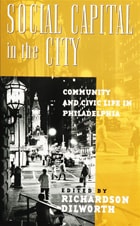
cover of Social Capital in the City: Community and Civic Life in Philadelphia

Social Capital in the City

Community and Civic Life in Philadelphia

edited by Richardson Dilworth

Temple University Press, 2006
Much of today's heated academic discussion about "social capital" is either theoretical in nature or revolves around national survey data, neither of which adequately explains the specific social networks that actually sustain life in cities. This is the first book about social capital that both spans a broad range of social contexts and time periods and focuses on a single city, Philadelphia. Contributors examine such subjects as voter behavior, education, neighborhood life, church participation, park advocacy, and political activism. The wide scope of the book reflects its concern for comprehending the uniqueness and diversity of urban social networks.Moving beyond typical definitions, the original essays collected here utilize case studies to demonstrate how social capital is nested in larger structures of power and cannot be appreciated without an understanding of context. Arguing that urban society is "social capital writ large," contributors complicate and deepen our knowledge of a crucial concept and its fruitful applications.
[more]
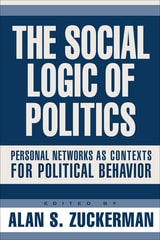
cover of Social Logic Of Politics: Personal Networs As Contexts

Social Logic Of Politics

Personal Networs As Contexts

edited by Alan S. Zuckerman

Temple University Press, 2005

Using classic theories and methodologies, this collection maintains that individuals make political choices by taking into account the views, preferences, evaluations, and actions of other people who comprise their social networks. These include family members, friends, neighbors, and workmates, among others. The volume re-establishes the research of the Columbia School of Electoral Sociology from several decades ago, and contrasts it with rational choice theory and the Michigan School of Electoral Analysis. Written by political scientists with a range of interests, this volume returns the social logic of politics to the heart of political science.
[more]
cover of Still Connected: Family and Friends in America Since 1970

Still Connected

Family and Friends in America Since 1970

Claude S. Fischer

Russell Sage Foundation, 2011

National news reports periodically proclaim that American life is lonelier than ever, and new books on the subject with titles like Bowling Alone generate considerable anxiety about the declining quality of Americans' social ties. Still Connected challenges such concerns by asking a simple yet significant question: have Americans' bonds with family and friends changed since the 1970s, and, if so, how? Noted sociologist Claude Fischer examines long-term trends in family ties and friendships and paints an insightful and ultimately reassuring portrait of Americans' personal relationships. Still Connected analyzes forty years of survey research to address whether and how Americans' personal ties have changed—their involvement with relatives, the number of friends they have and their contacts with those friends, the amount of practical and emotional support they are able to count on, and how emotionally tied they feel to these relationships. The book shows that Americans today have fewer relatives than they did forty years ago and that formal gatherings have declined over the decades—at least partially as a result of later marriages and more women in the work force. Yet neither the overall quantity of personal relationships nor, more importantly, the quality of those relationships has diminished. Americans' contact with relatives and friends, as well as their feelings of emotional connectedness, has changed relatively little since the 1970s. Although Americans are marrying later and single people feel lonely, few Americans report being socially isolated and the percentage who do has not really increased. Fischer maintains that this constancy testifies to the value Americans place on family and friends and to their willingness to adapt to changing circumstances in ways that sustain their social connections. For example, children now often have schedules as busy as their parents. Yet today's parents spend more quality time with their children than parents did forty years ago—although less in the form of organized home activities and more in the form of accompanying them to play dates or sports activities. And those family meals at home that seem to be disappearing? While survey research shows that families dine at home together less often, it also shows that they dine out together more often. Americans are fascinated by the quality of their relationships with family and friends and whether these bonds fray or remain stable over time. With so many voices heralding the demise of personal relationships, it's no wonder that confusion on this topic abounds. An engrossing and accessible social history, Still Connected brings a much-needed note of clarity to the discussion. Americans' personal ties, this book assures us, remain strong.
[more]
cover of Survival at Treblinka: Geography, Gender, and Social Networks in Jewish Resistance

Survival at Treblinka

Geography, Gender, and Social Networks in Jewish Resistance

Chad S.A. Gibbs

University of Wisconsin Press, 2026

On August 2, 1943, prisoners at the Nazi extermination camp Treblinka, located in occupied Poland, launched an uprising against their captors, during which hundreds successfully escaped while guards killed as many in the process. In this groundbreaking work, Chad S.A. Gibbs draws upon recently discovered sources and novel research methods to fundamentally reassess Jewish resistance at Treblinka—both before and during the revolt.

Using the testimonies of revolt survivors, prior escapees, those who passed through the camp, and a handful of bystander witnesses and former SS guards, Gibbs sheds new light on the events of August 2 as well as many prior acts of resistance. Critical to these new interpretations of the revolt are the actions of women prisoners, who here assume a central place in this story for the first time.

[more]