Results by title
135 books match the query 'Sociological aspects' and 12 start with s

Scammer's Yard
The Crime of Black Repair in JamaicaJovan Scott Lewis
University of Minnesota Press, 2020
Tells the story of Jamaican “scammers” who use crime to gain autonomy, opportunity, and repair
There is romance in stealing from the rich to give to the poor, but how does that change when those perceived rich are elderly white North Americans and the poor are young Black Jamaicans? In this innovative ethnography, Jovan Scott Lewis tells the story of Omar, Junior, and Dwayne. Young and poor, they strive to make a living in Montego Bay, where call centers and tourism are the two main industries in the struggling economy. Their experience of grinding poverty and drastically limited opportunity leads them to conclude that scamming is the best means of gaining wealth and advancement. Otherwise, they are doomed to live in “sufferation”—an inescapable poverty that breeds misery, frustration, and vexation.
In the Jamaican lottery scam run by these men, targets are told they have qualified for a large loan or award if they pay taxes or transfer fees. When the fees are paid, the award never arrives, netting the scammers tens of thousands of U.S. dollars. Through interviews, historical sources, song lyrics, and court testimonies, Lewis examines how these scammers justify their deceit, discovering an ethical narrative that reformulates ideas of crime and transgression and their relationship to race, justice, and debt.
Scammer’s Yard describes how these young men, seeking to overcome inequality and achieve autonomy, come to view crime as a form of liberation. Their logic raises unsettling questions about a world economy that relegates postcolonial populations to deprivation even while expecting them to follow the rules of capitalism that exacerbate their dispossession. In this groundbreaking account, Lewis asks whether true reparation for the legacy of colonialism is to be found only through radical—even criminal—means.
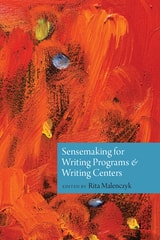
Sensemaking for Writing Programs and Writing Centers
Rita Malenczyk
Utah State University Press, 2023
The book is divided into two sections: Sensemaking with Tutors and Teachers, and Sensemaking and Institutional Structures. Chapter authors employ several theoretical approaches to sensemaking, ranging from individual experience to institutional history to document design, providing readers with ideas for how to administer and teach within their programs more effectively; how to advocate for their programs within larger university contexts; and how to positively influence the lives and careers of those they work with.
Sensemaking for Writing Programs and Writing Centers theorizes daily experiences from working lives and suggests problem-solving strategies. Writing program administrators, writing department chairs, and writing center directors, tutors, and staff will find value in its pages.
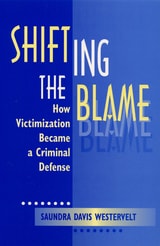
Shifting The Blame
How Victimization Became a Criminal DefenseWestervelt, Saundra D
Rutgers University Press, 1998
More than just a study of legal history, Shifting the Blame looks at the "abuse excuse" defense as an indicator of broad social change in cultural understandings of victimization, responsibility, and womanhood. The introduction of victimization as an exculpatory condition within the context of a criminal defense tells the story of a society that has accepted victimization as a new way of explaining and excusing misbehavior.
Through case law analysis, the book documents the initial development of the strategy in three different types of cases in the 1970s - "rotten social background", brainwashing, and battered women's self-defense cases. Since its initial acceptance in battered women's cases in the early 1980s, the use of the strategy has expanded to a variety of offenders in different types of relationships arguing different defenses. In lively, readable prose, Westervelt examines each form of expansion, revealing that while the expansion of the strategy has been fairly extensive, it has also been limited in some important ways. Her research shows readers that only certain types of "victims," particularly victims of physical abuse, have successfully used this defense. Shifting the Blame exposes the ways in which the acceptance of this new defense strategy illuminates a cultural shift in understandings of individual responsibility and shows how the law plays a role in defining who can be an acceptable victim.
Saundra D. Westervelt is an assistant professor in the Sociology Department at the University of North Carolina at Greensboro.
Shifting The Blame
How Victimization Became a Criminal DefenseWestervelt, Saundra D
Rutgers University Press, 1996
More than just a study of legal history, Shifting the Blame looks at the "abuse excuse" defense as an indicator of broad social change in cultural understandings of victimization, responsibility, and womanhood. The introduction of victimization as an exculpatory condition within the context of a criminal defense tells the story of a society that has accepted victimization as a new way of explaining and excusing misbehavior.
Through case law analysis, the book documents the initial development of the strategy in three different types of cases in the 1970s - "rotten social background", brainwashing, and battered women's self-defense cases. Since its initial acceptance in battered women's cases in the early 1980s, the use of the strategy has expanded to a variety of offenders in different types of relationships arguing different defenses. In lively, readable prose, Westervelt examines each form of expansion, revealing that while the expansion of the strategy has been fairly extensive, it has also been limited in some important ways. Her research shows readers that only certain types of "victims," particularly victims of physical abuse, have successfully used this defense. Shifting the Blame exposes the ways in which the acceptance of this new defense strategy illuminates a cultural shift in understandings of individual responsibility and shows how the law plays a role in defining who can be an acceptable victim.
Saundra D. Westervelt is an assistant professor in the Sociology Department at the University of North Carolina at Greensboro.
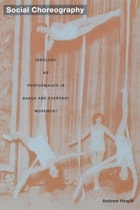
Social Choreography
Ideology as Performance in Dance and Everyday MovementAndrew Hewitt
Duke University Press, 2005
Hewitt focuses on the period between the mid-nineteenth century and the early twentieth and considers dancers and social theorists in Germany, Britain, France, and the United States. Analyzing the arguments of writers including Friedrich Schiller, Theodor Adorno, Hans Brandenburg, Ernst Bloch, and Siegfried Kracauer, he reveals in their thinking about the movement of bodies a shift from an understanding of play as the condition of human freedom to one prioritizing labor as either the realization or alienation of embodied human potential. Whether considering understandings of the Charleston, Isadora Duncan, Nijinsky, or the famous British chorus line the Tiller Girls, Hewitt foregrounds gender as he uses dance and everyday movement to rethink the relationship of aesthetics and social order.

Solidarity in Strategy
Making Business Meaningful in American Trade AssociationsLyn Spillman
University of Chicago Press, 2012
Popular conceptions hold that capitalism is driven almost entirely by the pursuit of profit and self-interest. Challenging that assumption, this major new study of American business associations shows how market and non-market relations are actually profoundly entwined at the heart of capitalism.
In Solidarity in Strategy, Lyn Spillman draws on rich documentary archives and a comprehensive data set of more than four thousand trade associations from diverse and obscure corners of commercial life to reveal a busy and often surprising arena of American economic activity. From the Intelligent Transportation Society to the American Gem Trade Association, Spillman explains how business associations are more collegial than cutthroat, and how they make capitalist action meaningful not only by developing shared ideas about collective interests but also by articulating a disinterested solidarity that transcends those interests.
Deeply grounded in both economic and cultural sociology, Solidarity in Strategy provides rich, lively, and often surprising insights into the world of business, and leads us to question some of our most fundamental assumptions about economic life and how cultural context influences economic.

Sport and Moral Conflict
A Conventionalist TheoryWilliam J.Morgan
Temple University Press, 2020
What is the purpose of sport, and how are ethical conceptions of sport shaped by the answers to this question? In Sport and Moral Conflict, William Morgan investigates, examining sport as a moral crucible that puts athletes in competitive, emotionally charged situations where fairness and equality are contested alongside accomplishment.
Morgan looks at the modern Olympics—from 1906 Athens to 1924 Paris, when the Games reached international prestige — in order to highlight the debate about athletic excellence and the amateur-professional divide. Whereas the Americans emphasized winning, the Europeans valued a love of the game. Morgan argues that the existing moral theories of sport—formalism and broad internalism (aka interpretivism), which rely on rules and general principles—fall short when confronted with such a dispute as the transition from amateur to professional sport. As such, he develops a theory of conventionalism, in which the norms at work in athletic communities determine how players should ethically acquit themselves. Presenting his case for an ethical theory of sport, Morgan provides insights regarding the moral controversies and crises that persist today.

Sportista
Female Fandom in the United StatesAndrei S. Markovits
Temple University Press, 2012
The typical female sports fan remains very different from her male counterparts. In their insightful and engaging book, Sportista, Andrei S. Markovits and Emily Albertson examine the significant ways many women have become fully conversant with sports—acquiring a knowledge of and passion for them as a way of forging identities that until recently were quite alien to women.
Sportista chronicles the relationship that women have developed with sports in the wake of the second wave of feminism of the late 1960s and early 1970s. The changes women athletes have achieved have been nothing short of revolutionary. But, as Markovits and Albertson argue, women’s identities as sports fans, though also changed in recent decades, remain notably different from that of men. Sportista highlights the impediments to these changes that women have faced and the reality that, even as bona fide fans, they “speak” sports differently from and remain largely unaccepted by men.
In the series Politics, History and Social Change, edited by John C. Torpey

Sports Immortals
Deifying the American AthletePeter Williams
University of Wisconsin Press, 1994

Sports in Africa, Past and Present
Todd Cleveland
Ohio University Press, 2020
These groundbreaking essays demonstrate how Africans past and present have utilized sports to forge complex identities and shape Africa’s dynamic place in the world.
Since the late nineteenth century, modern sports in Africa have both reflected and shaped cultural, social, political, economic, generational, and gender relations on the continent. Although colonial powers originally introduced European sports as a means of “civilizing” indigenous populations and upholding then current notions of racial hierarchies and “muscular Christianity,” Africans quickly appropriated these sporting practices to fulfill their own varied interests. This collection encompasses a wide range of topics, including women footballers in Nigeria, Kenya’s world-class long-distance runners, pitches and stadiums in communities large and small, fandom and pay-to-watch kiosks, the sporting diaspora, sports pedagogy, sports as resistance and as a means to forge identity, sports heritage, the impact of politics on sports, and sporting biography.

Sports, Power, and Resistance
An Introduction to Critical Sports StudiesEdited by Thomas P. Oates and Travis Vogan
University of Illinois Press, 2026
Topics range from Black coaches in the National Football League to disordered eating within distance running to transgender athletes’ fight to participate in sports. The editors have organized the contributions into three sections. Part one probes how sports build communities that foster belonging as well as exclusion. The essays in part two explore multiple forms of resistance in sports through various performances and representations. In the final section, essayists analyze more explicit efforts to use sports as a platform for activism from various political viewpoints. Throughout, the works nurture and demonstrate a sensibility that encourages humanistic, critical, and interdisciplinary inquiry.
Wide-reaching and accessible, Sports, Power, and Resistance explores timely issues while demonstrating the value of blending perspectives to better understand the games we play and watch.
Contributors: Ali Bouterse, Adrian Burgos, Jr., Michael L. Butterworth, Noah Cohan, Douglas Hartmann, Victoria E. Johnson, Abraham I. Khan, Jason Kido Lopez, Theresa Runstedtler, Jaime Schultz, Samantha N. Sheppard, and Travers

Staying Sober in Mexico City
By Stanley Brandes
University of Texas Press, 2002
Staying sober is a daily struggle for many men living in Mexico City, one of the world's largest, grittiest urban centers. In this engaging study, Stanley Brandes focuses on a common therapeutic response to alcoholism, Alcoholics Anonymous (A.A.), which boasts an enormous following throughout Mexico and much of Latin America.
Over several years, Brandes observed and participated in an all-men's chapter of A.A. located in a working class district of Mexico City. Employing richly textured ethnography, he analyzes the group's social dynamics, therapeutic effectiveness, and ritual and spiritual life. Brandes demonstrates how recovering alcoholics in Mexico redefine gender roles in order to preserve masculine identity. He also explains how an organization rooted historically in evangelical Protestantism has been able to flourish in Roman Catholic Latin America.