Results by title
382 books match the query 'Southwest (AZ, NM, OK, TX)' and 19 start with s
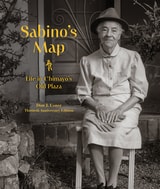
Sabino's Map
Life in Chimayó’s Old Plaza, Thirtieth Anniversary EditionDon J. Usner
Museum of New Mexico Press, 2024
“Brimming with voices, las voces de la gente…. the first-person narrator who returns again and again to the text like a knowing and trusted pariente inviting the reader to sit for a while in the Plaza del Cerro. —Jim Sagel
“Quite simply…the best history yet made of a northern New Mexico community. It is thorough, balanced, gracefully written, and blessed with an insider’s access and affection.”—William De Buys
Chimayó is renowned for its Hispano master weaving families, lowriders, and its storied church, El Santurio de Chimayó. The old Plaza del Cerro had once been the village’s center place, where locals gathered to pick up mail, socialize and celebrate religious and family events. Over the years after WWII, the plaza was neglected, but the memory of the once-vibrant place remained vivid in the stories of village elders.
The first edition of Sabino’s Map, published in 1995, documented oral histories of these elders. It would prove to be a critical turning point for many Chimayosos. At the Chimayó book launch, Usner recalls locals embraced the book, one cousin of his even declaring, “For the first time in my life I feel like I can be proud to be from Chimayó.” In the past thirty years since its publication, the community and its people have been revitalized with the help of the Chimayó Cultural Preservation Association and the establishment of a museum on the old plaza—in the home of Usner’s ancestors.
This landmark publication, read and passed on through generations, is considered a classic of New Mexico literature, alongside other treasured books including John Nichols’s Milagro Beanfield War, Rudolfo Anaya’s Bless Me Ultima, and Ruben Cobos’s Dictionary of New Mexico and Northern New Mexico Spanish.
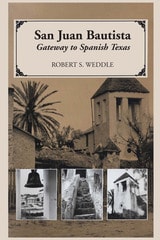
San Juan Bautista
Gateway to Spanish TexasBy Robert S. Weddle
University of Texas Press, 1968
Winner, Presidio La Bahia Award, Sons of the Republic of Texas, 1978
In their efforts to assert dominion over vast reaches of the (now U.S.) Southwest in the seventeenth century, the Spanish built a series of far-flung missions and presidios at strategic locations. One of the most important of these was San Juan Bautista del Río Grande, located at the present-day site of Guerrero in Coahuila, Mexico.
Despite its significance as the main entry point into Spanish Texas during the colonial period, San Juan Bautista was generally forgotten until the first publication of this book in 1968. Weddle's narrative is a fascinating chronicle of the many religious, military, colonial, and commerical expeditions that passed through San Juan and a valuable addition to knowledge of the Spanish borderlands. It won the Texas Institute of Letters Amon G. Carter Award for Best Southwest History in 1969.
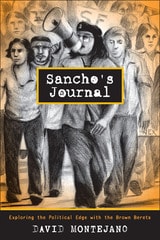
Sancho's Journal
Exploring the Political Edge with the Brown BeretsBy David Montejano
University of Texas Press, 2012
How do people acquire political consciousness, and how does that consciousness transform their behavior? This question launched the scholarly career of David Montejano, whose masterful explorations of the Mexican American experience produced the award-winning books Anglos and Mexicans in the Making of Texas, 1836–1986, a sweeping outline of the changing relations between the two peoples, and Quixote’s Soldiers: A Local History of the Chicano Movement, 1966–1981, a concentrated look at how a social movement “from below” began to sweep away the last vestiges of the segregated social-political order in San Antonio and South Texas. Now in Sancho’s Journal, Montejano revisits the experience that set him on his scholarly quest—“hanging out” as a participant-observer with the South Side Berets of San Antonio as the chapter formed in 1974.
Sancho’s Journal presents a rich ethnography of daily life among the “batos locos” (crazy guys) as they joined the Brown Berets and became associated with the greater Chicano movement. Montejano describes the motivations that brought young men into the group and shows how they learned to link their individual troubles with the larger issues of social inequality and discrimination that the movement sought to redress. He also recounts his own journey as a scholar who came to realize that, before he could tell this street-level story, he had to understand the larger history of Mexican Americans and their struggle for a place in U.S. society. Sancho’s Journal completes that epic story.
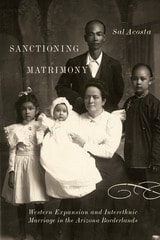
Sanctioning Matrimony
Western Expansion and Interethnic Marriage in the Arizona BorderlandsSal Acosta
University of Arizona Press, 2016
Following the Treaty of Mesilla (1853), interethnic relationships played a significant part in the Southwest. Acosta provides previously unseen archival research on the scope and tenor of interracial marriages in Arizona. Contending that scholarship on intermarriage has focused on the upper classes, Acosta takes us into the world of the working and lower classes and illuminates how church and state shaped the behavior of participants in interracial unions.
Marriage practices in Tucson reveal that Mexican women were pivotal in shaping family and social life between 1854 and 1930. Virtually all intermarriages before 1900 were, according to Acosta, between Mexican women and white men, or between Mexican women and blacks or Chinese until the 1920s, illustrating the importance of these women during the transformation of Tucson from a Mexican pueblo to an American town.
Acosta’s deep analysis of vital records, census data, and miscegenation laws in Arizona demonstrates how interethnic relationships benefited from and extended the racial fluidity of the Arizona borderlands.
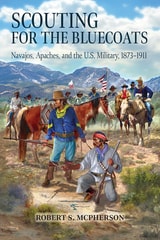
Scouting for the Bluecoats
Navajos, Apaches, and the U.S. Military, 1873–1911Robert S. McPherson
University Press of Colorado, 2022
—Kent Powell, Senior historian at Utah Division of State History and editor of Utah State Historical Quarterly (retired)
"Scouting for the Bluecoats examines the important role that Navajos played in military operations during the last quarter of the nineteenth and beginning of the twentieth centuries. Unlike the famous Navajo code talkers of World War II, little has been written about these men who served in some of the most challenging and noteworthy struggles against the Apaches. Until now, their story has been forgotten. Navajo skills in understanding and tracking a wily foe across an inhospitable landscape proved to be essential elements in ending the Apache wars. For those interested in the recruitment and deployment of the scouts, measures taken to counter enemy tactics, and the challenge of obtaining recognition for their service, this book is an invaluable source and a must-read for any serious scholar of Navajo history."
—Ronald P. Maldonado, Tribal historic preservation officer (retired), Navajo Nation
Secession and the Union in Texas
By Walter L. Buenger
University of Texas Press, 1984
In 1845 Texans voted overwhelmingly to join the Union. They voted just as overwhelmingly to secede in 1861. The story of why and how that happened is filled with colorful characters, such as the aged Sam Houston, and with the southwestern flavor of raiding Comanches, German opponents of slavery, and a border with Mexico.
Texas was unique among the seceding states because of its ambivalence toward secession. Yet for all its uniqueness the story of the secession of Texas has broad implications for the secession movement in general. Despite the local color and the southwestern nature of the state, Texas was more southern than western in 1860. Texans supported the Union or insisted upon secession for reasons common to the South and to the whole nation. Most Texans in 1860 were recent immigrants from southern and border states. They still thought and acted like citizens of their former states. The newness of Texas then makes it a particularly appropriate place from which to draw conclusions about the entire secession movement.
Secession and the Union in Texas is both a narrative of secession in Texas and a case study of the causes of secession in a southern state. Politics play a key role in this history, but politics broadly defined to include the influence of culture, partisanship, ideology, and self-interest. As any study of a mass movement carried out in tense circumstances must be, this is social history as well as political history. It is a study of public hysteria, the pressure for consensus, and the vanishing of a political process in which rational debate about secession and the Union could take place.
Although relying primarily on traditional sources such as manuscript collections and newspapers, a particularly rich source for this study, the author also uses election returns, population shifts over the course of the 1850s, and the breakdown of population within Texas counties to provide a balanced approach.
These sources indicate that Texans were not simply secessionists or unionists. At the end of 1860 Texans ranged from ardent secessionists to equally passionate supporters of the Union. But the majority fell in between these two extremes, creating an atmosphere of ambivalence toward secession which was not erased even by the war.
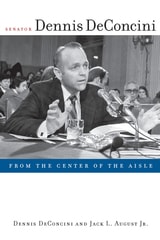
Senator Dennis DeConcini
From the Center of the AisleDennis DeConcini and Jack L. August, Jr.
University of Arizona Press, 2006
A vigilant centrist, who got results by building coalitions on both sides of the aisle, Senator DeConcini’s approach was not bound to strict party alliances but was deeply rooted in the independent political environment of Arizona. During his career, he sponsored legislation limiting the sale of assault weapons, which provoked the National Rifle Association. He confounded Democratic Party regulars by supporting Clarence Thomas during the controversial confirmation hearings and again split with his party in his support for William Rehnquist’s nomination to Chief Justice. In 1980 he voted for Ronald Reagan, but in 1993 he cast the swing vote for President Bill Clinton’s tax bill, which was strongly opposed by Republicans in Arizona.
This political memoir will be of interest to anyone concerned with the inner workings of the U.S. Senate or Arizona politics and offers relevant insights into today’s political climate.
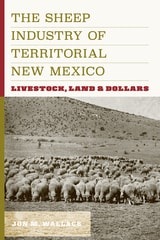
Sheep Industry of Territorial New Mexico
Livestock, Land, and DollarsJon M. Wallace
University Press of Colorado, 2023
Author Jon Wallace tells the story of evolving living conditions as the sheep industry came to encompass innumerable families of modest means. The transformation improved many New Mexicans’ lives and helped establish the territory as a productive part of the United States. There was a cost, however, with widespread ecological changes to the lands—brought about in large part by heavy grazing. Following the US annexation of New Mexico, new markets for mutton and wool opened. Well-connected, well-financed Anglo merchants and growers who had recently arrived in the territory took advantage of the new opportunity and joined their Hispanic counterparts in entering the sheep industry.
The Sheep Industry of Territorial New Mexico situates this socially imbued economic story within the larger context of the environmental consequences of open-range grazing while examining the relationships among Hispanic, Anglo, and Indigenous people in the region. Historians, students, general readers, and specialists interested in the history of agriculture, labor, capitalism, and the US Southwest will find Wallace’s analysis useful and engaging.
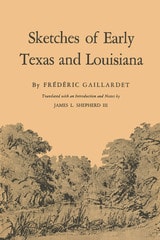
Sketches of Early Texas and Louisiana
By Frédéric Gaillardet
University of Texas Press, 1966
A lively report of travels in early nineteenth-century Texas and Louisiana and a fascinating account of the discovery, exploration, and settlement of those areas is presented in the work of this ebullient young French dramatist and journalist who traveled to Louisiana in 1837 and to Texas in 1839.
Frédéric Gaillardet, an alert and talented writer of the romantic school, was lured away for a decade from a successful career in Paris to satisfy his wanderlust and to seek inspiration on the American frontier. During that time he visited the American Southwest, and he talked with many personages there—men like Sam Houston, Mirabeau B. Lamar, and Achille Murat. His character sketches of these men add zest to the book, as do the facets of Gaillardet's own personality and life displayed in these pages.
Gaillardet's reports of his travels were published in various French-language newspapers of the time; a few were incorporated into the author's posthumous memoirs. His opinions, as recorded in his writings, exerted undeniable influence in the French decision to recognize Texas; one of his theses was that the Republic of Texas might become a curb, rather than a stepping stone, to an expanding United States. Despite Gaillardet's historical importance, however, none of these chapters has ever appeared before in English translation.
This collection was gathered from several sources: the Journal des Débats, the Constitutionnel, the Courrier des États-Unis, and Gaillardet's memoirs, entitled L'Aristocratie en Amérique.
The latter chapters concentrate on the career of a prominent Louisiana lawyer, politician, and diplomat, Pierre Soulé, whose much maligned name Gaillardet repeatedly and stoutly defended. A less favorable treatment of Soulé, contained in Fanny Calderón de la Barca's Attaché in Madrid, is reprinted in the appendix to aid the reader in judging the accuracy of Gaillardet's analysis of this arresting figure.
Copious footnotes to clarify the text have been added by the translator. His introduction presents a biographical sketch of Gaillardet, together with a careful analysis of the book, which has been translated lucidly and vividly.
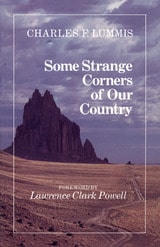
Some Strange Corners of Our Country
Charles F. Lummis; Foreword by Lawrence Clark Powell
University of Arizona Press, 1989

Sonora
A Description of the ProvinceIgnaz Pfefferkorn; Foreword by Bernard L. Fontana; Translated and Annotated by Theodore E. Treutlein
University of Arizona Press, 1989
"To be read for enjoyment; nevertheless, the historian will find in it a wealth of information that has been shrewdly appraised, carefully sifted, and creditably related."—Catholic Historical Review
"Of interest not only to the historian but to the geographer and anthropologist."—Pacific Historical Review
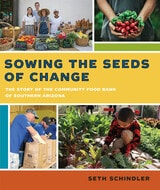
Sowing the Seeds of Change
The Story of the Community Food Bank of Southern ArizonaSeth Schindler
University of Arizona Press, 2021
The numbers are no less shocking in southern Arizona: one in six residents, and one in four children, are food insecure. How can this be in the richest country in the world? This book explores that paradox and the innovative solutions that one organization has developed to create a healthier, more secure tomorrow for the less fortunate among us.
The Community Food Bank of Southern Arizona (CFB) is one of the oldest and most respected food banks in America. It is a widely recognized leader not simply in providing hunger relief but in attacking the root causes of hunger and poverty through community development, education, and advocacy. In 2018, Feeding America—the national organization of food banks—named it “Food Bank of the Year.” The CFB serves as a model for all nonprofits to follow, no matter their mission.
This profusely illustrated book chronicles the CFB’s amazing success and evolution from a tiny grassroots hunger-relief organization to one with more than six thousand workers and an annual budget exceeding $100 million. The book gives voice to the thousands of CFB participants past and present, weaving their profiles and quotes throughout the book. These profiles personalize the history of the CFB and give readers an insider’s perspective on the people and events that shaped the food bank’s success. It shows how individuals working together can help prevent hunger and break the cycle of poverty that is its cause.
The aim of Sowing the Seeds of Change is not to laud the CFB’s achievements. It is to demonstrate to readers that the war against hunger, despite the obstacles, can be won. And not tomorrow. Now!
Spanish Colonial Tucson
A Demographic HistoryHenry F. Dobyns
University of Arizona Press, 1976
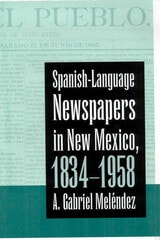
Spanish-Language Newspapers in New Mexico, 1834-1958
A. Gabriel Meléndez
University of Arizona Press, 2005
Gabriel Meléndez details the education and formation of a generation of Spanish-language journalists who were instrumental in creating a culture of print in nativo communities. He then offers in-depth cultural and literary analyses of the texts produced by los periodiqueros, establishing them thematically as precursors of the Chicano literary and political movements of the 1960s and ’70s.
Moving beyond a simple effort to reinscribe Nuevomexicanos into history, Meléndez views these newspapers as cultural productions and the work of the editors as an organized movement against cultural erasure amid the massive influx of easterners to the Southwest. Readers will find a wealth of information in this book. But more important, they will come away with the sense that the survival of Nuevomexicanos as a culturally and politically viable group is owed to the labor of this brilliant generation of newspapermen who also were statesmen, scholars, and creative writers.
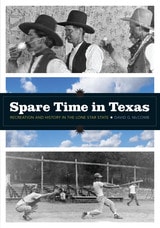
Spare Time in Texas
Recreation and History in the Lone Star StateBy David G. McComb
University of Texas Press, 2008
What do Texans' pastimes and recreations say about their characters? Looking at Texas history from a new angle, David McComb starts from the premise that how people spend their leisure time may well reveal more about their true natures and interests than the work they do or their family connections. In this innovative book, McComb traces the history of various types of recreation in Texas, gathering significant insights into the characters of Texans from the pleasures they have pursued.
Reflecting the frontier origins of Texas, McComb starts with the recreations that were most popular with men in a crude, still-developing society—drinking, gambling, and whoring. He goes on to show how, as Texas became more civilized, so did its diversions. He describes how Texans have connected with nature in parks and zoos; watched football and baseball in great stadiums such as the Astrodome and Cotton Bowl; discovered the pleasure of reading in public and university libraries; and enjoyed radio, TV, movies, and live theater in places such as Houston's Alley Theatre.
This recreational history reveals that Texans are open-minded and generous; that they respect the land; oppose prostitution but indulge in gambling and drinking; support racial and gender rights; love zoos; champion libraries; take pride in theatrical productions; and adore sports.

Stages of Struggle and Celebration
A Production History of Black Theatre in TexasBy Sandra M. Mayo and Elvin Holt
University of Texas Press, 2015
From plantation performances to minstrel shows of the late nineteenth century, the roots of black theatre in Texas reflect the history of a state where black Texans have continually created powerful cultural emblems that defy the clichés of horses, cattle, and bravado. Drawing on troves of archival materials from numerous statewide sources, Stages of Struggle and Celebration captures the important legacies of the dramatic arts in a historical field that has paid most of its attention to black musicians.
Setting the stage, the authors retrace the path of the cakewalk and African-inspired dance as forerunners to formalized productions at theaters in the major metropolitan areas. From Houston’s Ensemble and Encore Theaters to the Jubilee in Fort Worth, gospel stage plays of the Black Academy of Arts and Letters in Dallas, as well as San Antonio’s Hornsby Entertainment Theater Company and Renaissance Guild, concluding with ProArts Collective in Austin, Stages of Struggle and Celebration features founding narratives, descriptions of key players and memorable productions, and enlightening discussions of community reception and the business challenges faced by each theatre. The role of drama departments in historically black colleges in training the companies’ founding members is also explored, as is the role the support of national figures such as Tyler Perry plays in ensuring viability. A canon of Texas playwrights completes the tour. The result is a diverse tribute to the artistic legacies that continue to inspire new generations of producers and audiences.

State of Minds
Texas Culture and Its DiscontentsBy Don Graham
University of Texas Press, 2011
John Steinbeck once famously wrote that "Texas is a state of mind." For those who know it well, however, the Lone Star State is more than one mind-set, more than a collection of clichés, more than a static stereotype. There are minds in Texas, Don Graham asserts, and some of the most important are the writers and filmmakers whose words and images have helped define the state to the nation, the world, and the people of Texas themselves. For many years, Graham has been critiquing Texas writers and films in the pages of Texas Monthly and other publications. In State of Minds, he brings together and updates essays he published between 1999 and 2009 to paint a unique, critical picture of Texas culture.
In a strong personal voice—wry, humorous, and ironic—Graham offers his take on Texas literary giants ranging from J. Frank Dobie to Larry McMurtry and Cormac McCarthy and on films such as The Alamo, The Last Picture Show, and Brokeback Mountain. He locates the works he discusses in relation to time and place, showing how they sprang (or not) from the soil of Texas and thereby helped to define Texas culture for generations of readers and viewers—including his own younger self growing up on a farm in Collin County. Never shying from controversy and never dull, Graham's essays in State of Minds demolish the notion that "Texas culture" is an oxymoron.
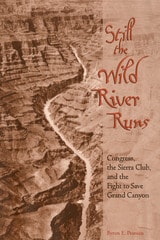
Still the Wild River Runs
Congress, the Sierra Club, and the Fight to Save Grand CanyonByron E. Pearson
University of Arizona Press, 2002

Stirring It Up with Molly Ivins
A Memoir with RecipesBy Ellen Sweets
University of Texas Press, 2011
You probably knew Molly Ivins as an unabashed civil libertarian who used her rapier wit and good ole Texas horse sense to excoriate political figures she deemed unworthy of our trust and respect. But did you also know that Molly was one helluva cook? And we're not just talking chili and chicken-fried steak, either. Molly Ivins honed her culinary skills on visits to France—often returning with perfected techniques for saumon en papillote or delectable clafouti aux cerises. Friends who had the privilege of sharing Molly's table got not only a heaping helping of her insights into the political shenanigans of the day, but also a mouth-watering meal, prepared from scratch with the finest ingredients and assembled with the same meticulous attention to detail that Molly devoted to skewering a political recalcitrant.
In Stirring It Up with Molly Ivins, her longtime friend, fellow reporter, and frequent sous-chef Ellen Sweets takes us into the kitchen with Molly and introduces us to the private woman behind the public figure. She serves up her own and others' favorite stories about Ivins as she recalls the fabulous meals they shared, complete with recipes for thirty-five of Molly's signature dishes. These stories reveal a woman who was even more fascinating and complex than the "professional Texan" she enjoyed playing in public. Friends who ate with Molly knew a cultured woman who was a fluent French speaker, voracious reader, rugged outdoors aficionado, music lover, loyal and loving friend, and surrogate mom to many of her friends' children, as well as to her super-spoiled poodle. They also came to revere the courageous woman who refused to let cancer stop her from doing what she wanted, when she wanted. This is the Molly you'll be delighted to meet in Stirring It Up with Molly Ivins.