Results by title
70 books match the query 'Spanish' and 14 start with s
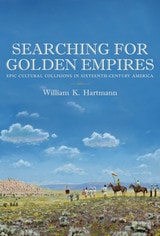
Searching for Golden Empires
Epic Cultural Collisions in Sixteenth-Century AmericaWilliam K. Hartmann
University of Arizona Press, 2014
Recounting eyewitness experiences that the Spaniards recorded in letters and memoirs, Hartmann describes ancient lifeways from Mexico to the western United States; Aztec accounts of the conquest; discussions between Aztec priests and Spanish priests about the nature of the universe; Cortés’s lifelong relationship with his famous Native mistress, Malinche (not to mention the mysterious fate of his wife); lost explorers who wandered from Florida to Arizona; and Marcos de Niza’s controversial reports of the “Seven Cities of Cíbola.”
Searching for Golden Empires describes how, even after the conquest of Mexico, Cortés remained a “wildcat” competitor with Coronado in a race to see who could find the “next golden empire,” believed to lie in the north. It is an exciting history of the shared story of the United States and Mexico, unveiling episodes both tragic and uplifting.
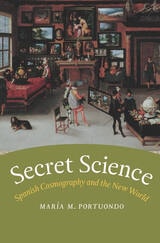
Secret Science
Spanish Cosmography and the New WorldMaría M. Portuondo
University of Chicago Press, 2009
The discovery of the New World raised many questions for early modern scientists: What did these lands contain? Where did they lie in relation to Europe? Who lived there, and what were their inhabitants like? Imperial expansion necessitated changes in the way scientific knowledge was gathered, and Spanish cosmographers in particular were charged with turning their observations of the New World into a body of knowledge that could be used for governing the largest empire the world had ever known.
As María M. Portuondo here shows, this cosmographic knowledge had considerable strategic, defensive, and monetary value that royal scientists were charged with safeguarding from foreign and internal enemies. Cosmography was thus a secret science, but despite the limited dissemination of this body of knowledge, royal cosmographers applied alternative epistemologies and new methodologies that changed the discipline, and, in the process, how Europeans understood the natural world.
Sin fronteras
Inclusive Spanish Grammar GuidebookLiana Stepanyan, María Mercedes Fages Agudo, Carolina Castillo Larrea, Goretti Prieto Botana
Amherst College Press, 2024
Sites of Translation
What Multilinguals Can Teach Us about Digital Writing and RhetoricLaura Gonzales
University of Michigan Press, 2018
Winner of the 2016 Sweetland Digital Rhetoric Collaborative Book Prize
Sites of Translation illustrates the intricate rhetorical work that multilingual communicators engage in as they translate information for their communities. Blending ethnographic and empirical methods from multiple disciplines, Laura Gonzales provides methodological examples of how linguistic diversity can be studied in practice, both in and outside the classroom, and provides insights into the rhetorical labor that is often unacknowledged and made invisible in multilingual communication. Sites of Translation is relevant to researchers and teachers of writing as well as technology designers interested in creating systems, pedagogies, and platforms that will be more accessible and useful to multilingual audiences. Gonzales presents multilingual communication as intellectual labor that should be further valued in both academic and professional spaces, and supported by multilingual technologies and pedagogies that center the expertise of linguistically diverse communicators.

Southwestern Medical Dictionary
Spanish-English, English-SpanishMargarita Artschwager Kay
University of Arizona Press, 2001
A staple of southwestern health care for more than twenty years, this dictionary can make a difference in patient care. Now available in a revised edition, it focuses on vocabulary used in health contexts by Spanish-speaking people in order to help patients tell their stories and medical practitioners to understand them. Unlike other bilingual dictionaries that emphasize scientific terms, this one focuses on standard Spanish terms as well as regional expressions peculiar to Mexican Spanish—language encountered in Chicago as easily as in Phoenix.
In the Spanish-to-English section, Spanish terms are followed by English translations and sample sentences to help health care practitioners understand how a patient might use them:
acedías, heartburn, pain in lower esophagus perceived as in the heart. Uno tiene la tendencia a sufrir de acedías después de comer chile. One has a tendency to suffer heartburn after eating chile. (syn: acidez, agruras del estómago)
In the English-to-Spanish section, English words are translated into simple Spanish terms along with English synonyms.
Now available in a revised edition, this handy reference features:
• more than 3,000 entries
• new entries that reflect current health problems and treatments
• inclusion of cognates
• Spanish definitions of English words
• anatomical drawings with bilingual labels
• more material on medicinal plants, including an appendix of poisonous and non-poisonous plants
• lists of food items and kinship terms
This book is an indispensable reference for all health care professionals who see patients of Mexican origin. Combining idiomatic precision with technical accuracy, it can help break down language barriers on either side of the border.

Spain and Portugal in the New World, 1492-1700
Lyle N. McAlister
University of Minnesota Press, 1984
Spain and Portugal in the New World, 1492-1700 was first published in 1984. Minnesota Archive Editions uses digital technology to make long-unavailable books once again accessible, and are published unaltered from the original University of Minnesota Press editions.
Spanish and Portuguese expansion substantially altered the social, political, and economic contours of the modern world. In his book, Lyle McAlister provides a narrative and interpretive history of the exploration and settlement of the Americas by Spain and Portugal.
McAlister divides this period (and the book) into three parts. First, he describes the formation of Old World societies with particular attention to those features that influenced the directions and forms of overseas expansion. Second, he traces the dynamic processes of conquest and colonization that between 1492 and about 1570 firmly established Spanish and Portuguese dominion in the New World. The third part deals with colonial growth and consolidation down to about 1700. McAlister's main themes are: the post-conquest territorial expansion that established the limits of what later came to be called Latin America, the emergence of distinctively Spanish and Portuguese American societies and economies, the formation of systems of imperial control and exploitation, and the ways in which conflicts between imperial and American interests were reconciled.
This comprehensive history, with its extensive bibliographic essay and attention to historiographic issues, will be a standard reference for students and scholars of the period.

Spanish Expeditions into Texas, 1689-1768
By William C. Foster
University of Texas Press, 1995
Mapping old trails has a romantic allure at least as great as the difficulty involved in doing it. In this book, William Foster produces the first highly accurate maps of the eleven Spanish expeditions from northeastern Mexico into what is now East Texas during the years 1689 to 1768.
Foster draws upon the detailed diaries that each expedition kept of its route, cross-checking the journals among themselves and against previously unused eighteenth-century Spanish maps, modern detailed topographic maps, aerial photographs, and on-site inspections. From these sources emerges a clear picture of where the Spanish explorers actually passed through Texas.
This information, which corrects many previous misinterpretations, will be widely valuable. Old names of rivers and landforms will be of interest to geographers. Anthropologists and archaeologists will find new information on encounters with some 139 named Indian tribes. Botanists and zoologists will see changes in the distribution of flora and fauna with increasing European habitation, and climatologists will learn more about the "Little Ice Age" along the Rio Grande.
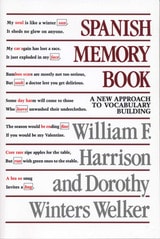
Spanish Memory Book
A New Approach to Vocabulary BuildingBy William F. Harrison and Dorothy Winters Welker
University of Texas Press, 1990
Using mnemonics is an age-old technique for remembering names, numbers, and many other things. In Spanish Memory Book, William Harrison and Dorothy Welker offer original mnemonic rimes that are by turns amusing, ironic, pathetic, sentimental, and sardonic to help students and independent learners acquire and remember Spanish vocabulary.
Included are mnemonic jingles for 700 of the 2,000 most commonly used Spanish words. Each jingle contains both the sound of the Spanish word and its English meaning. The authors have included a general pronunciation guide to Spanish vowels and consonants.
This innovative approach, which the authors have used successfully with their own students, is simple, effective, and entertaining. In the words of one student, "This book teaches me not only Spanish words but English words as well."
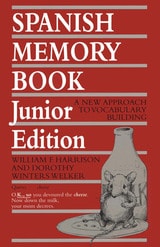
Spanish Memory Book
A New Approach to Vocabulary Building, Junior EditionBy William F. Harrison and Dorothy Winters Welker
University of Texas Press, 1990
Mnemonics is an age-old technique for remembering names, numbers, and many other things. In Spanish Memory Book, Junior Edition, William Harrison and Dorothy Welker offer onginal mnemonic rimes appropriate in subject matter and skill level for junior high and high school students to help them acquire and remember Spanish vocabulary.
Included are mnemonic jingles for several hundred of the 2,000 most commonly used Spanish words. Each jingle contains both the sound of the Spanish word and its English meaning. The authors have also included a general pronunciation guide to Spanish vowels and consonants.
This innovative approach, which the authors have used successfully with their own students, is simple, effective, and entertaining. In the words of one student, "This book teaches me not only Spanish words but English words as well."
Spanish Pronunciation in the Americas
D. Lincoln Canfield
University of Chicago Press, 1981
Spanish Verbs Made Simple(r)
By David Brodsky
University of Texas Press, 2005
It's time for a new approach to learning Spanish verbs. Unlike popular verb guides that require the rote memorization of hundreds of verb forms, this book clearly explains the rules that govern the conjugation of all classes of Spanish verbs—especially the irregular ones that give second-language learners the most trouble. These simple, easy-to-understand rules for conjugating Spanish verbs are effective learning tools for both beginning students and more advanced speakers who want to perfect their usage of Spanish verb forms.
Spanish Verbs Made Simple(r) has many helpful features that you won't find in any other verb guide:
- Clear explanations of all verb tenses and forms.
- The simple rules that govern the conjugation of all verbs—including the 90% of irregular verbs whose irregularities are entirely predictable.
- A detailed discussion of how each verb form is used, with numerous examples.
- A full explanation of the distinction between ser and estar—the single most confusing element in the Spanish verbal system.
- An extended treatment of the subjunctive that will help you understand why it is used in some situations but not others.
- Conjugations for 35 model Spanish verbs and a comprehensive listing of 4,800 verbs that indicates which of the models each verb follows.
Going well beyond any other guide in the clarity and detail of its explanations—as well as the innovative manner in which individual verbs are linked to model conjugations—Spanish Verbs Made Simple(r) is the only guide to Spanish verbs a learner needs.
Spanish Vocabulary
An Etymological ApproachBy David Brodsky
University of Texas Press, 2008
Unlike other vocabulary guides that require the rote memorization of literally thousands of words, this book starts from the premise that using the etymological connections between Spanish and English words—their common derivations from Latin, Greek, and other languages—is the most effective way to acquire and remember vocabulary. This approach is suitable for beginners as well as for advanced students. Teachers of the language will also find much material that can be used to help motivate their students to acquire, and retain, Spanish vocabulary.
Spanish Vocabulary is divided into four parts and four annexes:
- Part I provides background material on the origins of Spanish and begins the process of presenting Spanish vocabulary.
- Part II presents "classical" Spanish vocabulary—words whose form (in both Spanish and English) is nearly unchanged from Latin and Greek.
- Part III deals with "popular" Spanish vocabulary, which underwent significant changes in form (and often meaning) during the evolution from Latin to Spanish. A number of linguistic patterns are identified that will help learners recognize and remember new vocabulary.
- Part IV treats a wide range of themes, including words of Germanic and Arabic origin, numbers, time, food and animals, the family, the body, and politics.
- Annex A: Principal exceptions to the "Simplified Gender Rule"
- Annex B: 700 words whose relations, if any, to English words are not immediately obvious
- Annex C: -cer verbs and related words
- Annex D: 4,500 additional words, either individually or in groups, with English correspondences
Spanish and Empire
Nelsy Echavez-Solano
Vanderbilt University Press, 2007
Subversions of the American Century
Filipino Literature in Spanish and the Transpacific Transformation of the United StatesAdam Lifshey
University of Michigan Press, 2016