Results by title
870 books match the query 'Sports & Recreation' and 92 start with s
Sailing to the Far Horizon
The Restless Journey and Tragic Sinking of a Tall ShipPamela Sisman Bitterman
University of Wisconsin Press, 2004
San Francisco Bay Area Sports
Golden Gate Athletics, Recreation, and CommunityRita Liberti
University of Arkansas Press, 2017
San Francisco Bay Area Sports brings together fifteen essays covering the issues, controversies, and personalities that have emerged as northern Californians recreated and competed over the last 150 years. The area’s diversity, anti-establishment leanings, and unique and beautiful natural surroundings are explored in the context of a dynamic sporting past that includes events broadcast to millions or activities engaged in by just a few.
Professional and college events are covered along with lesser-known entities such as Oakland’s public parks, tennis player and Bay Area native Rosie Casals, environmentalism and hiking in Marin County, and the origins of the Gay Games. Taken as a whole, this book clarifies how sport is connected to identities based on sexuality, gender, race, and ethnicity. Just as crucial, the stories here illuminate how sport and recreation can potentially create transgressive spaces, particularity in a place known for its nonconformity.
Sandlot Seasons
SPORT IN BLACK PITTSBURGHRob Ruck
University of Illinois Press, 1987
Satchel Paige's America
William Price Fox
University of Alabama Press, 2005
Captures the sometimes outrageous, often humorous, and always bigger-than-life spirit of the World's Greatest Pitcher, Leroy Satchel Paige
This book began when the author met "the Satch" for the first time at the Twilight Zone Lounge of the Rhythm Lanes Bowling Alley in Kansas City. What started as a simple interview for Holiday magazine quickly grew into an animated conversation that lasted nearly a week as Paige and Fox moved from bar to club to restaurant to auto repair shop and from one topic to the next. Fox describes, with amazement, the reception the legendary baseball player received at Gates' Place, a famous barbecue restaurant, and The Flamingo, a big dance club. Over the course of the week, Paige shared stories about his start in the Negro leagues, his time with the Kansas City Monarchs, and barnstorming around the country, sleeping on the ground because there were no hotels for blacks. He also tells of his breakthrough to the big leagues when he signed with the Cleveland Indians and later pitched two shutouts against the Chicago White Sox.
In addition to his baseball career, Paige tells Fox about his childhood in Mobile, Alabama, catching fish during the Jubilee, throwing rocks at white boys, hustling bags at the train station, and working in the Depression era medicine shows. In contrast to these humble beginnings, Satchel recounts his later connections with film and music celebrities like Orson Welles, Jelly Roll Morton, Billie Holliday, and Cab Calloway. He also expounds on his friendships with other sports greats, including Goose Tatum, Meadowlark Lemon, and Sugar Ray Robinson.
The ironic intersections between oppression and fame, and between poverty and wealth, that emerge from Paige's narrative memoir exemplify the affliction of talent and genius in an era of racial discrimination and segregation.
Say Her Name
Centering Black Feminism and Black Women in SportLetisha Engracia Cardoso Brown
Rutgers University Press, 2025
Say Her Name delves deeply into issues of gender, the politics of punishment, athlete activism, the politics of Black hair, fingernails and fashion, and the representation and commodification of Blackgirlwomen in sport and society. An entry point into the growing research in sport studies and beyond from a Black feminist lens, Say Her Name offers a clear window into the power and potential of nuanced examinations of sport. As a reflection of the larger social world, sport provides a framework for understanding larger social issues, including racism, sexism, and misogynoir. Blackgirlwomen have varied experiences in sport, and Say Her Name provides a window into those experiences. The book discusses Black women in sports including the South African runner Caster Semenya and the American runners Florence Griffith Joyner and Sha’Carri Richardson, as well as Venus and Serena Williams, Gabby Douglas, and Simone Biles. The women in this book have lived experiences that speak to the larger experiences of Black women and girls in sport and society, while also leaning into a larger discussion of the importance of the social movement #SayHerName.
Saying It's So
A Cultural History of the Black Sox ScandalDaniel A. Nathan
University of Illinois Press, 2002

Schools for Scandal
The Dysfunctional Marriage of Division I Sports and Higher EducationSheldon Anderson
University of Missouri Press, 2024
Sea Drift
Rafting Adventures in the Wake of Kon-TikiCapelotti, P. J
Rutgers University Press, 2001
It was the original Survivor series, only without the omnipresent cameras, paramedics, and faux tribal rituals. Between the spring of 1947 and the summer of the year 2000, more than forty expeditions sought to drift across the oceans of the world on rafts made from straw, from bamboo, and from the same kinds of wood that children use to make model airplanes. These audacious raft voyages began with the legendary Kon-Tiki expedition, under the leadership of the renowned Norwegian explorer Thor Heyerdahl. The Kon-Tiki balsa wood raft drifted more than four thousand miles from Peru to Polynesia, and remained afloat months after experts predicted it would sink to the bottom of the Pacific. Heyerdahl’s radical thesis of a prehistoric world where ancient mariners drifted between continents on ocean currents electrified the postwar world. His Kon-Tiki: Across the Pacific by Raft sold twenty million copies in sixty-five languages.
Sea Drift is the first and only book to document all of the transoceanic raft expeditions that were organized and carried out in the half century after Kon-Tiki. But it is much more than a simple history of exploration. Readers learn of the Mormon who drifted to Hawaii to prove that wise men from Israel had colonized America, and the Frenchman who squeezed fresh water from the entrails of fish as he drifted alone across the Atlantic in a rubber boat. Then there was the anthropologist who put five men and six women on a raft to see who would make love to whom first.
Spanning more than fifty years and recounting more than forty expeditions, Sea Drift is a riveting chronicle of human daring, endurance, and folly.
Seasons in the Sun
The Story of Big League Baseball in MissouriRoger D. Launius
University of Missouri Press, 2002

Seattle Sports
Play, Identity, and Pursuit in the Emerald CityTerry Anne Scott
University of Arkansas Press, 2020
Seattle Sports: Play, Identity, and Pursuit in the Emerald City, edited by Terry Anne Scott, explores the vast and varied history of sports in this city where diversity and social progress are reflected in and reinforced by play. The work gathered here covers Seattle’s professional sports culture as well as many of the city’s lesser-known figures and sports milestones. Fresh, nuanced takes on the Seattle Mariners, Supersonics, and Seahawks are joined by essays on gay softball leagues, city court basketball, athletics in local Japanese American communities during the interwar years, ultimate, the fierce women of roller derby, and much more. Together, these essays create a vivid portrait of Seattle fans, who, in supporting their teams—often in rain, sometimes in the midst of seismic activity—check the country’s implicit racial bias by rallying behind outspoken local sporting heroes.

Secrets of the English War Bow
Hugh D. H. Soar
Westholme Publishing, 2010
A Complete Recreation of the Deadliest Medieval Arm
Dominating medieval battlefields for more than two centuries but requiring long and arduous practice to command, the English war bow and its battle shaft are the symbols of the rise of British power in Europe. Despite being crafted for hundreds of years and wielded by generations of archers, no example of the war bow—the military version of the longbow—exists, outside of a single broken limb. Now for the first time, expert craftsmen use all available evidence including applied archaeology to unlock the secrets of the English war bow. Historian Hugh D. H. Soar is joined by Mark Stretton, master blacksmith, and Joseph Gibbs, bowyer, in order to demonstrate how a war bow and its associated arrow heads and shafts may have been constructed and used. In addition to showing the complete manufacture of a bow from tree selection to stringing and how specialized arrowheads were forged and attached to shafts, Secrets of the English War Bowprovides information on the actual performance of the war bow, including the bow's effectiveness against various materials and, for the first time, its use against moving targets, since bows were often drawn against mounted soldiers. Armed with this new information, Soar provides an analysis of both successes and failures of the war bow in several important battles. Illustrated in color and black and white, Secrets of the English War Bowprovides an invaluable service for those interested in medieval military history, archery, and technology.

Secrets of the Greatest Snow on Earth, Second Edition
Weather, Climate Change, and Finding Deep Powder in Utah's Wasatch Mountains and Around the WorldJim Steenburgh
Utah State University Press, 2023
Utah has long claimed to have the greatest snow on Earth—the state itself has even trademarked the phrase. In Secrets of the Greatest Snow on Earth, Jim Steenburgh investigates Wasatch weather, exposing the myths, explaining the reality, and revealing how and why Utah’s powder lives up to its reputation. Steenburgh also examines ski and snowboard regions beyond Utah, providing a meteorological guide to mountain weather and snow climates around the world.
Chapters explore mountain weather, avalanches and snow safety, historical accounts of weather events and snow conditions, and the basics of climate and weather forecasting. In this second edition, Steenburgh explains what creates the best snow for skiing and snowboarding using accurate and accessible language and 150 color photographs and illustrations, making Secrets of the Greatest Snow on Earth a helpful tool for planning vacations and staying safe during mountain adventures.
This edition is updated with two new chapters covering microclimates and climate change in greater depth. Steenburgh addresses the declining snowpack and the future of snow across the western United States, as well as the declining snow and ice in several regions of the world—the European Alps in particular. Snowriders, weather enthusiasts, meteorologists, students of snow science, and anyone who dreams of deep powder and bluebird skies will want to get their gloves on this new edition of Secrets of the Greatest Snow on Earth.
Praise for the first edition:
“Everything you always wanted to know about how snow forms and how to follow forecasts so you see
how much an”d where is in the book. It’s a must-have for any fan of snow, sure to get you excited about
winter, and give you a bevy of conversation topics for the chairlift ride.”
—Utah Adventure Journal
“For backcountry enthusiasts that find themselves infatuated with weather patterns, snow-water
equivalents, microclimates, and Utah, this book is a dream come true.”
—The Backcountry Skiing Blog
“Steenburgh shares a career’s worth of knowledge in this book. His love of both snow science and skiing
is obvious, and he adds humor and personality to the scientific discussion.”
—First Tracks!! Online Skiing Magazine
“When it comes to snow, the details—both small- and large-scale—do matter. If we all observed our
surroundings with as much curiosity and enthusiasm as Steenburgh, the world could be a much better-
tended place.”
—American Scientist

Secrets of the Greatest Snow on Earth
Weather, Climate Change, and Finding Deep Powder in Utah's Wasatch Mountains and around the WorldJim Steenburgh
Utah State University Press, 2014
Chapters explore mountain weather, avalanches and snow safety, historical accounts of weather events and snow conditions, and the basics of climate and weather forecasting. Steenburgh explains what creates the best snow for skiing and snowboarding in accurate and accessible language and illustrates his points with 150 color photographs, making Secrets of the Greatest Snow on Earth a helpful tool for planning vacations and staying safe during mountain adventures. Snowriders, weather enthusiasts, meteorologists, students of snow science, and anyone who dreams of deep powder and bluebird skies will want to get their gloves on Secrets of the Greatest Snow on Earth.
Watch Book Trailer!(Special thanks to Ski Utah)
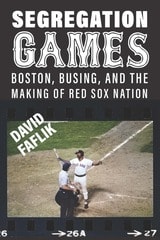
Segregation Games
Boston, Busing, and the Making of Red Sox NationDavid Faflik
University of Massachusetts Press, 2026
A cultural history of race, resistance, and representation in a city divided by politics and play
When outfielder Bernie Carbo joined the Red Sox in 1974, he brought with him a toy gorilla named Mighty Joe Young that became the team’s unofficial mascot for several players and many in the local press. This seemingly innocent stuffed animal was introduced within a baseball team notorious for its stubborn discrimination, and during a particularly fraught era of racial discord in Boston. That June, after years of activism from the city’s Black community, Judge W. Arthur Garrity Jr. ruled that Boston must address the segregation of its schools through redistricting and busing. The ensuing racial animus to these policies led some of the city’s white residents to throw bananas and chant monkey sounds at African American students as they integrated the predominantly white South Boston High School. In this agitated atmosphere, cultural symbols like the Red Sox’s Mighty Joe Young mirrored and amplified the heightened racial tensions of Boston’s busing crisis.
Situated at the intersection of US cultural and social history, Segregation Games examines the surprising ties in 1970s Boston between the racial segregation of the city’s schools and the racial controversies expressed on and off the field of “Red Sox Nation.” “I found out in the black community why they don’t come out [to Fenway Park],” explained Black player Reggie Smith of his experiences with the Red Sox and the city during this period. “The team was the last to get Black players, and some of the things I hear out in the stands make me sick.” To understand these connections, Faflik erases the lines between politics and sport, which routinely blurred in a city suffused with an anti-Black racism that was both deceptively subtle and fiercely overt.
Drawing upon deep archival research from sources that have largely been ignored, such as the Black press of the time, Faflik offers a carefully nuanced portrait of Boston’s cultural life at a pivotal moment in the city’s history.
Selling The Five Rings
The IOC and the Rise of the Olympic CommercialismRobert K Barney
University of Utah Press, 2004
The original scheme for the modern Olympic Games was hatched at an international sports conference at the Sorbonne in June 1894. At the time, few provisions were made for the financial underwriting of the project—providence and the beneficence of host cities would somehow take care of the costs. For much of the first century of modern Olympic history, this was the case, until the advent of television and corporate sponsorship transformed that idealism.
Now, linking with the five-ring logo is good business. Advertising during the Olympic Games guarantees a global audience unmatched in size by any other sports audience in the world. However, if the image begins to tarnish and the corporate sector loses interest, television companies can’t sell advertising to business interests. This was the greatest threat posed by the scandal surrounding Salt Lake City’s bid.
Selling the Five Rings outlines the rise of the Olympic movement from an envisioned instrument of peace and brotherhood, to a transnational commercial giant of imposing power and influence. Using primary source documents such as minutes of the IOC General Sessions, minutes and reports of various IOC sub-committees and commissions concerned with finance, reports of key marketing agencies, and the letters and memoranda written to and by the major figures in Olympic history, the authors track the history of a fascinating global institution.
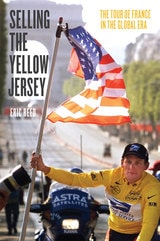
Selling the Yellow Jersey
The Tour de France in the Global EraEric Reed
University of Chicago Press, 2014
In Selling the Yellow Jersey, Eric Reed examines the Tour’s development in France as well as the event’s global athletic, cultural, and commercial influences. The race is the crown jewel of French cycling, and at first the newspapers that owned the Tour were loath to open up their monopoly on coverage to state-owned television. However, the opportunity for huge payoffs prevailed, and France tapped into global networks of spectatorship, media, business, athletes, and exchanges of expertise and personnel. In the process, the Tour helped endow world cycling with a particularly French character, culture, and structure, while providing proof that globalization was not merely a form of Americanization, imposed on a victimized world. Selling the Yellow Jersey explores the behind-the-scenes growth of the Tour, while simultaneously chronicling France’s role as a dynamic force in the global arena.
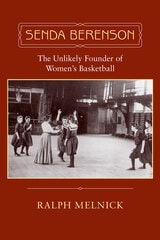
Senda Berenson
The Unlikely Founder of Women's BasketballRalph Melnick
University of Massachusetts Press, 2007
In the winter of 1892 the new instructor of physical training at Smith College, a diminutive young woman with a heavy accent, introduced her students to an adaptation of James Naismith's new game of Basket Ball. An immediate if unexpected success, the game spread to other women's schools across the country, and soon its founder, Senda Berenson (1868–1954), was called upon to codify its distinctive set of gender-specific rules. Emphasizing team passing and position over individual play, the version she instituted defined women's basketball for seventy years and eventually earned her the honor of being the first female elected to the Basketball Hall of Fame.
Yet as Ralph Melnick points out, Berenson's pioneering role in the history of women's athletics was more a matter of accident than destiny. A Jewish immigrant from Lithuania, prone to ill health throughout her childhood, she enrolled in the Boston Normal School for Gymnastics in the fall of 1890 with the hope of strengthening herself so that she could pursue a career as a pianist, dancer, or painter. Instead she soon became both a practitioner and a proponent of a new approach to women's physical education, one aimed at providing a “natural outlet of the play instinct,” developing “endurance and physical courage” as well as “quickness of thought and action,” and promoting through teamwork the “power of organization” women needed to achieve full social equality.
Extending her work into the factories and blighted urban tenements of America, Berenson later won the recognition of Jane Addams, Margaret Sanger, and other progressive reformers. Believing that “Americans have forgotten how to play,” she wanted to teach others to live “joyfully—beautifully.” For Berenson, the physical culture of exercise and games, played not for competition but for personal and social development as well as sheer enjoyment, was but another form of art.
This convergence of athletics and aesthetics was hardly surprising, Melnick explains, because the single most important influence on Senda Berenson's life was her brother, the renowned art critic and connoisseur Bernard Berenson. The two siblings wrote frequently to each other over the course of their lives, and the author draws heavily on their correspondence throughout the book to create an intimate and insightful portrait of a remarkable American woman.
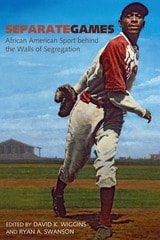
Separate Games
African American Sport behind the Walls of SegregationDavid K. Wiggins
University of Arkansas Press, 2017
Winner of the 2017 NASSH Book Award for best edited collection.
The hardening of racial lines during the first half of the twentieth century eliminated almost all African Americans from white organized sports, forcing black athletes to form their own teams, organizations, and events. This separate sporting culture, explored in the twelve essays included here, comprised much more than athletic competition; these “separate games” provided examples of black enterprise and black self-help and showed the importance of agency and the quest for racial uplift in a country fraught with racialist thinking and discrimination.
The significance of this sporting culture is vividly showcased in the stories of the Cuban Giants baseball team, basketball’s New York Renaissance Five, the Tennessee State Tigerbelles track-and-field team, black college football’s Turkey Bowl Classic, car racing’s Gold and Glory Sweepstakes, Negro League Baseball’s East-West All-Star game, and many more. These teams, organizations, and events made up a vibrant national sporting complex that remained in existence until the integration of sports beginning in the late 1940s. Separate Games explores the fascinating ways sports helped bind the black community and illuminate race pride, business acumen, and organizational abilities.
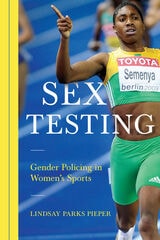
Sex Testing
Gender Policing in Women's SportsLindsay Pieper
University of Illinois Press, 2016
Ranging from Cold War tensions to gender anxiety to controversies around doping, Lindsay Parks Pieper explores sex testing in sport from the 1930s to the early 2000s. Pieper examines how the IOC in particular insisted on a misguided binary notion of gender that privileged Western norms. Testing evolved into a tool to identify--and eliminate--athletes the IOC deemed too strong, too fast, or too successful. Pieper shows how this system punished gifted women while hindering the development of women's athletics for decades. She also reveals how the flawed notions behind testing--ideas often sexist, racist, or ridiculous--degraded the very idea of female athleticism.
Shakespeare and Baseball
Reflections of a Shakespeare Professor and Detroit Tigers FanSamuel Crowl
Ohio University Press, 2024
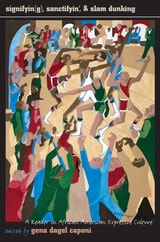
Signifyin(g), Sanctifyin', and Slam Dunking
A Reader in African American Expressive CultureGena Tabery
University of Massachusetts Press, 1999
Observers of American society have long noted the distinctive contribution of African Americans to the nation's cultural life. We find references to African American music and dance, black forms of oral expression, even a black style of playing basketball. But what do such terms really mean? Is it legitimate to talk about a distinct African American aesthetic, or is this simply a vestige of an outmoded racial essentialism? What makes a particular form of cultural expression “black” other than the fact that some African Americans may practice it? These are some of the questions addressed in the readings gathered in this volume by Gena Dagel Caponi. The essays, some previously published and others new, spring from a variety of disciplines and cover a broad range of topics, from the communal ritual of the ring shout to the evolution of rap to the improvisational genius of Michael Jordan. While each piece focuses on a different aspect of African American expressive culture, together they reveal a set of creative principles, techniques, and practices—a cultural aesthetic—that is remarkably consistent and resilient.
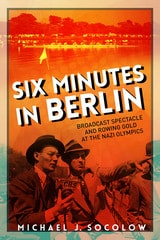
Six Minutes in Berlin
Broadcast Spectacle and Rowing Gold at the Nazi OlympicsMichael J Socolow
University of Illinois Press, 2016
The Berlin Games matched cutting-edge communication technology with compelling sports narrative to draw the blueprint for all future sports broadcasting. A global audience--the largest cohort of humanity ever assembled--enjoyed the spectacle via radio. This still-novel medium offered a "liveness," a thrilling immediacy no other technology had ever matched. Michael J. Socolow's account moves from the era's technological innovations to the human drama of how the race changed the lives of nine young men. As he shows, the origins of global sports broadcasting can be found in this single, forgotten contest. In those origins we see the ways the presentation, consumption, and uses of sport changed forever.
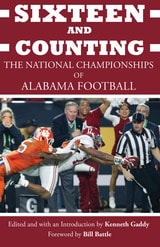
Sixteen and Counting
The National Championships of Alabama FootballEdited and with an Introduction by Kenneth Gaddy; Foreword by Bill Battle
University of Alabama Press, 2017
Dramatic accounts of every University of Alabama National Championship football season recounted by noted sports writers, players, and Alabamians.
Dating back to 1925, when Wallace Wade coached the Crimson Tide to an undefeated season and earned a spot in the Rose Bowl, the driving goal of every University of Alabama football season has been a national championship. A winning team surfaced that very next year, when Hoyt “Wu” Winslett’s squad sealed the national championship at the Rose Bowl for a second time. Winning seasons and bowl games culminating in the coveted crown followed again in 1930, 1934, 1941, 1961, 1964, 1965, 1973, 1978, 1979, 1992, 2009, 2011, 2012, and 2015—more championships than any other college team in the nation.
Sixteen and Counting features a chapter highlighting each of these championship seasons and collects the legendary stories of many of the outstanding coaches and players on the University of Alabama’s championship teams. College football legends such as Wallace Wade, Wu Winslett, Johnny Mack Brown, Pooley Herbert, Frank Thomas, Dixie Howell, Don Hutson, Jimmy Nelson, Holt Rast, Pat Trammel, Sam Bailey, Lee Roy Jordan, Harry Gilmer, Bill Lee, Ken Stabler, Joe Namath, Gary Rutledge, Randy Billingsley, Barry Krauss, Clem Gryska, Gene Stallings, Paul “Bear” Bryant, and, of course, Nick Saban all make prominent appearances.
A seventeenth chapter is included that looks at the uncrowned teams commonly referred to as “the other five,” who were considered national champions by at least one national ranking service at the end of the season. Every glorious milestone and high point in Alabama football history is included here: “Mama called,” the wishbone formation, “The Goal Line Stand,” the Million Dollar Band, the coaching tower, the Davis kicking dynasty, the Notre Dame box, Coach of the Year, Team of the Decade, and two Heisman trophy winners.

Skate Life
Re-Imagining White MasculinityEmily Chivers Yochim
University of Michigan Press, 2009
"Intellectually deft and lively to read, Skate Life is an important addition to the literature on youth cultures, contemporary masculinity, and the role of media in identity formation."
---Janice A. Radway, Northwestern University, author of Reading the Romance: Women, Patriarchy, and Popular Literature
"With her elegant research design and sophisticated array of anthropological and media studies approaches, Emily Chivers Yochim has produced one of the best books about race, gender, and class that I have read in the last ten years. In a moment where celebratory studies of youth, youth subcultures, and their relationship to media abound, this book stands as a brilliantly argued analysis of the limitations of youth subcultures and their ambiguous relationship to mainstream commercial culture."
---Ellen Seiter, University of Southern California
"Yochim has made a valuable contribution to media and cultural studies as well as youth and American studies by conducting this research and by coining the phrase 'corresponding cultures,' which conceptualizes the complex and dynamic processes skateboarders employ to negotiate their identities as part of both mainstream and counter-cultures."
---JoEllen Fisherkeller, New York University
Skate Life examines how young male skateboarders use skate culture media in the production of their identities. Emily Chivers Yochim offers a comprehensive ethnographic analysis of an Ann Arbor, Michigan, skateboarding community, situating it within a larger historical examination of skateboarding's portrayal in mainstream media and a critique of mainstream, niche, and locally produced media texts (such as, for example, Jackass, Viva La Bam, and Dogtown and Z-Boys). The book uses these elements to argue that adolescent boys can both critique dominant norms of masculinity and maintain the power that white heterosexual masculinity offers. Additionally, Yochim uses these analyses to introduce the notion of "corresponding cultures," conceptualizing the ways in which media audiences both argue with and incorporate mediated images into their own ideas about identity. In a strong combination of anthropological and media studies approaches, Skate Life asks important questions of the literature on youth and provides new ways of assessing how young people create their identities.
Emily Chivers Yochim is Assistant Professor in the Department of Communication Arts, Allegheny College.
Cover design by Brian V. Smith

Skating Away from the Binary
Erica Rand
University of Minnesota Press, 2026
Reimagining sport beyond the gender binary, where movement and identity break free from tradition
Skating Away from the Binary takes a critical look at the ways gender binarism remains deeply embedded in sport, with a focus on pairs figure skating. Erica Rand examines the persistence of these traditional gender structures and explores why trans-hostile sports policies are on the rise, even among those who may otherwise oppose anti-trans rhetoric. Drawing on her own experience as part of a gender-nonconforming pairs team, Rand reveals how figure skating’s historical gender norms intersect with racialized expectations to reinforce widely exclusionary practices in sport.
In 2018, Rand teamed up with Anna Kellar, a democracy advocate and skating journalist, to learn pairs skating. Charting this endeavor, Skating Away from the Binary highlights the challenges and joys Rand and Kellar encounter as they navigate a sport designed around rigid male/female roles. Through lively descriptions of their training and insightful comparisons to other physical activities like tennis, quadball, and ballet, Rand identifies the interconnected binarisms shaping athletic participation, from oversimplified distinctions between cis and trans to the artificial division between athletic and artistic.
Ultimately, Skating Away from the Binary is more than a critique of gender norms in sport—it’s a call to transform them. Challenging readers to consider new possibilities for movement, connection, and collaboration beyond conventional gendered expectations, Rand offers a vision of sport as a space where all people can experience joy and freedom in their bodies and identities.
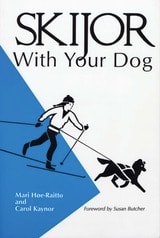
Skijor With Your Dog
Mari Høe-Raitto and Carol Kaynor
University of Alaska Press, 1991
Skijoring is the exciting sport of being pulled on skis by one or more dogs in harness. With 200 pages and more than 75 photos and illustrations, Skijor With Your Dog is the first full-length volume written for those interested in this simple, enjoyable Scandinavian sport. In this book you will find: how to teach your dog to pull, what equipment you need, how to include children, racing tips and how to train for competition, and how to camp and travel with dogs.
Designed for easy reading, this practical guide to skijoring is a must for anyone interested in dogs, skiing, and winter fun.
Skijor with Your Dog
Second EditionMari Høe-Raitto and Carol Kaynor
University of Alaska Press, 2012
Skijoring, or being pulled on skis by a dog in harness, is a great sport in which almost everyone—and almost any breed of dog—can participate. It requires little beyond a pair of skis and a dog with a desire to pull. The second edition of this popular and practical guide to the sport covers what equipment is needed, how to teach a dog to pull, and how to work with your dog year-round. Although it is geared toward beginners, Skijor with Your Dog offers plenty of useful information for experienced skijorers as well, including racing tips, how to involve children, how to camp and travel with dogs, and how to train for competition. The book also covers canicross, bikejoring, and other ways to work with dogs when there’s no snow.With this book in hand, readers will have all the information they need to begin enjoying the outdoors with their dogs in a whole new way.

So Great Was the Slaughter
Market Hunters, Sportsmen, and Wildlife Conservation in ArkansasBuckley T. Foster
University of Alabama Press, 2025
Winner of the 2026 J.G. Ragsdale Book Award
So Great Was the Slaughter reveals the untold story of Arkansas conservation pioneers who saved the state’s game and fish populations. As Arkansas entered the twentieth century, the national demand for meat combined with the ability to ship millions of animals to hungry cities like New Orleans, Memphis, and Chicago had driven many species, including bison and passenger pigeons, to extinction in Arkansas. Many others, including deer, bear, turkey, quail, and fish, were in danger of disappearing.
In response, an unlikely coalition of Arkansas sportsmen, hunters, and conservationists created a vision for conservation legislation, game laws, and the establishment of fish hatcheries and wildlife refuges. With support from influential outsiders like E. A. McIlhenny and the United States Biological Survey, they waged a long battle against entrenched political and commercial interests.
Buckley Foster’s meticulous research reveals how these pioneers fought to save the state’s wildlife resources from destruction and laid the foundations for sustainable, modern wildlife management in Arkansas. So Great Was the Slaughter will fascinate hunters, conservationists, historians, and those interested in the history of wildlife conservation and conflicts between market hunters and sportsmen in the United States and the American South.

Soccer
Jean-Philippe Toussaint
Rutgers University Press, 2019
Soccer takes readers on an idiosyncratic journey that delves deep into the author’s childhood memories, but also transports us to World Cup matches in Japan, Germany, South Africa, and Brazil. Along the way, it kicks around such provocative questions as: How does soccer fandom both support and transcend nationalism? How are our memories of soccer matches both collective and distinctly personal? And how can a game this beautiful and this ephemeral be adequately captured in words?
Part travelogue, part memoir, and part philosophical essay, Soccer is entirely unique, a thrilling departure from the usual clichés of sports writing. Even readers with little knowledge of the game will be enthralled by Touissant’s profound musings and lyrical prose.
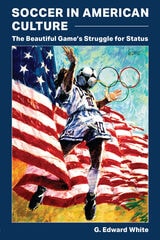
Soccer in American Culture
The Beautiful Game’s Struggle for StatusG. Edward White
University of Missouri Press, 2023
In Soccer in American Culture: The Beautiful Game’s Struggle for Status, G. Edward White seeks to answer two questions. The first is why the sport of soccer failed to take root in the United States when it spread from England around much of the rest of the world in the late nineteenth and twentieth centuries. The second is why the sport has had a significant renaissance in America since the last decade of the twentieth century, to the point where it is now the 4th largest participatory sport in the United States and is thriving, in both men’s and women’s versions, at the high school, college, and professional levels.
White considers the early history of “Association football” (soccer) in England, the persistent struggles by the sport to establish itself in America for much of the twentieth century, the role of public high schools and colleges in marginalizing the sport, the part played by FIFA, the international organization charged with developing soccer around the globe, in encumbering the development of the sport in the United States, and the unusual history of women’s soccer in America, which evolved in the twentieth century from a virtually nonexistent sport to a major factor in the emergence of men’s—as well as women's—soccer in the U.S. in the twentieth century.
Incorporating insights from sociology and economics, White explores the multiple factors that have resulted in the sport of soccer struggling to achieve major status in America and why it currently has nothing like the cultural impact of other popular American sports—baseball and American football— which can be seen by the comparative lack of attention paid to it in sports media, its low television ratings, and virtually nonexistent radio broadcast coverage.
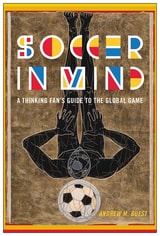
Soccer in Mind
A Thinking Fan's Guide to the Global GameAndrew M. Guest
Rutgers University Press, 2022
This book provides a thinking fan’s guide to the world’s most popular game, proposing a way of engaging soccer that sparks intellectual curiosity and employs critical consciousness. Using stories and data, along with ideas from sociology, psychology, and across the social sciences, it provides readers with new ways of understanding fanaticism, peak performance, talent development, and more. Drawing on concepts ranging from cognitive bias to globalization, it illuminates meanings of the game for players and fans while investigating impacts on our lives and communities. While it considers soccer cultures across the globe, the book also analyzes what makes U.S. soccer culture special, including its embrace of the women’s game.
As a scholar, former minor league player and coach, and fan, Andrew Guest offers a distinctive perspective on soccer in society. Whatever name you call it, and whatever your interest in it, Soccer in Mind will enrich your own view of the one truly global game.
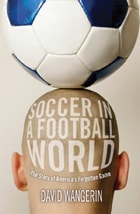
Soccer in a Football World
The Story of America's Forgotten GameDavid Wangerin
Temple University Press, 2008
David Beckham’s arrival in Los Angeles represents the latest attempt to jump-start soccer in the United States where, David Wangerin says, it “remains a minority sport.” With the rest of the globe so resolutely attached to the game, why is soccer still mostly dismissed by Americans?
Calling himself “a soccer fan born in the wrong country at nearly the wrong time,” Wangerin writes with wit and passion about the sport’s struggle for acceptance in Soccer in a Football World. A Wisconsin native, he traces the fragile history of the game from its early capitulation to gridiron on college campuses to the United States’ impressive performance at the 2002 World Cup. Placing soccer in the context of American sport in general, he chronicles its enduring struggle alongside the country’s more familiar pursuits and recounts the shifting attitudes toward the “foreign” game. His story is one that will enrich the perspective of anyone whose heart beats for the sport, and is curious as to where the game has been in America—and where it might be headed.
Soccer's Neoliberal Pitch
The Sport's Power, Profit, and Discursive PoliticsJohn M. Sloop
University of Alabama Press, 2023
A powerful cultural critique of soccer’s public rhetoric
American sports agnostics might raise an eyebrow at the idea that soccer represents a staging ground for cultural, social, and political possibility. It is just another game, after all, in a society where mass-audience spectator sports largely avoid any political stance other than a generic, corporate-friendly patriotism. But John M. Sloop picks up on the work of Laurent Dubois and others to see in American soccer—a sport that has achieved immense participation and popularity despite its struggle to establish major league status—a game that permits surprisingly diverse modes of thinking about national identity because of its marginality.
As a rhetorician who draws on both critical theory and culture, Sloop seeks to read soccer as the game intersects with gender, race, sexuality, and class. The result of this engagement is a sense of both enormous possibility and real constraint. If American soccer offers more possibility because of its marginality, looking at how those possibilities are constrained can provide valuable insights into neoliberal logics of power, profit, politics, and selfhood.
In Soccer’s Neoliberal Pitch, Sloop analyzes a host of soccer-adjacent phenomena: the equal pay dispute between the US women’s national team and the US Soccer Federation, the significance of hooligan literature, the introduction of English soccer to American TV audiences, the strange invisibility of the Mexican soccer league despite its consistent high TV ratings, and the reading of US national teams as “underdogs” despite the nation’s quasi-imperial dominance of the Western hemisphere. An invaluable addition to a growing bookshelf on soccer titles, Soccer’s Neoliberal Pitch serves as a model for critical cultural work with sports, with appeal to not only sports studies, but cultural studies, communication, and even gender studies classrooms.
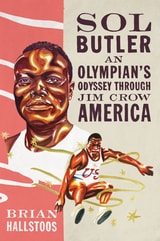
Sol Butler
An Olympian's Odyssey through Jim Crow AmericaBrian Hallstoos
University of Illinois Press, 2026
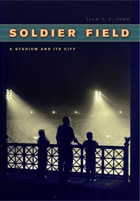
Soldier Field
A Stadium and Its CityLiam T. A. Ford
University of Chicago Press, 2009
Sports fans nationwide know Soldier Field as the home of the Chicago Bears. For decades its signature columns provided an iconic backdrop for gridiron matches. But few realize that the stadium has been much more than that. Soldier Field: A Stadium and Its City explores how this amphitheater evolved from a public war memorial into a majestic arena that helped define Chicago.
Chicago Tribune staff writer Liam Ford led the reporting on the stadium’s controversial 2003 renovation—and simultaneously found himself unearthing a dramatic history. As he tells it, the tale of Soldier Field truly is the story of Chicago, filled with political intrigue and civic pride. Designed by Holabird and Roche, Soldier Field arose through a serendipitous combination of local tax dollars, City Beautiful boosterism, and the machinations of Mayor “Big Bill” Thompson. The result was a stadium that stood at the center of Chicago’s political, cultural, and sporting life for nearly sixty years before the arrival of Walter Payton and William “The Refrigerator” Perry.
Ford describes it all in the voice of a seasoned reporter: the high school football games, track and field contests, rodeos, and even NASCAR races. Photographs, including many from the Chicago Park District’s own collections, capture these remarkable scenes: the swelling crowds at ethnic festivals, Catholic masses, and political rallies. Few remember that Soldier Field hosted Billy Graham and Martin Luther King Jr., Judy Garland and Johnny Cash—as well as Grateful Dead’s final show.
Soldier Field captures the dramatic history of Chicago’s stadium on the lake and will captivate sports fans and historians alike.
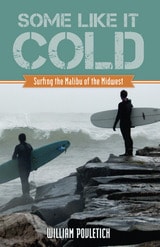
Some Like It Cold
Surfing the Malibu of the MidwestWilliam Povletich
Wisconsin Historical Society Press, 2016
Some Like It Cold
chronicles the true story of twin brothers Lee and Larry Williams, whose love of surfing evolved in the most unlikely of geographies: off the shores of Lake Michigan. From their boyhood home in Sheboygan, Wisconsin, the brothers trekked to the local beach with their longboards and their dreams to master the waves at spots like the Elbow and the Cove. The next six decades proved that their zeal for catching grinders and barrels was much more than a hobby.
Surfing in the cold had its challenges, and Lee and Larry recall stories of freak storms, ice-encrusted beaches, and near drownings, along with the usual hypothermia, helped but not cured by their customized cold-water wetsuits. Despite living nearly 2,000 miles from either coast, Lee and Larry have made a lifestyle out of freshwater surfing, recreating their hometown as "The Malibu of the Midwest" and gaining international fame as hosts of the Dairyland Surf Classic.
With humor and wit, author William Povletich brings their tale of revolutionizing surf culture to the page.
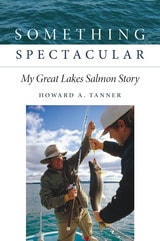
Something Spectacular
My Great Lakes Salmon StoryHoward A. Tanner
Michigan State University Press, 2018
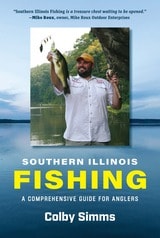
Southern Illinois Fishing
A Comprehensive Guide for AnglersColby Simms
Southern Illinois University Press, 2025
The ultimate resource for sport fishing in southern Illinois
Southern Illinois’s many waterways teem with an incredible variety of fish species, and award-winning fisherman and journalist Colby Simms knows exactly where and how to catch them all.
Within these pages, Simms shares the secrets he’s gleaned from years of hard-won experience: colossal catfish dominate the Mississippi River; monstrous muskies rule over Kinkaid Lake. Rend gives up record crappie and bowfin, while Crab Orchard produces excellent largemouth bass fishing and Cedar offers huge striped bass. Whether you’re powerboating a large lake or paddling an out-of-the-way oxbow, the region presents countless opportunities for different styles of fishing. Wondering which bait and tackle will produce the best results, or how seasonal weather affects fish migration patterns? Simms has already conferred with fellow fishing pros as well as biologists, outdoor sports media figures, and other experts to bring you the most current, site-specific information possible. From fishing fundamentals to the most advanced, cutting-edge techniques, he presents a battle plan for attacking the waters, big and small, of the lower Prairie State, which will benefit all anglers—from beginners to seasoned tournament competitors.
Nestled between the critical information and detailed instructions, you’ll find stories from Simms and additional professional anglers, state fisheries staff, recreational fishers, and others. You’ll find encouragement and motivation to put away life’s modern distractions and get back to nature. Southern Illinois Fishing brims with enthusiasm, humor, and heart, and is sure to educate and inspire readers to lose themselves in the ancient tradition and modern sport of fishing.
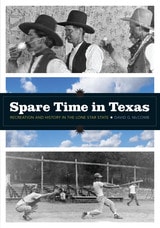
Spare Time in Texas
Recreation and History in the Lone Star StateBy David G. McComb
University of Texas Press, 2008
What do Texans' pastimes and recreations say about their characters? Looking at Texas history from a new angle, David McComb starts from the premise that how people spend their leisure time may well reveal more about their true natures and interests than the work they do or their family connections. In this innovative book, McComb traces the history of various types of recreation in Texas, gathering significant insights into the characters of Texans from the pleasures they have pursued.
Reflecting the frontier origins of Texas, McComb starts with the recreations that were most popular with men in a crude, still-developing society—drinking, gambling, and whoring. He goes on to show how, as Texas became more civilized, so did its diversions. He describes how Texans have connected with nature in parks and zoos; watched football and baseball in great stadiums such as the Astrodome and Cotton Bowl; discovered the pleasure of reading in public and university libraries; and enjoyed radio, TV, movies, and live theater in places such as Houston's Alley Theatre.
This recreational history reveals that Texans are open-minded and generous; that they respect the land; oppose prostitution but indulge in gambling and drinking; support racial and gender rights; love zoos; champion libraries; take pride in theatrical productions; and adore sports.
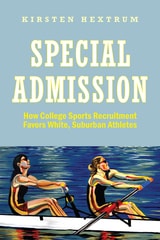
Special Admission
How College Sports Recruitment Favors White Suburban AthletesKirsten Hextrum
Rutgers University Press, 2021
Special Admission contradicts the national belief that college sports provide upward mobility opportunities. Kirsten Hextrum documents how white middle-class youth become overrepresented on college teams. Her institutional ethnography of one elite athletic and academic institution includes over 100 hours of interviews with college rowers and track & field athletes. She charts the historic and contemporary relationships between colleges, athletics, and white middle-class communities that ensure white suburban youth are advantaged in special athletic admissions. Suburban youth start ahead in college admissions because athletic merit—the competencies desired by university recruiters—requires access to vast familial, communal, and economic resources, all of which are concentrated in their neighborhoods. Their advantages increase as youth, parents, and coaches strategically invest in and engineer novel opportunities to maintain their race and class status. Thus, college sports allow white, middle-class athletes to accelerate their racial and economic advantages through admission to elite universities.
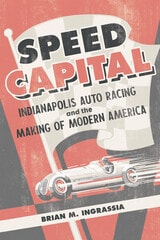
Speed Capital
Indianapolis Auto Racing and the Making of Modern AmericaBrian M. Ingrassia
University of Illinois Press, 2024
The 1909 opening of the Indianapolis Motor Speedway marked a foundational moment in the history of automotive racing. Events at the famed track and others like it also helped launch America’s love affair with cars and an embrace of road systems that transformed cities and shrank perceptions of space.
Brian Ingrassia tells the story of the legendary oval’s early decades. This story revolves around Speedway cofounder and visionary businessman Carl Graham Fisher, whose leadership in the building of the transcontinental Lincoln Highway and the iconic Dixie Highway had an enormous impact on American mobility. Ingrassia looks at the Speedway’s history as a testing ground for cars and airplanes, its multiple close brushes with demolition, and the process by which racing became an essential part of the Golden Age of Sports. At the same time, he explores how the track’s past reveals the potent links between sports capitalism and the selling of nostalgia, tradition, and racing legends.
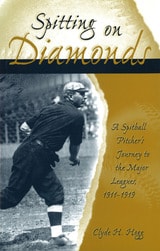
Spitting on Diamonds
A Spitball Pitcher's Journey to the Major Leagues, 1911-1919Clyde H. Hogg
University of Missouri Press, 2005

Sponsorship for Sport Managers
John L. Crompton
FiT Publishing, 2014
Securing financial resources through sponsorships is a prominent element in the job descriptions of many sport managers and the importance of that task has increased exponentially in recent years. Sponsorship for Sport Managers provides readers with an understanding of how companies use sponsorship in their marketing programs and how sport managers can leverage that knowledge into greater sponsorship opportunities.
Widely acclaimed author John Crompton masterfully integrates the conceptual with the applied as Sponsorship for Sport Managers helps readers:
• understand how companies use sponsorship in their marketing programs,
• be responsive to sponsors' needs,
• charge an equitable fee for providing sponsors with leveraging opportunities,
• be active partners with the sponsors to help them meet their objectives, and
• measure the extent to which the objectives were accomplished.
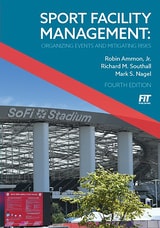
Sport Facility Management
Organizing Events and Mitigating Risks, Fourth EditionRobert E. Ammon
FiT Publishing, 2023
The success of facilities and events in a multi-billion dollar sport industry requires that sport and event facility managers understand the complex relationships between the events, facilities, the players and the public and the risks involved in organizing events.
Sport Facility Management: Organizing Events and Mitigating Risks, 4th Edition, examines what it takes to successfully operate and manage a sport facility. Veteran authors Robin Ammon, Richard Southall, and Mark Nagel provide a framework for the successful operation of sport and event venues through proven strategies and techniques, as highlighted through salient industry examples.
Chapters in this edition explore the complex rules and relationships of public and private financing and ownership, the management of facility revenues and expenses, pricing strategies at the box office, approaches to booking and scheduling, best practices in leveraging human resources, as well as an understanding of and adherence to laws and regulations governing and affecting facilities, employees, and the public through venue contracts, risks, liability, negligence, crowd and alcohol management, as well as emergency planning.
Sport Facility Management: Organizing Events and Mitigating Risks, 4th Edition, builds understanding of this important segment of the global sport industry to prepare undergraduate and graduate students for the challenges, the risks, and the rewards inherent in operating sport and event facilities.
Sport and Exercise Science
ESSAYS IN THE HISTORY OF SPORTS MEDICINEEdited by Jack W. Berryman and Roberta J. Parks
University of Illinois Press, 1992
athlete's heart, exercise physiology, physical activity and sport for females, women's
health, physical culture and quackery, diet, and more.

Sport and Moral Conflict
A Conventionalist TheoryWilliam J.Morgan
Temple University Press, 2020
What is the purpose of sport, and how are ethical conceptions of sport shaped by the answers to this question? In Sport and Moral Conflict, William Morgan investigates, examining sport as a moral crucible that puts athletes in competitive, emotionally charged situations where fairness and equality are contested alongside accomplishment.
Morgan looks at the modern Olympics—from 1906 Athens to 1924 Paris, when the Games reached international prestige — in order to highlight the debate about athletic excellence and the amateur-professional divide. Whereas the Americans emphasized winning, the Europeans valued a love of the game. Morgan argues that the existing moral theories of sport—formalism and broad internalism (aka interpretivism), which rely on rules and general principles—fall short when confronted with such a dispute as the transition from amateur to professional sport. As such, he develops a theory of conventionalism, in which the norms at work in athletic communities determine how players should ethically acquit themselves. Presenting his case for an ethical theory of sport, Morgan provides insights regarding the moral controversies and crises that persist today.
Sport and Neoliberalism
Politics, Consumption, and CultureDavid L. Andrews
Temple University Press, 2012
Offering new approaches to thinking about sports and political ideologies, Sport and Neoliberalism explores the structures, formations, and mechanics of neoliberalism. The editors and contributors to this original and timely volume examine the intersection of sport as a national pastime and also an engine for urban policy—e.g., stadium building—as well as a powerful force for influencing our understanding of the relationship between culture, politics, and identity.
Sport and Neoliberalism examines the ways the neoliberal project creates priorities for civic society and how, in effect, it turns many aspects of sport into a vehicle of public governance. From the relationship between sport and the neo-liberal state, through the environmental dimensions of neo-liberal sport, to the political biopolitics of obesity, the essays in this volume explore the ways in which the “logics” of neoliberalism are manifest as powerful public pedagogies through the realm of popular culture.
Contributors include: Michael Atkinson, Ted Butryn, C. L. Cole, Norman Denzin, Grant Farred, Jessica Francombe, Caroline Fusco, Michael D. Giardina, Mick Green, Leslie Heywood, Samantha King, Lisa McDermott, Mary G. McDonald, Toby Miller, Mark Montgomery, Joshua I. Newman, Jay Scherer, Kimberly S. Schimmel, and Brian Wilson
In the series Sporting, edited by Amy Bass
Sport and Political Ideology
By John M. Hoberman
University of Texas Press, 1984
Across the modern political spectrum, left-wing and right-wing political theorists have invested sport with ideological significance. That significance, however, varies distinctively and characteristically with the ideology—a phenomenon John Hoberman terms "ideological differentiation." Taking this phenomenon as its point of departure, this provocative work interprets the major sport ideologies of the twentieth century as distinct expressions of political doctrine.
Hoberman argues that a political ideology's interpretation of sport is shaped in part by the value it assigns to work and play as modes of experience; the political anthropologies of right and left can be distinguished by examining their resistance to—or affinity for—sportive imagery of their leaders and of the state itself; there exists a fascist temperament that shows an affinity to athleticism and the sphere of the body that is not shared by the left.
Tracing modern sport ideology back to its premodern antecedents, Hoberman examines the interpretations of sport that have been promulgated by European political intellectuals, such as cultural conservatives and contemporary neo-Marxists, and by the official ideologists of Nazi Germany, the Soviet Union, the German Democratic Republic, and China before and after Mao.
As a form of mass theater, sport can advertise any ideology. But the deeper relationship between sport and political ideology has never before been explored wth such vigor. Presenting the first general theory of sport and political ideology to appear in any language, Hoberman's groundbreaking work is a unique and invaluable contribution to the intellectual and political history of sport in the twentieth century.
Sport and the Law
Historical and Cultural IntersectionsSamuel O. Regalado
University of Arkansas Press, 2014
Sport and the Neoliberal University
Profit, Politics, and PedagogyKing-White, Ryan
Rutgers University Press, 2018
The contributors to Sport and the Neoliberal University examine how intercollegiate athletics became a contested terrain of public/private interests. They look at college sports from economic, social, legal, and cultural perspectives to cut through popular mythologies regarding intercollegiate athletics and to advocate for increased clarity about what is going on at a variety of campuses with regard to athletics. Focusing on current issues, including the NCAA, Title IX, recruitment of high school athletes, and the Penn State scandal, among others, Sport and the Neoliberal University shows the different ways institutions, individuals, and corporations are interacting with university athletics in ways that are profoundly shaped by neoliberal ideologies.