Results by title
77 books match the query 'States' and 18 start with s
State Constitutional Politics
Governing by Amendment in the American StatesJohn Dinan
University of Chicago Press, 2018
With State Constitutional Politics, John Dinan looks at the various occasions in American history when state constitutional amendments have served as instruments of governance. Among other things, amendments have constrained state officials in the way they levy taxes and spend money; enacted policies unattainable through legislation on issues ranging from minimum wage to the regulation of marijuana; and updated understandings of rights, including religious liberty, equal protection, and the right to bear arms. In addition to comprehensively chronicling the ways amendments shape politics in the states, Dinan also assesses the consequences of undertaking changes in governance through amendments rather than legislation or litigation. For various reasons, including the greater stability and legitimacy of changes achieved through the amendment process, he argues that it might be a more desirable way of achieving change.

State Taxation Policy and Economic Growth
Michael Barker, ed.
Duke University Press, 1983
States And Labor Markets
edited by John Myles and Jill Quadagno
Temple University Press, 1991
During the last decade worries about population aging, increases in national expenditures for the elderly, and the trend toward early retirement have aroused new concerns about the future of old-age security. Myles and Quadagno have assembled a collection of original essays that examine how different countries have responded to these issues.
The essays in Part I explore the recent politics of old age in Great Britain, Canada, Poland, Scandinavia, West Germany, France, the Netherlands, Japan, and Australia. They demonstrate that while, during the Reagan and Thatcher era, the United States and Great Britain forged debates about old-age policies around a neo-conservative agenda, other countries facing similar matters followed different paths. In Part II, the authors examine how transformations in labor- market practices are gradually altering the status of older workers and with it our conventional understanding of old age.
The reconstruction of the international division of labor, the shift of employment from goods to services, and the adoption of new, knowledge-intensive technologies are changing the economic and political basis of the organization of old age. As we move toward the next century, these essays provide a starting point for a new generation of studies in the political economy of aging.
States And Strangers
Refugees And Displacements Of StatecraftNevzat Soguk
University of Minnesota Press, 1999
Looks at the role of refugees in international relations.
Refugees may flee their country, but can they escape the confining, defining logic of all the voices that speak for them? As refugees multiply in our troubled world, more and more scholars, studies, and pundits focus on their plight. Most of these analyses, says Nevzat Soguk, start from a model that shares the assumptions manifested in traditional definitions of citizen, nation, and state. Within this hierarchy, he argues, a refugee has no place to go. States and Strangers questions this paradigm, particularly its vision of the territoriality of life.
A radical retheorization of the refugee from a Foucauldian perspective, the book views the international refugee regime not as a simple tertiary response, arising from the practice of states regarding refugee problems, but as itself an aspect of the regimentation of statecraft. The attendant discourse negates the multiplicity of refugee events and experience; by assigning the refugee an identity-someone without the citizen’s grounding within a territorial space-the state renders him voiceless and deprives him of representation and protection. States and Strangers asks how this happens and how it can be avoided.Using historical, archival research and interpretive strategies drawn from a genealogical approach, Soguk considers the role of the refugee in the emergence and maintenance of the sovereign territorial state from the late seventeenth century to contemporary times. ISBN 0-8166-3166-2 Cloth/jacket £00.00 $62.95x340 Pages 5 7/8 x 9 MarchBorderlines Series, volume 11Translation inquiries: University of Minnesota Press
States Of Exception
Everyday Life and Postcolonial IdentityKeya Ganguly
University of Minnesota Press, 2001
Explores the conflict between capitalism and tradition in an immigrant community.
A philosophical anthropology of everyday experience, this book is also a deeply informed and thought-provoking reflection on the work of cultural critique. States of Exception looks into a community of immigrants from India living in southern New Jersey—a group to whom the author, as a daughter of two of its members, enjoyed unprecedented access.
Her position allows Keya Ganguly to approach the culture of a middle-class group (albeit one that is marginalized by racial prejudice), while the group’s relatively comfortable and protected style of life offers unusual insight into the concept of the everyday and the sense in which a seemingly commonplace existence can be understood as in crisis: a state of exception. Thus, Ganguly draws on the work of the Frankfurt School, particularly Walter Benjamin and Theodor Adorno, to explore the possibilities of a dialectical critique of the everyday—a state of exception informing ordinary yet crisis-ridden narratives of the self under late capitalism.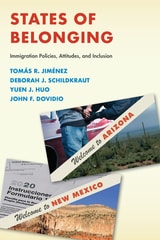
States of Belonging
Immigration Policies, Attitudes, and InclusionTomas R. Jimenez
Russell Sage Foundation, 2021
Arizona and New Mexico are historically and demographically similar, but they differ in their immigration policies. Arizona has enacted unwelcoming policies towards immigrants, restricting the access of immigrants to state resources, social services, and public institutions. New Mexico is more welcoming, actively seeking to protect the rights of immigrants and extending access to state resources and institutions. The authors draw on an original survey and in-depth interviews of a cross-section of each state’s population to illustrate how these differing approaches affect the sense of belonging not only among immigrants, but among the U.S.-born as well.
Respondents in Arizona, regardless of whether they were foreign- or native-born or their ethno-racial background, agreed that the state is unwelcoming to immigrants, and they pointed to Arizona’s restrictive policies as the primary factor. The sense of rejection perceived by Latinos in Arizona, including the foreign-born and the U.S.-born, was profound. They felt the effects of administrative and symbolic exclusions of the state’s unwelcoming policies as they went about their daily lives.
New Mexico’s more welcoming approach had positive effects on the Latino immigrant population, and these policies contributed to an increased sense of belonging among U.S.-born Latinos and U.S.-born whites as well. The authors show that exposure to information about welcoming policies is associated with an improved sense of belonging across most population groups. They also find that the primary dividing line when it came to reactions to welcoming policies was political, not ethno-racial. Only self-identified Republicans, Latino as well as white, showed reduced feelings of belonging.
States of Belonging demonstrates that welcoming policies cultivate a greater sense of belonging for immigrants and other state citizens, suggesting that policies aimed at helping immigrants gain a social, economic, and political foothold in this country can pay a broad societal dividend.
States of Defeat
US Imaginaries of Revolutionary Central AmericaEric A. Vázquez
University of Minnesota Press, 2025
The cultural reverberations of Central America’s failed revolutions on US intellectual thought
The thwarted Central American revolutions during the latter half of the twentieth century marked a watershed in what had become a global anti-imperialist movement striving for a more egalitarian future. Examining a range of documentary, literary, and artistic works, States of Defeat looks at how left-wing intellectuals in the United States reckoned with the fallout from these defeats through wide-ranging creative expressions of indignation, cynicism, and grief.
As he argues for the historical significance of Central America in the transition out of the Cold War, Eric A. Vázquez shows how the unfulfilled revolutionary ambitions in Nicaragua, El Salvador, and Guatemala prompted intellectuals in the United States to reexamine their desires for radical transformation. Analyzing novels, memoirs, anthropological writings, documentary film, and archival materials from the 1980s and 1990s, he demonstrates how these texts prefigured later anxieties about secrecy and securitization, the rise of nongovernmental organizational forms, and state failure.
Examining the legacies of unfulfilled anti-imperialist political ideals and their implications for the global left in the twenty-first century, States of Defeat offers a renewed perspective on the function of Central America in the US imagination. Amid a resurgence of crackdowns on public protest and a rise in virulent anti-immigrant campaigns throughout the United States and globally, Vázquez presents urgent and valuable insights into the viability of political solidarity and state power.

States of Desire Revisited
Travels in Gay AmericaEdmund White
University of Wisconsin Press, 2014
White frames those past travels with a brief, bracing review of gay America since the 1970s ("now we were all supposed to settle down with a partner in the suburbs and adopt a Korean daughter"), and a reflection on how Internet culture has diminished unique gay places and scenes but brought isolated individuals into a global GLBTQ community.
States of Exception in American History
Edited by Gary Gerstle and Joel Isaac
University of Chicago Press, 2020
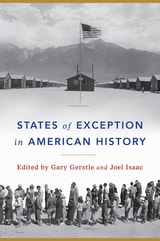
The first comprehensive account of the politics of exceptions and emergencies in the history of the United States, this book weaves together historical studies of moments and spaces of exception with conceptual analyses of emergency, the state of exception, sovereignty, and dictatorship. The Civil War, the Great Depression, and the Cold War figure prominently in the essays; so do Francis Lieber, Frederick Douglass, John Dewey, Clinton Rossiter, and others who explored whether it was possible for the United States to survive states of emergency without losing its democratic way. States of Exception combines political theory and the history of political thought with histories of race and political institutions. It is both inspired by and illuminating of the American experience with constitutional rule in the age of terror and Trump.

States of Grace
Senegalese in Italy and the New European ImmigrationDonald Martin Carter
University of Minnesota Press, 1997
States of Grace was first published in 1997. Minnesota Archive Editions uses digital technology to make long-unavailable books once again accessible, and are published unaltered from the original University of Minnesota Press editions.
Leaving their depleted fields for better prospects, Senegalese immigrants have made their way to Italy in significant numbers. What this migration means, in the context of both the migratory traditions and conditions of Africa and the history and future of the European nation-state, is the subject of this timely and ambitious book.
Focusing on Turin, the northern Italian point of entry for so many Senegalese, States of Grace chronicles the arrival and formation of a transnational African Islamic community in a largely Catholic Western European country, one that did not have immigrant legislation until 1991. With no colonial relation to Italy, the Senegalese represent the vanguard of population movements expanding outside of the arch of former colonial powers.
Donald Martin Carter locates the Senegalese migration in the context of past African internal and international migration and of present crises in West African agriculture. He also shows how the Senegalese migration, constituting a "phenomenon" and catalyzing new immigration restrictions among European states, calls into question the European interstate system, the future of the nation-state, and the nature of its relationship with non-European states.
Throughout Europe, protectionist immigration policies are often crafted in chauvinist and racist tones in which "migrants" is a euphemism for blacks, Arabs, and Asians. States of Grace uses Senegalese migration to demonstrate that racial conceptions are crucial to understanding the classifications of non-national "outside" and internal "other." The book is a bracing encounter with the ever-increasing cultural and ethnic heterogeneity that is the new and pressing reality of European society.
Donald Martin Carter is visiting assistant professor of anthropology at Johns Hopkins University.
States of Imagination
Ethnographic Explorations of the Postcolonial StateThomas Blom Hansen and Finn Stepputat, eds.
Duke University Press, 2001
Focusing on the micropolitics of everyday state-making, the contributors examine the mythologies, paradoxes, and inconsistencies of the state through ethnographies of diverse postcolonial practices. They show how the authority of the state is constantly challenged from the local as well as the global and how growing demands to confer rights and recognition to ever more citizens, organizations, and institutions reveal a persistent myth of the state as a source of social order and an embodiment of popular sovereignty. Demonstrating the indispensable value of ethnographic work on the practices and the symbols of the state, States of Imagination showcases a range of studies and methods to provide insight into the diverse forms of the postcolonial state as an arena of both political and cultural struggle.
This collection will interest students and scholars of anthropology, cultural studies, sociology, political science, and history.
Contributors. Lars Buur, Mitchell Dean, Akhil Gupta, Thomas Blom Hansen, Steffen Jensen, Aletta J. Norval, David Nugent, Sarah Radcliffe, Rachel Sieder, Finn Stepputat, Martijn van Beek, Oskar Verkaaik, Fiona Wilson
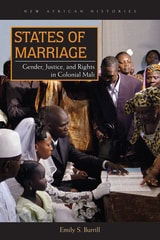
States of Marriage
Gender, Justice, and Rights in Colonial MaliEmily S. Burrill
Ohio University Press, 2015
States of Memory
Continuities, Conflicts, and Transformations in National RetrospectionJeffrey K. Olick, ed.
Duke University Press, 2003
The contributors—including historians and social scientists—describe societies’ struggles to produce and then use ideas of what a “normal” past should look like. They examine claims about the genuineness of revolution (in fascist Italy and communist Russia), of inclusiveness (in the United States and Australia), of innocence (in Germany), and of inevitability (in Israel). Essayists explore the reputation of Confucius among Maoist leaders during China’s Cultural Revolution; commemorations of Martin Luther King Jr. in the United States Congress; the “end” of the postwar era in Japan; and how national calendars—in signifying what to remember, celebrate, and mourn—structure national identification. Above all, these essays reveal that memory is never unitary, no matter how hard various powers strive to make it so.
States of Memory will appeal to those scholars—in sociology, history, political science, cultural studies, anthropology, and art history-who are interested in collective memory, commemoration, nationalism, and state formation.
Contributors. Paloma Aguilar, Frederick C. Corney, Carol Gluck, Matt K. Matsuda, Jeffrey K. Olick, Francesca Polletta, Uri Ram, Barry Schwartz, Lyn Spillman, Charles Tilly, Simonetta Falasca Zamponi, Eviatar Zerubavel, Tong Zhang
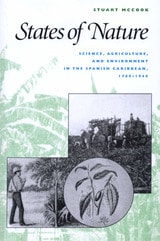
States of Nature
Science, Agriculture, and Environment in the Spanish Caribbean, 1760-1940By Stuart George McCook
University of Texas Press, 2002
The process of nation-building in Latin America transformed the relations between the state, the economy, and nature. Between 1760 and 1940, the economies of most countries in the Spanish Caribbean came to depend heavily on the export of plant products, such as coffee, tobacco, and sugar. After the mid-nineteenth century, this model of export-led economic growth also became a central tenet of liberal projects of nation-building. As international competition grew and commodity prices fell over this period, Latin American growers strove to remain competitive by increasing agricultural production. By the turn of the twentieth century, their pursuit of export-led growth had generated severe environmental problems, including soil exhaustion, erosion, and epidemic outbreaks of crop diseases and pests.
This book traces the history of the intersections between nature, economy, and nation in the Spanish Caribbean through a history of the agricultural and botanical sciences. Growers and governments in Venezuela, Puerto Rico, Cuba, Colombia, and Costa Rica turned to scientists to help them establish practical and ideological control over nature. They hoped to use science to alleviate the pressing environmental and economic stresses, without having to give up their commitment to export-led growth. Starting from an overview of the relationship among science, nature, and development throughout the export boom of 1760 to 1930, Stuart McCook examines such topics as the relationship between scientific plant surveys and nation-building, the development of a "creole science" to address the problems of tropical agriculture, the ecological rationalization of the sugar industry, and the growth of technocratic ideologies of science and progress. He concludes with a look at how the Great Depression of the 1930s changed the paradigms of economic and political development and the role of science and nature in these paradigms.

States of Plague
Reading Albert Camus in a PandemicAlice Kaplan and Laura Marris
University of Chicago Press, 2022
As one of the most discussed books of the COVID-19 crisis, Albert Camus’s classic novel The Plague has become a new kind of literary touchstone. Surrounded by terror and uncertainty, often separated from loved ones or unable to travel, readers sought answers within the pages of Camus’s 1947 tale about an Algerian city gripped by an epidemic. Many found in it a story about their own lives—a book to shed light on a global health crisis.
In thirteen linked chapters told in alternating voices, Alice Kaplan and Laura Marris hold the past and present of The Plague in conversation, discovering how the novel has reached people in their current moment. Kaplan’s chapters explore the book’s tangled and vivid history, while Marris’s are drawn to the ecology of landscape and language. Through these pages, they find that their sense of Camus evolves under the force of a new reality, alongside the pressures of illness, recovery, concern, and care in their own lives. Along the way, Kaplan and Marris examine how the novel’s original allegory might resonate with a new generation of readers who have experienced a global pandemic. They describe how they learned to contemplate the skies of a plague spring, to examine the body politic and the politics of immunity.
Both personal and eloquently written, States of Plague uncovers for us the mysterious way a novel can imagine the world during a crisis and draw back the veil on other possible futures.
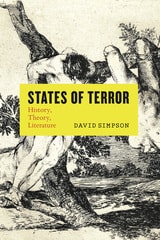
States of Terror
History, Theory, LiteratureDavid Simpson
University of Chicago Press, 2019
Introducing the concept of the “fear-terror cluster,” Simpson is able to capture the wide range of terms that we have used to express extreme emotional states over the centuries—from anxiety, awe, and concern to dread, fear, and horror. He shows that the choices we make among such words to describe shades of feeling have seriously shaped the attribution of motives, causes, and effects of the word “terror” today, particularly when violence is deployed by or against the state. At a time when terror-talk is widely and damagingly exploited by politicians and the media, this book unpacks the slippery rhetoric of terror and will prove a vital resource across humanistic and social sciences disciplines.

States of Violence
Fernando Coronil and Julie Skurski, Editors
University of Michigan Press, 2005
By means of a combination of detailed historical studies and imaginative reflection, this book explores the often unrecognized violent foundations of modern nations. Focusing on the relations between the state and the domestic order, it directs attention to contests over the establishment and representation of meanings and addresses the impact of state-centered categories and narratives on the organization and collective remembering of violence. The essays cover a wide range of regions, time periods, and processes, including the Middle East, South Asia, Latin America, the United States, and Europe, and span violent uprisings as well as the quotidian administration of the law. As its title suggests, States of Violence brings together the stable and the transient, the institutional and the experiential, the state sanctioned and the insurgent, inviting recognition of the multiple intersections of practices of governance and processes of feeling.
"Few scholars have managed as effectively as these to denature the place of violence in modern social life and thought. They make it abundantly plain that the frank brutality, often associated with colonial contexts, is inseparable from less acknowledged forms of "peaceful violence" that pervade much of our contemporary political life."
-Jean Comaroff, Bernard E. and Ellen C. Distinguished Service Professor, University of Chicago
Fernando Coronil, a Venezuelan citizen, is Associate Professor of Anthropology and History at the University of Michigan and Director of the Latin American and Caribbean Studies Program. His research focuses on contemporary historical transformations in Latin America and on theoretical issues concerning the state, modernity, and postcolonialism. His numerous publications include The Magical State: Nature, Money, and Modernity in Venezuela; "Beyond Occidentalism: Towards Non-Imperial Geohistorical Categories"; and the introductory essay in Cuban Counterpoint: Tobacco and Sugar, by Fernando Ortiz. He is completing a book on the coup against President Chávez of Venezuela.
Julie Skurski teaches in the Departments of Anthropology and History at the University of Michigan and is the Associate Director of the Doctoral Program in Anthropology and History. Her research concerns the intersections of national, racial, and gender relations in Latin America, with a focus on popular religiosity. Her publications include "The Ambiguities of Authenticity in Latin America: Doña Bárbara and the Construction of National Identity," in Becoming National, G. Eley and R. Suny, eds. She is currently completing Civilizing Barbarism, a book on gender, mestizaje, and the state in Venezuela.
Studies in State and Local Public Finance
Edited by Harvey S. Rosen
University of Chicago Press, 1986
Developed from a National Bureau of Economic Research conference on state and local financing, the volume includes papers summarizing and extending recent research as well as commentaries. Covering a wide range of topics, the papers share an empirical orientation and a concern with policy issues. The first two papers look at the role of tax-exempt bonds in local public finance. Their findings suggest that tax policies significantly affect municipal borrowing practices and that financial advantage can be achieved under certain of these practices. Other papers address specific issues related to state and local tax policy: the impact of local taxes on location decisions; efficient road-use charges for trucks; and the relation of income and general sales tax systems over time. Examining issues related to United States federalism, the last paper focuses on the impact of federal grant aid to states.
The research and findings these papers report make an important contribution to the study of local public finance and should be of particular interest to policymakers and those involved in private and public financing at the local, state, or federal level.