Results by title
53 books match the query 'Statesmen' and 4 start with s
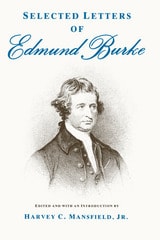
Selected Letters of Edmund Burke
Edmund Burke
University of Chicago Press, 1984
Edmund Burke (1729-97) was a British statesman, a political philosopher, a literary critic, the grandfather of modern conservatism, and an elegant, prolific letter writer and prose stylist. His most important letters, filled with sparkling prose and profound insights, are gathered here for the first time in one volume. Arranged topically, the letters bring alive Burke's passionate views on such issues as party politics, reform and revolution, British relations with America, India, and Ireland, toleration and religion, and literary and philosophical concerns.
[more]
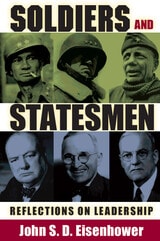
Soldiers and Statesmen
Reflections on LeadershipJohn S. D. Eisenhower
University of Missouri Press, 2012
Which generals were most influential in World War II? Did Winston Churchill really see himself as culturally "half American"? What really caused the break between Harry S. Truman and Dwight Eisenhower? In Soldiers and Statesmen, John S. D. Eisenhower answers these questions and more, offering his personal reflections on great leaders of our time.
The son of President Dwight D. Eisenhower, John S. D. Eisenhower possesses an expert perspective on prominent political and military leaders, giving readers a matchless view on relationships between powerful figures and the president. Eisenhower also had a long military career, coincidentally beginning with his graduation from West Point on D-Day. His unique position as a young Army staff officer and close relationship with his father gave him insider's access to leaders such as Winston Churchill, Harry Truman, George Patton, Douglas MacArthur, Omar Bradley, John Foster Dulles, Mark Clark, Terry Allen, and Matthew Ridgway. He combines personal insight with the specialized knowledge of a veteran soldier and accomplished historian to communicate exclusive perspectives on U. S. foreign relations and leadership.
Eisenhower's observations of various wartime leaders began in June 1944, just after the Allied landings in Normandy. On orders from General George C. Marshall, Army chief of staff, Eisenhower sailed from New York aboard the British-liner-turned-American-troopship Queen Maryto join his father, Supreme Commander of the Allied Expeditionary Force, in London, where he stayed for over two weeks. A year later, at the end of the war, Eisenhower accompanied his father as a temporary aide on trips where Ike's former associates were present. In the mid-1950s, Eisenhower's perspective was broadened by his service in a room next to the White House Oval Office during his father's tenure as president.
On the light side, Eisenhower has added a special appendix called "Home Movies," in which he reveals amusing and often irreverent vignettes from his life in military service. Eisenhower gives readers both a taste of history from the inside and a rich and relatable memoir filled with compelling remembrances.
[more]
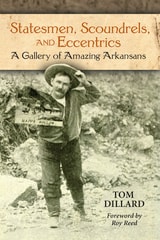
Statesmen, Scoundrels, and Eccentrics
A Gallery of Amazing ArkansansTom Dillard
University of Arkansas Press, 2010
From Native Americans, explorers, and early settlers to entertainers, business people, politicians, lawyers, artists, and many others, the well-known and not-so-well-known Arkansans featured in Statesmen, Scoundrels, and Eccentrics have fascinating stories. To name a few, there’s the “Hanging Judge,” Isaac C. Parker of Fort Smith, and Hattie Caraway, the first elected female U.S. senator. Isaac T. Gillam, a slave who became a prominent politician in post–Civil War Little Rock, is included, as is Norman McLeod, an eccentric Hot Springs photographer and owner of the city’s first large tourist trap. These entertaining short biographies from Dillard’s Remembering Arkansas column will be enjoyed by all kinds of readers, young and old alike. All the original columns reprinted here have also been enhanced with Dillard’s own recommended reading lists. Statesmen will serve as an introduction or reintroduction to the state’s wonderfully complex heritage, full of rhythm and discord, peopled by generations of hardworking men and women who have contributed much to the region and nation.
[more]
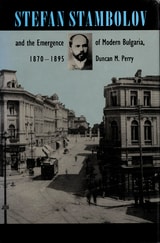
Stefan Stambolov and the Emergence of Modern Bulgaria, 1870-1895
Duncan M. Perry
Duke University Press, 1993
Little known in the United States but increasingly important in the affairs of southeastern Europe, Bulgaria is a land with a stormy history. No less stormy is the story of Stefan Stambolov, who ruled the country during some of its most turbulent years. Duncan M. Perry's biography of Stambolov, the first in English in the twentieth century, illuminates the life, motives, and personality of this major figure.
Perry begins with Bulgaria in the tumultuous years immediately following its founding in 1878. After the ousting of the country's first prince, Stambolov enters the stage as the fiery young lawyer who restored him to the throne. Although the prince promptly abdicated, Stambolov stepped into the breach and led the nation during the interregnum. Perry traces this patriotic politician's transformation into an authoritarian prime minister. He shows how Stambolov stabilized the Bulgarian economy and brought relative security to the land—but not without cost to himself and his regime. Perry depicts a man whose promotion of Bulgaria's independence exacted its price in individual rights, a ruler whose assassination in 1895 was the cause of both rejoicing and sorrow.
Stambolov thus emerges from these pages as a complex historical figure, an authoritarian ruler who protected his country's liberty at the cost of the people's freedom and whose dictatorial policies set Bulgaria upon a course of stability and modernization. An afterword compares the Bulgarian liberation era of Stambolov with the communist-era dictator, Todor Zhikov, analyzing similarities and differences.
[more]