63 books match the query 'Statistics' and 8 start with s

cover of School, State, and Society: The Growth of Elementary Schooling in Nineteenth-Century France--A Quantitative Analysis

School, State, and Society

The Growth of Elementary Schooling in Nineteenth-Century France--A Quantitative Analysis

Raymond Grew and Patrick J. Harrigan

University of Michigan Press, 1992
School, State, and Society is a comprehensive analysis of French elementary education in the nineteenth century. It begins in the decades before the Guizot law of 1833, which made the establishment of public schools in every commune France's national policy, and continues to 1906, just after Church and state were formally separated and Catholic schools officially abolished. Grew and Harrigan base their study on the vast amount of statistical information that was systematically collected in France beginning in the 1830s. This information was put into machine-readable form for computer analysis.  School, State, and Society examines several important aspects of elementary schools in France in the nineteenth century: the availability of schooling; enrollment; different types of schools (Catholic and lay, public and private); schooling for girls versus schooling for boys; elementary teachers' the elementary school as an institution and the links between elementary education and further instruction; and budgets and expenditures. The analysis revises some standard interpretations of the role of Catholic schools and of a nationally centralized system. The picture that emerges challenges some common impressions – among them that schooling in France progressed slowly and late, that it had to overcome great local resistance, and that the enrollment of girls long lagged behind that of boys.
[more]
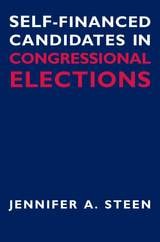
cover of Self-Financed Candidates in Congressional Elections

Self-Financed Candidates in Congressional Elections

Jennifer A. Steen

University of Michigan Press, 2006

Are our elections for sale? Americans have long asked this question in the face of skyrocketing campaign spending by candidates and parties. Then, in the 1990s, came a wave of wealthy individuals whose deep pockets seemed to be buying political offices across the country. Our worst suspicions were confirmed. Or were they? What effect do self-financers really have on electoral outcomes? Jennifer Steen's authoritative empirical study of self-financed candidates is a landmark in American politics. Steen thoroughly dispels the notion that self-funded candidates can buy legislative seats, proving that the vast majority of self-financers do not win their elections. Her book gives us a truer understanding of self-financers' actual influence on campaign competition and rhetoric.

Jennifer A. Steen is Assistant Professor of Political Science at Boston College and a former political consultant. She is one of the nation's leading authorities on self-financed candidates.

[more]
cover of Sex and Death on the Western Emigrant Trail: The Biology of Three American Tragedies

Sex and Death on the Western Emigrant Trail

The Biology of Three American Tragedies

Donald K. Grayson

University of Utah Press, 2018

During the winter of 1846–1847, members of the Donner Party found themselves stuck in the snows of the Sierra Nevada on their journey to California, losing many in their group to severe cold and starvation. Those who survived did so by cannibalizing their dead comrades. Today the Donner Party may be the most famous of American overland emigrant groups, but it was not the only one to face extreme conditions. Ten years after the Donner Party, two groups sponsored by the Mormon Church, the Willie and Martin handcart companies ran into similar difficulties. Unlike the Donner Party, however, these people were following a well-traveled path, but they were doing it in a novel way—pushing and pulling their goods and children in handcarts some 1,300 miles from Iowa to Utah. Caught in early winter storms in Wyoming, 200 members of these two companies died along the trail.

The plights of these emigrant groups have been addressed by different historians in different ways; this book is the first to examine the tragedies in terms of biology. Grayson shows that who lived or died can largely be explained by age, sex, and family ties. His investigation reveals what happens when our cultural mechanisms for dealing with famine and extreme cold are reduced to only what our bodies can provide within structured social contexts. His results are surprising and not always intuitive as he investigates who survived in these life threatening situations. 

[more]
cover of Social Forecasting Methodology: Suggestions for Research

Social Forecasting Methodology

Suggestions for Research

Daniel P. Harrison

Russell Sage Foundation, 1976

A volume in the Social Science Frontiers series, which are occasional publications reviewing new fields for social science development. These occasional publications seek to summarize recent work being done in particular areas of social research, to review new developments in the field, and to indicate issues needing further investigation. The publications are intended to help orient those concerned with developing current research programs and broadening the use of social science in the policy-making process. A Volume in the Russell Sage Foundation's Social Science Frontiers Series
[more]
cover of Social Statistics in Use

Social Statistics in Use

Philip Morris Hauser

Russell Sage Foundation, 1975
Shows why social statistics are important and how they are put to use in the interest of the public. Written by a sociologist who serves as Director of the Population Research Center at the University of Chicago, the book illustrates the many applications social statistics have for governmental agencies at the federal, state, and local levels; for the business community; for labor unions; for educators and researchers; and for the general public. The author provides a description of the major bodies of social statistical information, including population; births, deaths, and health; marriage, divorce, and the family; education; the labor force; crime; consumption and the consumer; recreation; governments; and public opinion polls.
[more]
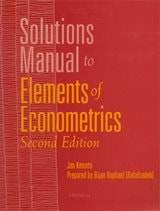
cover of Solutions Manual to Elements of Econometrics

Solutions Manual to Elements of Econometrics

Jan Kmenta

University of Michigan Press, 1997

The Solutions Manual to Elements of Econometrics, Second Edition provides chapter solutions to the exercises in the college textbook: Elements of Econometrics, Second Edition by Jan Kmenta.
[more]
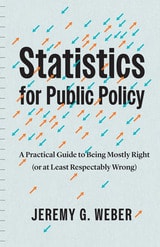
cover of Statistics for Public Policy: A Practical Guide to Being Mostly Right (or at Least Respectably Wrong)

Statistics for Public Policy

A Practical Guide to Being Mostly Right (or at Least Respectably Wrong)

Jeremy G. Weber

University of Chicago Press, 2024

A long-overdue guide on how to use statistics to bring clarity, not confusion, to policy work.

Statistics are an essential tool for making, evaluating, and improving public policy. Statistics for Public Policy is a crash course in wielding these unruly tools to bring maximum clarity to policy work. Former White House economist Jeremy G. Weber offers an accessible voice of experience for the challenges of this work, focusing on seven core practices: 

  • Thinking big-picture about the role of data in decisions
  • Critically engaging with data by focusing on its origins, purpose, and generalizability
  • Understanding the strengths and limits of the simple statistics that dominate most policy discussions
  • Developing reasons for considering a number to be practically small or large  
  • Distinguishing correlation from causation and minor causes from major causes
  • Communicating statistics so that they are seen, understood, and believed
  • Maintaining credibility by being right (or at least respectably wrong) in every setting

Statistics for Public Policy dispenses with the opacity and technical language that have long made this space impenetrable; instead, Weber offers an essential resource for all students and professionals working at the intersections of data and policy interventions. This book is all signal, no noise.
[more]
cover of Strategies for Primary Health Care: Technologies Appropriate for the Control of Disease in the Developing World

Strategies for Primary Health Care

Technologies Appropriate for the Control of Disease in the Developing World

Edited by Julia A. Walsh and Kenneth S. Warren

University of Chicago Press, 1986

[more]