1927 books match the query 'Technology & Engineering' and 153 start with s

cover of S-class destroyer Piet Hein (ex HMS Serapis)

S-class destroyer Piet Hein (ex HMS Serapis)

Jantinus Mulder

Amsterdam University Press, 2024

Ordered by the Royal Navy in 1941, the destroyers of the 5th Emergency Flotilla became known as S-class and served as fleet and convoy escorts in World War II. In the last months of the war, three were transferred to the Royal Netherlands Navy for service in the Far East. HMS Serapis was renamed HNLMS Piet Hein and served in the Indonesian War of Independence and saw action in the Korean War. She was sold for scrap in 1962.
[more]
cover of SF6 Switchgear

SF6 Switchgear

H.M. Ryan

The Institution of Engineering and Technology, 1989

This book provides an extensive review of recent developments in SF6 Switchgear and covers fundamental properties of SF6 interrupter types, characteristics and associated operating mechanisms, arc modelling and computer aided methods for interrupter design and evaluation. The impact of SF6 Technology upon (i) Transmission Switchgear (ii) Distribution and Utility Switchgear and (iii) Regulations, Testing and Instrumentation is dealt with comprehensively.
[more]
cover of SIMOX

SIMOX

Maria J. Anc

The Institution of Engineering and Technology, 2004

SIMOX explores Separation-by-IMplanted-OXygen technology, a method of fabricating silicon-on-insulator structures and substrates by implanting high doses of oxygen and high temperature annealing.
[more]
cover of SS Australis

SS Australis

Bert Lamers

Amsterdam University Press, 2024

The ss 'Australis' was a well known ocean liner which entered service in 1940 as the
ss 'America' for the United States Lines. The ship was sold to the Greek Chandris Lines in 1964 and served until 1977 very succesfully on the route Western-Europe-Australia-New Zealand. Later the route became a full round-the-world-service. After her Australian period the liner sailed under the names of 'America' (for the third time), 'Italis', 'Noga', 'Alferdoss' and finally 'American Star'. In this volume of Liners the history of the great liner from when she was purchased by the Greek interest in 1964 until her sad wracking in January 1994.
[more]
cover of Salmon and Acorns Feed Our People: Colonialism, Nature, and Social Action

Salmon and Acorns Feed Our People

Colonialism, Nature, and Social Action

Kari Marie Norgaard

Rutgers University Press, 2019

Finalist for the 2020 C. Wright Mills Award from the Society for the Study of Social Problems

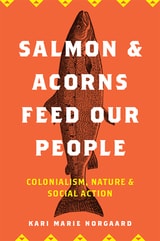
Since time before memory, large numbers of salmon have made their way up and down the Klamath River. Indigenous management enabled the ecological abundance that formed the basis of capitalist wealth across North America. These activities on the landscape continue today, although they are often the site of intense political struggle. Not only has the magnitude of Native American genocide been of remarkable little sociological focus, the fact that this genocide has been coupled with a reorganization of the natural world represents a substantial theoretical void. Whereas much attention has (rightfully) focused on the structuring of capitalism, racism and patriarchy, few sociologists have attended to the ongoing process of North American colonialism. Salmon and Acorns Feed Our People draws upon nearly two decades of examples and insight from Karuk experiences on the Klamath River to illustrate how the ecological dynamics of settler-colonialism are essential for theorizing gender, race and social power today. 

[more]
cover of Satellite Communication Systems

Satellite Communication Systems

B.G. Evans

The Institution of Engineering and Technology, 1999

This updated and extended new edition has been compiled from the course material of the highly successful IEE Vacation School of the same name. The vacation school was designed to give a broad introduction to the subject of satellite communications and provide the background knowledge and tools of the trade for those entering the field. The 3rd edition of the book continues this theme and up-to-date information on mobile and personal satellite constellations, navigation and positioning, and military and small satellite systems has been added, as well as a look to future Ka-band multimedia systems. We have also included updated ITU information and sections on history, organisation and the satellite business. The book differs from others on the subject in its pragmatic and engineering-oriented approach. The contributors are all current practitioners from industry or academics specialising in the field.
[more]
cover of Satellite Communications in the 5G Era

Satellite Communications in the 5G Era

Shree Krishna Sharma

The Institution of Engineering and Technology, 2018
Satellite communications (SatCom) plays a vital role in ensuring seamless access to telecommunications services anytime, and is a viable option for delivering telecommunication services in a wide range of sectors such as aeronautical, military, maritime, rescue and disaster relief. It should be an important component of 5G-and-beyond wireless architectures as it can complement terrestrial telecommunication solutions in various scenarios to provide highly reliable and secure connectivity over a wide geographical area. This book explores promising scenarios for 5G SatCom, novel paradigms for hybrid/integrated satellite-terrestrial integration, and emerging technologies for the next generation of SatCom systems. Topics covered include: Role of SatCom in the 5G Era; 5G satellite use cases and scenarios; SDN-enabled networks, NFV-based scenarios and on-board processing for satellite-terrestrial integration; EHF broadband aeronautical SatCom systems; Next-generation NGSO SatCom systems; Diversity combining and handover techniques for MEO satellites; Non-linear countermeasures for multicarrier satellites; SDN demonstrator for multi-beam satellite precoding; Beam-hopping SatCom systems; Optical on-off keying data links for LEO downlink applications; Ultra-high speed data relay systems; On-board interference detection and localization; Advanced random access schemes for SatCom systems; Interference avoidance, mitigation and dynamic spectrum sharing for hybrid satellite-terrestrial systems; and Two-way satellite relaying.
[more]
cover of Satellite-to-Ground Radiowave Propagation

Satellite-to-Ground Radiowave Propagation

J.E. Allnutt

The Institution of Engineering and Technology, 2011

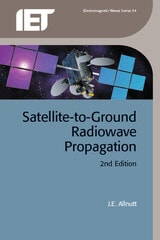
This book is a follow-up to the award-winning first edition and is written as a comprehensive guide for those who need to obtain a working knowledge of radiowave propagation on satellite-to-ground links at frequencies above 1 GHz and as a reference book for experts in the field. To accomplish this, expanded sections of explanatory text, copiously illustrated, enable an undergraduate or non-specialist to grasp the fundamentals involved. An extensive reference list permits the expert to go to the source material should the level of enquiry go beyond the level of this book.
[more]
cover of Saving Seeds, Preserving Taste: Heirloom Seed Savers in Appalachia

Saving Seeds, Preserving Taste

Heirloom Seed Savers in Appalachia

Bill Best

Ohio University Press, 2013

The Brown Goose, the White Case Knife, Ora’s Speckled Bean, Radiator Charlie’s Mortgage Lifter—these are just a few of the heirloom fruits and vegetables you’ll encounter in Bill Best’s remarkable history of seed saving and the people who preserve both unique flavors and the Appalachian culture associated with them. As one of the people at the forefront of seed saving and trading for over fifty years, Best has helped preserve numerous varieties of beans, tomatoes, corn, squashes, and other fruits and vegetables, along with the family stories and experiences that are a fundamental part of this world. While corporate agriculture privileges a few flavorless but hardy varieties of daily vegetables, seed savers have worked tirelessly to preserve genetic diversity and the flavors rooted in the Southern Appalachian Mountains—referred to by plant scientists as one of the vegetative wonders of the world.

Saving Seeds, Preserving Taste will introduce readers to the cultural traditions associated with seed saving, as well as the remarkable people who have used grafting practices and hand-by-hand trading to keep alive varieties that would otherwise have been lost. As local efforts to preserve heirloom seeds have become part of a growing national food movement, Appalachian seed savers play a crucial role in providing alternatives to large-scale agriculture and corporate food culture. Part flavor guide, part people’s history, Saving Seeds, Preserving Taste will introduce you to a world you’ve never known—or perhaps remind you of one you remember well from your childhood.

[more]
cover of Saving Seeds, Preserving Taste: Heirloom Seed Savers in Appalachia

Saving Seeds, Preserving Taste

Heirloom Seed Savers in Appalachia

Bill Best

Ohio University Press, 0

The Brown Goose, the White Case Knife, Ora’s Speckled Bean, Radiator Charlie’s Mortgage Lifter — these are just a few of the heirloom fruits and vegetables you’ll encounter in Bill Best’s remarkable history of seed saving and the people who preserve both unique flavors and the Appalachian culture associated with them. As one of the people at the forefront of seed saving and trading for over fifty years, Best has helped preserve numerous varieties of beans, tomatoes, corn, squashes, and other fruits and vegetables, along with the family stories and experiences that are a fundamental part of this world. While corporate agriculture privileges a few flavorless but hardy varieties of daily vegetables, seed savers have worked tirelessly to preserve genetic diversity and the flavors rooted in the Southern Appalachian Mountains — referred to by plant scientists as one of the vegetative wonders of the world.

Saving Seeds, Preserving Taste will introduce readers to the cultural traditions associated with seed saving, as well as the remarkable people who have used grafting practices and hand-by-hand trading to keep alive varieties that would otherwise have been lost. As local efforts to preserve heirloom seeds have become part of a growing national food movement, Appalachian seed savers play a crucial role in providing alternatives to large-scale agriculture and corporate food culture. Part flavor guide, part people’s history, Saving Seeds, Preserving Taste will introduce you to a world you’ve never known — or perhaps remind you of one you remember well from your childhood.

[more]
cover of Scattering of Electromagnetic Waves by Obstacles

Scattering of Electromagnetic Waves by Obstacles

Gerhard Kristensson

The Institution of Engineering and Technology, 2016

This book is an introduction to some of the most important properties of electromagnetic waves and their interaction with passive materials and scatterers. The main purpose of the book is to give a theoretical treatment of these scattering phenomena, and to illustrate numerical computations of some canonical scattering problems for different geometries and materials. The scattering theory is also important in the theory of passive antennas, and this book gives several examples on this topic.
[more]
cover of Scattering of Wedges and Cones with Impedance Boundary Conditions

Scattering of Wedges and Cones with Impedance Boundary Conditions

Mikhail A. Lyalinov

The Institution of Engineering and Technology, 2013

This book is a systematic and detailed exposition of different analytical techniques used in studying two of the canonical problems, the wave scattering by wedges or cones with impedance boundary conditions. It is the first reference on novel, highly efficient analytical-numerical approaches for wave diffraction by impedance wedges or cones. This text includes calculations of the diffraction or excitation coefficients, including their uniform versions, for the diffracted waves from the edge of the wedge or from the vertex of the cone; study of the far-field behavior in diffraction by impedance wedges or cones, reflected waves, space waves from the singular points of the boundary (from edges or tips), and surface waves; and the applicability of the reported solution procedures and formulae to existing software packages designed for solving real-world high-frequency problems encountered in antenna, wave propagation, and radar cross section. This book is for researchers in wave phenomena physics, radio, optics and acoustics engineers, applied mathematicians and specialists in mathematical physics and specialists in quantum scattering of many particles.
[more]
cover of Scenarios for a Future Electricity Supply: Cost-optimised variations on supplying Europe and its neighbours with electricity from renewable energies

Scenarios for a Future Electricity Supply

Cost-optimised variations on supplying Europe and its neighbours with electricity from renewable energies

Gregor Czisch

The Institution of Engineering and Technology, 2011
This book pursues the fundamental idea of using renewable energies in a rational and economic way in order to develop a climate-friendly electricity supply. As the most cost efficient solution, an electricity network for the whole of Europe and parts of Africa and Asia must be found. The sources of renewable and partly decentralised electricity generation could be connected in a comprehensive power supply to meet the electricity needs of an entire region.
[more]
cover of Scenes of Projection: Recasting the Enlightenment Subject

Scenes of Projection

Recasting the Enlightenment Subject

Jill H. Casid

University of Minnesota Press, 2015

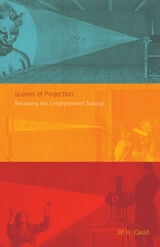
Theorizing vision and power at the intersections of the histories of psychoanalysis, media, scientific method, and colonization, Scenes of Projection poaches the prized instruments at the heart of the so-called scientific revolution: the projecting telescope, camera obscura, magic lantern, solar microscope, and prism. From the beginnings of what is retrospectively enshrined as the origins of the Enlightenment and in the wake of colonization, the scene of projection has functioned as a contraption for creating a fantasy subject of discarnate vision for the exercise of “reason.”

Jill H. Casid demonstrates across a range of sites that the scene of projection is neither a static diagram of power nor a fixed architecture but rather a pedagogical setup that operates as an influencing machine of persistent training. Thinking with queer and feminist art projects that take up old devices for casting an image to reorient this apparatus of power that produces its subject, Scenes of Projection offers a set of theses on the possibilities for felt embodiment out of the damaged and difficult pasts that haunt our present.

[more]
cover of Science and Technology Encyclopedia

Science and Technology Encyclopedia

The University of Chicago Press

University of Chicago Press, 2000

Up-to-date, concise, and easy to use, the Science and Technology Encyclopedia is a reliable resource for a wide general readership-from high school students to undergraduates to all those with an interest in the comprehensive array of scientific fields it covers.

It includes:
*More than 6,500 authoritative A-Z entries covering earth and life sciences (including natural history, physics, chemistry, medicine, information technology, and other disciplines)

*Biographical entries for more than 850 famous scientists, detailing their careers and achievements

*Over 20,000 cross-references

*More than 250 detailed illustrations, including schematic diagrams, representational natural history artwork, and technical cutaway diagrams

[more]
cover of Science and Technology Policy in the United States: Open Systems in Action

Science and Technology Policy in the United States

Open Systems in Action

Kraemer, Sylvia

Rutgers University Press, 2006

During the latter half of the twentieth century, federal funding in the United States for scientific research and development increased dramatically. Yet despite the infusion of public funds into research centers, the relationship between public policy and research and development remains poorly understood.

How does the federal government attempt to harness scientific knowledge and resources for the nation's economic welfare and competitiveness in the global marketplace? Who makes decisions about controversial scientific experiments, such as genetic engineering and space exploration? Who is held accountable when things go wrong?

In this lucidly-written introduction to the topic, Sylvia Kraemer draws upon her extensive experience in government to develop a useful and powerful framework for thinking about the American approach to shaping and managing scientific innovation. Kraemer suggests that the history of science, technology, and politics is best understood as a negotiation of ongoing tensions between open and closed systems. Open systems depend on universal access to information that is complete, verifiable, and appropriately used. Closed systems, in contrast, are composed of unique and often proprietary features, which are designed to control usage.

From the Constitution's patent clause to current debates over intellectual property, stem cells, and internet regulation, Kraemer shows the promise-as well as the limits-of open systems in advancing scientific progress as well as the nation's economic vitality.

[more]
cover of Science and the American Century: Readings from "Isis"

Science and the American Century

Readings from "Isis"

Edited and with an Introduction by Sally Gregory Kohlstedt and David Kaiser

University of Chicago Press, 2013
The twentieth century was one of astonishing change in science, especially as pursued in the United States. Against a backdrop of dramatic political and economic shifts brought by world wars, intermittent depressions, sporadic and occasionally massive increases in funding, and expanding private patronage, this scientific work fundamentally reshaped everyday life. Science and the American Century offers some of the most significant contributions to the study of the history of science, technology, and medicine during the twentieth century, all drawn from the pages of the journal Isis.
 
Fourteen essays from leading scholars are grouped into three sections, each presented in roughly chronological order. The first section charts several ways in which our knowledge of nature was cultivated, revealing how scientific practitioners and the public alike grappled with definitions of the “natural” as they absorbed and refracted global information. The essays in the second section investigate the changing attitudes and fortunes of scientists during and after World War II. The final section documents the intricate ways that science, as it advanced, became intertwined with social policies and the law.
 
This important and useful book provides a thoughtful and detailed overview for scholars and students of American history and the history of science, as well as for scientists and others who want to better understand modern science and science in America.
[more]
cover of Science in the Archives: Pasts, Presents, Futures

Science in the Archives

Pasts, Presents, Futures

Edited by Lorraine Daston

University of Chicago Press, 2017

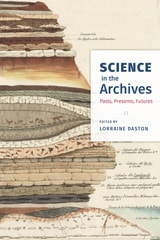
Archives bring to mind rooms filled with old papers and dusty artifacts. But for scientists, the detritus of the past can be a treasure trove of material vital to present and future research: fossils collected by geologists; data banks assembled by geneticists; weather diaries trawled by climate scientists; libraries visited by historians. These are the vital collections, assembled and maintained over decades, centuries, and even millennia, which define the sciences of the archives.
 
With Science in the Archives, Lorraine Daston and her co-authors offer the first study of the important role that these archives play in the natural and human sciences. Reaching across disciplines and centuries, contributors cover episodes in the history of astronomy, geology, genetics, philology, climatology, medicine, and more—as well as fundamental practices such as collecting, retrieval, and data mining. Chapters cover topics ranging from doxology in Greco-Roman Antiquity to NSA surveillance techniques of the twenty-first century. Thoroughly exploring the practices, politics, economics, and potential of the sciences of the archives, this volume reveals the essential historical dimension of the sciences, while also adding a much-needed long­-term perspective to contemporary debates over the uses of Big Data in science. 

[more]
cover of Science on the Air: Popularizers and Personalities on Radio and Early Television

Science on the Air

Popularizers and Personalities on Radio and Early Television

Marcel Chotkowski LaFollette

University of Chicago Press, 2008

Mr. Wizard’s World. Bill Nye the Science Guy. NPR’s Science Friday. These popular television and radio programs broadcast science into the homes of millions of viewers and listeners. But these modern series owe much of their success to the pioneering efforts of early-twentieth-century science shows like Adventures in Science and “Our Friend the Atom.” Science on the Air is the fascinating history of the evolution of popular science in the first decades of the broadcasting era.

Marcel Chotkowski LaFollette transports readers to the early days of radio, when the new medium allowed innovative and optimistic scientists the opportunity to broadcast serious and dignified presentations over the airwaves. But the exponential growth of listenership in the 1920s, from thousands to millions, and the networks’ recognition that each listener represented a potential consumer, turned science on the radio into an opportunity to entertain, not just educate.

Science on the Air chronicles the efforts of science popularizers, from 1923 until the mid-1950s, as they negotiated topic, content, and tone in order to gain precious time on the air. Offering a new perspective on the collision between science’s idealistic and elitist view of public communication and the unbending economics of broadcasting, LaFollette rewrites the history of the public reception of science in the twentieth century and the role that scientists and their institutions have played in both encouraging and inhibiting popularization. By looking at the broadcasting of the past, Science on the Air raises issues of concern to all those who seek to cultivate a scientifically literate society today.
[more]
cover of Sea Clutter: Scattering, the K distribution and radar performance

Sea Clutter

Scattering, the K distribution and radar performance

Keith D. Ward

The Institution of Engineering and Technology, 2006
This book provides an authoritative account of the current understanding of radar sea clutter, describing its phenomenology, EM scattering and statistical modelling and simulation, and their use in the design of detection systems and the calculation and practical evaluation of radar performance.
[more]
cover of Sea Clutter: Scattering, the K distribution and radar performance

Sea Clutter

Scattering, the K distribution and radar performance

Keith Ward

The Institution of Engineering and Technology, 2013

Sea Clutter: Scattering, the K Distribution and Radar Performance, 2nd Edition gives an authoritative account of our current understanding of radar sea clutter. Topics covered include the characteristics of radar sea clutter, modelling radar scattering by the ocean surface, statistical models of sea clutter, the simulation of clutter and other random processes, detection of small targets in sea clutter, imaging ocean surface features, radar detection performance calculations, CFAR detection, and the specification and measurement of radar performance. The calculation of the performance of practical radar systems is presented in sufficient detail for the reader to be able to tackle related problems with confidence. In this second edition the contents have been fully updated and reorganised to give better access to the different types of material in the book. Extensive new material has been added on the Doppler characteristics of sea clutter and detection processing; bistatic sea clutter measurements; electromagnetic scattering theory of littoral sea clutter and bistatic sea clutter; the use of models for predicting radar performance; and use of the K distribution in other fields.
[more]
cover of Sea Monsters: A Voyage around the World's Most Beguiling Map

Sea Monsters

A Voyage around the World's Most Beguiling Map

Joseph Nigg

University of Chicago Press, 2013

Smart phones and GPS give us many possible routes to navigate our daily commute, warn us of traffic and delays, and tell us where to find a cup of coffee. But what if there were sea serpents and giant man-eating lobsters waiting just off course if we were to lose our way? Would there be an app for that? In the sixteenth century, these and other monsters were thought to swim the northern waters, threatening seafarers who ventured too far from shore. Thankfully, Scandinavian mariners had Olaus Magnus, who in 1539 charted these fantastic marine animals in his influential map of the Nordic countries, the Carta Marina. In Sea Monsters, well-known expert on magical beasts Joseph Nigg brings readers face-to-face with these creatures, alongside the other magnificent components of Magnus’s map.

Nearly two meters wide in total, the map’s nine wood-block panels comprise the largest and first realistic portrayal of Northern Europe. But in addition to these important geographic elements, Magnus’s map goes beyond cartography to scenes both domestic and mystic. Close to shore, Magnus shows humans interacting with common sea life—boats struggling to stay afloat, merchants trading, children swimming, and fisherman pulling lines. But from the offshore deeps rise some of the most magical and terrifying sea creatures imaginable at the time or thereafter—like sea swine, whales as large as islands, and the Kraken. In this book, Nigg provides a thorough tour of the map’s cartographic details, as well as a colorful look at its unusual pictorial and imaginative elements. He draws on Magnus’s own text to further describe and illuminate the inventive scenes and to flesh out the stories of the monsters.

Sea Monsters is a stunning tour of a world that still holds many secrets for us land dwellers, who will forever be fascinated by reports of giant squid and the real-life creatures of the deep that have proven to be as bizarre and otherworldly as we have imagined for centuries. It is a gorgeous guide for enthusiasts of maps, monsters, and the mythic.

[more]
cover of Searchlight: The Camp That Didn't Fail

Searchlight

The Camp That Didn't Fail

Harry Reid

University of Nevada Press, 2007
Deep in the desolate Mojave Desert in Nevada’s extreme southern tip lies a small mining town called Searchlight. This meticulously researched book by Searchlight’s most distinguished native son recounts the colorful history of the town and the lives of the hardy people who built it and sustained a community in one of the least hospitable environments in the United States. Its story encompasses both Nevada’s early twentieth-century mining boom and the phenomenal growth of southern Nevada after World War II. Searchlight is a valuable contribution to the history of Nevada and a lively account of life in the forbidding depths of the Mojave Desert.<br> <br>
[more]
cover of Seaway to the Future: American Social Visions and the Construction of the Panama Canal

Seaway to the Future

American Social Visions and the Construction of the Panama Canal

Alexander Missal

University of Wisconsin Press, 2008

Realizing the century-old dream of a passage to India, the building of the Panama Canal was an engineering feat of colossal dimensions, a construction site filled not only with mud and water but with interpretations, meanings, and social visions. Alexander Missal’s Seaway to the Future unfolds a cultural history of the Panama Canal project, revealed in the texts and images of the era’s policymakers and commentators. Observing its creation, journalists, travel writers, and officials interpreted the Canal and its environs as a perfect society under an efficient, authoritarian management featuring innovations in technology, work, health, and consumption. For their middle-class audience in the United States, the writers depicted a foreign yet familiar place, a showcase for the future—images reinforced in the exhibits of the 1915 Panama-Pacific International Exposition that celebrated the Canal’s completion. Through these depictions, the building of the Panama Canal became a powerful symbol in a broader search for order as Americans looked to the modern age with both anxiety and anticipation.
            Like most utopian visions, this one aspired to perfection at the price of exclusion. Overlooking the West Indian laborers who built the Canal, its admirers praised the white elite that supervised and administered it. Inspired by the masculine ideal personified by President Theodore Roosevelt, writers depicted the Canal Zone as an emphatically male enterprise and Chief Engineer George W. Goethals as the emblem of a new type of social leader, the engineer-soldier, the benevolent despot. Examining these and other images of the Panama Canal project, Seaway to the Future shows how they reflected popular attitudes toward an evolving modern world and, no less important, helped shape those perceptions.

Best Books for Regional Special Interests, selected by the American Association of School Librarians, and Best Books for General Audiences, selected by the Public Library Association

“Provide[s] a useful vantage on the world bequeathed to us by the forces that set out to put America astride the globe nearly a century ago.”—Chris Rasmussen, Bookforum

[more]
cover of Secret Maps: Maps You Were Never Meant to See, from the Middle Ages to Today

Secret Maps

Maps You Were Never Meant to See, from the Middle Ages to Today

Tom Harper, Nick Dykes, and Magdalena Peszko

University of Chicago Press, 2025

An illustrated story of the relationship between mapping and secrecy, charting the role maps played in concealing and revealing knowledge across centuries.

Is there anything more intriguing than a secret map? One that reveals clandestine information or meanings, or a map that is itself a secret? Secret Maps features over one hundred examples of these kinds of maps, connected by their varied relationships to secrecy, and ranging from the twelfth to the twenty-first centuries and across the globe. They include views into state secrecy and power—such as maps used for domestic and military purposes, imperial expansion, espionage, and surveillance as well as those with private or commercial uses, such as charts of private land, trade routes, or the flights of private jets. The maps span widely in their scope and cover issues of broad interest, from old-fashioned spying to contemporary concerns about technology and privacy.

As illuminating as it is thrilling, Secret Maps unearths the once-hidden routes, landscapes, and locations that have covertly shaped our world.

[more]
cover of Secured Hardware Accelerators for DSP and Image Processing Applications

Secured Hardware Accelerators for DSP and Image Processing Applications

Anirban Sengupta

The Institution of Engineering and Technology, 2021
Written by an acknowledged expert in the field, this book focuses on approaches for designing secure hardware accelerators for digital signal processing and image processing, which are also optimised for performance and efficiency. State-of-the art security and optimization algorithms are presented, and their roles in the design of secured hardware accelerators for DSP, multimedia and image processing applications are explored.
[more]
cover of Security and Privacy Schemes for Dense 6G Wireless Communication Networks

Security and Privacy Schemes for Dense 6G Wireless Communication Networks

Agbotiname Lucky Imoize

The Institution of Engineering and Technology, 2023

Fifth generation (5G) wireless networks are now commercialized, and the research focus has shifted towards sixth generation (6G) wireless systems. The integration of sensor nodes and massive machine type communication (MTC) devices (MDs) in ubiquitous 5G networks has facilitated the design of critical enabling technologies to support billions of data-hungry applications. By leveraging sensor nodes in wireless sensor networks (WSNs), sensitive user information can be harvested and transmitted to receivers via WSN-assisted channels, which are often not well secured. Consequently, sensitive user information can be intercepted and used unlawfully. The security and confidentiality measures used for data transmission over existing 5G WSN-assisted channels are limited. 6G systems are envisaged to face fiercer security challenges. In 6G wireless networks, a new set of sensing and precise localization techniques are predicted. Thus, the need to secure user information against adversarial attacks needs to be implemented at the design stage.
[more]
cover of Security for Mobility

Security for Mobility

Chris J. Mitchell

The Institution of Engineering and Technology, 2004

Over the last two decades, mobile telecommunications has grown dramatically, from a small niche technology to a massive industry. Mobile telephones are now ubiquitous, and the divisions between PCs, PDAs, mobile telephones and other mobile devices are becoming increasingly blurred. Against this background, the security of information of both the devices themselves, and the information handled by these devices, is becoming ever more important.
[more]
cover of Seed Testing: Principles and Practices

Seed Testing

Principles and Practices

Sabry G. Elias

Michigan State University Press, 2012

An essential reference for students, seed technologists, researchers, and seed industry personnel, this comprehensive guide outlines the most widely performed modern seed quality tests, explores the principles behind them, the history of seed testing, why seeds are tested and when, and sampling, sub-sampling, seed laboratory management, accreditation, and seed quality assurance programs. The authors describe statistical applications to seed testing and tolerances, and they provide a detailed morphological and structural description of seed formation and development. The book examines the testing of genetic traits and transgenic seeds, including DNA and protein genetic purity tests, and cultivar purity identification for conventional seeds. In addition to the most common seed purity and viability tests, tests for seed and seedling vigor, seed-borne diseases and seed moisture determination are also discussed.

[more]
cover of Seeds and Sovereignty: Debate Over the Use and Control of Plant Genetic Resources

Seeds and Sovereignty

Debate Over the Use and Control of Plant Genetic Resources

Jack R. Jr. Kloppenburg, ed.

Duke University Press, 1988

Seeds for economically important crops are big business indeed. As large seed companies continue to improve their product in various ways, they make use of the original gene pools of these plants, often located in tropical and subtropical areas of the world. With increasing recognition that plant germplasm is an important raw material, highly charged international disputes have developed over the exchange and use of this material, adding another point of contention between poor nations and the manufacturing wealthier ones.
Twenty experts from several nations, representing both the natural and social sciences, consider the historical background, the issue of patent rights as applied to plant germplasm, the nature of global genetic interdependence, the internationalization of the seed industry, the implications of biotechnology on genetic resources, the Third World attitude toward the debate, and the viewpoints of the International Agricultural Research Centers.
[more]
cover of Seeing Like a Rover: How Robots, Teams, and Images Craft Knowledge of Mars

Seeing Like a Rover

How Robots, Teams, and Images Craft Knowledge of Mars

Janet Vertesi

University of Chicago Press, 2015

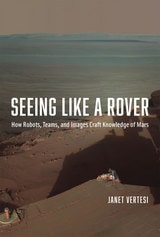
In the years since the Mars Exploration Rover Spirit and Opportunity first began transmitting images from the surface of Mars, we have become familiar with the harsh, rocky, rusty-red Martian landscape. But those images are much less straightforward than they may seem to a layperson: each one is the result of a complicated set of decisions and processes involving the large team behind the Rovers.

With Seeing Like a Rover, Janet Vertesi takes us behind the scenes to reveal the work that goes into creating our knowledge of Mars. Every photograph that the Rovers take, she shows, must be processed, manipulated, and interpreted—and all that comes after team members negotiate with each other about what they should even be taking photographs of in the first place. Vertesi’s account of the inspiringly successful Rover project reveals science in action, a world where digital processing uncovers scientific truths, where images are used to craft consensus, and where team members develop an uncanny intimacy with the sensory apparatus of a robot that is millions of miles away. Ultimately, Vertesi shows, every image taken by the Mars Rovers is not merely a picture of Mars—it’s a portrait of the whole Rover team, as well.
[more]
cover of Seeing Underground: Maps, Models, and Mining Engineering in America

Seeing Underground

Maps, Models, and Mining Engineering in America

Eric C. Nystrom

University of Nevada Press, 2014

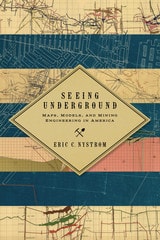
Digging mineral wealth from the ground dates to prehistoric times, and Europeans pursued mining in the Americas from the earliest colonial days. Prior to the Civil War, little mining was deep enough to require maps. However, the major finds of the mid-nineteenth century, such as the Comstock Lode, were vastly larger than any before in America. In Seeing Underground, Nystrom argues that, as industrial mining came of age in the United States, the development of maps and models gave power to a new visual culture and allowed mining engineers to advance their profession, gaining authority over mining operations from the miners themselves.

Starting in the late nineteenth century, mining engineers developed a new set of practices, artifacts, and discourses to visualize complex, pitch-dark three-dimensional spaces. These maps and models became necessary tools in creating and controlling those spaces. They made mining more understandable, predictable, and profitable. Nystrom shows that this new visual culture was crucial to specific developments in American mining, such as implementing new safety regulations after the Avondale, Pennsylvania fire of 1869 killed 110 men and boys; understanding complex geology, as in the rich ores of Butte, Montana; and settling high-stakes litigation, such as the Tonopah, Nevada, Jim Butler v. West End lawsuit, which reached the US Supreme Court.

Nystrom demonstrates that these neglected artifacts of the nineteenth and early twentieth centuries have much to teach us today. The development of a visual culture helped create a new professional class of mining engineers and changed how mining was done. Seeing Undergound is the winner of the 2015 Mining History Association’s Clark Spence Award for the best book on mining history.

[more]
cover of Selected Topics in Advanced Solid State and Fibre Optic Sensors

Selected Topics in Advanced Solid State and Fibre Optic Sensors

S.M. Vaezi-Nejad

The Institution of Engineering and Technology, 2000

New techniques and technologies for sensors are developing fast and being applied in a wide range of fields for measurement and instrumentation, both for research and commercial purposes. This book aims to provide advanced students and practising engineers with a selective tour of highlights in the topical field of sensors for measurement. The authors provide descriptions of the operation, characteristics and applications of the sensors on which they work, together with recent advances and prospects for the future. The chapters cover both fibre optic and solid state sensing, applied across a wide range of applications.
[more]
cover of Self-Healing Materials: From fundamental concepts to advanced space and electronics applications

Self-Healing Materials

From fundamental concepts to advanced space and electronics applications

Brahim Aïssa

The Institution of Engineering and Technology, 2019

Self-healing materials are an emerging class of smart materials that are capable of repairing themselves from damage, either spontaneously or under a stimulus such as light, heat, or the application of a solvent. Intended for an audience of researchers in academia and industry, this book addresses a wide range of self-healing materials and processes, with emphasis on their performance in the space environment.
[more]
cover of Self-Organizing Dynamic Agents for the Operation of Decentralized Smart Grids

Self-Organizing Dynamic Agents for the Operation of Decentralized Smart Grids

Alfredo Vaccaro

The Institution of Engineering and Technology, 2024

Integrating intermittent distributed generation, distributed storage systems, electric vehicles, and flexible loads will present security, stability, and power quality challenges in future smart grids. The amount of data to be processed to face these issues can overwhelm grid operation tools and conventional IT-based applications, limiting situational awareness and decision support. Decentralized and self-organizing technologies can help with that problem. In a self-organizing system, information processing is based on local interactions of its elementary parts (dynamic agents), enabling the cooperative solution of complex decision-making problems by only requiring local information exchange without needing a fusion center for data collection and processing.
[more]
cover of Selling Outer Space: Kennedy, the Media, and Funding for Project Apollo, 1961-1963

Selling Outer Space

Kennedy, the Media, and Funding for Project Apollo, 1961-1963

James Kauffman

University of Alabama Press, 2009

Examines how the Kennedy administration and the media constructed the space program in ways designed to win congressional and public approval

Examines the Kennedy administration’s rhetorical campaign to persuade Congress and the public to adopt a manned flight to the moon. In so doing, the study addresses three key themes.

First, it illuminates the contrasting nature of technical and narrative arguments and explores how those arguments play different roles in public discussion of social policy. Second, the book examines how both the executive branch and the news media function to help set the agenda in American politics. Offering a case study of the increasingly complex relationship between the government and the media.

Finally, Selling Outer Space explores the power of technology to shape and direct human action.
 
[more]
cover of Selling Power: Economics, Policy, and Electric Utilities Before 1940

Selling Power

Economics, Policy, and Electric Utilities Before 1940

John L. Neufeld

University of Chicago Press, 2016

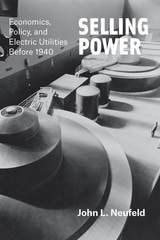
We remember Thomas Edison as the inventor of the incandescent light bulb, but he deserves credit for something much larger, an even more singular invention that profoundly changed the way the world works: the modern electric utility industry. Edison’s light bulb was the first to work within a system where a utility generated electricity and distributed it to customers for lighting. The story of how electric utilities went within one generation from prototype to an indispensable part of most Americans’ lives is a story about the relationships between political and technological change.
           
John L. Neufeld offers a comprehensive historical treatment of the economics that shaped electric utilities. Compared with most industries, the organization of the electric utility industry is not—and cannot be—economically efficient. Most industries are kept by law in a state of fair competition, but the capital necessary to start an electric company—generators, transmission and distribution systems, and land and buildings—is so substantial that few companies can enter the market and compete. Therefore, the natural state of the electric utility industry since its inception has been a monopoly subject to government oversight. These characteristics of electric utilities—and electricity’s importance—have created over time sharp political controversies, and changing public policies have dramatically changed the industry’s structure to an extent matched by few other industries. Neufeld outlines the struggles that shaped the industry’s development, and shows how the experience of electric utilities provides insight into the design of economic institutions, including today’s new large-scale markets.

 
[more]
cover of Selling the Air: A Critique of the Policy of Commercial Broadcasting in the United States

Selling the Air

A Critique of the Policy of Commercial Broadcasting in the United States

Thomas Streeter

University of Chicago Press, 1996

In this interdisciplinary study of the laws and policies associated with commercial radio and television, Thomas Streeter reverses the usual take on broadcasting and markets by showing that government regulation creates rather than intervenes in the market. Analyzing the processes by which commercial media are organized, Streeter asks how it is possible to take the practice of broadcasting—the reproduction of disembodied sounds and pictures for dissemination to vast unseen audiences—and constitute it as something that can be bought, owned, and sold.

With an impressive command of broadcast history, as well as critical and cultural studies of the media, Streeter shows that liberal marketplace principles—ideas of individuality, property, public interest, and markets—have come into contradiction with themselves. Commercial broadcasting is dependent on government privileges, and Streeter provides a searching critique of the political choices of corporate liberalism that shape our landscape of cultural property and electronic intangibles.
[more]
cover of Semi-custom IC Design and VLSI

Semi-custom IC Design and VLSI

P.J. Hicks

The Institution of Engineering and Technology, 1983
The contents of this book were first presented as a series of lectures at the first IEE Vacation School on Semi-Custom IC Design and VLSI held at the University of Edinburgh on 4-8 July 1983. The earlier chapters provide an introduction to silicon IC technology and include descriptions of the various processing techniques employed in the manufacture of microelectronic components. Different types of semi-custom IC are then reviewed and the factors that have to be considered in choosing a semi-custom technique are examined in detail. Logic design is next presented as an activity that is best carried out at a higher level of abstraction than the customary/logic gate level by using the algorithmic state machine (ASM) method. In the sections that follow, computer aids to design and design automation tools are introduced as essential requirements for the rapid and error-free design of semicustom ICs. Testing strategies and the need to design for testability are also covered in some detail.
[more]
cover of Semiconductor Lasers and Diode-based Light Sources for Biophotonics

Semiconductor Lasers and Diode-based Light Sources for Biophotonics

Peter E. Andersen

The Institution of Engineering and Technology, 2019
Semiconductor lasers are small, reliable, low cost, high-performance and user-friendly optical devices which make them highly suitable for a variety of biomedical applications.
[more]
cover of Sensors for Ranging and Imaging

Sensors for Ranging and Imaging

Graham Brooker

The Institution of Engineering and Technology, 2022

Sensors for Ranging and Imaging is a comprehensive textbook and professional reference that provides a solid background in active sensing technology. This new edition has been comprehensively updated and expanded to include the latest radar technologies.
[more]
cover of Sensors in the Age of the Internet of Things: Technologies and applications

Sensors in the Age of the Internet of Things

Technologies and applications

Octavian Adrian Postolache

The Institution of Engineering and Technology, 2019
The IoT is the inter-networking of connected and smart devices, buildings, vehicles and other items which are embedded with electronics, software, sensors, actuators, and network connectivity that enable these objects to collect and exchange data. A sensor is a detection device that measures, records, or responds to a physical property. Sensors represent the front end of information processing. Progress in communication technologies is part of the multi-factorial advances in electronics, sensors, embedded computing, signal processing and machine learning methods that has led to the development of new capabilities in the IoT.
[more]
cover of Sensors, Actuators, and Their Interfaces: A multidisciplinary introduction

Sensors, Actuators, and Their Interfaces

A multidisciplinary introduction

Nathan Ida

The Institution of Engineering and Technology, 2020
Sensors and actuators are used daily in countless applications to ensure more accurate and reliable workflows and safer environments. Many students and young engineers with engineering and science backgrounds often come prepared with circuits and programming skills but have little knowledge of sensors and sensing strategies and their interfacing.
[more]
cover of Sensors, Actuators, and their Interfaces: A multidisciplinary introduction

Sensors, Actuators, and their Interfaces

A multidisciplinary introduction

Nathan Ida

The Institution of Engineering and Technology, 2014
As sensors and actuators are normally not (and have not been) treated in academic curricula as a subject in its own right; many students and current professionals often find themselves limited in their knowledge and dealing with topics and issues based on material they may have never encountered. Until now.
[more]
cover of Sensory Systems for Robotic Applications

Sensory Systems for Robotic Applications

Ravinder Dahiya

The Institution of Engineering and Technology, 2022

Robots have come a long way thanks to advances in sensing and computer vision technologies and can be found today in healthcare, medicine and industry. Researchers have been looking at providing them with senses such as the ability to see, smell, hear and perceive touch in order to mimic and interact with humans and their surrounding environments.
[more]
cover of Sevick's Transmission Line Transformers: Theory and practice

Sevick's Transmission Line Transformers

Theory and practice

Raymond A. Mack

The Institution of Engineering and Technology, 2014
The long awaited revision of the classic book Transmission Line Transformers, by Jerry Sevick, is now in its fifth edition and has been updated and reorganised by Raymond Mack to provide communication engineers with a clear technical presentation of both the theory and practical applications of the transmission of radio communication.
[more]
cover of Shadowing Function from Randomly Rough Surfaces: Derivation and applications

Shadowing Function from Randomly Rough Surfaces

Derivation and applications

Christophe Bourlier

The Institution of Engineering and Technology, 2019
The shadowing function is an important element in the simulation and calculation of how electromagnetic waves scatter at randomly rough surfaces. Its derivation and use is an active, interdisciplinary area of research with practical applications in fields such as radar, optics, acoustics, geoscience, computer graphics and remote sensing.
[more]
cover of Shaping Science and Technology Policy: The Next Generation of Research

Shaping Science and Technology Policy

The Next Generation of Research

Edited by David H. Guston and Daniel Sarewitz

University of Wisconsin Press, 2006

With scientific progress occurring at a breathtaking pace, science and technology policy has never been more important than it is today. Yet there is a very real lack of public discourse about policy-making, and government involvement in science remains shrouded in both mystery and misunderstanding.  Who is making choices about technology policy, and who stands to win or lose from these choices?  What criteria are being used to make decisions and why?  Does government involvement help or hinder scientific research?  

Shaping Science and Technology Policy brings together an exciting and diverse group of emerging scholars, both practitioners and academic experts, to investigate current issues in science and technology policy.  Essays explore such topics as globalization, the shifting boundary between public and private, informed consent in human participation in scientific research, intellectual property and university science, and the distribution of the costs and benefits of research. 

Contributors: Charlotte Augst, Grant Black, Mark Brown, Kevin Elliott, Patrick Feng, Pamela M. Franklin, Carolyn Gideon, Tené N. Hamilton, Brian A. Jackson, Shobita Parthasarathy, Jason W. Patton, A. Abigail Payne, Bhaven Sampat, Christian Sandvig, Sheryl Winston Smith, Michael Whong-Barr
[more]
cover of Shaping Science: Organizations, Decisions, and Culture on NASA’s Teams

Shaping Science

Organizations, Decisions, and Culture on NASA’s Teams

Janet Vertesi

University of Chicago Press, 2020

Drawing on a decade of immersive ethnography with NASA’s robotic spacecraft teams to create a comparative account of two great space missions of the early 2000s, Janet Vertesi uncovers how the social organization of a scientific team affects their scientific practices and results.

In Shaping Science, Janet Vertesi draws on a decade of immersive ethnography with NASA’s robotic spacecraft teams to create a comparative account of two great space missions of the early 2000s. Although these missions featured robotic explorers on the frontiers of the solar system bravely investigating new worlds, their commands were issued from millions of miles away by a very human team. By examining the two teams’ formal structures, decision-making techniques, and informal work practices in the day-to-day process of mission planning, Vertesi shows just how deeply entangled a team’s local organizational context is with the knowledge they produce about other worlds.
 
Using extensive, embedded experiences on two NASA spacecraft teams, this is the first book to apply organizational studies of work to the laboratory environment in order to analyze the production of scientific knowledge itself. Engaging and deeply researched, Shaping Science demonstrates the significant influence that the social organization of a scientific team can have on the practices of that team and the results they yield.
[more]
cover of Shared Mobility and Automated Vehicles: Responding to socio-technical changes and pandemics

Shared Mobility and Automated Vehicles

Responding to socio-technical changes and pandemics

Ata M. Khan

The Institution of Engineering and Technology, 2022

Shared vehicles are a key part of any future intelligent and clean transport system, as they can allow for the sharing and potentially more efficient use of transport resources and fuel. Shared mobility has been gaining attention in the private and public sectors as a possible strategy for taming auto ownership, vehicle miles/kilometers travelled, and emissions.
[more]