Results by title
146 books match the query 'Terrorism' and 16 start with s
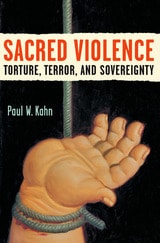
Sacred Violence
Torture, Terror, and SovereigntyPaul W. Kahn
University of Michigan Press, 2008
In Sacred Violence, the distinguished political and legal theorist Paul W. Kahn investigates the reasons for the resort to violence characteristic of premodern states. In a startling argument, he contends that law will never offer an adequate account of political violence. Instead, we must turn to political theology, which reveals that torture and terror are, essentially, forms of sacrifice. Kahn forces us to acknowledge what we don't want to see: that we remain deeply committed to a violent politics beyond law.
Paul W. Kahn is Robert W. Winner Professor of Law and the Humanities at Yale Law School and Director of the Orville H. Schell, Jr. Center for International Human Rights.
Cover Illustration: "Abu Ghraib 67, 2005" by Fernando Botero. Courtesy of the artist and the American University Museum.

Secret Service
National Security in an Age of Open InformationJonathan Evans
Haus Publishing, 2020
Securing the Sacred
Religion, National Security, and the Western StateRobert M. Bosco
University of Michigan Press, 2014
Despite significant theoretical distinctions between securitization on the domestic and the international levels, he finds that the outcome of addressing religion within the context of security hinges upon partnerships. Whereas states may harness the power of international allies, they cannot often find analogous domestic allies; therefore, states that attempt to securitize religion at home are more vulnerable to counterattack and more likely to abandon their efforts. Securing the Sacred makes a significant contribution to the fields of political theory, international relations, Islamic studies, and security/military studies.

Seeds of Hate
How America's Flawed Middle East Policy Ignited the JihadLawrence Pintak
Pluto Press, 2003
Selling Fear
Counterterrorism, the Media, and Public OpinionBrigitte L. Nacos, Yaeli Bloch-Elkon, Robert Y. Shapiro
University of Chicago Press, 2011
While we’ve long known that the strategies of terrorism rely heavily on media coverage of attacks, Selling Fear is the first detailed look at the role played by media in counterterrorism—and the ways that, in the wake of 9/11, the Bush administration manipulated coverage to maintain a climate of fear.
Drawing on in-depth analysis of counterterrorism in the years after 9/11—including the issuance of terror alerts and the decision to invade Iraq—the authors present a compelling case that the Bush administration hyped fear, while obscuring civil liberties abuses and concrete issues of preparedness. The media, meanwhile, largely abdicated its watchdog role, choosing to amplify the administration’s message while downplaying issues that might have called the administration’s statements and strategies into question. The book extends through Hurricane Katrina, and the more skeptical coverage that followed, then the first year of the Obama administration, when an increasingly partisan political environment presented the media, and the public, with new problems of reporting and interpretation.
Selling Fear is a hard-hitting analysis of the intertwined failures of government and media—and their costs to our nation.
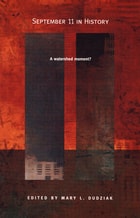
September 11 in History
A Watershed Moment?Mary L. Dudziak, ed.
Duke University Press, 2003
From a variety of perspectives, the contributors to this collection scrutinize claims about September 11, in terms of both their historical validity and their consequences. Essays range from an analysis of terms like “ground zero,” “homeland,” and “the axis of evil” to an argument that the U.S. naval base at Guantánamo Bay has become a site for acting out a repressed imperial history. Examining the effect of the attacks on Islamic self-identity, one contributor argues that Osama bin Laden enacted an interpretation of Islam on September 11 and asserts that progressive Muslims must respond to it. Other essays focus on the deployment of Orientalist tropes in categorizations of those who “look Middle Eastern,” the blurring of domestic and international law evident in a number of legal developments including the use of military tribunals to prosecute suspected terrorists, and the justifications for and consequences of American unilateralism. This collectionultimately reveals that everything did not change on September 11, 2001, but that some foundations of democratic legitimacy have been significantly eroded by claims that it did.
Contributors. Khaled Abou el Fadl, Mary L. Dudziak, Christopher L. Eisgruber, Laurence R. Helfer, Sherman A. Jackson, Amy B. Kaplan, Elaine Tyler May, Lawrence G. Sager, Ruti G. Teitel, Leti Volpp, Marilyn B. Young
Seven Shots
An NYPD Raid on a Terrorist Cell and Its AftermathJennifer C. Hunt
University of Chicago Press, 2010
On July 31, 1997, a six-man Emergency Service team from the NYPD raided a terrorist cell in Brooklyn and narrowly prevented a suicide bombing of the New York subway that would have cost hundreds, possibly thousands of lives.
Seven Shots tells the dramatic story of that raid, the painstaking police work involved, and its paradoxical aftermath, which drew the officers into a conflict with other rank-and-file police and publicity-hungry top brass. Jennifer C. Hunt draws on her personal knowledge of the NYPD and a network of police contacts extending from cop to four-star chief, to trace the experience of three officers on the Emergency Service entry team and the two bomb squad detectives who dismantled the live device. She follows their lives for five years, from that near-fatal day in 1997, through their encounters inside the brutal world of departmental politics, and on to 9/11, when they once again put their lives at risk in the fight against terrorism, racing inside the burning towers and sorting through the ash, debris, and body parts. Throughout this fast paced narrative, Hunt maintains a strikingly fine-grained, street-level view, allowing us to understand the cops on their own terms—and often in their own words. The result is a compelling insider’s picture of the human beings who work in two elite units in the NYPD and the moral and physical danger and courage involved.
As gripping as an Ed McBain novel—and just as steeped in New York cop culture and personalities—Seven Shots takes readers on an unforgettable journey behind the shield and into the hearts of New York City police.
Shadow Lives
The Forgotten Women of the War on TerrorVictoria Brittain
Pluto Press, 2013
Shadow Lives reveals the unseen side of the '9/11 wars': their impact on the wives and families of men incarcerated in Guantanamo, or in prison or under house arrest in Britain and the US. Victoria Brittain shows how these families have been made socially invisible and a convenient scapegoat for the state in order to exercise arbitrary powers under the cover of the 'War on Terror'.
A disturbing exposé of the perilous state of freedom and democracy in our society, the book reveals how a culture of intolerance and cruelty has left individuals at the mercy of the security services’ unverifiable accusations and punitive punishments.
Both a j'accuse and a testament to the strength and humanity of the families, Shadow Lives shows the methods of incarceration and social control being used by the British state and gives a voice to the families whose lives have been turned upside down. In doing so it raises urgent questions about civil liberties which no one can afford to ignore.
Shock and Yawn
Resisting Banal Terror Through Queer StorytellingMegan Sibbett
The Ohio State University Press, 2026
Building on queer theorists’ critiques of intimate and administrative violence, especially Gloria Anzaldúa’s “intimate terrorism,” Sibbett develops methodologies for conceptualizing and subverting violence aimed at queer, racialized, and gendered bodies in this era of surveillance and increasing authoritarianism. Sibbett addresses book bans, anti-trans legislation, idealized histories of westward expansion, and more, examining materials that include public service announcements, advertising, social media, news reports, poems, interviews, and novels. In so doing, she demonstrates the crucial role queer testimonies—and queer histories and queer futures—play in revealing systemic violence and illuminating the transformative potential of everyday resistance.
Slave of Allah
Zacarias Moussaoui Vs the USAKatherine C. Donahue
Pluto Press, 2007
The book begins with his arrest and moves to the courtroom, telling the tale of Moussaoui's struggle with his defense lawyers and raising questions about his ability to be "represented" given his national and personal identity. Donahue explores his background in France as the son of Moroccan immigrants and follows him to London, Afghanistan, and Malaysia as he joins the growing fraternity of an Islam without borders. He acquires an extra-national identity in which his loyalty is no longer constituted by his national identity, but by his allegiance to fundamental Islam.
Speculative Security
The Politics of Pursuing Terrorist MoniesMarieke de Goede
University of Minnesota Press, 2012
Since the terrorist acts of September 11, 2001, finance and security have become joined in new ways to produce particular targets of state surveillance. In Speculative Security, Marieke de Goede describes how previously unscrutinized practices such as donations and remittances, especially across national borders, have been affected by security measures that include datamining, asset freezing, and transnational regulation. These “precrime” measures focus on transactions that are perfectly legal but are thought to hold a specific potential to support terrorism. The pursuit of suspect monies is not simply an issue of financial regulation, she shows, but a broad political, social, and even cultural phenomenon with profound effects on everyday life.
Speculative Security offers a range of examples that illustrate the types of security interventions employed today, including the extralegal targeting and breaking up of the al-Barakaat financial network that was accompanied by raids in the United States, asset freezes in Sweden, and the incarceration of a money remitter at Guantánamo Bay. De Goede develops the paradigm of “speculative security” as a way to understand the new fusing of finance and security, denoting the speculative nature of both the means and the ends of the war on terrorist financing.
Ultimately, de Goede reveals how the idea of creating “security” appeals to multiple imaginable—and unimaginable—futures in order to enable action in the present.
States of Terror
History, Theory, LiteratureDavid Simpson
University of Chicago Press, 2019
Introducing the concept of the “fear-terror cluster,” Simpson is able to capture the wide range of terms that we have used to express extreme emotional states over the centuries—from anxiety, awe, and concern to dread, fear, and horror. He shows that the choices we make among such words to describe shades of feeling have seriously shaped the attribution of motives, causes, and effects of the word “terror” today, particularly when violence is deployed by or against the state. At a time when terror-talk is widely and damagingly exploited by politicians and the media, this book unpacks the slippery rhetoric of terror and will prove a vital resource across humanistic and social sciences disciplines.
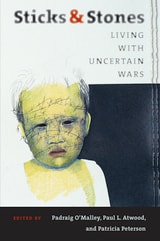
Sticks and Stones
Living with Uncertain WarsPadraig O'Malley
University of Massachusetts Press, 2006
Following an introduction by Padraig O'Malley, the book is divided into four sections: "Understanding the World as We Have Known It"; "Global Uncertainties"; "Whose Values? Whose Justice?"; and "Shaping a New World." The first section reviews what we have learned about war and establishes benchmarks for judging whether that knowledge is being translated into changes in the behavior of our political cultures. It suggests that the world's premier superpower, in its effort to promote Western-style democracy, has taken steps that have inhibited rather than facilitated democratization.
The second section examines the war on terror and the concept of global war. From the essays in this section emerges a consensus that democracy as practiced in the West cannot be exported to countries with radically different cultures, traditions, and values. The third section visits the question of means and ends in the context of varying value systems and of theocracy, democracy, and culture. In the final section, the focus shifts to our need for global institutions to maintain order and assist change in the twenty-first century.
Although each contributor comes from a different starting point, speaks with a different voice, and has a different ideological perspective, the essays reach startlingly similar conclusions. In sum, they find that the West has not absorbed the lessons from the wars of the last century and is inadequately prepared to meet the new challenges that now confront us.
Contributors to the volume include J. Brian Atwood, Susan J. Atwood, John Cooley, Romeo Dallaire, Ramu Damodaran, Valerie Epps, Michael J. Glennon, Stanley Heginbotham, Robert Jackson, Winston Langley, Alfred W. McCoy, Greg Mills, Jonathan Moore, Chris Patten, Gwyn Prins, Jonathan Schell, John Shattuck, Cornelio Sommargua, Brian Urquhart, Stephen Van Evera, and Robert Weiner.
Suicide Bombers
Allah's New MartyrsFarhad Khosrokhavar
Pluto Press, 2005
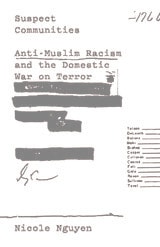
Suspect Communities
Anti-Muslim Racism and the Domestic War on TerrorNicole Nguyen
University of Minnesota Press, 2019
The first major qualitative study of “countering violent extremism” in key U.S. cities
Suspect Communities is a powerful reassessment of the U.S. government’s “countering violent extremism” (CVE) program that has arisen in major cities across the United States since 2011. Drawing on an interpretive qualitative study, it examines how the concept behind CVEaimed at combating homegrown terrorism by engaging Muslim community members, teachers, and religious leaders in monitoring and reporting on young peoplehas been operationalized through the everyday work of CVE actors, from high-level national security workers to local community members, with significant penalties for the communities themselves.
Nicole Nguyen argues that studying CVE provides insight into how the drive to bring liberal reforms to contemporary security regimes through “community-driven” and “ideologically ecumenical” programming has in fact further institutionalized anti-Muslim racism in the United States. She forcefully contends that the U.S. security state has designed CVE to legitimize and shore up support for the very institutions that historically have criminalized, demonized, and dehumanized communities of color, while appearing to learn from and attenuate past practices of coercive policing, racial profiling, and political exclusion.
By undertaking this analysis, Suspect Communities offers a vital window into the inner workings of the U.S. security state and the devastating impact of CVE on local communities.
Suspect Community
People's Experiences of the Prevention of Terrorism ActPaddy Hillyard
Pluto Press, 1993