Results by title
660 books match the query 'Texas' and 28 start with s

Sacred Modern
Faith, Activism, and Aesthetics in the Menil CollectionBy Pamela G. Smart
University of Texas Press, 2010
Renowned as one of the most significant museums built by private collectors, the Menil Collection in Houston, Texas, seeks to engage viewers in an acutely aesthetic, rather than pedagogical, experience of works of art. The Menil's emphasis on being moved by art, rather than being taught art history, comes from its founders' conviction that art offers a way to reintegrate the sacred and the secular worlds. Inspired by the French Catholic revivalism of the interwar years that recast Catholic tradition as the avant-garde, Dominique and John de Menil shared with other Catholic intellectuals a desire to reorder a world in crisis by imbuing modern cultural forms with religious faith, binding the sacred with the modern.
Sacred Modern explores how the Menil Collection gives expression to the religious and political convictions of its founders and how "the Menil way" is being both perpetuated and contested as the Museum makes the transition from operating under the personal direction of Dominique de Menil to the stewardship of career professionals. Taking an ethnographic approach, Pamela G. Smart analyzes the character of the Menil aesthetic, the processes by which it is produced, and the sensibilities that it is meant to generate in those who engage with the collection. She also offers insight into the extraordinary impact Dominique and John de Menil had on the emergence of Houston as a major cultural center.
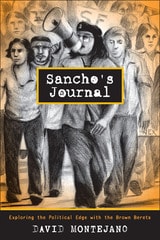
Sancho's Journal
Exploring the Political Edge with the Brown BeretsBy David Montejano
University of Texas Press, 2012
How do people acquire political consciousness, and how does that consciousness transform their behavior? This question launched the scholarly career of David Montejano, whose masterful explorations of the Mexican American experience produced the award-winning books Anglos and Mexicans in the Making of Texas, 1836–1986, a sweeping outline of the changing relations between the two peoples, and Quixote’s Soldiers: A Local History of the Chicano Movement, 1966–1981, a concentrated look at how a social movement “from below” began to sweep away the last vestiges of the segregated social-political order in San Antonio and South Texas. Now in Sancho’s Journal, Montejano revisits the experience that set him on his scholarly quest—“hanging out” as a participant-observer with the South Side Berets of San Antonio as the chapter formed in 1974.
Sancho’s Journal presents a rich ethnography of daily life among the “batos locos” (crazy guys) as they joined the Brown Berets and became associated with the greater Chicano movement. Montejano describes the motivations that brought young men into the group and shows how they learned to link their individual troubles with the larger issues of social inequality and discrimination that the movement sought to redress. He also recounts his own journey as a scholar who came to realize that, before he could tell this street-level story, he had to understand the larger history of Mexican Americans and their struggle for a place in U.S. society. Sancho’s Journal completes that epic story.

Savage Frontier Volume I
Rangers, Riflemen, and Indian Wars in Texas, 1835-1837Stephen L. Moore
University of North Texas Press, 2002

Savage Frontier Volume III
Rangers, Riflemen, and Indian Wars in Texas, 1840-1841Stephen L. Moore
University of North Texas Press, 2007

Savage Frontier Volume IV
Rangers, Riflemen, and Indian Wars in Texas, 1842-1845Stephen L. Moore
University of North Texas Press, 2002

Saving Ben
A Father's Story of AutismDan E. Burns
University of North Texas Press, 2009
Saving the Big Thicket
From Exploration to Preservation, 1685-2003James J. Cozine Jr.
University of North Texas Press, 2004

Science in the American Southwest
A Topical HistoryGeorge E. Webb
University of Arizona Press, 2002
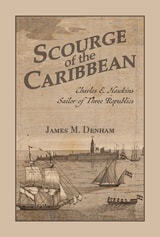
Scourge of the Caribbean
Charles E. Hawkins, Sailor of Three RepublicsJames M. Denham
University of Alabama Press, 2026
Illuminates the early American period in the upper Caribbean
Scourge of the Caribbean explores the mysterious and dramatic life and career of Charles E. Hawkins, a relatively unknown naval figure in early national America. Hawkins’s action-packed life at sea in his brief but accomplished career reveals much about an era when the rules of the maritime world, especially in the Caribbean, were in flux. For the US Navy and its commanders, the Caribbean presented an untold number of ambiguities: revolutionary juntas, privateering, piracy, and deadly disease, all within some of the most beautiful landscapes and waterscapes on earth.
Hawkins, from a well-connected family, took to the sea as a midshipman in the US Navy. Stalled promotion, economic setbacks, and blunted opportunities stymied the young officer, but ambition, combined with varied experiences and maritime pursuits, presented other prospects. At a time when individual agency mattered most, Hawkins stepped outside traditional boundaries of conduct on numerous occasions. Hawkins followed a mentor into the Mexican navy and became the most successful and feared raider of Spanish ships, earning the sobriquet “scourge” because of his raids along Cuba’s northern coast. In 1835, Hawkins joined the Texas independence movement against Mexico. Within the historical narrative are lurid accounts of adultery, affairs of honor, a bloody assassination, and complicated maritime legal battles. Based on prodigious research, this lively tale will appeal to those interested in maritime and early American history and the upper Caribbean in the Age of Sail.
Secession and the Union in Texas
By Walter L. Buenger
University of Texas Press, 1984
In 1845 Texans voted overwhelmingly to join the Union. They voted just as overwhelmingly to secede in 1861. The story of why and how that happened is filled with colorful characters, such as the aged Sam Houston, and with the southwestern flavor of raiding Comanches, German opponents of slavery, and a border with Mexico.
Texas was unique among the seceding states because of its ambivalence toward secession. Yet for all its uniqueness the story of the secession of Texas has broad implications for the secession movement in general. Despite the local color and the southwestern nature of the state, Texas was more southern than western in 1860. Texans supported the Union or insisted upon secession for reasons common to the South and to the whole nation. Most Texans in 1860 were recent immigrants from southern and border states. They still thought and acted like citizens of their former states. The newness of Texas then makes it a particularly appropriate place from which to draw conclusions about the entire secession movement.
Secession and the Union in Texas is both a narrative of secession in Texas and a case study of the causes of secession in a southern state. Politics play a key role in this history, but politics broadly defined to include the influence of culture, partisanship, ideology, and self-interest. As any study of a mass movement carried out in tense circumstances must be, this is social history as well as political history. It is a study of public hysteria, the pressure for consensus, and the vanishing of a political process in which rational debate about secession and the Union could take place.
Although relying primarily on traditional sources such as manuscript collections and newspapers, a particularly rich source for this study, the author also uses election returns, population shifts over the course of the 1850s, and the breakdown of population within Texas counties to provide a balanced approach.
These sources indicate that Texans were not simply secessionists or unionists. At the end of 1860 Texans ranged from ardent secessionists to equally passionate supporters of the Union. But the majority fell in between these two extremes, creating an atmosphere of ambivalence toward secession which was not erased even by the war.
See Sam Run
A Mother's Story of AutismPeggy Heinkel-Wolfe
University of North Texas Press, 2008
Segregation by Experience
Agency, Racism, and Learning in the Early GradesJennifer Keys Adair and Kiyomi Sánchez-Suzuki Colegrove
University of Chicago Press, 2021
Early childhood can be a time of rich discovery, a period when educators have an opportunity to harness their students’ fascination to create unique learning opportunities. Some teachers engage with their students’ ideas in ways that make learning collaborative--but not all students have access to these kinds of learning environments.
In Segregation by Experience, the authors filmed and studied a a first-grade classroom led by a Black immigrant teacher who encouraged her diverse group of students to exercise their agency. When the researchers showed the film to other schools, everyone struggled. Educators admired the teacher but didn’t think her practices would work with their own Black and brown students. Parents of color—many of them immigrants—liked many of the practices, but worried that they would compromise their children. And the young children who viewed the film thought that the kids in the film were terrible, loud, and badly behaved; they told the authors that learning was supposed to be quiet, still, and obedient. In Segregation by Experience Jennifer Keys Adair and Kiyomi Sánchez-Suzuki Colegrove show us just how much our expectations of children of color affect what and how they learn at school, and they ask us to consider which children get to have sophisticated, dynamic learning experiences at school and which children are denied such experiences because of our continued racist assumptions about them.
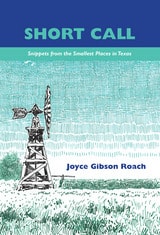
Short Call
Snippets from the Smallest Places in Texas, 1935-2000Joyce Gibson Roach
University of North Texas Press, 2014
Single Star of the West
The Republic of Texas, 1836-1845Kenneth W. Howell
University of North Texas Press, 2017

Six-Shooters and Shifting Sands
The Wild West Life of Texas Ranger Captain Frank JonesBob Alexander
University of North Texas Press, 2015

Someday All the Adults Will Die!
The Birth of Texas PunkPat Blashill
University of Texas Press, 2025
A deep dive into the early days of punk in Austin, Texas, this oral history immerses readers in a diverse and influential music scene.
Texas has always teemed with music and counterculture. When punk came to the state in 1978, it flourished in San Antonio, Dallas, Houston, and, especially, Austin. Punk and post-punk musicians, including nationally acclaimed bands like the Butthole Surfers, the Big Boys, the Dicks, and Daniel Johnston influenced local culture before slashing into the American musical psyche. (See Kurt Cobain sporting Johnston’s “Hi, How are you?” T-shirt.) Someday All the Adults Will Die! is an oral history of punk in Texas, from its rise in the late 1970s, through its strong anti-racist, feminist, and queer peak, to its dissolution in the late 1980s.
Now a seasoned music journalist, Blashill experienced the zenith of Texas punk as a teenager, and he captures its intensity in words and pictures. Someday All the Adults Will Die! is rife with electrifying images and firsthand tales of what made this scene such a storm of pleasures and terrors, uncompromising artists, and wild performances. This dynamic portrait of an untamed, all-out musical era is a must-read for fans of punk music, counterculture, and live music.

Somos Tejanas!
Chicana Identity and Culture in TexasEdited by Jody A. Marín and Norma E. Cantú
University of Texas Press, 2025
2026 Outstanding Book Award for Non-Fiction, National Association for Chicana and Chicano Studies (NACCS) Tejas Foco
2026 Silver Medal for the Dolores Huerta Best Cultural & Community Themed Book – English, Conference on Latin American History (CLAH)
An expansive volume on Tejana identity and Tejanidad told through personal narratives, poetry, and essays.
Being Tejanx is different than just being from Texas. Being Tejanx means you are a border subject. Being Tejanx means living in and from a certain history of oppression, possibility, activism, and cultural-linguistic hybridity arising within the US-Mexico borderland that is home. And being Tejanx means something in particular if you are a woman.
In ¡Somos Tejanas!, editors Norma E. Cantú and Jody A. Marín assemble contemporary Tejanx writers who provide firsthand accounts of their experience of identity, enriching the field of Tejanx studies through an encounter with gender and sexuality. The contributions, including personal and scholarly essays, poems, criticism, and artworks, explore the heterogeneity of Tejana identity and the sociopolitical movements, stories, dances, music, and athletic feats that mark Tejanidad. Authors contemplate the history and memory of segregation in Texas, the struggles of surviving the unnatural disaster and blackouts of 2021 amid the global pandemic of COVID-19, and the drug-war violence and ever-tightening immigration restrictions that strangle a transborder way of life shared by millions. An unrepentant act of expression from women under attack by state policymakers, this collection dispels the silence imposed by colonial erasure.
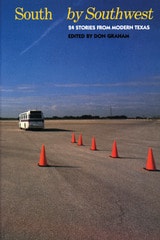
South by Southwest
24 Stories from Modern TexasEdited by Don Graham
University of Texas Press, 1986
These Texas stories are among the best produced by the state's writers in the mid-twentieth century. Selected above all for their artistic excellence and their narrative mastery, they also present a vital picture of the Southwest in microcosm, as revealed in its largest state.
Texas and Texas writing moved from a Southern orientation in the 1940s—reflected here in works by William Goyen, William Humphrey, and others—to the strong Southwestern flavor of stories by such authors as Larry McMurtry and A. C. Greene to, finally, urban or Sunbelt Texas, mirrored in the edgy, sometimes experimental prose of Doug Crowell, William Harrison, and Peter LaSalle.
Here are stories by such celebrated authors as Paul Horgan and William A. Owens, as well as startling, in some cases previously unpublished work by writers like Harryette Mullen, Naomi Shihab Nye, Pat Ellis Taylor, and Thomas Zigal. A few stories may already be favorites—Larry McMurtry's "There Will Be Peace in Korea," Amado Muro's "Cecilia Rosas." Many others have become classics, such as Vassar Miller's poignantly autobiographical "Pact," Hughes Rudd's hilarious record of grade school fieldtrips, R. E. Smith's gripping story of a Houstonian's life-changing encounter with nature, and Dave Hickey's astonishing account of an old cowboy's imprisonment . . . in a bathtub.
Bill Brett, James Crumley, Linda West Eckhardt, Robert Flynn, Mary Gray Hughes, Carolyn Osborn—all are represented here by stories guaranteed to banish stereotypes and boredom and to enlarge one's vision of the Lone Star State. Anyone who thinks that oil wells and big hair define Texas will find out differently in the dazzling short fiction presented in South by Southwest.
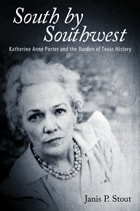
South by Southwest
Katherine Anne Porter and the Burden of Texas HistoryJanis P. Stout
University of Alabama Press, 2013
An interdisciplinary study of Katherine Anne Porter’s troubled relationship to her Texas origins and southern roots, South by Southwest offers a fresh look at this ever-relevant author.
Today, more than thirty years after her death, Katherine Anne Porter remains a fascinating figure. Critics and biographers have portrayed her as a strikingly glamorous woman whose photographs appeared in society magazines. They have emphasized, of course, her writing— particularly the novel Ship of Fools, which was made into an award-winning film, and her collection Pale Horse, Pale Rider, which cemented her role as a significant and original literary modernist. They have highlighted her dramatic, sad, and fragmented personal life. Few, however, have addressed her uneasy relationship to her childhood in rural Texas.
Janis P. Stout argues that throughout Porter’s life she remained preoccupied with the twin conundrums of how she felt about being a woman and how she felt about her Texas origins. Her construction of herself as a beautiful but unhappy southerner sprung from a plantation aristocracy of reduced fortunes meant she construed Texas as the Old South. The Texas Porter knew and re-created in her fiction had been settled by southerners like her grandparents, who brought slaves with them. As she wrote of this Texas, she also enhanced and mythologized it, exaggerating its beauty, fertility, and gracious ways as much as the disaffection that drove her to leave. Her feelings toward Texas ran to both extremes, and she was never able to reconcile them.
Stout examines the author and her works within the historical and cultural context from which she emerged. In particular, Stout emphasizes four main themes in the history of Texas that she believes are of the greatest importance in understanding Porter: its geography and border location (expressed in Porter’s lifelong fascination with marginality, indeterminacy, and escape); its violence (the brutality of her first marriage as well as the lawlessness that pervaded her hometown); its racism (lynchings were prevalent throughout her upbringing); and its marginalization of women (Stout draws a connection between Porter’s references to the burning sun and oppressive heat of Texas and her life with her first husband).

Spanish Expeditions into Texas, 1689-1768
By William C. Foster
University of Texas Press, 1995
Mapping old trails has a romantic allure at least as great as the difficulty involved in doing it. In this book, William Foster produces the first highly accurate maps of the eleven Spanish expeditions from northeastern Mexico into what is now East Texas during the years 1689 to 1768.
Foster draws upon the detailed diaries that each expedition kept of its route, cross-checking the journals among themselves and against previously unused eighteenth-century Spanish maps, modern detailed topographic maps, aerial photographs, and on-site inspections. From these sources emerges a clear picture of where the Spanish explorers actually passed through Texas.
This information, which corrects many previous misinterpretations, will be widely valuable. Old names of rivers and landforms will be of interest to geographers. Anthropologists and archaeologists will find new information on encounters with some 139 named Indian tribes. Botanists and zoologists will see changes in the distribution of flora and fauna with increasing European habitation, and climatologists will learn more about the "Little Ice Age" along the Rio Grande.
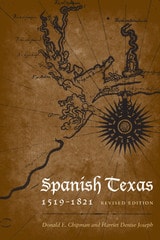
Spanish Texas, 1519–1821
Revised EditionBy Donald E. Chipman and Harriett Denise Joseph
University of Texas Press, 2010
Winner, Kate Broocks Bates Award, Texas State Historical Association
Presidio La Bahía Award, Sons of the Republic of Texas
A Choice Magazine Outstanding Academic Book
Modern Texas, like Mexico, traces its beginning to sixteenth-century encounters between Europeans and Indians who contested control over a vast land. Unlike Mexico, however, Texas eventually received the stamp of Anglo-American culture, so that Spanish contributions to present-day Texas tend to be obscured or even unknown. The first edition of Spanish Texas, 1519–1821 (1992) sought to emphasize the significance of the Spanish period in Texas history. Beginning with information on the land and its inhabitants before the arrival of Europeans, the original volume covered major people and events from early exploration to the end of the colonial era.
This new edition of Spanish Texas has been extensively revised and expanded to include a wealth of discoveries about Texas history since 1990. The opening chapter on Texas Indians reveals their high degree of independence from European influence and extended control over their own lives. Other chapters incorporate new information on La Salle's Garcitas Creek colony and French influences in Texas, the destruction of the San Sabá mission and the Spanish punitive expedition to the Red River in the late 1750s, and eighteenth-century Bourbon reforms in the Americas. Drawing on their own and others' research, the authors also provide more inclusive coverage of the role of women of various ethnicities in Spanish Texas and of the legal rights of women on the Texas frontier, demonstrating that whether European or Indian, elite or commoner, slave owner or slave, women enjoyed legal protections not heretofore fully appreciated.
Spare Time in Texas
Recreation and History in the Lone Star StateBy David G. McComb
University of Texas Press, 2008
What do Texans' pastimes and recreations say about their characters? Looking at Texas history from a new angle, David McComb starts from the premise that how people spend their leisure time may well reveal more about their true natures and interests than the work they do or their family connections. In this innovative book, McComb traces the history of various types of recreation in Texas, gathering significant insights into the characters of Texans from the pleasures they have pursued.
Reflecting the frontier origins of Texas, McComb starts with the recreations that were most popular with men in a crude, still-developing society—drinking, gambling, and whoring. He goes on to show how, as Texas became more civilized, so did its diversions. He describes how Texans have connected with nature in parks and zoos; watched football and baseball in great stadiums such as the Astrodome and Cotton Bowl; discovered the pleasure of reading in public and university libraries; and enjoyed radio, TV, movies, and live theater in places such as Houston's Alley Theatre.
This recreational history reveals that Texans are open-minded and generous; that they respect the land; oppose prostitution but indulge in gambling and drinking; support racial and gender rights; love zoos; champion libraries; take pride in theatrical productions; and adore sports.
Spartan Band
Burnett's 13th Texas Cavalry in the Civil WarThomas Reid
University of North Texas Press, 2005

Stages of Struggle and Celebration
A Production History of Black Theatre in TexasBy Sandra M. Mayo and Elvin Holt
University of Texas Press, 2015
From plantation performances to minstrel shows of the late nineteenth century, the roots of black theatre in Texas reflect the history of a state where black Texans have continually created powerful cultural emblems that defy the clichés of horses, cattle, and bravado. Drawing on troves of archival materials from numerous statewide sources, Stages of Struggle and Celebration captures the important legacies of the dramatic arts in a historical field that has paid most of its attention to black musicians.
Setting the stage, the authors retrace the path of the cakewalk and African-inspired dance as forerunners to formalized productions at theaters in the major metropolitan areas. From Houston’s Ensemble and Encore Theaters to the Jubilee in Fort Worth, gospel stage plays of the Black Academy of Arts and Letters in Dallas, as well as San Antonio’s Hornsby Entertainment Theater Company and Renaissance Guild, concluding with ProArts Collective in Austin, Stages of Struggle and Celebration features founding narratives, descriptions of key players and memorable productions, and enlightening discussions of community reception and the business challenges faced by each theatre. The role of drama departments in historically black colleges in training the companies’ founding members is also explored, as is the role the support of national figures such as Tyler Perry plays in ensuring viability. A canon of Texas playwrights completes the tour. The result is a diverse tribute to the artistic legacies that continue to inspire new generations of producers and audiences.

State of Minds
Texas Culture and Its DiscontentsBy Don Graham
University of Texas Press, 2011
John Steinbeck once famously wrote that "Texas is a state of mind." For those who know it well, however, the Lone Star State is more than one mind-set, more than a collection of clichés, more than a static stereotype. There are minds in Texas, Don Graham asserts, and some of the most important are the writers and filmmakers whose words and images have helped define the state to the nation, the world, and the people of Texas themselves. For many years, Graham has been critiquing Texas writers and films in the pages of Texas Monthly and other publications. In State of Minds, he brings together and updates essays he published between 1999 and 2009 to paint a unique, critical picture of Texas culture.
In a strong personal voice—wry, humorous, and ironic—Graham offers his take on Texas literary giants ranging from J. Frank Dobie to Larry McMurtry and Cormac McCarthy and on films such as The Alamo, The Last Picture Show, and Brokeback Mountain. He locates the works he discusses in relation to time and place, showing how they sprang (or not) from the soil of Texas and thereby helped to define Texas culture for generations of readers and viewers—including his own younger self growing up on a farm in Collin County. Never shying from controversy and never dull, Graham's essays in State of Minds demolish the notion that "Texas culture" is an oxymoron.
Still the Arena of Civil War
Violence and Turmoil in Reconstruction Texas, 1865-1874Kenneth W. Howell
University of North Texas Press, 2012

Surf Texas
By Kenny Braun
University of Texas Press, 2014
The urge to ride a wave, the search for the next perfect swell, is an enduring preoccupation that draws people to coastlines around the world. In recent decades, surfing has grown into a multimillion-dollar industry with over three million surfers in the United States alone and an international competitive circuit that draws top surfers to legendary beaches in Hawaii, California, and Australia. But away from the crowds and the hype, dedicated surfers catch waves in places like the Texas Gulf Coast for the pure pleasure of being in harmony with life, their sport, and the ocean. Kenny Braun knows that primal pleasure, as both a longtime Texas surfer and a fine art photographer who has devoted years to capturing the surf culture on Texas beaches. In Surf Texas, he presents an eloquent photo essay that portrays the enduring fascination of surfing, as well as the singular and sometimes unexpected beauty of the coast.
Texas is one of the top six surfing states in America, and Braun uses evocative black-and-white photography to reveal the essence of the surfers’ world from Galveston to South Padre. His images catch the drama of shooting the waves, those moments of skill and daring as riders rip across the breaking face, as well as the downtime of bobbing on swells like seabirds and hanging out on the beach with friends. Braun also photographs the place—beaches and dunes, skies and storms, surf shops, motels, and parking lots—with a native’s knowing eye for defining details. Elegant and timeless, this vision of the Texas Coast is redolent of sea breezes and salt air and the memories and dreams they evoke. Surfer or not, everyone who feels the primeval attraction of wind and waves will enjoy Surf Texas.
Sutherland Springs, Texas
Saratoga on the CiboloRichard B. McCaslin
University of North Texas Press, 2017