Results by title
265 books match the query 'To 1500' and 13 start with s
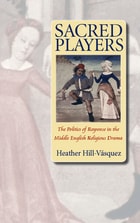
Sacred Players
The Politics of Response in the Middle English Religious DramaHeather Hill-Vásquez
Catholic University of America Press, 2007
Sacrifice Your Love
Psychoanalysis, Historicism, ChaucerL.O. Aranye Fradenburg
University of Minnesota Press, 2002
A long-awaited reevaluation of Chaucer through the lens of sacrifice by a major figure in medieval studies
Historicism and its discontents have long been central to the work of Louise Fradenburg, one of the world’s most original and provocative literary medievalists. Sacrifice Your Love brings this interest to bear on Chaucer’s writing and his world, rethought in light of a theory of sacrifice and its part in cultural production. Fradenburg writes the "history of the signifier"—a way of reading change in the symbolic order—and its role in making sacrifice enjoyable.
Sacrifice Your Love develops the idea that sacrifice is a mode of enjoyment—that our willingness to sacrifice our desire is actually a way of pursuing it. Fradenburg considers the implications of this idea for various problems important in medieval studies today—how to understand the religiosity of cultural forms, particularly chivalry, in the later Middle Ages and how to understand the ethics of Chaucer’s famously nondidactic poetry—as well as in other fields of inquiry. A major rethinking of Chaucer, Sacrifice Your Love works in depth as well as across a broad range of topics from medievalism to psychoanalysis, advancing both the theory and practice of a new kind of historicist approach.
Sainted Women of the Dark Ages
Jo Ann McNamara, John E. Halborg, and Gordon Whatley, eds.
Duke University Press, 1992
Three of these holy women were queens who turned to religion only after a period of intense worldly activity. Others were members of the Carolingian family, deeply implicated in the political ambitions of their male relatives. Some were partners in the great Irish missions to the pagan countryside and others worked for the physical salvation of the poor. From the peril and suffering of their lives they shaped themselves as paragons of power and achievement. Beloved by their sisters and communities for their spiritual gifts, they ultimately brought forth a new model of sanctity.
These biographies are unusually authentic. At least two were written by women who knew their subjects, while others reflect the direct testimony of sisters within the cloister walls. Each biography is accompanied by an introduction and notes that clarify its historical context. This volume will be an excellent source for students and scholars of women's studies and early medieval social, religious, and political history.
Satiric Advice on Women and Marriage
From Plautus to ChaucerWarren S. Smith, Editor
University of Michigan Press, 2005
Advice on sex and marriage in the literature of antiquity and the middle ages typically stressed the negative: from stereotypes of nagging wives and cheating husbands to nightmarish visions of women empowered through marriage. Satiric Advice on Women and Marriage brings together the leading scholars of this fascinating body of literature. Their essays examine a variety of ancient and early medieval writers' cautionary and often eccentric marital satire beginning with Plautus in the third century B.C.E. through Chaucer (the only non-Latin author studied). The volume demonstrates the continuity in the Latin tradition which taps into the fear of marriage and intimacy shared by ancient ascetics (Lucretius), satirists (Juvenal), comic novelists (Apuleius), and by subsequent Christian writers starting with Tertullian and Jerome, who freely used these ancient sources for their own purposes, including propaganda for recruiting a celibate clergy and the promotion of detachment and asceticism as Christian ideals.
Warren S. Smith is Professor of Classical Languages at the University of New Mexico.
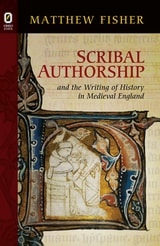
Scribal Authorship and the Writing of History in Medieval England
Matthew Fisher
The Ohio State University Press, 2012
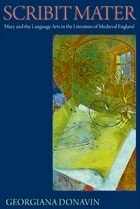
Scribit Mater
Marey and the Language Arts in the Literature of Medieval EnglandGeorgiana Donavin
Catholic University of America Press, 2012
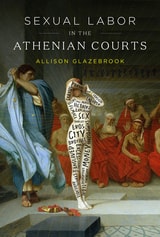
Sexual Labor in the Athenian Courts
Allison Glazebrook
University of Texas Press, 2021
Oratory is a valuable source for reconstructing the practices, legalities, and attitudes surrounding sexual labor in classical Athens. It provides evidence of male and female sex laborers, sex slaves, brothels, sex traffickers, the cost of sex, contracts for sexual labor, and manumission practices for sex slaves. Yet the witty, wealthy, and independent hetaira, well-known from other genres, does not feature. Its detailed narratives and character portrayals provide a unique discourse on sexual labor and reveal the complex relationship between such labor and Athenian society.
Through a holistic examination of five key speeches, Sexual Labor in the Athenian Courts considers how portrayals of sex laborers intersected with gender, the body, sexuality, the family, urban spaces, and the polis in the context of the Athenian courts. Drawing on gender theory and exploring questions of space, place, and mobility, Allison Glazebrook shows how sex laborers represented a diverse set of anxieties concerning social legitimacy and how the public discourse about them is in fact a discourse on Athenian society, values, and institutions.
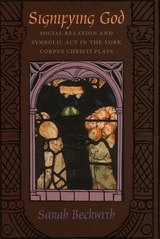
Signifying God
Social Relation and Symbolic Act in the York Corpus Christi PlaysSarah Beckwith
University of Chicago Press, 2001
Introducing a radical new understanding of these plays as "sacramental theater," Beckwith shows how organizing the plays served as a political mechanism for regulating labor, and how theater and sacrament combined in them to do important theological work. She argues, for instance, that the theology of Corpus Christi in the resurrection plays can only be understood as a theatrical exploration of eucharistic absence and presence. Beckwith frames her study with discussions of twentieth-century manifestations of sacramental theater in Barry Unsworth's novel Morality Play and Denys Arcand's film Jesus of Montreal, and the connections between contemporary revivals of the York Corpus Christi plays and England's heritage culture.
Siren Songs
Gender, Audiences, and Narrators in the OdysseyLillian Eileen Doherty
University of Michigan Press, 1995
Siren Songs synthesizes audience-oriented and narratological approaches, and examines the relationships among three kinds of audiences: internal, implied, and actual. The author prefaces her own reading of the Odyssey with an analysis of the issues posed by the earlier feminist readings on which she builds. Should the Odyssey be read as a "closed" text, that is, as one whose meaning is highly determined, or as an "open" text whose contradictions and ambiguities undercut its overt meanings?
Siren Songs presents a feminist critique of the Odyssey in an accessible manner aimed at a more general audience. All Greek is translated, and critical terminology is clearly defined.
Lillian Eileen Doherty is Associate Professor of Classics, University of Maryland, College Park.
Social Memory in Athenian Public Discourse
Uses and Meanings of the PastBernd Steinbock
University of Michigan Press, 2013
Integrating literary, epigraphic, and archaeological evidence with recent scholarship on memory, identity, rhetoric, and international relations, Social Memory in Athenian Public Discourse: Uses and Meanings of the Past enhances our understanding of both the function of memory in Athenian public discourse and the history of Athenian-Theban relations. It should be of interest not only to students of Greek history and oratory but to everybody interested in memory studies, Athenian democracy, and political decision making.
Stumbling Blocks Before the Blind
Medieval Constructions of a DisabilityEdward Wheatley
University of Michigan Press, 2010
"Bold, deeply learned, and important, offering a provocative thesis that is worked out through legal and archival materials and in subtle and original readings of literary texts. Absolutely new in content and significantly innovative in methodology and argument, Stumbling Blocks Before the Blind offers a cultural geography of medieval blindness that invites us to be more discriminating about how we think of geographies of disability today."
---Christopher Baswell, Columbia University
"A challenging, interesting, and timely book that is also very well written . . . Wheatley has researched and brought together a leitmotiv that I never would have guessed was so pervasive, so intriguing, so worthy of a book."
---Jody Enders, University of California, Santa Barbara
Stumbling Blocks Before the Blind presents the first comprehensive exploration of a disability in the Middle Ages, drawing on the literature, history, art history, and religious discourse of England and France. It relates current theories of disability to the cultural and institutional constructions of blindness in the eleventh through fifteenth centuries, examining the surprising differences in the treatment of blind people and the responses to blindness in these two countries. The book shows that pernicious attitudes about blindness were partially offset by innovations and ameliorations---social; literary; and, to an extent, medical---that began to foster a fuller understanding and acceptance of blindness.
A number of practices and institutions in France, both positive and negative---blinding as punishment, the foundation of hospices for the blind, and some medical treatment---resulted in not only attitudes that commodified human sight but also inhumane satire against the blind in French literature, both secular and religious. Anglo-Saxon and later medieval England differed markedly in all three of these areas, and the less prominent position of blind people in society resulted in noticeably fewer cruel representations in literature.
This book will interest students of literature, history, art history, and religion because it will provide clear contexts for considering any medieval artifact relating to blindness---a literary text, a historical document, a theological treatise, or a work of art. For some readers, the book will serve as an introduction to the field of disability studies, an area of increasing interest both within and outside of the academy.
Edward Wheatley is Surtz Professor of Medieval Literature at Loyola University, Chicago.
Stylistic and Narrative Structures in the Middle English Romances
By Susan Wittig
University of Texas Press, 1978
This volume provides a generic description, based on a formal analysis of narrative structures, of the Middle English noncyclic verse romances. As a group, these poems have long resisted generic definition and are traditionally considered to be a conglomerate of unrelated tales held together in a historical matrix of similar themes and characters. As single narratives, they are thought of as random collections of events loosely structured in chronological succession. Susan Wittig, however, offers evidence that the romances are carefully ordered (although not always consciously so) according to a series of formulaic patterns and that their structures serve as vehicles for certain essential cultural patterns and are important to the preservation of some community-held beliefs.
The analysis begins on a stylistic level, and the same theoretical principles applied to the linguistic formulas of the poems also serve as a model for the study of narrative structures. The author finds that there are laws that govern the creation, selection, and arrangement of narrative materials in the romance genre and that act to restrict innovation and control the narrative form.
The reasons for this strict control are to be found in the functional relationship of the genre to the culture that produced it. The deep structure of the romance is viewed as a problem-solving pattern that enables the community to mediate important contradictions within its social, economic, and mythic structures. Wittig speculates that these contradictions may lie in the social structures of kinship and marriage and that they have been restructured in the narratives in a “practical” myth: the concept of power gained through the marriage alliance, and the reconciliation of the contradictory notions of marriage for power’s sake and marriage for love’s sake.
This advanced, thorough, and completely original study will be valuable to medieval specialists, classicists, linguists, folklorists, and Biblical scholars working in oral-formulaic narrative structure.

Surviving Sudden Environmental Change
Answers From ArchaeologyJago Cooper
University Press of Colorado, 2012