Results by title
62 books match the query 'Transgender people' and 7 start with s

Self-Made Woman
A MemoirDenise Chanterelle DuBois
University of Wisconsin Press, 2017
Defying all expectations, DuBois didn't crash and burn. Embracing her identity as a woman, she remade herself. Writing with resolute honesty and humor, she confronts both her past and her present to tell an American story of self-discovery.

Sex Isn't Real
The Invention of an Incoherent BinaryBeans Velocci
Duke University Press, 2026

Sex Science Self
A Social History of Estrogen, Testosterone, and IdentityBob Ostertag
University of Massachusetts Press, 2016
Ostertag situates this history alongside the story of an increasingly visible and political lesbian, gay, bisexual, and transgender population. He persuasively argues that scholarship on the development of sex hormone chemicals does not take into account LGBT history and activism, nor has work in LGBT history fully considered the scientific research that has long attempted to declare a chemical essence of gender. In combining these histories, Ostertag reveals the complex motivations behind hormone research over generations and expresses concern about the growing profits from estrogen and testosterone, which now are marketed with savvy ad campaigns to increase their use across multiple demographics.
Ostertag does not argue against the use of pharmaceutical hormones. Instead he points out that at a time when they are increasingly available, it is more important than ever to understand the history and current use of these powerful chemicals so that everyone—within the LGBT community and beyond—can make informed choices.
In this short, thoughtful, and engaging book, Ostertag tells a fascinating story while opening up a wealth of new questions and debates about gender, sexuality, and medical treatments.

Sexuality and the Politics of Ethos in the Writing Classroom
Zan Meyer Goncalves
Southern Illinois University Press, 2005
Applying the complexities of literacy development and personal ethos to the teaching of composition, Zan Meyer Goncalves challenges writing teachers to consider ethos as a series of identity performances shaped by the often-inequitable social contexts of their classrooms and communities. Using the rhetorical experiences of students who identify as lesbian, gay, bisexual, and/or transgender, she proposes a new way of thinking about ethos that addresses the challenges of social justice, identity, and transfer issues in the classroom.
Goncalves offers an innovative approach to teaching identity performance theory bound by social contexts. She applies this new approach to theories of specificity and intersectionality, illustrating how teachers can help students redefine the relationship between their social identities and their writing. She also addresses bringing social activism and identity politics into the classroom, helping writers make transfers across rhetorical contexts and linking students' interests to public conversations.
Theoretical and practical, Sexuality and the Politics of Ethos in the Writing Classroom provides teachers of first-year and advanced composition studies with useful, detailed assignments based in specific identity performance. Goncalves offers techniques to subvert oppressive language practices, while encouraging students to recognize themselves as writers, citizens, and active participants in their own educations and communities.
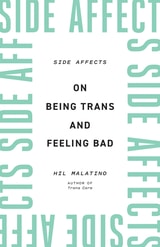
Side Affects
On Being Trans and Feeling BadHil Malatino
University of Minnesota Press, 2022
How the “bad feelings” of trans experience inform trans survival and flourishing
Some days—or weeks, or months, or even years—being trans feels bad. Yet as Hil Malatino points out, there is little space for trans people to think through, let alone speak of, these bad feelings. Negative emotions are suspect because they unsettle narratives of acceptance or reinforce virulently phobic framings of trans as inauthentic and threatening.
In Side Affects, Malatino opens a new conversation about trans experience that acknowledges the reality of feeling fatigue, envy, burnout, numbness, and rage amid the ongoing onslaught of casual and structural transphobia in order to map the intricate emotional terrain of trans survival. Trans structures of feeling are frequently coded as negative on both sides of transition. Before transition, narratives are framed in terms of childhood trauma and being in the “wrong body.” Posttransition, trans individuals—especially trans people of color—are subject to unrelenting transantagonism. Yet trans individuals are discouraged from displaying or admitting to despondency or despair.
By moving these unloved feelings to the center of trans experience, Side Affects proposes an affective trans commons that exists outside political debates about inclusion. Acknowledging such powerful and elided feelings as anger and exhaustion, Malatino contends, is critical to motivating justice-oriented advocacy and organizing—and recalibrating new possibilities for survival and well-being.

Sideways Developments
Queer and Trans Aesthetics of Global Hong KongKai Hang Cheang
University of Michigan Press, 2026
In this moment of multiple crises, Sideways Developments offers a timely hermeneutic and theory of solidarity and sustainability. The book tracks how sideways aesthetics have evolved from a feature of LGBTQ+ plots, performance, and nonlinear approaches to space-time to a form of togetherness that links postcolonial Hong Kong with struggles worldwide. Using what Cheang terms intersectional formalism as an analytical tool, the book provides a multilayered examination of the alternative pathways exemplified by queer and trans resilience and regeneration.

Standardizing Sex
A History of Trans MedicineKetil Slagstad
University of Chicago Press, 2025
Standardizing Sex traces the emergence of trans medicine in Scandinavia in the twentieth century, exploring the construction and negotiation of medical expertise among medical professionals, patients, and activists in the media and government bureaucracy. The book combines the author’s analysis of medical records and other archival sources with oral history interviews with former patients, activists, doctors, psychologists, and civil servants. Physician-historian Ketil Slagstad uses the Scandinavian story of sex reassignment to anchor not only the role of the state but also bureaucracy and social rights. Scandinavian countries, he shows, played a foundational role in the emergence of trans medicine internationally. As a result, Standardizing Sex tells a transnational history of medicine that sheds light on a set of relations and problems that continue to impact discussions of trans medicine and trans rights around the world.
Slagstad’s sources offer a rare opportunity to explore the emergence of trans medicine in action in the clinic, laboratory, waiting room, and operating room, as well as in the bureaucrat’s office, on the psychologist’s couch, and in the publications and meetings of activist groups. Together, these sources allow for the analysis of the increasingly complex negotiations of nosological criteria, medical knowledge, and medical practices in a formative period for transgender medicine. More generally, the book offers a story about the reshaping of the normal and the pathological in modern societies.