Results by title
96 books match the query 'Truth' and 4 start with s

Scandalous Knowledge
Science, Truth, and the HumanBarbara Herrnstein Smith
Duke University Press, 2006
With keen wit, Smith demonstrates that the familiar charges involved in these scandals—including the recurrent invocation of “postmodern relativism”—protect intellectual orthodoxy by falsely associating important intellectual developments with logically absurd and morally or politically disabling positions. She goes on to offer bold, original, and insightful perspectives on the currently strained relations between the natural sciences and the humanities; on the grandiose but dubious claims of evolutionary psychology to explain human behavior, cognition, and culture; and on contemporary controversies over the psychology, biology, and ethics of animal-human relations. Scandalous Knowledge is a provocative and compelling intervention into controversies that continue to roil through journalism, pulpits, laboratories, and classrooms throughout the United States and Europe.
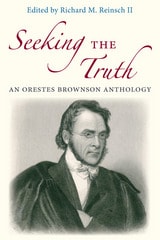
Seeking the Truth
Richard Reinsch II
Catholic University of America Press, 2016
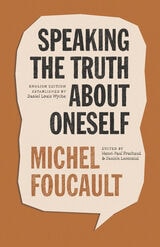
Speaking the Truth about Oneself
Lectures at Victoria University, Toronto, 1982Michel Foucault
University of Chicago Press, 2021
Just before the summer of 1982, French philosopher Michel Foucault gave a series of lectures at Victoria University in Toronto. In these lectures, which were part of his project of writing a genealogy of the modern subject, he is concerned with the care and cultivation of the self, a theme that becomes central to the second, third, and fourth volumes of his History of Sexuality. Foucault had always been interested in the question of how constellations of knowledge and power produce and shape subjects, and in the last phase of his life, he became especially interested not only in how subjects are formed by these forces but in how they ethically constitute themselves.
In this lecture series and accompanying seminar, Foucault focuses on antiquity, starting with classical Greece, the early Roman empire, and concluding with Christian monasticism in the fourth and fifth centuries AD. Foucault traces the development of a new kind of verbal practice—“speaking the truth about oneself”—in which the subject increasingly comes to be defined by its inner thoughts and desires. He deemed this new form of “hermeneutical” subjectivity important not just for historical reasons, but also due to its enduring significance in modern society.

St. Austin Review, Truth in Fiction
The Art of the Novel, Vol. 10 No. 3Joseph Pearce and Robert Asch
St. Augustine's Press, 2010