Results by title
923 books match the query 'Urban' and 80 start with s
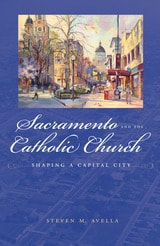
Sacramento and the Catholic Church
Shaping a Capital CitySteven Avella
University of Nevada Press, 2008
Besides the numerous institutions that the Church sponsored, it brought together a wide spectrum of the city’s diverse ethnic populations and offered them several routes to assimilation. Catholic Sacramentans have always played an active role in government and in the city’s economy, and Catholic institutions provided a matrix for the creation of new communities as the city spread into neighboring suburbs. At the same time, the Church was forced to adapt itself to the needs and demands of its various ethnic constituents, particularly the flood of Spanish-speaking newcomers in the late twentieth century.
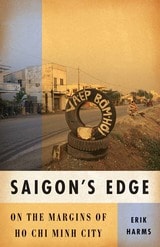
Saigon’s Edge
On the Margins of Ho Chi Minh CityErik Harms
University of Minnesota Press, 2010
Unlike the idealized Vietnamese model of urban space, Hóc Môn is between worlds, neither outside nor inside but always uncomfortably both. With particular attention to everyday social realities, Harms demonstrates how living on the margin can be both alienating and empowering, as forces that exclude its denizens from power and privilege in the inner city are used to thwart the status quo on the rural edges.
More than a local case study of urban change, Harms’s work also opens a window on Vietnam’s larger turn toward market socialism and the celebration of urbanization—transformations instructively linked to trends around the globe.
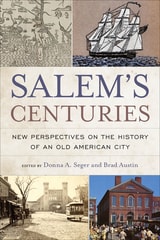
Salem's Centuries
New Perspectives on the History of an Old American CityEdited by Donna A. Seger and Brad Austin
Temple University Press, 2026
In advance of the city’s quadricentennial, the editors and contributors highlight the depth and diversity of Salem’s history, including stories of indigenous peoples, early settlers, African Americans, and immigrants, spanning from the American and industrial revolutions to World War II and the present. Chronologically arranged by century, chapters examine how Salem’s history has been lost or distorted in its public presentations over time.
Salem’s Centuries is a fresh look at an old American city. And yes, it includes the accused witches.
Contributors: Kimberly S. Alexander, Emerson W. Baker, Aviva Chomsky, Andrew Darien, Elizabeth Duclos-Orsello, Theresa Giard, Marilyn Hayward, Bethany Jay, Michele Louro, Elizabeth McKeigue, Robert W. McMicken, Dane A. Morrison, Maria Pride, J.D. Scrimgeour, Margo Shea, Hans Schwartz, Brian Valimont, Maryann Zujewski, and the editors
In the series History and the Public
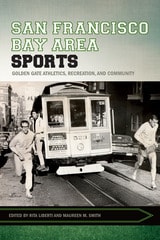
San Francisco Bay Area Sports
Golden Gate Athletics, Recreation, and CommunityRita Liberti
University of Arkansas Press, 2017
San Francisco Bay Area Sports brings together fifteen essays covering the issues, controversies, and personalities that have emerged as northern Californians recreated and competed over the last 150 years. The area’s diversity, anti-establishment leanings, and unique and beautiful natural surroundings are explored in the context of a dynamic sporting past that includes events broadcast to millions or activities engaged in by just a few.
Professional and college events are covered along with lesser-known entities such as Oakland’s public parks, tennis player and Bay Area native Rosie Casals, environmentalism and hiking in Marin County, and the origins of the Gay Games. Taken as a whole, this book clarifies how sport is connected to identities based on sexuality, gender, race, and ethnicity. Just as crucial, the stories here illuminate how sport and recreation can potentially create transgressive spaces, particularity in a place known for its nonconformity.
San Francisco Year Zero
Political Upheaval, Punk Rock and a Third-Place Baseball TeamLincoln A. Mitchell
Rutgers University Press, 2019
In San Francisco Year Zero, San Francisco native Lincoln Mitchell traces the roots of the current situation back to 1978, when three key events occurred: the assassination of George Moscone and Harvey Milk occurring fewer than two weeks after the massacre of Peoples Temple members in Jonestown, Guyana, the explosion of the city’s punk rock scene, and a breakthrough season for the San Francisco Giants. Through these three strands, Mitchell explores the rifts between the city’s pro-business and progressive-left politicians, the emergence of Dianne Feinstein as a political powerhouse, the increasing prominence of the city’s LGBT community, punk’s reinvigoration of the Bay Area’s radical cultural politics, and the ways that the Giants helped unify one of the most ethnically and culturally diverse cities in the nation.
Written from a unique insider’s perspective, San Francisco Year Zero deftly weaves together the personal and the political, putting a human face on the social upheavals that transformed a city.
Sarajevo
A Bosnian KaleidoscopeFran Markowitz
University of Illinois Press, 2010
This fascinating urban anthropological analysis of Sarajevo and its cultural complexities examines contemporary issues of social divisiveness, pluralism, and intergroup dynamics in the context of national identity and state formation. Rather than seeing Bosnia-Herzegovina as a volatile postsocialist society, the book presents its capital city as a vibrant yet wounded center of multicultural diversity, where citizens live in mutual recognition of difference while asserting a lifestyle that transcends boundaries of ethnicity and religion. It further illuminates how Sarajevans negotiate group identity in the tumultuous context of history, authoritarian rule, and interactions with the built environment and one another.
As she navigates the city, Fran Markowitz shares narratives of local citizenry played out against the larger dramas of nation and state building. She shows how Sarajevans' national identities have been forged in the crucible of power, culture, language, and politics. Sarajevo: A Bosnian Kaleidoscope acknowledges this Central European city's dramatic survival from the ravages of civil war as it advances into the present-day global arena.
Saul Alinsky and the Dilemmas of Race
Community Organizing in the Postwar CityMark Santow
University of Chicago Press, 2023
Saul Alinsky is the most famous—even infamous—community organizer in American history. Almost single-handedly, he invented a new political form: community federations, which used the power of a neighborhood’s residents to define and fight for their own interests. Across a long and controversial career spanning more than three decades, Alinsky and his Industrial Areas Foundation organized Eastern European meatpackers in Chicago, Kansas City, Buffalo, and St. Paul; Mexican Americans in California and Arizona; white middle-class homeowners on the edge of Chicago’s South Side black ghetto; and African Americans in Rochester, Buffalo, Chicago, and other cities.
Mark Santow focuses on Alinsky’s attempts to grapple with the biggest moral dilemma of his age: race. As Santow shows, Alinsky was one of the few activists of the period to take on issues of race on paper and in the streets, on both sides of the color line, in the halls of power, and at the grassroots, in Chicago and in Washington, DC. Alinsky’s ideas, actions, and organizations thus provide us with a unique and comprehensive viewpoint on the politics of race, poverty, and social geography in the United States in the decades after World War II. Through Alinsky’s organizing and writing, we can see how the metropolitan color line was constructed, contested, and maintained—on the street, at the national level, and among white and black alike. In doing so, Santow offers new insight into an epochal figure and the society he worked to change.

Saul Alinsky and the Dilemmas of Race
Community Organizing in the Postwar CityMark Santow
University of Chicago Press, 2023
A groundbreaking examination of Saul Alinsky's organizing work as it relates to race.
Saul Alinsky is the most famous—even infamous—community organizer in American history. Almost single-handedly, he invented a new political form: community federations, which used the power of a neighborhood’s residents to define and fight for their own interests. Across a long and controversial career spanning more than three decades, Alinsky and his Industrial Areas Foundation organized Eastern European meatpackers in Chicago, Kansas City, Buffalo, and St. Paul; Mexican Americans in California and Arizona; white middle-class homeowners on the edge of Chicago’s South Side black ghetto; and African Americans in Rochester, Buffalo, Chicago, and other cities.
Mark Santow focuses on Alinsky’s attempts to grapple with the biggest moral dilemma of his age: race. As Santow shows, Alinsky was one of the few activists of the period to take on issues of race on paper and in the streets, on both sides of the color line, in the halls of power, and at the grassroots, in Chicago and in Washington, DC. Alinsky’s ideas, actions, and organizations thus provide us with a unique and comprehensive viewpoint on the politics of race, poverty, and social geography in the United States in the decades after World War II. Through Alinsky’s organizing and writing, we can see how the metropolitan color line was constructed, contested, and maintained—on the street, at the national level, and among white and black alike. In doing so, Santow offers new insight into an epochal figure and the society he worked to change.
Scenescapes
How Qualities of Place Shape Social LifeDaniel Aaron Silver and Terry Nichols Clark
University of Chicago Press, 2016
In Scenescapes, Daniel Aaron Silver and Terry Nichols Clark examine the patterns and consequences of the amenities that define our streets and strips. They articulate the core dimensions of the theatricality, authenticity, and legitimacy of local scenes—cafes, churches, restaurants, parks, galleries, bowling alleys, and more. Scenescapes not only reimagines cities in cultural terms, it details how scenes shape economic development, residential patterns, and political attitudes and actions. In vivid detail and with wide-angle analyses—encompassing an analysis of 40,000 ZIP codes—Silver and Clark give readers tools for thinking about place; tools that can teach us where to live, work, or relax, and how to organize our communities.
Schools Betrayed
Roots of Failure in Inner-City EducationKathryn M. Neckerman
University of Chicago Press, 2007
The problems commonly associated with inner-city schools were not nearly as pervasive a century ago, when black children in most northern cities attended school alongside white children. In Schools Betrayed, her innovative history of race and urban education, Kathryn M. Neckerman tells the story of how and why these schools came to serve black children so much worse than their white counterparts.
Focusing on Chicago public schools between 1900 and 1960, Neckerman compares the circumstances of blacks and white immigrants, groups that had similarly little wealth and status yet came to gain vastly different benefits from their education. Their divergent educational outcomes, she contends, stemmed from Chicago officials’ decision to deal with rising African American migration by segregating schools and denying black students equal resources. And it deepened, she shows, because of techniques for managing academic failure that only reinforced inequality. Ultimately, these tactics eroded the legitimacy of the schools in Chicago’s black community, leaving educators unable to help their most disadvantaged students.
Schools Betrayed will be required reading for anyone who cares about urban education.
Schools for Sale
Disinvestment, Dispossession, and School Building Reuse in PhiladelphiaJulia McWilliams, Ariel H. Bierbaum, Amy J. Bach and Elaine Simon
University of Chicago Press, 2026
School districts across the United States have closed thousands of schools since 2000 to cope with chronic underfunding and budget crises, declining enrollment, and poorly maintained buildings. Our knowledge about school closures has focused on battles over closure decision-making and the impacts of closing schools on communities of color in the immediate aftermath of these decisions. But what of the large, sometimes magisterial, formerly public spaces once at the center of community life? How do these now vacant buildings change daily life in the surrounding neighborhood?
In Schools for Sale, Julia McWilliams, Ariel H. Bierbaum, Amy J. Bach, and Elaine Simon examine how school closures change the spatial and social arrangements of neighborhoods. Following a series of school closures in Philadelphia, the authors draw from research in urban studies, education, planning, and geography to explain how race, place, and capital merge to influence the trajectory of closed schools in Black and Brown communities and their surrounding neighborhoods. Some closed schools are repurposed as charter schools, upending the role those buildings have historically played in bringing communities together. Other buildings are sold for commercial development, caught up in cycles of gentrification even as developers foster programs to support community members. Others are left vacant or are demolished in the heart of their neighborhoods, decisions that reflect not only disinvestment in Black communities but the sobering reality of environmental racism.
Drawing needed attention to one of the significant consequences of school closures, Schools for Sale imparts a deeper understanding of the connections between place, race, and education amid broader urban transformations, prompting us to consider how school districts can work toward a new vision for public education and community development.

Science and the Creative Imagination in Latin America
Edited by Evelyn Fishburn and Eduardo L. Ortiz
University of London Press, 2004
Chapters include: Darwin in South America: Geology, Imagination and Encounter Walking Backward to the Future: Time, Travel and Race Natural Parts and Unnatural Others: A reflection on Patrimony at the Turn of the 19th Century On the Transition from Realism to the Fantastic in the Argentina of the 1870s: Holmberg and the Six of Cordoba Literature and Science in Martinez Estrada's Work The Nature Effect in Latin American Science Publications: The Case of the Journal Redes Two Scientific Traditions in Martin Fierro Heisenberg's Uncertainty Principle in Contemporary Spanish American Fiction Constructing Postcoloniality: Scientific Enquiries in Cien Anos de Soledad Holograms and Simulacra: Bioy Casares, Subiela, Piglia The Desert Poetics of Mario Montalbetti: Writing, Knowledge, Topologies
Seattle Sports
Play, Identity, and Pursuit in the Emerald CityTerry Anne Scott
University of Arkansas Press, 2020
Seattle Sports: Play, Identity, and Pursuit in the Emerald City, edited by Terry Anne Scott, explores the vast and varied history of sports in this city where diversity and social progress are reflected in and reinforced by play. The work gathered here covers Seattle’s professional sports culture as well as many of the city’s lesser-known figures and sports milestones. Fresh, nuanced takes on the Seattle Mariners, Supersonics, and Seahawks are joined by essays on gay softball leagues, city court basketball, athletics in local Japanese American communities during the interwar years, ultimate, the fierce women of roller derby, and much more. Together, these essays create a vivid portrait of Seattle fans, who, in supporting their teams—often in rain, sometimes in the midst of seismic activity—check the country’s implicit racial bias by rallying behind outspoken local sporting heroes.
Second Cities
Globalization and Local Politics in Manchester and PhiladelphiaAuthored by Jerome I. Hodos
Temple University Press, 2013
Manchester, England, and Philadelphia, Pennsylvania, are what sociologist Jerome Hodos calls second cities—viable alternatives to well-known global cities such as London and New York. In Second Cities, Hodos considers how Manchester and Philadelphia have confronted problems of globalization over the past two centuries.
This thought-provoking, comparative look at these cities examines their histories, economies, migration patterns, cultural innovations, transportation planning, and self-identities. Hodos demonstrates not just how the two cities are positioned in global flows of capital, goods, people, and ideas but also how each has used what he calls “municipal foreign policy” to preserve and rejuvenate its position over time. The second city offers an illustrative lens through which to view other urban centers, from Atlanta to Bangalore, Seattle, and Turin.
Hodos’s description and analysis of urban development over a broad time frame offer lessons for policy makers, scholars, and community leaders concerned with the impact of globalization on their own cities.
Second Tier Cities
Rapid Growth beyond the MetropolisAnn Markusen
University of Minnesota Press, 1999
Analyzes and compares the rapid growth of medium-sized cities.
Over the past thirty years, transnational investment, trade, and government policies have encouraged the decentralization of national economies, disrupting traditional patterns of urban and regional growth. Many smaller cities-such as Seattle, Washington; Campinas, Brazil; Oita, Japan; and Kumi, Korea-have grown markedly faster than the largest metropolitan regions. These “second tier cities” are home to specialized industrial complexes that have taken root, provided significant job growth, and attracted mobile capital and labor.
The culmination of an ambitious five-year, fourteen-city research project conducted by an international team of economists and geographers, Second Tier Cities examines the potential of these new regions to balance uneven regional development, create good, stable jobs, and moderate hyper-urbanization. Comparing across national borders, the contributors describe four types of second tier cities: Marshallian industrial districts, hub-and-spoke cities, satellite platforms, and government-anchored complexes. They find that both industrial and regional policies have been important contributors to the rise of second tier cities, though the former often trump the latter. Lessons for local, national, and international policymakers are drawn. The authors are critical of devolution and argue that it must be accompanied by strong labor and environmental standards and mechanisms to overcome differential regional resource endowments.Contributors: Clelio Campolina Diniz, U Federal de Minas Gerais, Brazil; Masatomi Funaba, Kobe U of Commerce, Japan; Elyse Golob, NYC Economic Development Goup; Mia Gray, Cambridge U; Jun Ho Jeong, Oxford U; Sam Ock Park, Seoul National U; Mohammad Razavi; Fabiana Borges T. Santos, U Federal de Minas Gerais, Brazil; and Masayuki Sasaki, Kanzawa U, Japan.
Securing the City
Neoliberalism, Space, and Insecurity in Postwar GuatemalaKevin Lewis O Neill and Kedron Thomas, eds.
Duke University Press, 2011
Contributors. Peter Benson, Manuela Camus, Avery Dickins de Girón, Edward F. Fischer, Deborah Levenson, Thomas Offit, Kevin Lewis O’Neill, Kedron Thomas, Rodrigo José Véliz
Seeing New York
History Walks for Armchair and Footloose TravelersHope Cooke
Temple University Press, 1995
Since the 1700s, various ethnic and immigrant groups have been shifting and negotiating their place in New York City. Hope Cooke also struggled to find a "correlation of space" and "sense of belonging" when she returned to the city after spending her adult life living in a place in the Himalayas, the Queen of Sikkim (a tiny kingdom near Nepal). Abroad for so long, she returned with an urgent need to rediscover this city, to "find her way home."
It was not always a comfortable journey for Cooke: "On the days I felt secure, Manhattan's maelstrom was pure energy. On shaky days, the boundlessness made me yearn for limits, or, failing that, at least a vantage point." The book that has emerged is an entertaining and integrated account of New York City's social history, architecture, physical space, and culture. Starting with the American Indian settlements and the early days when the southern-most tip of Manhattan held little more than a bleak outpost of Dutch fur traders, Cooke tracks the economic development and journeys north, from the Village's beginnings as a refuge from dreaded summer fevers to the present day Dominican enclave of Washington Heights.
Written for armchair enthusiasts and walkabout adventurers, this book travels fourteen of the city's distinct and significant neighborhoods. Cooke's guide will make a historical sleuth out of local residents and tourists alike. Her off-the-beaten-path insights and witty observations help decode the urban landscape and reveal how social changes have reworked the city's terrain. Enhancing the narrative are 140 illustrations, including old engravings, maps, and current photographs.
In the series Critical Perspectives on the Past, edited by Susan Porter Benson, Stephen Brier, and Roy Rosenzweig.

Seeking Spatial Justice
Edward W. Soja
University of Minnesota Press, 2010
Seeking a Future for the Past
Space, Power, and Heritage in a Chinese CityPhilipp Demgenski
University of Michigan Press, 2024
Segregating Cities
An Arnold R. Hirsch ReaderArnold R. Hirsch
University of Chicago Press, 2026
Arnold R. Hirsch (1949–2018) was one of the preeminent urban historians of his generation, a reputation cemented by his landmark book, Making the Second Ghetto. With compelling clarity, Hirsch demonstrated that segregation is not the inevitable result of individual choices, natural tendencies, or cultural traits—it is a structural phenomenon, reinforced on every level by state power.
Segregating Cities collects the author’s key essays, some previously unpublished, to reveal a more complete picture of a remarkable scholar and his exploration of race, place, politics, and policy in the twentieth-century American city. Together, these essays can help us see segregation for what it is, so that we can then begin to truly work to overcome it.
Selling The Lower East
Culture, Real Estate, and Resistance in New York CityChristopher Mele
University of Minnesota Press, 2000
Tracks the shifting views of the Lower East Side from ghetto to desirable urban niche.
The Lower East Side of Manhattan is rich in stories-of poor immigrants who flocked there in the late nineteenth and early twentieth centuries; of beatniks, hippies, and artists who peopled it mid-century; and of the real estate developers and politicians who have always shaped what is now termed the "East Village." Today, the musical Rent plays on Broadway to a mostly white and suburban audience, MTV exploits the neighborhood’s newly trendy squalor in a film promotion, and on the Internet a cyber soap opera and travel-related Web pages lure members of the middle class to enjoy a commodified and sanitized version of the neighborhood.
In this sweeping account, Christopher Mele analyzes the political and cultural forces that have influenced the development of this distinctive community. He describes late nineteenth-century notions of the Lower East Side as a place of entrenched poverty, ethnic plurality, political activism, and "low" culture that elicited feelings of revulsion and fear among the city’s elite and middle classes. The resulting-and ongoing-struggle between government and residents over affordable and decent housing has in turn affected real estate practices and urban development policies. Selling the Lower East Side recounts the resistance tactics used by community residents, as well as the impulse on the part of some to perpetuate the image of the neighborhood as dangerous, romantic, and bohemian, clinging to the marginality that has been central to the identity of the East Village and subverting attempts to portray it as "new and improved." Ironically, this very image of urban grittiness has been appropriated by a cultural marketplace hungry for new fodder. Mele explores the ways that developers, media executives, and others have coopted the area’s characteristics-analyzing the East Village as a "style provider" where what is being marketed is "difference." The result is a visionary look at how political and economic actions transform neighborhoods and at what happens when a neighborhood is what is being "consumed."A comprehensive web site for Selling the Lower East Side can be found at www.upress.umn.edu/sles.
Sensing Chicago
Noisemakers, Strikebreakers, and MuckrakersAdam Mack
University of Illinois Press, 2015
In Sensing Chicago, Adam Mack lets fresh air into the sensory history of Chicago in the nineteenth and early twentieth centuries by examining five case studies: the Chicago River, the Great Fire, the 1894 Pullman Strike, the publication of Upton Sinclair's The Jungle, and the rise and fall of the White City amusement park. His vivid recounting of the smells, sounds, and tactile miseries of city life reveals how input from the five human senses influenced the history of class, race, and ethnicity in the city. At the same time, he transports readers to an era before modern refrigeration and sanitation, when to step outside was to be overwhelmed by the odor and roar of a great city in progress.
Separate Societies
Poverty and Inequality in U.S. CitiesAuthored by William W. Goldsmith and Edward J. Blakely with a foreword by President Bill Clinton
Temple University Press, 2010
“Economic and political forces no longer combat poverty—they generate poverty!" exclaim William Goldsmith and Edward Blakely in their report on the plight of American's urban poor. In this revised and updated edition of their 1992 book Separate Societies,the authors present a compelling examination of the damaging divisions that isolate poor city minority residents from the middle-class suburban majority. They pay special attention to how the needs of the permanently poor have been unmet through the alternating years of promises and neglect, and propose a progressive turn away from 30 years of conservative policies.
Separate Societies vividly documents how the urban working class has been pushed out of industrial jobs through global economic restructuring, and how the Wall Street meltdown has aggravated underemployment, depleted public services, and sharpened racial and class inequalities.
The authors insist that the current U.S. approach puts Americans out of work and lowers the standard of living for all. As such, Goldsmith and Blakely urge the Obama administration to create better urban policy and foster better metropolitan management to effectively and efficiently promote equality.
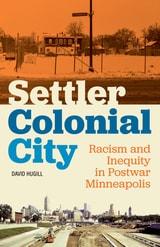
Settler Colonial City
Racism and Inequity in Postwar MinneapolisDavid Hugill
University of Minnesota Press, 2021
Revealing the enduring link between settler colonization and the making of modern Minneapolis
Colonial relations are often excluded from discussions of urban politics and are viewed instead as part of a regrettable past. In Settler Colonial City, David Hugill confronts this culture of organized forgetting by arguing that Minnesota’s largest city is enduringly bound up with the power dynamics of settler-colonial politics. Examining several distinct Minneapolis sites, Settler Colonial City tracks how settler-colonial relations were articulated alongside substantial growth in the Twin Cities Indigenous community during the second half of the twentieth century—creating new geographies of racialized advantage.
Studying the Phillips neighborhood of Minneapolis in the decades that followed the Second World War, Settler Colonial City demonstrates how colonial practices and mentalities shaped processes of urban reorganization, animated non-Indigenous “advocacy research,” informed a culture of racialized policing, and intertwined with a broader culture of American imperialism. It reveals how the actions, assumptions, and practices of non-Indigenous people in Minneapolis produced and enforced a racialized economy of power that directly contradicts the city’s “progressive” reputation.
Ultimately, Settler Colonial City argues that the hierarchical and racist political dynamics that characterized the city’s prosperous beginnings are not exclusive to a bygone era but rather are central to a recalibrated settler-colonial politics that continues to shape contemporary cities across the United States.

Sex Trafficking, Scandal, and the Transformation of Journalism, 1885-1917
Gretchen Soderlund
University of Chicago Press, 2013

Sex and Isolation
And Other EssaysBruce Benderson; Foreword by Catherine Texier
University of Wisconsin Press, 2007
In Sex and Isolation, readers will encounter eccentric street people, Latin American literary geniuses, a French cabaret owner, a transvestite performer, and many other unusual characters; they’ll visit subcultures rarely described in writing and be treated to Benderson’s iconoclastic opinions about culture in former and contemporary urban society. Whether proposing new theories about the relationship between art, entertainment, and sex, analyzing the rise of the Internet and the disappearance of public space, or considering how religion and sexual identity interact, each essay demonstrates sharp wit, surprising insight and some startling intellectual positions.
This is the first American volume of Benderson’s collected essays, featuring both new work and some of his best-known writings, including his famous essay “Toward the New Degeneracy.”
Shanghai Nightscapes
A Nocturnal Biography of a Global CityJames Farrer and Andrew David Field
University of Chicago Press, 2015
The book begins by examining the history of the jazz-age dance scenes that arose in the ballrooms and nightclubs of Shanghai’s foreign settlements. During its heyday in the 1930s, Shanghai was known worldwide for its jazz cabarets that fused Chinese and Western cultures. The 1990s have seen the proliferation of a drinking, music, and sexual culture collectively constructed to create new contact zones between the local and tourist populations. Today’s Shanghai night scenes are simultaneously spaces of inequality and friction, where men and women from many different walks of life compete for status and attention, and spaces of sociability, in which intercultural communities are formed. Shanghai Nightscapes highlights the continuities in the city’s nightlife across a turbulent century, as well as the importance of the multicultural agents of nightlife in shaping cosmopolitan urban culture in China’s greatest global city.
To listen to an audio diary of a night out in Shanghai with Farrer and Field, click here: http://n.pr/1VsIKAw.
Shanghai Rising
State Power and Local Transformations in a Global MegacityXiangming Chen
University of Minnesota Press, 2009
Analyzing a Chinese city’s dazzling rise to global megacity status
Until around 1990, Shanghai was China’s premier but sluggish industrial center. Now at the beginning of the twenty-first century, the joint impact of global forces and state power has turned Shanghai into a dynamic megacity. Shanghai’s remarkable growth in economy, infrastructure, and global presence has prompted questions about the Shanghai “miracle.” This collection places the city’s unprecedented rise in a rare comparative examination of U.S. cities, as well as with Asian megacities Singapore and Hong Kong, providing a nuanced account of how Shanghai’s politics, economy, society, and space have been transformed by macro- and micro-level forces.
Contributors: Stephen W. K. Chiu, Chinese U of Hong Kong; K. C. Ho, National U of Singapore; John D. Kasarda, U of North Carolina; Hanlong Lu, Shanghai Academy of Social Sciences; Tai-lok Lui, Chinese U of Hong Kong; Ann R. Markusen, U of Minnesota; Anthony M. Orum, U of Illinois, Chicago; Yuan Ren, Fudan U Shanghai; Saskia Sassen, Columbia U; Jiaming Sun, Texas A&M U, Commerce; Fulong Wu, Cardiff U; Pingkang Yu, George Washington U; Tingwei Zhang, U of Illinois, Chicago; Zhenhua Zhou, Development Research Center, Shanghai Municipal Government.
Shanghai and the Edges of Empires
Meng Yue
University of Minnesota Press, 2006
Calling into question conventional ways of conceptualizing modernity, colonialism, and intercultural relations, Meng Yue examines such cultural practices as the work of the commercial press, street theater, and literary arts, and shows that what appear to be minor cultural changes often signal the presence of larger political and economic developments. Engaging theories of modernity and postcolonial and global cultural studies, Meng Yue reveals the paradoxical interdependence between imperial and imperialist histories and the retranslation of culture that characterized the most notable result of China’s urban relocation—the emergence of the international city of Shanghai.
Meng Yue is assistant professor of East Asian languages and literature at the University of California, Irvine.
Shelter Poverty
New Ideas on Housing AffordabilityMichael E. Stone
Temple University Press, 1993
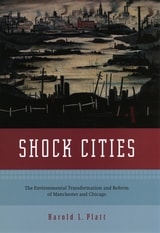
Shock Cities
The Environmental Transformation and Reform of Manchester and ChicagoHarold L. Platt
University of Chicago Press, 2005
Shock Cities also recasts the age of industry within a larger frame of nature. Frightening epidemics and unnatural "natural disasters" forced the city dwellers onto the path of environmental reform. Crusaders for social justice such as Chicago's Jane Addams and Manchester's Charles Rowley led class-bridging campaigns to clean up the slums. Women activists and other "municipal housekeepers" promoted regulations to reduce air pollution. Public health experts directed efforts to improve sanitation.
Out of these reform movements, the Progressives formulated new concepts of environmental conservation and regional planning. Comparing the two cities, Platt highlights the ways in which political culture and institutions act to turn social geography into physical shapes on the ground. This focus on the political formation of urban space helps illuminate questions of social and environmental justice. Shock Cities will be of enormous value to students of ecology, technology, urban planning, and public health in the Western world.
Showroom City
Real Estate and Resistance in the Furniture Capital of the WorldJohn Joe Schlichtman
University of Minnesota Press, 2022
A unique and engaging account of local urban decision-making within the globalizing world
High Point, North Carolina, is known as the “Furniture Capital of the World.” Once a manufacturing stronghold, most of its furniture factories have closed over the past forty years, with production shipped off to low-wage countries. Yet as manufacturing left, the city tightened its hold on a biannual global exposition that serves as the world’s furniture fashion runway. At the High Point Market, visitors from more than one hundred nations traverse twelve million square feet of meticulous design. Downtown buildings—once courthouses, movie theaters, post offices, and gas stations—are now chic showroom spaces, even as many sit empty between each exposition.
In Showroom City, John Joe Schlichtman applies an ethnographic lens to the global exposition’s relationship with High Point after it defeated rival Chicago in the 1960s and established itself as the world’s dominant furniture center. In recent decades, following trends in global finance, private equity firms were increasingly behind downtown High Point’s real estate transactions, coordinated by buyers far removed from the region. Then, in one massive transaction in 2011, a firm funded by Bain Capital purchased every major showroom building, and the majority of downtown real estate was under one owner.
Showroom City is a story of exclusionary growth and unchecked development, of a city flailing to fill the void left by its dwindling factories. But beyond that Schlichtman engages the general lessons behind both High Point’s deindustrialization and its stunning reinvention as a furniture fashion, merchandising, and design node. With great nuance, he delves deeply to reveal how power operates locally and how citizens may affirm, exploit, influence, and resist the takeover of their community.
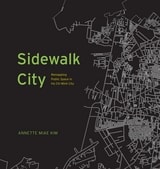
Sidewalk City
Remapping Public Space in Ho Chi Minh CityAnnette Miae Kim
University of Chicago Press, 2015
With Sidewalk City, Annette Miae Kim provides the first multidisciplinary case study of sidewalks in a distinctive geographical area. She focuses on Ho Chi Minh City, Vietnam, a rapidly growing and evolving city that throughout its history, her multicultural residents have built up alternative legitimacies and norms about how the sidewalk should be used. Based on fieldwork over 15 years, Kim developed methods of spatial ethnography to overcome habitual seeing, and recorded both the spatial patterns and the social relations of how the city’s vibrant sidewalk life is practiced.
In Sidewalk City, she transforms this data into an imaginative array of maps, progressing through a primer of critical cartography, to unveil new insights about the importance and potential of this quotidian public space. This richly illustrated and fascinating study of Ho Chi Minh City’s sidewalks shows us that it is possible to have an aesthetic sidewalk life that is inclusive of multiple publics’ aspirations and livelihoods, particularly those of migrant vendors.

Singaporean Creatures
Histories of Humans and Other Animals in the Garden CityEdited by Timothy Barnard
National University of Singapore Press, 2024
Modern Singapore is the Garden City, a biophilic urban space that includes a variety of animals, from mosquitoes to humans, even polar bears. Singaporean Creatures brings together historians to contemplate this human-animal relationship and how it has shaped society—socially, economically, politically, and environmentally. It is a work of historical and ecological analysis, in which various institutions, perspectives, and events involving animals provide insight into how the larger society has been formed and developed over the last half-century. The interaction of all Singaporean creatures thus provides a lens through which we can understand the creation of a modern and urban nation-state, shaped by the forces of the Anthropocene.
Sinking Chicago
Climate Change and the Remaking of a Flood-Prone EnvironmentHarold L. Platt
Temple University Press, 2018
In Sinking Chicago, Harold Platt shows how people responded to climate change in one American city over a hundred-and-fifty-year period. During a long dry spell before 1945, city residents lost sight of the connections between land use, flood control, and water quality. Then, a combination of suburban sprawl and a wet period of extreme weather events created damaging runoff surges that sank Chicago and contaminated drinking supplies with raw sewage.
Chicagoans had to learn how to remake a city built on a prairie wetland. They organized a grassroots movement to protect the six river watersheds in the semi-sacred forest preserves from being turned into open sewers, like the Chicago River. The politics of outdoor recreation clashed with the politics of water management. Platt charts a growing constituency of citizens who fought a corrupt political machine to reclaim the region’s waterways and Lake Michigan as a single eco-system. Environmentalists contested policymakers’ heroic, big-technology approaches with small-scale solutions for a flood-prone environment. Sinking Chicago lays out a roadmap to future planning outcomes.
Sites Unseen
Uncovering Hidden Hazards in American CitiesScott Frickel
Russell Sage Foundation, 2018
From a dive bar in New Orleans to a leafy residential street in Minneapolis, many establishments and homes in cities across the nation share a troubling and largely invisible past: they were once sites of industrial manufacturers, such as plastics factories or machine shops, that likely left behind carcinogens and other hazardous industrial byproducts. In Sites Unseen, sociologists Scott Frickel and James Elliott uncover the hidden histories of these sites to show how they are regularly produced and reincorporated into urban landscapes with limited or no regulatory oversight. By revealing this legacy of our industrial past, Sites Unseen spotlights how city-making has become an ongoing process of social and environmental transformation and risk containment.
To demonstrate these dynamics, Frickel and Elliott investigate four very different cities—New Orleans, Minneapolis, Philadelphia, and Portland, Oregon. Using original data assembled and mapped for thousands of former manufacturers’ locations dating back to the 1950s, they find that more than 90 percent of such sites have now been converted to urban amenities such as parks, homes, and storefronts with almost no environmental review. And because manufacturers tend to open plants on new, non-industrial lots rather than on lots previously occupied by other manufacturers, associated hazards continue to spread relatively unabated. As they do, residential turnover driven by gentrification and the rising costs of urban living further obscure these sites from residents and regulatory agencies alike.
Frickel and Elliott show that these hidden processes have serious consequences for city-dwellers. While minority and working class neighborhoods are still more likely to attract hazardous manufacturers, rapid turnover in cities means that whites and middle-income groups also face increased risk. Since government agencies prioritize managing polluted sites that are highly visible or politically expedient, many former manufacturing sites that now have other uses remain invisible. To address these oversights, the authors advocate creating new municipal databases that identify previously undocumented manufacturing sites as potential environmental hazards. They also suggest that legislation limiting urban sprawl might reduce the flow of hazardous materials beyond certain boundaries.
A wide-ranging synthesis of urban and environmental scholarship, Sites Unseen shows that creating sustainable cities requires deep engagement with industrial history as well as with the social and regulatory processes that continue to remake urban areas through time.
A Volume in the American Sociological Association's Rose Series in Sociology.
Slumming
Sexual and Racial Encounters in American Nightlife, 1885-1940Chad Heap
University of Chicago Press, 2009
Small Cities USA
Growth, Diversity, and InequalityNorman, Jon R
Rutgers University Press, 2012
Drawing on an assessment of eighty small cities between 1970 and 2000, Norman considers the factors that have altered the physical, social, and economic landscapes of such places. These cities are examined in relation to new patterns of immigration, shifts in the global economy, and changing residential preferences. Small Cities USA presents the first large-scale comparison of smaller cities over time in the United States, showing that small cities that have prospered over time have done so because of diverse populations and economies. These "glocal" cities, as Norman calls them, are doing well without necessarily growing into large metropolises.
Small Towns in Europe in the 20th and 21st Centuries
Heritage and Development StrategiesLud'a Klusáková et al.
Karolinum Press, 2017
Soaking the Middle Class
Suburban Inequality and Recovery from DisasterAnna Rhodes
Russell Sage Foundation, 2022
In 2017, Hurricane Harvey dropped record-breaking rainfall in Southeast Texas resulting in more than $125 billion in direct damages. Rhodes and Besbris followed 59 flooded households in Friendswood, Texas, for two years after the storm to better understand the recovery process in a well-resourced, majority-White, middle-class suburban community. As such, Friendswood should have been highly resilient to storms like Harvey, yet Rhodes and Besbris find that the recovery process exacerbated often-invisible economic inequality between neighbors. Two years after Harvey, some households were in better financial positions than they were before the storm, while others still had incomplete repairs, were burdened with large new debts, and possessed few resources to draw on should another disaster occur.
Rhodes and Besbris find that recovery policies were significant drivers of inequality, with flood insurance playing a key role in the divergent recovery outcomes within Friendswood. Households with flood insurance prior to Harvey tended to have higher incomes than those that did not. These households received high insurance payouts, enabling them to replace belongings, hire contractors, and purchase supplies. Households without coverage could apply for FEMA assistance, which offered considerably lower payouts, and for government loans, which would put them into debt. Households without coverage found themselves exhausting their financial resources, including retirement savings, to cover repairs, which put them in even more financially precarious positions than they were before the flood.
The vast majority of Friendswood residents chose to repair and return to their homes after Hurricane Harvey. Even this devastating flood did not alter their plans for long-term residential stability, and the structure of recovery policies only further oriented homeowners towards returning to their homes. Prior to Harvey, many Friendswood households relied on flood damage from previous storms to judge their vulnerability and considered themselves at low risk. After Harvey, many found it difficult to assess their level of risk for future flooding. Without strong guidance from federal agencies or the local government on how to best evaluate risk, many residents ended up returning to potentially unsafe places.
As climate-related disasters become more severe, Soaking the Middle Class illustrates how inequality in the United States will continue to grow if recovery policies are not fundamentally changed.
Social Capital in the City
Community and Civic Life in Philadelphiaedited by Richardson Dilworth
Temple University Press, 2006
Social Change in a Metropolitan Community
Otis Dudley Duncan
Russell Sage Foundation, 1973
Social Inequality in Oaxaca
A History of Resistance and ChangeArthur Murphy
Temple University Press, 1991
Social Justice in Diverse Suburbs
History, Politics, and ProspectsChristopher Niedt
Temple University Press, 2013
Editor Christopher Niedt and his contributors shed light on organizing and conflict in the suburbs with historical and contemporary case studies. Chapters address topical issues ranging from how suburbanites actively fought school segregation to industrial pollution and displacement along the suburban-rural fringe. Social Justice in Diverse Suburbs also considers struggles for integration and environmental justice as well as efforts to preserve suburban history and organize immigrant communities.
Contributors include: Douglas R. Appler, Aaron Cavin, Nancy A. Denton, Lisa Feldstein, Casey Gallagher, Anne Galletta, Joseph Gibbons, Robert Gioielli, Lucas Owen Kirkpatrick, JoAnna Mitchell-Brown, Manuel Pastor, john a. powell, Jason Reece, Alex Schafran, June Williamson, and the editor.
Sociology and Architectural Design
John Zeisel
Russell Sage Foundation, 1975
Solidarity Cities
Confronting Racial Capitalism, Mapping TransformationMaliha Safri
University of Minnesota Press, 2025
Mapping the transformative effects of America’s urban solidarity economies
Solidarity economies, characterized by diverse practices of cooperation and mutual support, have long played pivotal but largely invisible roles in fostering shared survival and envisioning alternatives to racial capitalism globally and in the United States. This book maps the thriving existence of these cooperative networks in three differently sized American cities, highlighting their commitment to cooperation, democracy, and inclusion and demonstrating the desire—and the pressing need—to establish alternative foundations for social and economic justice.
Collectively authored by four social scientists, Solidarity Cities analyzes the deeply entrenched racial and economic divides from which cooperative networks emerge as they work to provide unmet basic needs, including food security, affordable housing, access to fair credit, and employment opportunities. Examining entities such as community gardens, credit unions, cooperatives, and other forms of economic solidarity, the authors highlight how relatively small yet vital interventions into public life can expand into broader movements that help bolster the overall well-being of their surrounding communities.
Bringing together insights from geography, political economy, and political science with mapping and spatial analysis methodologies, surveys, and in-depth interviews, Solidarity Cities illuminates the extensive footprints of solidarity economies and the roles they play in communities. The authors show how these initiatives act as bulwarks against gentrification, exploitation, and economic exclusion, helping readers see them as part of the past, present, and future of more livable and just cities.
Retail e-book files for this title are screen-reader friendly with images accompanied by short alt text and/or extended descriptions.
Something Left To Lose
Personal Relations and Survival among New York's HomelessGwendolyn Dordick
Temple University Press, 1997
In Something Left to Lose, Gwendolyn A. Dordick gives us a dramatic portrait of the social and personal lives of the homeless. Through her extensive "hanging out" with homeless people, Dordick came to a profound understanding of the web of relationships that provides complex social structure in situations where, to the casual eye, there appears to be only chaos and paralysis.
The author shows us that improvising shelter means working hard to co-exist with others. Lacking conventional private dwellings, the homeless find or create shelter in unconventional places -- on street corners adjoining bus stations, on empty lots of land, or in shelters, public or private -- and negotiate the rules of these places with authorities, passersby, and fellow homeless.
The different environments lead to quite different social relations. The Armory, for example, is a frightening place, thanks to the authoritarian attitudes of the employees and cliques of homeless people in charge. In the Shanty, on the other hand, the difficult issues are those of a self-governing community concerned about safety -- controlling the drug use of some residents, deciding who is allowed to tap into the electricity, and worrying about intruders.
In all settings, daily life for people without homes, like daily life for people with homes, if full of the concerns of personal relationships. How will we share our goods and emotions, speak respectfully to each other, love and joke and work out our disputes, and act in a trustworthy fashion?
This book is also a miniature research odyssey, complete with moments of fear, frustration, blunders, distrust, and trust. In order to gather these interviews, Dordick had to not only win the the confidence of the homeless people she visited (the women at the Station thought she was interested in their boyfriends) but also negotiate with unsympathetic police and shelters employees or defy them.
Sons, Daughters, and Sidewalk Psychotics
Mental Illness and Homelessness in Los AngelesNeil Gong
University of Chicago Press, 2024
Drawing on the nuanced experiences of patients and care providers, Sons, Daughters, and Sidewalk Psychotics introduces readers to two drastically different forms of community psychiatric services: public safety net clinics focused on keeping people housed and out of jail and elite private care trying to push clients toward respectable futures.
In downtown Los Angeles, many people in psychiatric crisis only receive help after experiencing homelessness or arrest. Public providers engage in guerrilla social work to secure housing and safety, but these programs are rarely able to deliver true rehabilitation for psychological distress and addiction. Patients are free to refuse treatment or use illegal drugs—so long as they do so away from public view. Across town in West LA or Malibu, wealthy people diagnosed with serious mental illness attend luxurious treatment centers. Programs may offer yoga and organic meals alongside personalized therapeutic treatments, but patients can feel trapped, as their families pay exorbitantly to surveil and “fix” them. Meanwhile, middle-class families—stymied by private insurers, unable to afford elite providers, and yet not poor enough to qualify for social services—struggle to find care at all.
Examining this divergent treatment of people facing similar mental struggles, Gong raises provocative questions about urban policy, individual freedom, and what it would take to create a fundamentally different psychiatric system—one that will meet the needs of patients, their loved ones, and society at large.
South Koreans in the Debt Crisis
The Creation of a Neoliberal Welfare SocietyJesook Song
Duke University Press, 2009
Drawing on her experience during the crisis as an employee in a public works program in Seoul, Song provides an ethnographic assessment of the efforts of the state and civilians to regulate social insecurity, instability, and inequality through assistance programs. She focuses specifically on efforts to help two populations deemed worthy of state subsidies: the “IMF homeless,” people temporarily homeless but considered employable, and the “new intellectuals,” young adults who had become professionally redundant during the crisis but had the high-tech skills necessary to lead a transformed post-crisis South Korea.

South-South
The Architecture of Non-Alignment and CooperationEdited by Amit Srivastava, Vladimir Kulic, and Peter Scriver
National University of Singapore Press, 2027
Recovers the untold history of how the Global South cooperated to construct its own modernity.
During the era of decolonization, architecture began to travel along unprecedented paths. Newly independent nations in the Global South did not only build within their own borders; they built with one another, exchanging designs, experts, materials, and entire construction technologies across Africa, Asia, and Latin America. Exchanges operated through a range of formal frameworks, from the Non-Aligned Movement to the Afro-Asian Housing Organization, but also through a dense weave of professional and personal networks, connecting Bandung and Cairo to Kampala, Colombo, and Havana.
South-South considers architecture as a form of “worldmaking,” by which postcolonial nations imagined and materialized alternatives to both colonial legacies and Cold War binaries. Organized around the lenses of staging, cooperation, and mobilities, the contributions attend as much to lofty solidarities as to pragmatic necessities and persistent Northern dependencies, all of which shaped architecture on the ground. The result reframes modern architectural history, not as a story of influence flowing south, but of lateral exchange among so-called peripheries, an unfinished project whose stakes have only grown as the Global South reasserts itself today.