Results by title
147 books match the query 'Urban & Land Use Planning' and 11 start with s
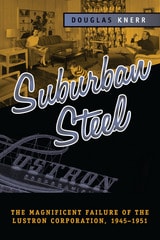
SUBURBAN STEEL
The Magnificent Failure of the Lustron Corporation, 1945–1951Douglas Knerr
The Ohio State University Press, 2004
Suburban Steel chronicles the rise and fall of the Lustron Corporation, once the largest and most completely industrialized housing company in U.S. history. Beginning in 1947, Lustron manufactured porcelain-enameled steel houses in a one-million-square-foot plant in Columbus, Ohio. With forty million dollars in federal funds and support from the highest levels of the Truman administration, the company planned to produce one hundred houses per day, each neatly arranged on specially designed tractor-trailers for delivery throughout the country. Lustron’s unprecedented size and scope of operations attracted intense scrutiny. The efficiencies of uninterrupted production, integrated manufacturing, and economies of scale promised to lead the American housing industry away from its decentralized, undercapitalized, and inefficient past toward a level of rationalization and organization found in other sectors of the industrial economy.
The company’s failure marked a watershed in the history of the American housing industry. Although people did not quit talking about industrialized housing, enthusiasm for its role in the transformation of the housing industry at large markedly waned. Suburban Steel considers Lustron’s magnificent failure in the context of historical approaches to the nation’s perpetual shortage of affordable housing, arguing that had Lustron’s path not been interrupted, affordable and desirable housing for America’s masses would be far more prevalent today.
School Siting and Healthy Communities
Why Where We Invest in School Facilities MattersRebecca Miles
Michigan State University Press, 2012
In recent decades, many metropolitan areas in the United States have experienced a decline in the population of urban centers and rapid growth in the suburbs, with new schools being built outside of cities and existing urban schools facing closure. These new schools are increasingly larger and farther from residences; in contrast, urban school facilities are often in closer proximity to homes but are also in dire need of upgrading or modernization. This eye-opening book explores the compelling health and economic rationales for new approaches to school siting, including economic savings to school districts, transportation infrastructure needs, and improved child health. An essential examination of public policy issues associated with school siting, this compiled volume will assist policy makers and help the public understand why it is important for government and school districts to work together on school siting and capital expenditures and how these new outlooks will improve local and regional outcomes.
Second-Order Preservation
Social Justice and Climate Action through Heritage PolicyErica Avrami
University of Minnesota Press, 2024
An urgent appeal to rethink the heritage enterprise
A critical reassessment of historic preservation policies in the United States, Second-Order Preservation brings needed attention to the hierarchical underpinnings and effects of established preservation frameworks. Questioning the criteria by which value is ascribed to historic buildings and neighborhoods, Erica Avrami works to elucidate and transform how—and which—claims to place become codified in and reinforced through public policy.
As she eschews dominant case-study approaches that center the individual object of preservation, such as a discrete building or site, Avrami develops the concept of second-order preservation as a means of integrating broader considerations around social justice, equitable land-use planning, and environmental sustainability. Ranging from municipal to state to national and international levels of governance, her critique of the origins and evolution of heritage policy reveals how this conventional emphasis on the object has contributed to policy tensions and systemic exclusion.
Stressing the need to reform current preservation practices to serve more diverse publics, Avrami encourages a turn to an approach that substantively considers contexts and implications of preservation in the scheme of climate and justice. Second-Order Preservation maintains the interrelation between theory and practice, serving as both a critical reflection and a provocation aimed at advancing a more just set of urban policy agendas.
Selling The Dream
The Gulf American Corporation and the Building of Cape Coral, FloridaDavid Dodrill
University of Alabama Press, 1993
Examining real estate ambition and urban growth in Cape Coral’s creation.
The Gulf American Corporation played a significant role in the development and urbanization of the state of Florida, especially southwest Florida, during the late 1950s and 1960s. The Miami-based company promoted living in Florida to people residing throughout North America and in several foreign countries. It also enabled people of average incomes to purchase home sites in Florida on an installment basis. As a result, Gulf American had a heavy influence on the migration of people to Florida as early as 1957.
Leonard and Julius J. Rosen of Baltimore, Maryland, founded and controlled the corporation during its 12-year existence from 1957 to 1969. The sale and promotion of Florida real estate was an extension of their marketing style developed in previous years when they sold mail-order cosmetics and other products. Their innovative sales strategies ultimately resulted in conflicts with state and federal regulatory agencies in the mid 1960s over the firm’s aggressive sales methods. The struggle with the state of Florida over regulation, which degenerated into a personal conflict between Governor Claude Kirk and the Rosens, resulted in the Rosens’ selling the business to GAC Corporation of Allentown, Pennsylvania, in 1969. After a series of business setbacks and continuing accusations of misrepresentations by salespeople, GAC declared bankruptcy in 1975 and was eventually resurrected as Avatar Holding, Inc., in 1980.
Gulf American left a mixed legacy to the state of Florida by building several growing cities like Cape Coral and Golden Gate, while at the same time selling worthless underwater swampland near the Everglades. The building of their first development was planned by the company. In that sense, Cape Coral was designed to be the Rosens’ most elaborate sales tool.
Based on 31 personal interviews with former Gulf American Corporation, GAC/Avatar Holding company officials and supplemented by articles from 25 different newspapers, this book provides a comprehensive and fascinating look at the Gulf American Corporation—the largest land sales firm in the United States in the 1960s. In many ways the story of Gulf American is a rags-to-riches tale of Leonard and Julius (Jack) Rosen, complete with intrigue and the fluctuations of fortune that matched the rising tides that covered much of the land they sold.
Shifting Sands
Landscape, Memory, and Commodities in China's Contemporary BorderlandsXiaoxuan Lu
University of Texas Press, 2023
How China’s borderlands transformed politically and culturally throughout the twentieth and twenty-first centuries.
China’s land borders, shared with fourteen other nations, are the world’s longest. Like all borders, they are not just lines on a map but also spaces whose histories and futures are defined by their frontier status. An ambitious appraisal of China’s borderlands, Shifting Sands addresses the full scope and importance of these regions, illustrating their transformation from imperial backwaters to hotbeds of resource exploitation and human development in the age of neoliberal globalization.
Xiaoxuan Lu brings to bear an original combination of archival research, fieldwork, cartography, and landscape analysis, broadening our understanding of the political economy and cultural changes in China’s borderlands in the twentieth and twenty-first centuries. While conventional wisdom looks to the era of Deng Xiaoping for China’s “opening,” Lu shows the integration of China’s borderlands into national and international networks from Sun Yat-sen onward. Yet, while the state has left a firm imprint on the borderlands, they were hardly created by China alone. As the Chinese case demonstrates, all borderlands are transnational, their physical and socioeconomic landscapes shaped by multidirectional flows of materials, ideas, and people.
Small Cities USA
Growth, Diversity, and InequalityNorman, Jon R
Rutgers University Press, 2012
Drawing on an assessment of eighty small cities between 1970 and 2000, Norman considers the factors that have altered the physical, social, and economic landscapes of such places. These cities are examined in relation to new patterns of immigration, shifts in the global economy, and changing residential preferences. Small Cities USA presents the first large-scale comparison of smaller cities over time in the United States, showing that small cities that have prospered over time have done so because of diverse populations and economies. These "glocal" cities, as Norman calls them, are doing well without necessarily growing into large metropolises.
Some Assembly Required
Michael Sorkin
University of Minnesota Press, 2001
The long-awaited collection by one of architecture’s most exciting voices.
Michael Sorkin is widely hailed as one of the best architecture critics writing today. Iconoclastic and often controversial, he is a witty, entertaining, yet ultimately serious writer. In this new collection, Sorkin reviews the state of contemporary architecture and surveys the dramatic changes in the urban environment of the past decade. From New York to New Delhi, from Shanghai to Cairo, Sorkin offers a sweeping assessment of the impact of globalization, environmental degradation, electronic media, rapid growth, and the legacies of modernist planning. Whether laying out, manifesto-like, eleven necessary tasks for urban design, providing a fresh take on the Disneyfication of Times Square, grappling with sprawl, or blasting the nostalgic prescriptions of "new urbanist" communities (which he dubs "Reaganville"), Sorkin makes a compelling argument for an architecture and urbanism firmly grounded in both artistic expression and social purpose.
Space Syntax
Selected Papers by Bill HillierEdited by Laura Vaughan, John Peponis, and Ruth Dalton
University College London, 2025
Few scholars have reshaped our understanding of architecture and urban design as profoundly as Bill Hillier. Space Syntax compiles the most influential works from his career, spanning over half a century, to showcase the evolution of his innovative theories on the spatial structure of cities and the social functions of built environments.
Including his early explorations of architecture as a research discipline and his later theories on how spatial configurations influence human movement and urban vitality, this collection provides a definitive overview of Hillier’s intellectual legacy. Featuring newly redrawn figures, rare texts, and expert introductions from leading theorists and practitioners, the volume offers fresh viewpoints on the continued relevance of space syntax in contemporary research and practice.
Relevant to subjects ranging from archaeology to physics, Space Syntax cements Hillier’s place as a revolutionary thinker whose ideas continue to shape how we design and understand space.
Sprawl and Suburbia
A Harvard Design Magazine ReaderWilliam Saunders
University of Minnesota Press, 2005
Sprawl and Suburbia brings together some of the foremost thinkers in the field to present in-depth diagnosis and critical analysis of the physical and social realities of exurban sprawl. Along with an introduction by Robert Fishman, these essays call for architects, urban planners, and landscape designers to work at mitigating the impact of sprawl on land and resources and improving the residential and commercial built environment as a whole. In place of vast residential exurbs, these writers offer visions of a fresh urbanism—appealing and persuasive models of life at greater density, with greater diversity, and within genuine communities.
With sprawl losing the support of suburban citizens themselves as economic, environmental, and social costs are being paid, Sprawl and Suburbia appears at a moment when design might achieve some critical influence over development—if architects and planners accept the challenge.
Contributors: Mike Davis, Ellen Dunham-Jones, Peter Hall, David Harvey, Jerold S. Kayden, Matthew J. Kiefer, Alex Krieger, Andrew Ross, James S. Russell, Mitchell Schwarzer.
William S. Saunders is editor of Harvard Design Magazine and assistant dean for external relations at the Harvard Design School. He is the author of Modern Architecture: Photographs by Ezra Stoller.
Robert Fishman is professor of architecture and urban planning at the Taubman College of Architecture, University of Michigan. He is author of Bourgeois Utopias: The Rise and Fall of Suburbia and editor of The American Planning Tradition: Culture and Policy.
Sprawl
A Compact HistoryRobert Bruegmann
University of Chicago Press, 2005
In his incisive history of the expanded city, Bruegmann overturns every assumption we have about sprawl. Taking a long view of urban development, he demonstrates that sprawl is neither recent nor particularly American but as old as cities themselves, just as characteristic of ancient Rome and eighteenth-century Paris as it is of Atlanta or Los Angeles. Nor is sprawl the disaster claimed by many contemporary observers. Although sprawl, like any settlement pattern, has undoubtedly produced problems that must be addressed, it has also provided millions of people with the kinds of mobility, privacy, and choice that were once the exclusive prerogatives of the rich and powerful.
The first major book to strip urban sprawl of its pejorative connotations, Sprawl offers a completely new vision of the city and its growth. Bruegmann leads readers to the powerful conclusion that "in its immense complexity and constant change, the city-whether dense and concentrated at its core, looser and more sprawling in suburbia, or in the vast tracts of exurban penumbra that extend dozens, even hundreds, of miles-is the grandest and most marvelous work of mankind."
“There are scores of books offering ‘solutions’ to sprawl. Their authors would do well to read this book.”—Witold Rybczynski, Slate
SynergiCity
Reinventing the Postindustrial CityEdited by Paul Hardin Kapp and Paul J. Armstrong
University of Illinois Press, 2012