Results by title
98 books match the query 'Urban renewal' and 8 start with s
Seeking a Future for the Past
Space, Power, and Heritage in a Chinese CityPhilipp Demgenski
University of Michigan Press, 2024
Selling The Lower East
Culture, Real Estate, and Resistance in New York CityChristopher Mele
University of Minnesota Press, 2000
Tracks the shifting views of the Lower East Side from ghetto to desirable urban niche.
The Lower East Side of Manhattan is rich in stories-of poor immigrants who flocked there in the late nineteenth and early twentieth centuries; of beatniks, hippies, and artists who peopled it mid-century; and of the real estate developers and politicians who have always shaped what is now termed the "East Village." Today, the musical Rent plays on Broadway to a mostly white and suburban audience, MTV exploits the neighborhood’s newly trendy squalor in a film promotion, and on the Internet a cyber soap opera and travel-related Web pages lure members of the middle class to enjoy a commodified and sanitized version of the neighborhood.
In this sweeping account, Christopher Mele analyzes the political and cultural forces that have influenced the development of this distinctive community. He describes late nineteenth-century notions of the Lower East Side as a place of entrenched poverty, ethnic plurality, political activism, and "low" culture that elicited feelings of revulsion and fear among the city’s elite and middle classes. The resulting-and ongoing-struggle between government and residents over affordable and decent housing has in turn affected real estate practices and urban development policies. Selling the Lower East Side recounts the resistance tactics used by community residents, as well as the impulse on the part of some to perpetuate the image of the neighborhood as dangerous, romantic, and bohemian, clinging to the marginality that has been central to the identity of the East Village and subverting attempts to portray it as "new and improved." Ironically, this very image of urban grittiness has been appropriated by a cultural marketplace hungry for new fodder. Mele explores the ways that developers, media executives, and others have coopted the area’s characteristics-analyzing the East Village as a "style provider" where what is being marketed is "difference." The result is a visionary look at how political and economic actions transform neighborhoods and at what happens when a neighborhood is what is being "consumed."A comprehensive web site for Selling the Lower East Side can be found at www.upress.umn.edu/sles.
Separate Societies
William Goldsmith
Temple University Press, 1992
Separate Societies
Poverty and Inequality in U.S. CitiesAuthored by William W. Goldsmith and Edward J. Blakely with a foreword by President Bill Clinton
Temple University Press, 2010
“Economic and political forces no longer combat poverty—they generate poverty!" exclaim William Goldsmith and Edward Blakely in their report on the plight of American's urban poor. In this revised and updated edition of their 1992 book Separate Societies,the authors present a compelling examination of the damaging divisions that isolate poor city minority residents from the middle-class suburban majority. They pay special attention to how the needs of the permanently poor have been unmet through the alternating years of promises and neglect, and propose a progressive turn away from 30 years of conservative policies.
Separate Societies vividly documents how the urban working class has been pushed out of industrial jobs through global economic restructuring, and how the Wall Street meltdown has aggravated underemployment, depleted public services, and sharpened racial and class inequalities.
The authors insist that the current U.S. approach puts Americans out of work and lowers the standard of living for all. As such, Goldsmith and Blakely urge the Obama administration to create better urban policy and foster better metropolitan management to effectively and efficiently promote equality.
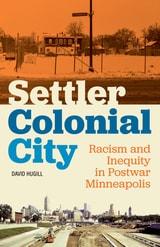
Settler Colonial City
Racism and Inequity in Postwar MinneapolisDavid Hugill
University of Minnesota Press, 2021
Revealing the enduring link between settler colonization and the making of modern Minneapolis
Colonial relations are often excluded from discussions of urban politics and are viewed instead as part of a regrettable past. In Settler Colonial City, David Hugill confronts this culture of organized forgetting by arguing that Minnesota’s largest city is enduringly bound up with the power dynamics of settler-colonial politics. Examining several distinct Minneapolis sites, Settler Colonial City tracks how settler-colonial relations were articulated alongside substantial growth in the Twin Cities Indigenous community during the second half of the twentieth century—creating new geographies of racialized advantage.
Studying the Phillips neighborhood of Minneapolis in the decades that followed the Second World War, Settler Colonial City demonstrates how colonial practices and mentalities shaped processes of urban reorganization, animated non-Indigenous “advocacy research,” informed a culture of racialized policing, and intertwined with a broader culture of American imperialism. It reveals how the actions, assumptions, and practices of non-Indigenous people in Minneapolis produced and enforced a racialized economy of power that directly contradicts the city’s “progressive” reputation.
Ultimately, Settler Colonial City argues that the hierarchical and racist political dynamics that characterized the city’s prosperous beginnings are not exclusive to a bygone era but rather are central to a recalibrated settler-colonial politics that continues to shape contemporary cities across the United States.
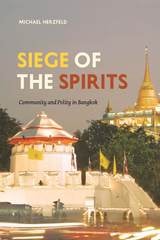
Siege of the Spirits
Community and Polity in BangkokMichael Herzfeld
University of Chicago Press, 2016
Herzfeld argues that even though the residents of Pom Mahakan have lost every legal battle the city government has dragged them into, they have won every public relations contest, highlighting their struggle as one against bureaucrats who do not respect the age-old values of Thai/Siamese social and cultural order. Such values include compassion for the poor and an understanding of urban space as deeply embedded in social and ritual relations. In a gripping account of their standoff, Herzfeld—who simultaneously argues for the importance of activism in scholarship—traces the agile political tactics and styles of the community’s leadership, using their struggle to illuminate the larger difficulties, tensions, and unresolved debates that continue to roil Thai society to this day.
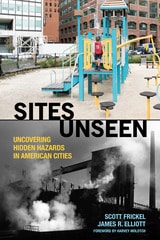
Sites Unseen
Uncovering Hidden Hazards in American CitiesScott Frickel
Russell Sage Foundation, 2018
From a dive bar in New Orleans to a leafy residential street in Minneapolis, many establishments and homes in cities across the nation share a troubling and largely invisible past: they were once sites of industrial manufacturers, such as plastics factories or machine shops, that likely left behind carcinogens and other hazardous industrial byproducts. In Sites Unseen, sociologists Scott Frickel and James Elliott uncover the hidden histories of these sites to show how they are regularly produced and reincorporated into urban landscapes with limited or no regulatory oversight. By revealing this legacy of our industrial past, Sites Unseen spotlights how city-making has become an ongoing process of social and environmental transformation and risk containment.
To demonstrate these dynamics, Frickel and Elliott investigate four very different cities—New Orleans, Minneapolis, Philadelphia, and Portland, Oregon. Using original data assembled and mapped for thousands of former manufacturers’ locations dating back to the 1950s, they find that more than 90 percent of such sites have now been converted to urban amenities such as parks, homes, and storefronts with almost no environmental review. And because manufacturers tend to open plants on new, non-industrial lots rather than on lots previously occupied by other manufacturers, associated hazards continue to spread relatively unabated. As they do, residential turnover driven by gentrification and the rising costs of urban living further obscure these sites from residents and regulatory agencies alike.
Frickel and Elliott show that these hidden processes have serious consequences for city-dwellers. While minority and working class neighborhoods are still more likely to attract hazardous manufacturers, rapid turnover in cities means that whites and middle-income groups also face increased risk. Since government agencies prioritize managing polluted sites that are highly visible or politically expedient, many former manufacturing sites that now have other uses remain invisible. To address these oversights, the authors advocate creating new municipal databases that identify previously undocumented manufacturing sites as potential environmental hazards. They also suggest that legislation limiting urban sprawl might reduce the flow of hazardous materials beyond certain boundaries.
A wide-ranging synthesis of urban and environmental scholarship, Sites Unseen shows that creating sustainable cities requires deep engagement with industrial history as well as with the social and regulatory processes that continue to remake urban areas through time.
A Volume in the American Sociological Association's Rose Series in Sociology.
Stadium City
Sports and Media Infrastructure in the United StatesHelen Morgan Parmett
University of Illinois Press, 2025