Results by title
195 books match the query 'Utah' and 13 start with s
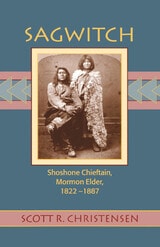
Sagwitch
Shoshone Chieftan, Mormon Elder 1822-1887Scott Christensen
Utah State University Press, 1999
The Northwestern Shoshone knew as home the northern Great Salt Lake, Bear River, Cache, and Bear Lake valleys of northern Utah. Sagwitch was born at a time when his people traded with the mountain men. In the late 1850s, wagons brought Mormon farmers to settle in Cache Valley, the Northwestern Shoshone heartland. Emigrants and settlers reduced Shoshone access to traditional village sites and food resources. Relationships with the Mormons were mostly good but often strained, and the Shoshone treatment of migrants, who now traveled north and south as well as west and east through the area, was increasingly opportunistic. It only took a few violent incidents for a zealous army colonel to seek severe punishment of the Northwestern Shoshone on a winter morning in 1863. The Bear River Massacre was among the bloodiest engagements of America's Indian wars. Hundreds of Shoshone, including Sagwitch's wife and two sons, died; Sagwitch was wounded but escaped. The band was shattered, other chiefs dead.
The following years were very hard for the survivors. The federal government negotiated a treaty with them but failed to get Sagwitch's signature when, en route to the sessions, he was arrested and then wounded by a white assassin. With the world around him changed, Sagwitch sought accommodation with the most immediate threat to his people's traditional way of survival—the Mormons occupying the Shoshone's valleys.
This, then, is also the story of the conversion of Sagwitch and his band to the Mormon Church. Though not without problems, that conversion was long lasting and thorough. Sagwitch and other Shoshone would demonstrate in important ways their new religious devotion. With the assistance of Mormon leaders, they established the Washakie community in northern Utah. Though efforts to secure a land base had an uneven history, they partly succeeded, and the story of these Shoshone's attempts at rural farming diverged significantly from what happened on government reservations. When Sagwitch died, his death went almost unnoticed outside of Washakie, but his children and grandchildren continued to be important voices among a people who, after experiencing near annihilation, survived in the new world into which Sagwitch led them.
Saints Observed
Studies of Mormon Village Life, 1850-2005Howard M. Bahr
University of Utah Press, 2014

Sally in Three Worlds
An Indian Captive in the House of Brigham YoungVirginia Kerns
University of Utah Press, 2021
In this remarkable and deeply felt book, Virginia Kerns uncovers the singular and forgotten life of a young Indian woman who was captured in 1847 in what was then Mexican territory. Sold to a settler, a son-in-law of Brigham Young, the woman spent the next thirty years as a servant to Young’s family. Sally, as they called her, lived in the shadows, largely unseen. She was later remembered as a “wild” woman made “tame” who happily shed her past to enter a new and better life in civilization.
Drawing from a broad range of primary sources, Kerns retrieves Sally from obscurity and reconstructs her complex life before, during, and after captivity. This true story from the American past resonates deeply in the current moment, attentive as it is to killing epidemics and racial injustices. In telling Sally’s story, Kerns presents a new narrative of the American West.
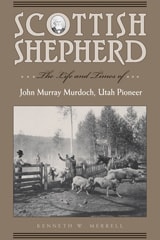
Scottish Shepherd
The Life and Times of John Murray Murdoch, Utah PioneerMerrell, Kenneth W
University of Utah Press, 2007
Murdoch embraced Mormonism and set out for the Utah Territory in 1852 with his wife, Ann, and their family. En route they suffered the deaths of their two young children. Two years later, John’s mother, Wee Granny, and Ann’s brother, James Steele, both perished, along with many others of the ill-fated Martin handcart company, as they attempted to immigrate to Salt Lake City.
Murdoch was a respected member of the community and participated in the military preparations and maneuvers against the U.S. Army in the 1857 Utah War. Eventually the family moved to the Heber valley as early settlers there. Murdoch later became one of Wasatch county’s first elected officials and helped establish the sheep-ranching industry in Utah. The 'everyman' aspect of John Murdoch’s life makes his a compelling story. It will fascinate anyone interested in the individuals who helped create Utah's history.
Winner of the Evans Handcart Award.
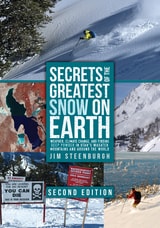
Secrets of the Greatest Snow on Earth, Second Edition
Weather, Climate Change, and Finding Deep Powder in Utah's Wasatch Mountains and Around the WorldJim Steenburgh
Utah State University Press, 2023
Utah has long claimed to have the greatest snow on Earth—the state itself has even trademarked the phrase. In Secrets of the Greatest Snow on Earth, Jim Steenburgh investigates Wasatch weather, exposing the myths, explaining the reality, and revealing how and why Utah’s powder lives up to its reputation. Steenburgh also examines ski and snowboard regions beyond Utah, providing a meteorological guide to mountain weather and snow climates around the world.
Chapters explore mountain weather, avalanches and snow safety, historical accounts of weather events and snow conditions, and the basics of climate and weather forecasting. In this second edition, Steenburgh explains what creates the best snow for skiing and snowboarding using accurate and accessible language and 150 color photographs and illustrations, making Secrets of the Greatest Snow on Earth a helpful tool for planning vacations and staying safe during mountain adventures.
This edition is updated with two new chapters covering microclimates and climate change in greater depth. Steenburgh addresses the declining snowpack and the future of snow across the western United States, as well as the declining snow and ice in several regions of the world—the European Alps in particular. Snowriders, weather enthusiasts, meteorologists, students of snow science, and anyone who dreams of deep powder and bluebird skies will want to get their gloves on this new edition of Secrets of the Greatest Snow on Earth.
Praise for the first edition:
“Everything you always wanted to know about how snow forms and how to follow forecasts so you see
how much an”d where is in the book. It’s a must-have for any fan of snow, sure to get you excited about
winter, and give you a bevy of conversation topics for the chairlift ride.”
—Utah Adventure Journal
“For backcountry enthusiasts that find themselves infatuated with weather patterns, snow-water
equivalents, microclimates, and Utah, this book is a dream come true.”
—The Backcountry Skiing Blog
“Steenburgh shares a career’s worth of knowledge in this book. His love of both snow science and skiing
is obvious, and he adds humor and personality to the scientific discussion.”
—First Tracks!! Online Skiing Magazine
“When it comes to snow, the details—both small- and large-scale—do matter. If we all observed our
surroundings with as much curiosity and enthusiasm as Steenburgh, the world could be a much better-
tended place.”
—American Scientist
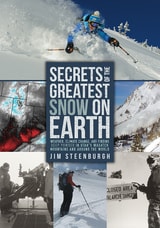
Secrets of the Greatest Snow on Earth
Weather, Climate Change, and Finding Deep Powder in Utah's Wasatch Mountains and around the WorldJim Steenburgh
Utah State University Press, 2014
Chapters explore mountain weather, avalanches and snow safety, historical accounts of weather events and snow conditions, and the basics of climate and weather forecasting. Steenburgh explains what creates the best snow for skiing and snowboarding in accurate and accessible language and illustrates his points with 150 color photographs, making Secrets of the Greatest Snow on Earth a helpful tool for planning vacations and staying safe during mountain adventures. Snowriders, weather enthusiasts, meteorologists, students of snow science, and anyone who dreams of deep powder and bluebird skies will want to get their gloves on Secrets of the Greatest Snow on Earth.
Watch Book Trailer!(Special thanks to Ski Utah)
Shooting Polaris
A Personal Survey in the American WestJohn Hales
University of Missouri Press, 2005
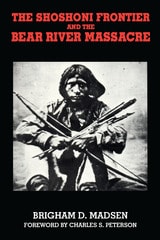
Shoshoni Frontier and Bear River Massacre
Brigham Madsen
University of Utah Press, 1985
Bear River was the culmination of events from nearly two decades of Indian-white interaction. The Shoshoni homelands encompassed a huge expanse of territory and were traversed by the main paths of western travel, forcing Indian-white encounters. Initially friendly and accommodating to white travelers in the 1840s, by the late 1850s resentment soared among the Indians as they were killed and their food stocks were consumed by emigrants and their livestock. The process of white appropriation of Indian lands reached crisis proportions in the Far West and Great Basin before it did on the Great Plains.
In the historiography of western Indians, few have appreciated the role of tribes inhabiting the regions of along the Oregon and California Trails. Madsen makes a compelling argument that precedents were established that were followed again and again on subsequent western Indian frontiers, offering a new view of early encounters in the Trans-Mississippi West. This detailed narrative of the events and conflicts that culminated in the massacre remains the definitive account of this bloody chapter in United States-Native American relations.
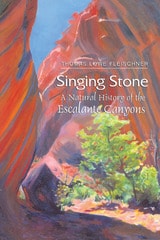
Singing Stone
Thomas L Fleischner
University of Utah Press, 1999
Integrating personal narrative and natural history, Fleischner presents what he calls a "guide to understanding" the relatively unknown landscape of the Grand Staircase-Escalante National Monument.
Like a bright blue seam incised deep in solid rock, the Escalante River binds the fir forests of Utah’s High Plateau with the barren deserts of the canyonlands region in the newly designed Grand Staircase-Escalante National Monument. To this wild landscape, naturalist Thomas Fleischner brings both emotional engagement and a wealth of knowledge. With unabashed passion and patient and learned observations Fleischner presents this relatively unknown landscape.
Singing Stone is ideal for curious visitors to the national monument as well as students of environmental studies. Fleischner’s background as a conservation biologist and former park ranger, a professor of environmental studies, and a naturalist in the Escalante Region for almost twenty years has provided him with a deep reservoir of experience and knowledge.
The book’s first three chapters survey the unique geology, flora and fauna, and human history of the region. Chapters four and five trace the more recent impacts of human activities—grazing and wilderness recreation—and explore the shifts in cultural values and public policy that have occurred as a result. Examining these topics in the context of a specific landscape offers a lens through which these changes, now the topic of examination and controversy throughout the New West, can be clearly seen and, hopefully, re-evaluated.
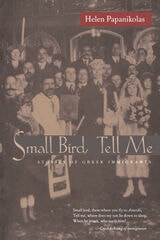
Small Bird Tell Me
Stories Of Greek ImmigrantsHelen Papanikolas
Ohio University Press, 1994

Sports in Zion
Mormon Recreation, 1890-1940Richard Ian Kimball
University of Illinois Press, 2002
If a religion cannot attract and instruct young people, it will struggle to survive, which is why recreational programs were second only to theological questions in the development of twentieth-century Mormonism. In this book, Richard Ian Kimball explores how Mormon leaders used recreational programs to ameliorate the problems of urbanization and industrialization and to inculcate morals and values in LDS youth. As well as promoting sports as a means of physical and spiritual excellence, Progressive Era Mormons established a variety of institutions such as the Deseret Gymnasium and camps for girls and boys, all designed to compete with more "worldly" attractions and to socialize adolescents into the faith.
Kimball employs a wealth of source material including periodicals, diaries, journals, personal papers, and institutional records to illuminate this hitherto underexplored aspect of the LDS church. In addition to uncovering the historical roots of many Mormon institutions still visible today, Sports in Zion is a detailed look at the broader functions of recreation in society.
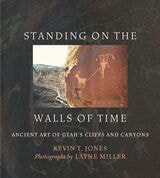
Standing on the Walls of Time
Ancient Art of Utah's Cliffs and CanyonsKevin T. Jones and Layne Miller
University of Utah Press, 2019
Miller’s photographs include many rare and relatively unknown panels and represent a lifetime of work by someone intimately familiar with the Colorado Plateau. The photos highlight the astonishing variety of rock art as well as the variability within traditions and time periods. Jones’s essays furnish general information about previous Colorado Plateau cultures and shine a light on rock art as art. The book emphasizes the exquisite artistry of these ancient works and their capacity to reach through the ages to envelop and inspire viewers.
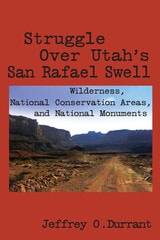
Struggle Over Utah's San Rafael Swell
Wilderness, National Conservation Areas, and National MonumentsJeffrey O. Durrant
University of Arizona Press, 2007
In detailing political and environmental squabbles over the San Rafael Swell, Durrant illuminates issues that confront land managers, bureaucrats, and elected officials throughout the country. He describes struggles between county commissioners and environmental activists, conflicts over water rights, proposals that repeatedly fail to gain government approval, and political posturings. Caught in the crossfire, and often overwhelmed, the Bureau of Land Management has seen its long-time mission—once centered on grazing and mining rights—transmogrify into a new and, to some, unsettling responsibility for recreation and preservation.
The sandstone crags and twisting valleys of the San Rafael Swell present a formidable landscape, but as this book clearly shows, the political landscape may be even more daunting, strewn with bureaucratic boulders and embedded with fixed positions on the functions and values of public land.