Results by title
66 books match the query 'Veterans' and 7 start with s
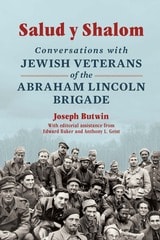
Salud y Shalom
Conversations with Jewish Veterans of the Abraham Lincoln BrigadeJoseph Butwin
University of Illinois Press, 2025
Joseph Butwin’s oral history presents conversations with ten Jewish veterans of the ALB. Recorded from 1992–94 in the wake of European communism’s collapse, the interviews explore the milieus that formed the volunteers. Immigrants established the secular Yiddish-speaking socialism that became a part of many Jewish American communities. Their children, reacting to economic depression and the rise of fascism, enlisted in the ALB. Butwin follows their stories from their youthful motives and choices through their lives as Jews and leftists, and records the reckonings that took place as they reflected on their past.
Insightful and revealing, Salud y Shalom explores the forces of identity and history that led young Jewish leftists to fight fascism.
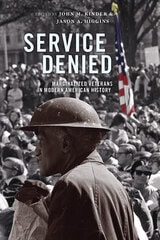
Service Denied
Marginalized Veterans in Modern American HistoryEdited by John M. Kinder and Jason A. Higgins
University of Massachusetts Press, 2022
Wartime military service is held up as a marker of civic duty and patriotism, yet the rewards of veteran status have never been equally distributed. Certain groups of military veterans—women, people of color, LGBTQ people, and former service members with stigmatizing conditions, “bad paper” discharges, or criminal records—have been left out of official histories, excised from national consciousness, and denied state recognition and military benefits.
Chronicling the untold stories of marginalized veterans in the twentieth and twenty-first centuries, Service Denied uncovers the generational divides, cultural stigmas, and discriminatory policies that affected veterans during and after their military service. Together, the chapters in this collection recast veterans beyond the archetype, inspiring an innovative model for veterans studies that encourages an intersectional and interdisciplinary analysis of veterans history. In addition to contributions from the volume editors, this collection features scholarship by Barbara Gannon, Robert Jefferson, Evan P. Sullivan, Steven Rosales, Heather Marie Stur, Juan Coronado, Kara Dixon Vuic, John Worsencroft, and David Kieran.
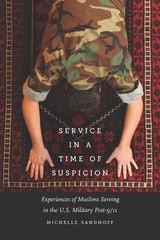
Service in a Time of Suspicion
Experiences of Muslims Serving in the U.S. Military Post-9/11Michelle Sandhoff
University of Iowa Press, 2017
In Service in a Time of Suspicion, fifteen such service members talk about what it means to be Muslim, American, and a uniformed member of the armed services in the twenty-first century. These honest accounts remind us of our shared humanity.
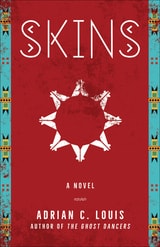
Skins
A NovelAdrian C. Louis
University of Nevada Press, 2022
It’s the early 1990s and Rudy Yellow Shirt and his brother, Mogie, are living on the Pine Ridge Reservation in South Dakota, home of the legendary Oglala Sioux warrior Crazy Horse. Both Vietnam veterans, the men struggle with daily life on the rez. Rudy, a criminal investigator with the Pine Ridge Public Safety Department, must frequently arrest his neighbors and friends, including his brother, who has become a rez wino.
But when Rudy falls and hits his head on a rock while pursuing a suspected murderer, Iktome the trickster enters his brain. Iktome restores Rudy’s youthful sexual vigor—long-lost to years of taking high blood pressure pills—and ignites his desire for political revenge via an alter ego, the “Avenging Warrior.” As the Avenging Warrior, Rudy takes direct action to punish local criminals. In a violent act, he torches the local liquor store, nearly burning Mogie alive while he is hiding on the store’s roof, plotting to steal booze. Although the brothers reconcile before Mogie dies, he leaves the Avenging Warrior with one final mission: go to Mount Rushmore and blow the nose off George Washington’s face.
Louis’s critically acclaimed novel was made into a movie in 2002, directed by Chris Eyre.
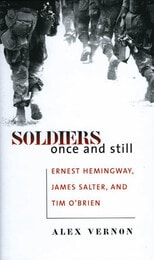
Soldiers Once and Still
Ernest Hemingway, James Salter, and Tim O'BrienAlex Vernon
University of Iowa Press, 2007
Hemingway, Salter, and O’Brien form the core of Soldiers Once and Still because each represents a different warring generation of twentieth-century America: World War I with Hemingway, World War II and Korea with Salter, and Vietnam with O’Brien. Each author also represents a different literary voice of the twentieth century, from modern to mid-century to postmodern, and each presents a different battlefield experience: Hemingway as noncombatant, Salter as air force fighter pilot, and O’Brien as army grunt.
War’s pervasive influence on the individual means that, for veterans-turned-writers like Hemingway, Salter, and O’Brien, the war experience infiltrates their entire body of writing—their works can be seen not only as war literature but also as veterans’ literature. As such, their entire postwar oeuvre, regardless of whether an individual work explicitly addresses the war or the military, is open to Vernon’s exploration of war, society, gender, and literary history.
Vernon’s own experiences as a soldier, a veteran, a writer, and a critic inform this enlightening critique of American literature, offering students and scholars of American literature and war studies an invaluable tool for understanding war’s effects on the veteran writer and his society.
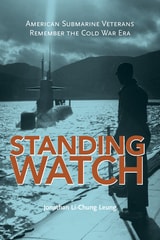
Standing Watch
American Submarine Veterans Remember the Cold War EraJonathan Li-Chung Leung
University of Alabama Press, 2019
Featuring interviews from seventeen veteran submariners, Standing Watch: American Submarine Veterans Remember the Cold War Era offers the perspective of the submariners themselves—lending them a voice and paying homage to their service. Jonathan Li-Chung Leung provides an original glimpse into a world of unique challenges and characters, a life isolated and submerged, and a duty defined by the juxtaposition of monotonous routine and unparalleled excitement.
These personal accounts of life below the surface offer readers a front-row seat to close encounters with Soviet submarines and the naval blockade during the Cuban Missile Crisis, as well as an intimate understanding of daily life onboard the vessels, the culture of military discipline, and the religious-like fervor exercised in honoring traditions big and small. By applying first-hand perspectives to a larger thematic overview, this book uses authentic narratives to deliver a lively and colorful picture of the Silent Service.
Set against the backdrop of sobering geo-political disputes and their own role as the nation’s defenders against a seemingly ambiguous super-enemy, these veterans focus on their responsibilities and reflect on careers built on the simple axioms of pride and service. This invigorating and unalloyed account is an unprecedented addition to the existing literature on naval and military history.
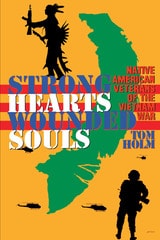
Strong Hearts, Wounded Souls
Native American Veterans of the Vietnam WarBy Tom Holm
University of Texas Press, 1996
At least 43,000 Native Americans fought in the Vietnam War, yet both the American public and the United States government have been slow to acknowledge their presence and sacrifices in that conflict. In this first-of-its-kind study, Tom Holm draws on extensive interviews with Native American veterans to tell the story of their experiences in Vietnam and their readjustment to civilian life.
Holm describes how Native American motives for going to war, experiences of combat, and readjustment to civilian ways differ from those of other ethnic groups. He explores Native American traditions of warfare and the role of the warrior to explain why many young Indian men chose to fight in Vietnam. He shows how Native Americans drew on tribal customs and religion to sustain them during combat. And he describes the rituals and ceremonies practiced by families and tribes to help heal veterans of the trauma of war and return them to the "white path of peace."
This information, largely unknown outside the Native American community, adds important new perspectives to our national memory of the Vietnam war and its aftermath.