Results by title
246 books match the query 'Violence in Society' and 9 start with s
Shattered Justice
Crime Victims' Experiences with Wrongful Convictions and ExonerationsKimberly J. Cook
Rutgers University Press, 2022
Shock and Yawn
Resisting Banal Terror Through Queer StorytellingMegan Sibbett
The Ohio State University Press, 2026
Building on queer theorists’ critiques of intimate and administrative violence, especially Gloria Anzaldúa’s “intimate terrorism,” Sibbett develops methodologies for conceptualizing and subverting violence aimed at queer, racialized, and gendered bodies in this era of surveillance and increasing authoritarianism. Sibbett addresses book bans, anti-trans legislation, idealized histories of westward expansion, and more, examining materials that include public service announcements, advertising, social media, news reports, poems, interviews, and novels. In so doing, she demonstrates the crucial role queer testimonies—and queer histories and queer futures—play in revealing systemic violence and illuminating the transformative potential of everyday resistance.

Showdown in Desire
The Black Panthers Take a Stand in New OrleansOrissa Arend
University of Arkansas Press, 2009

Silent Victims
Hate Crimes Against Native AmericansBarbara Perry
University of Arizona Press, 2008
Silent Victims is a unique contribution to the literature on hate crime. Because most extant literature treats hate crimes—even racial violence—rather generically, this work breaks new ground with its findings. For this book, Perry interviewed nearly 300 Native Americans and gathered additional data in three geographic areas: the Four Corners region of the U.S. Southwest, the Great Lakes, and the Northern Plains. In all of these locales, she found that bias-related crime oppresses and segregates Native Americans.
Perry is well aware of the history of colonization in North America and its attendant racial violence. She argues that the legacy of violence today can be traced directly to the genocidal practices of early settlers, and she adds valuable insights into the ways in which “Indians” have been constructed as the Other by the prevailing culture. Perry’s interviews with Native Americans recount instances of appalling treatment, often at the hands of law enforcement officials. In her conclusion, Perry draws from her research and interviews to suggest ways in which Native Americans can be empowered to defend themselves against all forms of racist victimization.
Social Violence in the Prehispanic American Southwest
Edited by Deborah L. Nichols and Patricia L. Crown
University of Arizona Press, 2008
CONTENTS
1. Introduction
Patricia Crown and Deborah Nichols
2. Dismembering the Trope: Imagining Cannibalism in the Ancient Pueblo World
Randall H. McGuire and Ruth Van Dyke
3. An Outbreak of Violence and Raiding in the Central Mesa Verde Region in the 12th Century AD
Brian R. Billman
4. Chaco Horrificus?
Wendy Bustard
5. Inscribed in the Body, Written in Bones: The Consequences of Social Violence at La Plata
Debra L. Martin, Nancy Akins, Bradley Crenshaw, and Pamela K. Stone
6. Veneration or Violence: A Study of Variations in Patterns of Human Bone Modification at La Quemada
Ventura R. Pérez, Ben A. Nelson, and Debra L. Martin
7. Witches, Practice, and the Context of Pueblo Cannibalism
William H. Walker
8. Explanation vs. Sensation: The Discourse of Cannibalism at Awat’ovi
Peter Whiteley
9. Devouring Ourselves
George J. Armelagos
References Cited
About the Contributors
Index

Sonic Strategies
Performing Mexico's War on Drugs, Mourning, and FeminicideChristina Baker
Vanderbilt University Press, 2023
In Sonic Strategies, author Christina Baker highlights the tactics employed by contemporary performance artists in Mexico in response to the violence surrounding the nation’s War on Drugs. The introduction opens with a description of the 2007 reenactment of the Grito, or “cry,” of independence, a moment fraught with sonic sparring, setting the stage for how each subsequent chapter focuses on themes related to war and violence. Each chapter focuses on the works of one or more performance artist, and taken together, the case studies illuminate how critiques of the nation’s rising death tolls, governmental corruption, and gendered violence very literally sound, whether in Música de balas, a post-dramatic piece by Hugo Salcedo; the lamentations of the nation’s Antigones in works by Violeta Luna and Lukas Avendaño; satirical revisions of Mexican Golden Age film in the cabaret piece Nosotras las proles; or the story of transfeminicide in César Enríquez’s La Prietty Guoman by way of US pop music.
Written in an accessible style grounded in theater studies but interdisciplinary by design, Sonic Strategies will appeal to literary critics, students, musicologists, and theater and performance scholars alike. By paying close attention to planned and spontaneous sounds within live and textual experiences, Sonic Strategies contends that conscientious listening reveals dynamic practices that reside beyond the linguistic and embodied gesture.
Spear of the Nation
Umkhonto weSizwe: South Africa’s Liberation Army, 1960s–1990sJanet Cherry
Ohio University Press, 2011
Umkhonto weSizwe, Spear of the Nation, was arguably the last of the great liberation armies of the twentieth century—but it never got to “march triumphant into Pretoria.” MK—as it was known—was the armed wing of the African National Congress, South Africa’s liberation movement, that challenged the South African apartheid government. A small group of revolutionaries committed to the seizure of power, MK discovered its principal members engaged in negotiated settlement with the enemy and was disbanded soon after.
The history of MK is one of paradox and contradiction, of successes and failures. In this short study, which draws widely on the personal experiences of—and commentary by—MK soldiers, Janet Cherry offers a new and nuanced account of the Spear of the Nation. She presents in broad outline the various stages of MK’s thirty-year history, considers the difficult strategic and moral problems the revolutionary army faced, and argues that its operations are likely to be remembered as a just war conducted with considerable restraint.
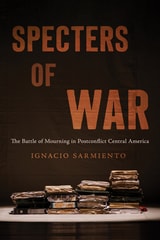
Specters of War
The Battle of Mourning in Postconflict Central AmericaIgnacio Sarmiento
University of Arizona Press, 2025
Specters of War explores mourning practices in postwar Central America, particularly in El Salvador and Guatemala. Ignacio Sarmiento delves into the intricate dynamics of grieving through an interdisciplinary lens, analyzing expressions of mourning in literature, theater, and sites of memory. At the heart of this analysis is the contention over who has the right to mourn, how mourning is performed, and who is included in this process. Sarmiento reveals mourning not as a private affair but as a battleground where different societal factions vie for the possibility of grieving the dead.
Through meticulous research and theoretical nuance, Specters of War sheds light on the politics of mourning in postconflict societies. Sarmiento argues that mourning is not merely a personal experience but a deeply political act intertwined with power struggles and societal divisions. From victims of state terrorism to military elites, various groups engage in a complex dance of grief, revealing the fraught nature of public mourning in postwar Central America. By examining cultural artifacts and memorialization projects, Sarmiento uncovers the multifaceted nature of mourning and its implications for memory, justice, and reconciliation.
This groundbreaking work is essential reading for scholars, students, and professionals interested in Central American history and culture, as well as post-authoritarian societies. Specters of War promises to deepen our understanding of postwar Central America and the legacy of loss in shaping collective identities and narratives of the past.

States of Violence
Fernando Coronil and Julie Skurski, Editors
University of Michigan Press, 2005
By means of a combination of detailed historical studies and imaginative reflection, this book explores the often unrecognized violent foundations of modern nations. Focusing on the relations between the state and the domestic order, it directs attention to contests over the establishment and representation of meanings and addresses the impact of state-centered categories and narratives on the organization and collective remembering of violence. The essays cover a wide range of regions, time periods, and processes, including the Middle East, South Asia, Latin America, the United States, and Europe, and span violent uprisings as well as the quotidian administration of the law. As its title suggests, States of Violence brings together the stable and the transient, the institutional and the experiential, the state sanctioned and the insurgent, inviting recognition of the multiple intersections of practices of governance and processes of feeling.
"Few scholars have managed as effectively as these to denature the place of violence in modern social life and thought. They make it abundantly plain that the frank brutality, often associated with colonial contexts, is inseparable from less acknowledged forms of "peaceful violence" that pervade much of our contemporary political life."
-Jean Comaroff, Bernard E. and Ellen C. Distinguished Service Professor, University of Chicago
Fernando Coronil, a Venezuelan citizen, is Associate Professor of Anthropology and History at the University of Michigan and Director of the Latin American and Caribbean Studies Program. His research focuses on contemporary historical transformations in Latin America and on theoretical issues concerning the state, modernity, and postcolonialism. His numerous publications include The Magical State: Nature, Money, and Modernity in Venezuela; "Beyond Occidentalism: Towards Non-Imperial Geohistorical Categories"; and the introductory essay in Cuban Counterpoint: Tobacco and Sugar, by Fernando Ortiz. He is completing a book on the coup against President Chávez of Venezuela.
Julie Skurski teaches in the Departments of Anthropology and History at the University of Michigan and is the Associate Director of the Doctoral Program in Anthropology and History. Her research concerns the intersections of national, racial, and gender relations in Latin America, with a focus on popular religiosity. Her publications include "The Ambiguities of Authenticity in Latin America: Doña Bárbara and the Construction of National Identity," in Becoming National, G. Eley and R. Suny, eds. She is currently completing Civilizing Barbarism, a book on gender, mestizaje, and the state in Venezuela.