Results by title
191 books match the query 'Volume 1' and 18 start with s

Selected Essays by Frank H. Knight, Volume 1
"What is Truth" in Economics?Frank H. Knight
University of Chicago Press, 2000
Ross B. Emmett's selection of Knight's essays is the first to offer a comprehensive picture of the work of this notable social scientist over the span of his career. Included are not only Knight's most influential writings, but also a number of uncollected papers which have not previously been widely accessible. These essays illustrate Knight's views on the central debates regarding economics, social science, ethics, education, and modern liberalism. Volume 1: "What is Truth" in Economics? contains fifteen of Knight's papers up through 1940. Volume 2: Laissez Faire: Pro and Con includes fourteen of Knight's papers from 1940 through 1967, including "Socialism: The Nature of the Problem" and "The Sickness of Liberal Society."
These twenty-nine essays together stand not only as a monument to one of economics' most significant and original thinkers, but will also serve as an invaluable resource for economists, philosophers, and political scientists interested in the development of the western liberal tradition.
Selected Papers, Volume 1
Stellar Structure and Stellar AtmospheresS. Chandrasekhar
University of Chicago Press, 1989
Chandrasekhar has selected papers that trace the development of his ideas and that present aspects of his work not fully covered in the books he has periodically published to summarize his research in each area.
Volume 1, Stellar Structure and Stellar Atmospheres, covers primarily the period 1930-40 and includes early papers on the theory of white dwarfs. In the Preface, Chandrasekhar explains the criteria for selection and provides historical background. Each subsequent volume will include a foreword by an authority on the topics covered.
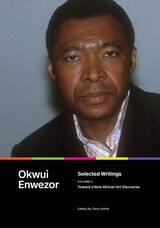
Selected Writings, Volume 1
Toward a New African Art DiscourseOkwui Enwezor. Edited by Terry Smith.
Duke University Press, 2025
Sex and the Gender Revolution, Volume 1
Heterosexuality and the Third Gender in Enlightenment LondonRandolph Trumbach
University of Chicago Press, 1998
In Sex and the Gender Revolution, Randolph Trumbach reconstructs the worlds of eighteenth-century prostitution, illegitimacy, sexual violence, and adultery. In those worlds the majority of men became heterosexuals by avoiding sodomy and sodomite behavior.
As men defined themselves more and more as heterosexuals, women generally experienced the new male heterosexuality as its victims. But women—as prostitutes, seduced servants, remarrying widows, and adulterous wives— also pursued passion. The seamy sexual underworld of extramarital behavior was central not only to the sexual lives of men and women, but to the very existence of marriage, the family, domesticity, and romantic love. London emerges as not only a geographical site but as an actor in its own right, mapping out domains where patriarchy, heterosexuality, domesticity, and female resistance take vivid form in our imaginations and senses.
As comprehensive and authoritative as it is eloquent and provocative, this book will become an indispensable study for social and cultural historians and delightful reading for anyone interested in taking a close look at sex and gender in eighteenth-century London.
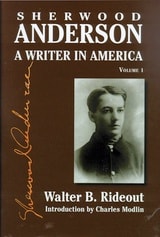
Sherwood Anderson
A Writer in America, Volume 1Walter B. Rideout
University of Wisconsin Press, 2006
Sherwood Anderson: A Writer in America is the definitive biography of this major American writer of novels and short stories, whose work includes the modern classic Winesburg, Ohio. In the first volume of this monumental two-volume work, Walter Rideout chronicles the life of Anderson from his birth and his early business career through his beginnings as a writer and finally to his move in the mid-1920s to “Ripshin,” his house near Marion, Virginia. The second volume will cover Anderson’s return to business pursuits, his extensive travels in the South touring factories, which resulted in his political involvement in labor struggles and several books on the topic, and finally his unexpected death in 1941.
No other existing Anderson biography, the most recent of which was published nearly twenty years ago, is as thoroughly researched, so extensively based on primary sources and interviews with a range of Anderson friends and family members, or as complete in its vision of the man and the writer. The result is an unparalleled biography—one that locates the private man, while astutely placing his life and writings in a broader social and political context.
Situation Theory and Its Applications, Volume 1
Edited by Robin Cooper, Kuniaki Mukai, and John Perry
CSLI, 1990

Social Control in Europe
Volume 1, 1500–1800Herman Roodenburg and Pieter Spierenburg
The Ohio State University Press, 2004
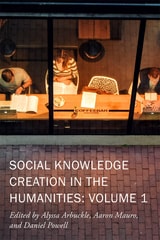
Social Knowledge Creation in the Humanities
Volume 1Edited by Alyssa Arbuckle, Aaron Mauro, and Daniel Powell
Iter Press, 2017
The ubiquity of social media has transformed the scope and scale of scholarly communication in the arts and humanities. The consequences of this new participatory and collaborative environment for humanities research has allowed for fresh approaches to communicating research. Social Knowledge Creation takes up the norms and customs of online life to reorient, redistribute, and oftentimes flatten traditional academic hierarchies. This book discusses the implications of how humanists communicate with the world and looks to how social media shapes research methods. This volume addresses peer-review, open access publishing, tenure and promotion, mentorship, teaching, collaboration, and interdisciplinarity as a comprehensive introduction to these rapidly changing trends in scholarly communication, digital pedagogy, and educational technology. Collaborative structures are rapidly augmenting disciplinary focus of humanities curriculum and the public impact of humanities research teams with new organizational and disciplinary thinking. Social Knowledge Creation represents a particularly dynamic and growing field in which the humanities seeks to find new ways to communicate the legacy and traditions of humanities based inquiry in a 21st century context.
New Technologies in Medieval and Renaissance Studies Volume 7.
Edited by Alyssa Arbuckle, Aaron Mauro, and Daniel Powell

Sovereign Traces, Volume 1
Not (Just) (An)OtherGordon D. Henry Jr.
Michigan State University Press, 2018

St. Augustine on Marriage and Sexuality (Selections from the Fathers of the Church, Volume 1)
Saint Augustine
Catholic University of America Press, 1996
State Trading in the Twenty-First Century
The World Trade Forum, Volume 1Thomas Cottier and Petros C. Mavroidis, Editors
University of Michigan Press, 1998

States at War, Volume 1
A Reference Guide for Connecticut, Maine, Massachusetts, New Hampshire, Rhode Island, and Vermont in the Civil WarEdited by Richard F. Miller
University Press of New England, 2013
Strindberg's Letters, Volume 1
1862-1892August Strindberg
University of Chicago Press, 1992
Studies in Rabbinic Narratives, Volume 1
Jeffrey L. Rubenstein
SBL Press, 2021
Explore new theoretical tools and lines of analysis of rabbinic stories
Rabbinic literature includes hundreds of stories and brief narrative traditions. These narrative traditions often take the form of biographical anecdotes that recount a deed or event in the life of a rabbi. Modern scholars consider these narratives as didactic fictions—stories used to teach lessons, promote rabbinic values, and grapple with the tensions and conflicts of rabbinic life. Using methods drawn from literary and cultural theory, including feminist, structuralist, Marxist, and psychoanalytic methods, contributors analyze narratives from the Babylonian Talmud, midrash, Mishnah, and other rabbinic compilations to shed light on their meanings, functions, and narrative art. Contributors include Julia Watts Belser, Beth Berkowitz, Dov Kahane, Jane L. Kanarek, Tzvi Novick, James Adam Redfield, Jay Rovner, Jeffrey L. Rubenstein, Zvi Septimus, Dov Weiss, and Barry Scott Wimpfheimer.
Studies in Weak Arithmetics, Volume 1
Edited by Patrick Cégielski
CSLI, 2009
The field of weak arithmetics is an application of logical methods to number theory that was developed by mathematicians, philosophers, and theoretical computer scientists. In this volume, after a general presentation of weak arithmetics, the following topics are studied: the properties of integers of a real closed field equipped with exponentiation; conservation results for the induction schema restricted to first-order formulas with a finite number of alternations of quantifiers; a survey on a class of tools called pebble games; the fact that the reals e and pi have approximations expressed by first-order formulas using bounded quantifiers; properties of infinite pictures depending on the universe of sets used; a language that simulates in a sufficiently nice manner all algorithms of a certain restricted class; the logical complexity of the axiom of infinity in some variants of set theory without the axiom of foundation; and the complexity to determine whether a trace is included in another one.
Summa Theologiae, Prima Pars
Volume 1, The One God, QQ 1-26: With the Commentary of Cardinal CajetanThomas Aquinas
Catholic University of America Press, 2023
Supplement to the Handbook of Middle American Indians, Volume 1
ArchaeologyVictoria Reifler Bricker, general editor; Jeremy A. Sabloff, volume editor
University of Texas Press, 1982
The sixteen-volume Handbook of Middle American Indians, completed in 1976, has been acclaimed the world over as the most valuable resource ever produced for those involved in the study of Mesoamerica. When it was determined in 1978 that the Handbook should be updated periodically, Victoria Reifler Bricker, well-known cultural anthropologist, was selected to be series editor.
This first volume of the Supplement is devoted to the dramatic changes that have taken place in the field of archaeology. The volume editor, Jeremy A. Sabloff, has gathered together detailed reports from the directors of many of the most significant archaeological projects of the mid-twentieth century in Mesoamerica, along with discussions of three topics of general interest (the rise of sedentary life, the evolution of complex culture, and the rise of cities).
Systematic Theology, Volume 1
Paul Tillich
University of Chicago Press, 1951
In this path-breaking volume Tillich presents the basic method and statement of his system—his famous "correlation" of man's deepest questions with theological answers. Here the focus is on the concepts of being and reason. Tillich shows how the quest for revelation is integral to reason itself. In the same way a description of the inner tensions of being leads to the recognition that the quest for God is implied in finite being.
Here also Tillich defines his thought in relation to philosophy and the Bible and sets forth his famous doctrine of God as the "Ground of Being." Thus God is understood not as a being existing beside other beings, but as being-itself or the power of being in everything. God cannot be made into an object; religious knowledge is, therefore, necessarily symbolic.