52 books match the query 'Women, Black' and 8 start with s

cover of Sadistic Cholas: Transfeminist Provocations in Contemporary Peru

Sadistic Cholas

Transfeminist Provocations in Contemporary Peru

Olga Rodriguez-Ulloa

University of Texas Press, 2026

Analyzing how Peruvian feminist art and activism subverts and reclaims the chola stereotype to confront colonial and patriarchal institutions.

Indigenous Andean women have long been derided in Peru, spurned by colonial and then national elites as depraved cholas. Olga Rodriguez-Ulloa shows how contemporary artists and activists not only reclaim this term of abuse but also mobilize the stereotype of the angry and perverted chola to confront the cruelties of patriarchy, capitalism, and white supremacy.

Sadistic Cholas examines music, visual arts, literature, and grassroots organizing by self-identified cholas—in particular, Black women and trans and queer feminists. Under colonial domination, cholas were destined for sexual coercion, labor extraction, and reproductive exploitation. While exhuming historical traces of chola resistance, Rodriguez-Ulloa argues that this condition of oppression persisted through the internal war of the 1980s, when Marxist women at the forefront of the armed campaign were condemned as hypersexual deviants. Inspired by their leftist forebears, today’s artists experiment with an aesthetic of sadistic vengeance, configured as rightful self-defense. Yet, in spite of their violent imagery, activist cholas pursue nonviolent goals, promoting a commons of care incorporating people, animals, and the environment.
[more]
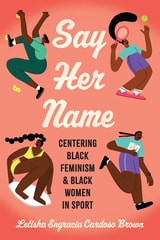
cover of Say Her Name: Centering Black Feminism and Black Women in Sport

Say Her Name

Centering Black Feminism and Black Women in Sport

Letisha Engracia Cardoso Brown

Rutgers University Press, 2025

Say Her Name: Centering Black Feminism and Black Women in Sports offers an in-depth look into the lived experiences of Blackgirlwomen as athletes, activists, and everyday people through a Black feminist lens. With so much research on race centered on Black men and gender research focusing on white women, Say Her Name offers a necessary conversation that places Blackgirlwomen at the center of discussion.

Say Her Name delves deeply into issues of gender, the politics of punishment, athlete activism, the politics of Black hair, fingernails and fashion, and the representation and commodification of Blackgirlwomen in sport and society. An entry point into the growing research in sport studies and beyond from a Black feminist lens, Say Her Name offers a clear window into the power and potential of nuanced examinations of sport. As a reflection of the larger social world, sport provides a framework for understanding larger social issues, including racism, sexism, and misogynoir. Blackgirlwomen have varied experiences in sport, and Say Her Name provides a window into those experiences. The book discusses Black women in sports including the South African runner Caster Semenya and the American runners Florence Griffith Joyner and Sha’Carri Richardson, as well as Venus and Serena Williams, Gabby Douglas, and Simone Biles. The women in this book have lived experiences that speak to the larger experiences of Black women and girls in sport and society, while also leaning into a larger discussion of the importance of the social movement #SayHerName.

 
[more]
cover of Scrap Theory: Reproductive Injustice in the Black Feminist Imagination

Scrap Theory

Reproductive Injustice in the Black Feminist Imagination

Mali D. Collins

The Ohio State University Press, 2025
Reproductive justice debates have often focused on the right to not have children, but rarely do they address the right to remember children lost to violence. Turning her attention to visual and written works by Black women documenting mother–child separation, Mali D. Collins invites us to deploy a theory of “scraps” to understand the ways that the lives of Black mothers and children are documentations of centuries of racialized and gendered torment. Focusing on creative works from the late twentieth century through the present, including the writings of Toni Cade Bambara, M. NourbeSe Philip, and Edwidge Danticat; the critical activism of Erica Garner; and visual/material art by Samaria Rice and Elizabeth Catlett, Collins argues that Black women’s creative work should be recognized as memory work that plays a crucial role in the cultural processing of racial and maternal trauma. By centering creative scraps—interstitial, fragmentary, or discarded elements—of maternal dispossession, Scrap Theory brings together theories of archival injustice and reproductive injustice to illuminate how the archival erasure of Black motherhood is an urgent concern for the movement for reproductive justice.
[more]
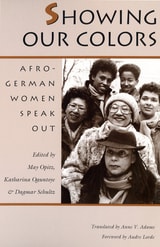
cover of Showing Our Colors: Afro-German Women Speak Out

Showing Our Colors

Afro-German Women Speak Out

May Optiz

University of Massachusetts Press, 1992

Showing Our Colors: Afro-German Women Speak Out is an English translation of the German book Farbe bekennen, edited by author May Ayim, Katharina Oguntoye, and Dagmar Schultz. It is the first published book by Afro-Germans. It is the first written use of the term Afro-German.

[more]
cover of Sierra Leone's Settler Women Traders: Women on the Afro-European Frontier

Sierra Leone's Settler Women Traders

Women on the Afro-European Frontier

E. Frances White

University of Michigan Press, 1987
The early part of the nineteenth century saw the establishment of West Africa’s Sierra Leone settlement as an important center for the expanding trade economy. A surprising number of Sierra Leonean traders were Krio women, whose crosscultural background helped them to mediate the contact between European and African markets.In Sierra Leone's Settler Women Traders, E. Frances White has unearthed the fascinating social and economic history of these women traders from the late eighteenth to the mid-twentieth century. Using a lively mixture of newspaper accounts, contemporary observations, colonial documents, and oral histories, this book tells the story of former slaves and captives from Jamaica, North America, and other areas of West Africa who became successful traders linking their regional trade networks with the international economy. The study traces the eventual decline of the Sierra Leone traders’ influence under the extension of colonial rule and documents the gradual shift of Krio women into professional and semiprofessional occupations.Sierra Leone's Settler Women Traders rescues these women from the invisibility that often befails colonial subcultures and sheds new light on the role of women as cultural brokers across ethnic boundaries, resulting in a study that makes a significant contribution to the ongoing debate over the impact of colonial rule on women in Africa.
[more]
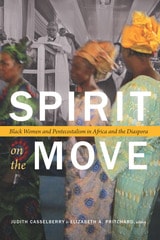
cover of Spirit on the Move: Black Women and Pentecostalism in Africa and the Diaspora

Spirit on the Move

Black Women and Pentecostalism in Africa and the Diaspora

Judith Casselberry and Elizabeth Pritchard, editors

Duke University Press, 2019

Pentecostalism is currently the fastest-growing Christian movement, with hundreds of millions of followers. This growth overwhelmingly takes place outside of the West, and women make up 75 percent of the membership. The contributors to Spirit on the Move examine Pentecostalism's appeal to black women worldwide and the ways it provides them with a source of community and access to power. Exploring a range of topics, from Neo-Pentecostal churches in Ghana that help women challenge gender norms to evangelical gospel musicians in Brazil, the contributors show how Pentecostalism helps black women draw attention to and seek remediation from the violence and injustices brought on by civil war, capitalist exploitation, racism, and the failures of the state. In fleshing out the experiences, theologies, and innovations of black women Pentecostals, the contributors show how Pentecostal belief and its various practices reflect the movement's complexity, reach, and adaptability to specific cultural and political formations.

Contributors. Paula Aymer, John Burdick, Judith Casselberry, Deidre Helen Crumbley, Elizabeth McAlister, Laura Premack, Elizabeth A. Pritchard, Jane Soothill, Linda van de Kamp
[more]
cover of Stepping Forward: Black Women in Africa and the Americas

Stepping Forward

Black Women in Africa and the Americas

Catherine Higgs

Ohio University Press, 2002

A unique and important study, Stepping Forward examines the experiences of nineteenth- and twentieth-century black women in Africa and African diaspora communities from a variety of perspectives in a number of different settings.

This wide-ranging collection designed for classroom use explores the broad themes that have shaped black women’s goals, options, and responses: religion, education, political activism, migration, and cultural transformation. Essays by leading scholars in the field examine the lives of black women in the United States and the Caribbean Basin; in the white settler societies of Kenya, Zimbabwe, and South Africa; and in the black settler societies of Liberia and Sierra Leone.

Among the contributors to this volume are historians, political scientists, and scholars of literature, music, and law. What emerges from their work is an image of black women’s agency, self-reliance, and resiliency. Despite cultural differences and geographical variations, black women have provided foundations on which black communities have not only survived, but also thrived. Stepping Forward is a valuable addition to our understanding of women’s roles in these diverse communities.

[more]
cover of Suspicion: Vaccines, Hesitancy, and the Affective Politics of Protection in Barbados

Suspicion

Vaccines, Hesitancy, and the Affective Politics of Protection in Barbados

Nicole Charles

Duke University Press, 2021

In 2014 Barbados introduced a vaccine to prevent certain strains of the human papillomavirus (HPV) and reduce the risk of cervical cancer in young women. Despite the disproportionate burden of cervical cancer in the Caribbean, many Afro-Barbadians chose not to immunize their daughters. In Suspicion, Nicole Charles reframes Afro-Barbadian vaccine refusal from a question of hesitancy to one of suspicion. Drawing on ethnographic fieldwork, black feminist theory, transnational feminist studies and science and technology studies, Charles foregrounds Afro-Barbadians' gut feelings and emotions and the lingering trauma of colonial and biopolitical violence. She shows that suspicion, far from being irrational, is a fraught and generative affective orientation grounded in concrete histories of mistrust of government and coercive medical practices foisted on colonized peoples. By contextualizing suspicion within these longer cultural and political histories, Charles troubles traditional narratives of vaccine hesitancy while offering new entry points into discussions on racialized biopolitics, neocolonialism, care, affect, and biomedicine across the Black diaspora.

Duke University Press Scholars of Color First Book Award recipient
[more]