Results by title
77 books match the query 'Words' and 7 start with s
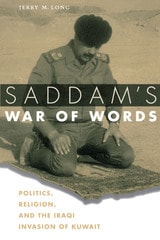
Saddam's War of Words
Politics, Religion, and the Iraqi Invasion of KuwaitBy Jerry M. Long
University of Texas Press, 2004
From a Western perspective, the Persian Gulf War of 1990-1991 largely fulfilled the first President Bush's objective: "In, out, do it, do it right, get gone. That's the message." But in the Arab world, the causes and consequences of Saddam Hussein's invasion of Kuwait and his subsequent defeat by a U.S.-led coalition were never so clear-cut. The potent blend of Islam and Arab nationalism that Saddam forged to justify the unjustifiable—his invasion of a Muslim state—gained remarkable support among both Muslims and Arabs and continued to resonate in the Middle East long after the fighting ended. Indeed, as this study argues in passing, it became a significant strand in the tangled web of ideologies and actions that led to the attacks of 9/11.
This landmark book offers the first in-depth investigation of how Saddam Hussein used Islam and Arab nationalism to legitimate his invasion of Kuwait in the eyes of fellow Muslims and Arabs, while delegitimating the actions of the U.S.-led coalition and its Arab members. Jerry M. Long addresses three fundamental issues: how extensively and in what specific ways Iraq appealed to Islam during the Kuwait crisis; how elites, Islamists, and the elusive Arab "street," both in and out of the coalition, responded to that appeal and why they responded as they did; and the longer-term effects that resulted from Saddam's strategy.
Secret Treachery Of Words
Feminism And Modernism In AmericaElizabeth Francis
University of Minnesota Press, 2002
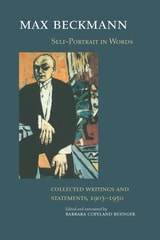
Self-Portrait in Words
Collected Writings and Statements, 1903-1950Max Beckmann
University of Chicago Press, 1997
"Barbara Copeland Buenger . . . has done an excellent job of editing and annotating Beckmann's voluminous private and public writings."—Andrea Barnet, New York Times Book Review
So What, or How to Make Films with Words
Alexander García Düttmann
Northwestern University Press, 2023
Images, whether filmic or not, cannot be replaced by words. Yet words can make images. This is the general thesis underlying So What, a collection of essays on canonical filmmakers like Luchino Visconti and Orson Welles; more experimental directors, such as Marguerite Duras and Albert Serra; and visual artists, including Hollis Frampton and Agnes Martin. Alexander García Düttmann aims to make their films as if they did not precede his text, capturing their idea and experience.
If the relationship between filmic image and text is a heterogeneous one, then this heterogeneity must leave a trace. This is why the book’s chapters are organized not according to historical periods or on the basis of film theories but rather by single concepts that function like dictionary entries. The chapters adopt different forms, blurring the lines between art and philosophy. So What is a practical exercise in “making films with words,” inviting readers to draw out insights from its conceptual play.
So What compiles previously untranslated and hard-to-find essays into a single volume, one that represents the absorbing and singular thought process of a major contemporary philosopher.
Speak Peace
Words of Wisdom, Work, and WonderLynette Ford
Parkhurst Brothers, Inc., 2019
Speechifying
The Words and Legacy of Johnnetta Betsch ColeJohnnetta Betsch Cole. Celeste Watkins-Hayes and Erica Lorraine Williams, editors
Duke University Press, 2023
Storm of Words
Science, Religion, and Evolution in the Civil War EraMonte Harrell Hampton
University of Alabama Press, 2014
A study of the ways that southern Presbyterians in the wake of the Civil War contended with a host of cultural and theological questions
Southern Presbyterian theologians enjoyed a prominent position in antebellum southern culture. Respected for both their erudition and elite constituency, these theologians identified the southern society as representing a divine, Biblically ordained order. Beginning in the 1840s, however, this facile identification became more difficult to maintain, colliding first with antislavery polemics, then with Confederate defeat and reconstruction, and later with women’s rights, philosophical empiricism, literary criticisms of the Bible, and that most salient symbol of modernity, natural science.
As Monte Harrell Hampton shows in Storm of Words, modern science seemed most explicitly to express the rationalistic spirit of the age and threaten the Protestant conviction that science was the faithful “handmaid” of theology. Southern Presbyterians disposed of some of these threats with ease. Contemporary geology, however, posed thornier problems. Ambivalence over how to respond to geology led to the establishment in 1859 of the Perkins Professorship of Natural Science in Connexion with Revealed Religion at the seminary in Columbia, South Carolina. Installing scientist-theologian James Woodrow in this position, southern Presbyterians expected him to defend their positions.
Within twenty-five years, however, their anointed expert held that evolution did not contradict scripture. Indeed, he declared that it was in fact God’s method of creating. The resulting debate was the first extended evolution controversy in American history. It drove a wedge between those tolerant of new exegetical and scientific developments and the majority who opposed such openness. Hampton argues that Woodrow believed he was shoring up the alliance between science and scripture—that a circumscribed form of evolution did no violence to scriptural infallibility. The traditionalists’ view, however, remained interwoven with their identity as defenders of the Lost Cause and guardians of southern culture.
The ensuing debate triggered Woodrow’s dismissal. It also capped a modernity crisis experienced by an influential group of southern intellectuals who were grappling with the nature of knowledge, both scientific and religious, and its relationship to culture—a culture attempting to define itself in the shadow of the Civil War and Reconstruction.