Results by title
295 books match the query 'Zoology' and 17 start with s
Sailing with Noah
Stories from the World of ZoosJeffrey P. Bonner
University of Missouri Press, 2013
Salmon, People, and Place
A Biologist's Search for Salmon RecoveryJim Lichatowich
Oregon State University Press, 2013
In Salmon, People, and Place, acclaimed fisheries biologist Jim Lichatowich eloquently exposes the misconceptions underlying salmon management and recovery programs that have fueled the catastrophic decline in Northwest salmon populations for more than a century. These programs will continue to fail, he suggests, so long as they regard salmon as products and ignore their essential relationship with their habitat.
But Lichatowich offers hope. In Salmon, People, and Place he presents a concrete plan for salmon recovery, one based on the myriad lessons learned from past mistakes. What is needed to successfully restore salmon, Lichatowich states, is an acute commitment to healing the relationships among salmon, people, and place.
A significant contribution to the literature on Pacific salmon, Salmon, People, and Place: A Biologist’s Search for Salmon Recovery is an essential read for anyone concerned about the fate of this Pacific Northwest icon.
Saving Our Sturgeon
Protecting Wisconsin's Ancient FishRebecca Hogue Wojahn
Wisconsin Historical Society Press, 2025
The story of a fascinating fish and the forward-thinking people who saved them in Wisconsin
For millennia, sturgeon swam the waterways of Wisconsin. Before the 1800s, an estimated eleven million sturgeon lived in Lake Michigan alone. Menominee and Ojibwe people depended on the fish for food and harvested them sustainably. But in the early 1900s, the lake sturgeon was near extinction. Saving Our Sturgeon tells the remarkable story of lake sturgeon in Wisconsin, the conservation efforts to save the species, and what is being done to keep the population healthy and thriving today.
Readers will learn about the natural history of the lake sturgeon—its anatomy, behavior, and habitat—and the factors that threatened its survival, from overharvesting to the building of dams that prevented sturgeon from reaching spawning areas. The book, written for young readers aged eleven and up, explains how government agencies, conservationists, and citizen groups worked together to save the sturgeon population in Wisconsin.
Saving Our Sturgeon includes a chapter about the Menominee Nation’s work to revitalize cultural traditions focused on the sturgeon and restore access to the fish on their reservation. The book also highlights how young people can get involved with sturgeon conservation efforts.
A great resource for classroom use, Saving Our Sturgeon contains maps, photos, and diagrams, plus a glossary of terms, a timeline of events, a Who’s Who list of individuals and groups featured in the book, and a bibliography that highlights kid-friendly sources to learn more. Young readers will learn basic facts about sturgeon biology, what it means for a species to be threatened or endangered, and how scientists use data to support repopulation. This inspiring book shares a conservation success story about one remarkable (and plenty peculiar) species of fish and shows young readers how they, too, can help protect these incredible creatures.
Ages 11 - 14; Grade level 6 - 9; Lexile® measure 1060L
Sea Turtles of the Eastern Pacific
Advances in Research and ConservationEdited by Jeffrey A. Seminoff and Bryan P. Wallace; Foreword by Peter C. H. Pritchard
University of Arizona Press, 2012
Sea turtles are flagship species for the world's oceans. They traverse international boundaries during their migrations, serve as vehicles for marine nutrients to terrestrial habitats, and embody the often tenuous relationship between human action and ecosystem health. The East Pacific Ocean is home to some of the most dynamic marine ecosystems, and the most unique sea turtles. Marine biodiversity within this massive ocean region abounds in mangrove estuaries, seagrass pastures, coral reefs, the open ocean, and many other habitats, with sea turtles often the most conspicuous species present. The distinctive traits of the Eastern Pacific have resulted in the smallest leatherbacks, a singular morph of the green turtle, dark and steeply domed olive ridleys, and the most cryptic hawksbills on the planet. Only now are we beginning to understand how these varieties have evolved.
However, the oceanographic conditions that make this an epicenter of sea turtle activity also promote massive artisanal and industrial fishing efforts that, coupled with illegal harvesting of eggs and turtles, have led to declines of several turtle populations in the region. The essays and stories in Sea Turtles of the Eastern Pacific describe for the first time the history of this exploitation, as well as recent sea turtle conservation initiatives and scientific research in the region. The first third of the book considers the biology of the turtles, focusing on general overviews of current ecological management challenges facing the turtles' survival. The second third treats issues of marine policy related to turtle conservation. In conclusion, the book offers six compelling stories of conservation success. By the end, readers will have gained a in-depth view not only of these magnificent creatures, but also the people involved in research and conservation efforts in one of the most remarkable regions of our planet.
Secrets of the Snout
The Dog’s Incredible NoseFrank Rosell
University of Chicago Press, 2018
With 300 million receptors to our mere 5 million, a dog’s nose is estimated to be between 100,000 and 100 million times more sensitive than a human’s. No wonder, then, that our nasally inferior species has sought to unleash the prodigious power of canine shnozzes. Rosell here takes us for a walk with a pack of superhero sniffers including Tutta, a dog with a fine nose for fine wine; the pet-finder pooch AJ; search-and-rescue dog Barry; the hunting dog Balder; the police dogs Rasko and Trixxi; the warfare dog Lisa; the cancer detection dog Jack; Tucker, who scents floating killer whale feces; and even Elvis, who can smell when you’re ovulating. With each dog, Rosell turns his nose to the evolution of the unique olfactory systems involved, which odors dogs detect, and how they do it.
A celebration of how the canine sense for scents works—and works for us—Secrets of the Snout will have dog lovers, trainers, and researchers alike all howling with delight. Exploring this most pointed of canine wonders, Rosell reveals the often surprising ways in which dogs are bettering our world, one nose at a time.

Selections from The Distribution and Abundance of Animals
H. G. Andrewartha and L. C. Birch
University of Chicago Press, 1982
Serengeti II
Dynamics, Management, and Conservation of an EcosystemEdited by A. R. E. Sinclair and Peter Arcese
University of Chicago Press, 1995
Building on the groundwork laid by the classic Serengeti: Dynamics of an Ecosystem, published in 1979 by the University of Chicago Press, this new book integrates studies of the ecosystem at every level—from the plants at the bottom of the visible food chain, to the many species of herbivores and predators, to the system as a whole. Drawing on new data from many long-term studies and from more recent research initiatives, and applying new theory and computer technology, the contributors examine the large-scale processes that have produced the Serengeti's extraordinary biological diversity, as well as the interactions among species and between plants and animals and their environment. They also introduce computer modeling as a tool for exploring these interactions, employing this new technology to test and anticipate the effects of social, political, and economic changes on the entire ecosystem and on particular species, and so to shape future conservation and management strategies.
Serengeti III
Human Impacts on Ecosystem DynamicsEdited by A. R. E. Sinclair, Craig Packer, Simon A. R. Mduma, and John M. Fryxel
University of Chicago Press, 2008

Serengeti IV
Sustaining Biodiversity in a Coupled Human-Natural SystemEdited by Anthony R. E. Sinclair, Kristine L. Metzger, Simon A. R. Mduma, and John M. Fryxell
University of Chicago Press, 2015
Serengeti IV, the latest installment in a long-standing series on the region’s ecology and biodiversity, explores the role of our species as a source of both discord and balance in Serengeti ecosystem dynamics. Through chapters charting the complexities of infectious disease transmission across populations, agricultural expansion, and the many challenges of managing this ecosystem today, this book shows how the people and landscapes surrounding crucial protected areas like Serengeti National Park can and must contribute to Serengeti conservation. In order to succeed, conservation efforts must also focus on the welfare of indigenous peoples, allowing them both to sustain their agricultural practices and to benefit from the natural resources provided by protected areas—an undertaking that will require the strengthening of government and education systems and, as such, will present one of the greatest conservation challenges of the next century.

Serengeti
Dynamics of an EcosystemEdited by A. R. E. Sinclair and M. Norton-Griffiths
University of Chicago Press, 1979
Snake Day
A Story of 24 Hours and 24 Serpentine LivesMarty Crump
University of Chicago Press, 2026
Does a snake crossing your path trigger delight or dread? The answer is clear for celebrated biologist Marty Crump, who shows us that snakes deserve our respect, admiration, and protection. In her short book Snake Day, each chapter introduces a single snake during a single hour, highlighting twenty-four different species from around the globe.
In the dark morning of a Brazilian forest, we avoid stepping on a jararaca, a nocturnal viper. If she bites, her venom will make our blood pressure—and us—drop. A synthetic version of this venom is now a lifesaving drug, used to treat hypertension and heart failure. Later in the morning, in the Zagros Mountains that trace Iran’s northwest border, what appears to be a tiny arachnid wiggles on the ground. When a hungry warbler approaches for a meal, realizes too late that the spider is actually a snake’s tail, and an Iranian spider-tailed viper makes a meal of the bird. In the early afternoon, in a pine forest outside Atlanta, Georgia, an eastern hognose snake strikes at us—a bluff—and then rolls over and plays dead. By the end of our snake day, we’ll have glimpsed the diversity of this unique group of reptiles, met serpentine friends who frighten and fascinate, and learned how humans can protect these amazing species.
For each hour, celebrated artist Stuart Patience has depicted serpentine scenes in stunning pen-and-ink drawings. Working together to narrate and illustrate these unique moments in time, Crump and Patience have created an engaging read that is a perfect way to spend an hour or two—and a true gift for amateur scientists or anyone who recoils at or relishes the sight of a snake.
Snowbird
Integrative Biology and Evolutionary Diversity in the JuncoEdited by Ellen D. Ketterson and Jonathan W. Atwell
University of Chicago Press, 2016
Intended for scholars, citizen scientists, and amateur ornithologists, alike, Snowbird synthesizes decades of research from the diverse and talented researchers who study the Junco genus. Though contributors approach their subject from a variety of perspectives, they share a common goal: elucidating the organismal and evolutionary processes by which animals adapt and diversify in response to environmental change. Placing special emphasis on the important role that underlying physiological, hormonal, and behavioral mechanisms play in these processes, Snowbird not only provides a definitive exploration of the junco’s evolutionary history and behavioral and physiological diversity but also underscores the junco’s continued importance as a model organism in a time of rapid global climate change. By merging often disparate biological fields, Snowbird offers biologists across disciplines an integrative framework for further research into adaptation, population divergence, and the formation of new species.

Spider Webs
Behavior, Function, and EvolutionWilliam Eberhard
University of Chicago Press, 2020
As Eberhard reveals, the extraordinary diversity of webs includes ingenious solutions to gain access to prey in esoteric habitats, from blazing hot and shifting sand dunes (to capture ants) to the surfaces of tropical lakes (to capture water striders). Some webs are nets that are cast onto prey, while others form baskets into which the spider flicks prey. Some aerial webs are tramways used by spiders searching for chemical cues from their prey below, while others feature landing sites for flying insects and spiders where the spider then stalks its prey. In some webs, long trip lines are delicately sustained just above the ground by tiny rigid silk poles.
Stemming from the author’s more than five decades observing spider webs, this book will be the definitive reference for years to come.
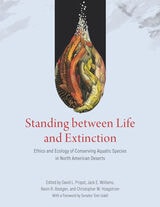
Standing between Life and Extinction
Ethics and Ecology of Conserving Aquatic Species in North American DesertsEdited by David L. Propst, Jack E. Williams, Kevin R. Bestgen, and Christopher W. Hoagstrom
University of Chicago Press, 2020
A precursor to this book, Battle Against Extinction, laid out the scope of the problem and related conservation activities through the late 1980s. Since then, many nascent conservation programs have matured, and researchers have developed new technologies, improved and refined methods, and greatly expanded our knowledge of the myriad influences on the ecology and dynamics of these species. Standing between Life and Extinction brings the story up to date. While the future for some species is more secure than thirty years ago, others are less fortunate. Calling attention not only to iconic species like the razorback sucker, Gila trout, and Devils Hole pupfish, but also to other fishes and obscure and fascinating invertebrates inhabiting intermittent aquatic habitats, this book explores the scientific, social, and political challenges of preserving these aquatic species and their habitats amid an increasingly charged political discourse and in desert regions characterized by a growing human population and rapidly changing climate.
Stations in the Field
A History of Place-Based Animal Research, 1870-1930Raf De Bont
University of Chicago Press, 2015
Raf De Bont’s Stations in the Field focuses on the early history of biological field stations and the role these played in the rise of zoological place-based research. Beginning in the 1870s, a growing number of biological field stations were founded—first in Europe and later elsewhere around the world—and thousands of zoologists received their training and performed their research at these sites. Through case studies, De Bont examines the material and social context in which field stations arose, the actual research that was produced in these places, the scientific claims that were developed there, and the rhetorical strategies that were deployed to convince others that these claims made sense. From the life of parasitic invertebrates in northern France and freshwater plankton in Schleswig-Holstein, to migratory birds in East Prussia and pest insects in Belgium, De Bont’s book is fascinating tour through the history of studying nature in nature.
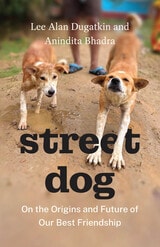
Street Dog
On the Origins and Future of Our Best FriendshipLee Alan Dugatkin and Anindita Bhadra
University of Chicago Press, 0
A fascinating look at the lives of the world’s largest dog population—street dogs—offering essential insights into your dog’s behavior and the mysterious origins of human-dog cooperation.
Today, there are close to a billion dogs on the planet. Some twenty thousand years ago, there were none. How did dogs originate from wolves? And how did we begin our best friendship? Although we can’t go back in time, we can study modern dogs for clues. Of today’s dogs, about eighty percent are street dogs, which don’t live in human homes, but near them, existing in a space between wild and domesticated.
This fascinating and eye-opening book offers us a chance to meet these street dogs and, through them, to imagine the earliest stages of human-canine companionship and collaboration. Award-winning author and animal behaviorist Lee Alan Dugatkin and world canine expert Anindita Bhadra take us from the hallways of Bhadra’s Dog Lab onto the bustling streets of Kolkata, India, where we encounter the intelligent, resourceful, and sometimes mischievous street dogs that have lived alongside humans for hundreds of dog generations. By observing these street dogs’ social structures, survival strategies, and personalities—and comparing them to foxes, wolves, and house dogs, among other species—we learn a lot about canine behavior. Take, for example, Bhadra’s discovery that, no matter how vital food is to a street dog, when given a choice between a meal and a gentle carress, dogs choose love over the food. We also learn that many dogs prefer yellow to other colors; that dog grandmoms may adopt unrelated puppies; and that dog genes harbor a mutation that, in humans, is associated with extreme friendliness. We even begin to understand why dogs pee on, well, everything—particularly on other dog pee.
Watching dogs live independent lives alongside humans, we also start to wonder, as Bhadra does, about the origins of human-dog cooperation. She persuades us that early dogs and humans likely protected each other, as many still do today, and that street dogs may help us to imagine our ancestors’ interactions with the earliest proto-dogs. In their engaging exploration, Dugatkin and Bhadra show that getting to know street dogs may help us understand the past, present, and future of our unique interspecies relationship.
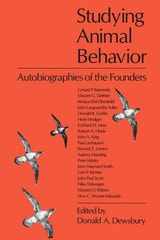
Studying Animal Behavior
Autobiographies of the FoundersEdited by Donald A. Dewsbury
University of Chicago Press, 1989