Results by title
22291 books match the query 'Social Science' and 1635 start with s
Sexual Exploitation of Teenagers
Adolescent Development, Discrimination, and Consent LawJennifer Ann Drobac
University of Chicago Press, 2016
When it comes to sexual relationships, adolescents pose a particular problem. Few teenagers possess all of the emotional and intellectual tools needed to navigate these threats, including the all too real advances made by supervisors, teachers, and mentors. In Sexual Exploitation of Teenagers, Jennifer Drobac explores the shockingly common problem of maturing adolescents who are harassed and exploited by adults in their lives. Reviewing the neuroscience and psychosocial evidence of adolescent development, she explains why teens are so vulnerable to adult harassers. Even today, in an age of increasing public awareness, criminal and civil law regarding the sexual abuse of minors remains tragically inept and irregular from state to state. Drobac uses six recent cases of teens suffering sexual harassment to illuminate the flaws and contradictions of this system, skillfully showing how our current laws fail to protect youths, and offering an array of imaginative legal reforms that could achieve increased justice for adolescent victims of sexual coercion.
Sexual Fields
Toward a Sociology of Collective Sexual LifeEdited by Adam Isaiah Green
University of Chicago Press, 2013
To build on the sexual fields framework, Green has gathered a distinguished group of scholars who together make a strong case for sexual field theory as the first systematic theoretical innovation since queer theory in the sociology of sexuality. Expanding on the work of Bourdieu, Green and contributors develop this distinctively sociological approach for analyzing collective sexual life, where much of the sexual life of our society resides today. Coupling field theory with the ethnographic and theoretical expertise of some of the most important scholars of sexual life at work today, Sexual Fields offers a game-changing approach that will revolutionize how sociologists analyze and make sense of contemporary sexual life for years to come.
Sexual Hegemony
Statecraft, Sodomy, and Capital in the Rise of the World SystemChristopher Chitty
Duke University Press, 2020
Sexual Identity and Faith
Helping Clients Find CongruenceMark A. Yarhouse
Templeton Press, 2019
Christians who struggle with a conflict between their sexual and religious identities have few therapeutic options available to them. ‘Sexual orientation change efforts’ (SOCE) have rightly fallen out of favor and are no longer practiced by most clinicians. At the same time, the common approach of gay affirmative therapy (GAT) can at times present challenges and may not be a good fit when clients hold to conventional religious beliefs and values.
An alternative to these methods is Sexual Identity Therapy (SIT)—an approach that aims to provide individuals with a safe therapeutic space to explore the tension between their sexuality and their faith. Working within the SIT framework, clients are able to resolve their inner conflict to their personal satisfaction and to freely choose a coherent identity that enables them to move forward in life.
SIT has several stages, each designed to enable the client to make meaning out of his or her same-sex sexuality. At no point in the process is the client encouraged to choose one sexual identity over another. The ultimate goal of SIT is congruence. Congruence is achieved when a person freely adopts an identity and lives it out in ways that are in keeping with his or her beliefs and values. The SIT model is brought to life throughout the book with the help of case studies drawn from the author’s 20 years of experience.
Written for both Christian and non-religious clinicians, Sexual Identity and Faith is an informed, respectful, and nuanced guide to help people navigate the difficult conflict between who they are sexually and what they believe religiously.
Sexual Labor in the Athenian Courts
Allison Glazebrook
University of Texas Press, 2021
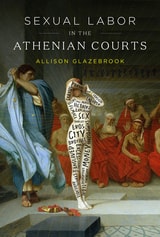
Oratory is a valuable source for reconstructing the practices, legalities, and attitudes surrounding sexual labor in classical Athens. It provides evidence of male and female sex laborers, sex slaves, brothels, sex traffickers, the cost of sex, contracts for sexual labor, and manumission practices for sex slaves. Yet the witty, wealthy, and independent hetaira, well-known from other genres, does not feature. Its detailed narratives and character portrayals provide a unique discourse on sexual labor and reveal the complex relationship between such labor and Athenian society.
Through a holistic examination of five key speeches, Sexual Labor in the Athenian Courts considers how portrayals of sex laborers intersected with gender, the body, sexuality, the family, urban spaces, and the polis in the context of the Athenian courts. Drawing on gender theory and exploring questions of space, place, and mobility, Allison Glazebrook shows how sex laborers represented a diverse set of anxieties concerning social legitimacy and how the public discourse about them is in fact a discourse on Athenian society, values, and institutions.

Sexual Nature/Sexual Culture
Edited by Paul R. Abramson and Steven D. Pinkerton
University of Chicago Press, 1995
Using as its center the idea that sexual pleasure is the primary motivational force behind human sexuality and that reproduction is simply a byproduct of the pleasurability of sex, this book examines sexuality at the individual, societal, and cultural levels. Beginning with a look at the evolution of sexuality in humans and other primates, the essays in the first section examine the sexual ingenuity of primates, the dominant theories of sexual behavior, the differences in male and female sexual interest and behavior, and the role of physical attractiveness in mate selection. The focus then shifts to biological approaches to sexuality, especially the genetic and hormonal origins of sexual orientation, gender, and pleasure.
The essays go on to look at the role of pleasure in different cultures. Included are essays on love among the tribespeople of the Brazilian rain forest and the regulation of adolescent sexuality in India. Finally, several contributors look at the methodological issues in the study of human sexuality, paying particular attention to the problems with research that relies on people's memories of their sexual experiences.
The contributors are Angela Pattatucci, Dean Hamer, David Greenberg, Frans de Waal, Mary McDonald Pavelka, Kim Wallen, Donald Symons, Heino Meyer-Bahlburg, Jean D. Wilson, Donald Tuzin, Lawrence Cohen, Thomas Gregor, Lenore Manderson, Robert C. Bailey, Alice Schlegel, Edward H. Kaplan, Richard Berk, Paul R. Abramson, Paul Okami, and Stephen D. Pinkerton.
Spanning the chasm of the nature versus nurture debate, Sexual Nature/Sexual Culture is a look at human sexuality as a complex interaction of genetic potentials and cultural influences. This book will be of interest to a wide range of readers—from scholars and students in psychology, anthropology, sociology, and history to clinicians, researchers, and others seeking to understand the many dimensions of sexuality.
"If we ever expect to solve the sexually based problems that modern societies face, we must encourage investigations of human sexual behavior. Moreover, those investigations should employ a broad range of disciplines—looking at sex from all angles, which is precisely what Sexual Nature, Sexual Culture does."—Mike May, American Scientist
"...This timely and relevant book reminds us that we cannot rely on simple solutions to complex problems. It represents a transdiciplinary approach integrating knowledge from diverse fields and provides the reader with a challenging and rewarding experience. Especially for those who are involved in teaching human sexuality to medical students and other health care professionals, this book is highly recommended."—Gerald Wiviortt, M.D., Journal of Nervous and Mental Disease
"In short, this volume contains much to stimulate, inform, and amuse, in varying proportions. What more can one ask?"—Pierre L. van den Berghe, Journal of the History of Sexuality
"...the book succeeds in bring together some of the sharpest thinkers in the field of human sexuality, and goes a long way toward clarifying the diverse perspectives that currently exist."—David M. Buss and Todd K. Shackelford, Quarterly Review of Biology

Sexual Politics and Popular Culture
Diane Raymond
University of Wisconsin Press, 1990
Sexual Politics, Sexual Communities
Second EditionJohn D'Emilio
University of Chicago Press, 1998
"How many students of American political culture know that during the McCarthy era more people lost their jobs for being alleged homosexuals than for being Communists? . . . These facts are part of the heretofore obscure history of homosexuality in America—a history that John D'Emilio thoroughly documents in this important book."—George DeStefano, Nation
"John D'Emilio provides homosexual political struggles with something that every movement requires—a sympathetic history rendered in a dispassionate voice."—New York Times Book Review
"A milestone in the history of the American gay movement."—Rudy Kikel, Boston Globe
Sexual Politics, Sexual Panics
Robyn Wiegman, special issue editor
Duke University Press, 0
Contributors. Kadji Amin, Eva Cherniavsky, Andrea Long Chu, Jennifer Doyle, Joseph J. Fischel, Lynne Joyrich, Jennifer C. Nash, Emily Owens, Shoniqua Roach, Juana María Rodríguez, Mairead Sullivan, Samia Vasa, Rebecca Wanzo, Robyn Wiegman, Terrance Wooten
Sexual Power
Feminism and the Family in AmericaCarolyn Ross Johnston
University of Alabama Press, 1992
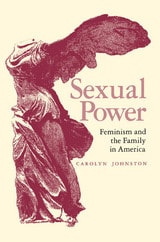
Since the early 1970s, scholars have argued, defined, and refined a wide range of interpretations of American women’s lives. Despite the richness of the recent literature, few interpretations sufficiently credit women’s family and sexual experiences for the emergence of feminism and the construction of pro-family agendas. Thus, Johnston’s approach offers an opportunity to view the history of feminism and the family from a fresh perspective.
Much of the literature on feminism has focused on women’s oppression and victimization, rather than on the power that women historically have exerted. Johnston’s interpretation of American feminism differs from previous works because she argues that the gradual growth of feminist consciousness lies not simply in oppression or feelings of victimization, but paradoxically in a growing sense of the empowerment of women as wives and mothers. She traces how reproduction, sexuality, domesticity, and motherhood have been socially constructed, and examines how feminists and anti-feminists have fought on the terrain of “family” issues.
Johnston explores critical questions concerning American women’s sexual lives. How have women’s empowering experiences in the family shaped feminist consciousness and action? How have feminists confronted family issues? How have women exerted sexual power? How was it contained within the limits of patriarchal society at times, while at other times it fueled the fires of feminist rebellion? How have gender and class issues affected domestic politics and feminism?
Sexual States
Governance and the Struggle over the Antisodomy Law in IndiaJyoti Puri
Duke University Press, 2016
Sexual Strangers
Gays, Lesbians, and Dilemmas of CitizenshipShane Phelan
Temple University Press, 2001
In Sexual Strangers, Shane Phelan argues that, in the United States, queers are strangers -- not exactly the enemy, since they are not excluded from all rights of citizenship, but not quite members. Rather, they are ambiguous figures who trouble the border between "us" and "them," a border just as central to liberal regimes as to other states. Life on this border structures both the exclusion of sexual minorities and their ambivalence about becoming part of the "mainstream."
Sexual Strangers addresses questions of long-standing importance to minority group politics: the meaning and terms of inclusion, respect, and resistance. Phelan looks at citizenship as including not only equal protection and equal rights to such institutions as marriage and military service, but also political and cultural visibility, as inclusion in the national imaginary. She discusses the continuing stigmatization of bisexuals and transgendered people within lesbian and gay communities as a result of the attempt to flee from strangeness, a flight that inevitably produces new strangers. Her goal is to convince students of politics, both academic and activist, to embrace the rewards of strangeness as a means of achieving inclusive citizenship, rather than a citizenship that defines itself by what it will not accept.
Sexual Violence against Jewish Women during the Holocaust
Edited by Sonja M. Hedgepeth and Rochelle G. Saidel
Brandeis University Press, 2010
Sexual Visions
Images Of Gender In Science And Medicine Between The Eighteenth And Twentieth CenturiesLudmilla Jordanova
University of Wisconsin Press, 1993
Sexuality across the Life Course
Edited by Alice S. Rossi
University of Chicago Press, 1994
In this wide-reaching volume, distinguished sociologist Alice S. Rossi addresses these questions and others through fourteen diverse essays on sexual behavior, covering adolescence through old age and studying such groups as singles, married couples, and homosexuals. This extensive study also explores the effects of chronic disease and medication on sexual functioning, recent developments in psychotherapy for sexual problems, and sexual abuse of children, incest, and rape.
"The interdisciplinary nature of the project has resulted in a text that is accessible to anyone with a behavioral science background. Well written, well edited, and well received by this reviewer."—Joan C. Chrisler, Journal of Sex & Marital Therapy
"This is a book that needs to be on the bookshelf of any AIDS researcher."—AIDS Book Review Journal

Sexuality and Abortion in Interwar Poland
Maternity in Times of CrisisElisa-Maria Hiemer
Central European University Press, 2026
Sexuality and Form
Caravaggio, Marlowe, and BaconGraham Hammill
University of Chicago Press, 2000
Sexuality and the Rise of China
The Post-1990s Gay Generation in Hong Kong, Taiwan, and Mainland ChinaTravis S. K. Kong
Duke University Press, 2023
Sexuality in School
The Limits of EducationJen Gilbert
University of Minnesota Press, 2014
From concerns over the bullying of LGBTQ youth and battles over sex education to the regulation of sexual activity and the affirmation of queer youth identity, sexuality saturates the school day. Rather than understand these conflicts as an interruption to the work of education, Jen Gilbert explores how sexuality comes to bear on and to enliven teaching and learning.
Gilbert investigates the breakdowns, clashes, and controversies that flare up when sexuality enters spaces of schooling. Education must contain the volatility of sexuality, Gilbert argues, and yet, when education seeks to limit the reach of sexuality, it risks shutting learning down. Gilbert penetrates this paradox by turning to fiction, film, legal case studies, and personal experiences. What, she asks, can we learn about school from a study of sexuality?
By examining the strange workings of sexuality in schools, Gilbert draws attention to the explosive but also compelling force of erotic life in teaching and learning. Ultimately, this book illustrates how the most intimate of our experiences can come to shape how we see and act in the world.
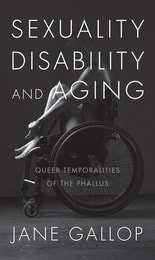
Sexuality, Disability, and Aging
Queer Temporalities of the PhallusJane Gallop
Duke University Press, 2019
Sexualizing Cancer
HPV and the Politics of Cancer PreventionLaura Mamo
University of Chicago Press, 2023
Starting in 2005, people in the US and Europe were inundated with media coverage announcing the link between cervical cancer and the sexually transmitted virus HPV. Within a year, product ads promoted a vaccine targeting cancer’s viral cause, and girls and women became early consumers of this new cancer vaccine. An understanding of HPV’s broadening association with other cancers led to the identification of new at-risk populations—namely boys and men—and ignited a plethora of gender and sexual issues related to cancer prevention.
Sexualizing Cancer is the first book dedicated to the emergence and proliferation of the HPV vaccine along with the medical capacity to screen for HPV—crucial landmarks in the cancer prevention arsenal based on a novel connection between sex and chronic disease. Interweaving accounts from the realms of biomedical science, public health, and social justice, Laura Mamo chronicles cervical cancer’s journey out of exam rooms and into public discourse. She shows how the late twentieth-century scientific breakthrough that identified the human papilloma virus as having a causative role in the onset of human cancer galvanized sexual politics, struggles for inclusion, new at-risk populations, and, ultimately, a new regime of cancer prevention. Mamo reveals how gender and other equity arguments from within scientific, medical, and advocate communities shaped vaccine guidelines, clinical trial funding, research practices, and clinical programs, with consequences that reverberate today. This is a must-read history of medical expansion—from a “woman’s disease” to a set of cancers that affect all genders—and of lingering sexualization, with specific gendered, racialized, and other contours along the way.
Sexuation
SIC 3Renata Salecl, ed.
Duke University Press, 2000
In this volume, contributors discuss a third way of thinking about sexual identity and sexual difference—a direction opened by Jacques Lacan. For Lacan, what we all recognize as sexual difference is first and foremost representative of a certain fundamental deadlock inherent in the symbolic order, that is, in language and in the entire realm of culture conceived as a symbol system structured on the model of language. For him, the logical matrix of this deadlock is provided by his own formulas of sexuation. The essays collected here elaborate on different aspects of this deadlock of sexual difference. While some examine the role of semblances in the relation between the sexes or consider sexual identity not as anatomy but still involving an impasse of the real, others discuss the difference between sexuation and identification, the role of symbolic prohibition in the process of the subject’s sexual formation, or the changed role of the father in contemporary society and the impact of this change on sexual difference. Other essays address such topics as the role of beating in sexual fantasies and jouissance in feminine jealousy.
Contributors. Alain Badiou, Elizabeth Bronfen, Darian Leader, Jacques Alain Miller, Genevieve Morel, Renata Salecl, Eric L. Santner, Colette Soler, Paul Verhaeghe, Slavoj Žižek, Alenka Zupancic

Shade-Grown Slavery
The Lives of Slaves on Coffee Plantations in CubaWilliam C. Van Norman
Vanderbilt University Press, 2013
In this broad, interdisciplinary study, William Van Norman describes how each type of plantation and the amount of manual labor it required directly influenced the nature of slave life in that community. Slaves on coffee plantations lived in a unique context in comparison to that of their fellow slaves on sugar plantations, one that gave them greater flexibility in cultural and artistic creativity. To gain a deeper understanding of plantation slavery in Cuba, Van Norman explores what life and labor was like for coffee slaves and how it was different from what sugar slaves experienced. Shade-Grown Slavery reconstructs their world and in turn deconstructs the picture we now have of Cuba in the late eighteenth and early nineteenth centuries.
Ultimately, Shade-Grown Slavery reveals the lives of enslaved Africans on Cuban coffee plantations and shows how they were able to maintain and transform their cultural traditions in spite of slavery.
Shaded Lives
African American Women and TelevisionBeretta E Smith-Shomade
Rutgers University Press, 2002
In Shaded Lives, Beretta Smith-Shomade sets out to dissect images of the African American woman in television from the 1980s. She calls their depiction "binaristic," or split. African American women, although an essential part of television programming today, are still presented as distorted and deviant. By closely examining the television texts of African-American women in comedy, music video, television news and talk shows (Oprah Winfrey is highlighted), Smith-Shomade shows how these voices are represented, what forces may be at work in influencing these images, and what alternate ways of viewing might be available.
Smith-Shomade offers critical examples of where the sexist and racist legacy of this country collide with the cultural strength of Black women in visual and real-lived culture. As the nation's climate of heightened racial divisiveness continues to relegate the representation of Black women to depravity and display, her study is not only useful, it is critical.
Shades of Black
Nathalie Etoke
Seagull Books, 2021
Situated at the crossroads of three countries—Cameroon, France, and, now, the United States—Nathalie Etoke is uniquely positioned for this polyphonic reflection on race. She examines what happens when race obliterates historical, social, cultural, and political differences among populations of African descent from different parts of the world. Focusing on recent and ongoing topics in the United States, including the murder of George Floyd, police brutality, the complex symbolism of Barack Obama and Kamala Harris, Etoke explores the relations of violence, oppression, dispossession, and inequalities that have brought us here, face to face with these existential questions: Are you breathing? Are we breathing?
Shades of Springsteen
Politics, Love, Sports, and MasculinityJohn Massaro
Rutgers University Press, 2021
In this unique blend of memoir and musical analysis, John Massaro reflects on his experiences as a lifelong fan of The Boss and one of the first professors to design a college course on Springsteen’s work. Focusing on five of the Jersey rocker’s main themes—love, masculinity, sports, politics, and the power of music—he shows how they are represented in Springsteen’s lyrics and shares stories from his own life that powerfully resonate with those lyrics. Meanwhile, paying tribute to Springsteen’s inclusive vision, he draws connections among figures as seemingly disparate as James Joyce, Ta-Nehisi Coates, Thomas Aquinas, Bobby Darin, and Lin-Manuel Miranda. Shades of Springsteen offers a deeply personal take on the musical and cultural legacies of an American icon.
Shades of White Flight
Evangelical Congregations and Urban DepartureMark T. Mulder
Rutgers University Press, 2015

Shadow Bodies
Black Women, Ideology, Representation, and PoliticsJordan-Zachery, Julia S.
Rutgers University Press, 2018
Grounded in Black feminist thought, Julia S. Jordan-Zachery looks at the functioning of scripts ascribed to Black women’s bodies in the framing of HIV/AIDS, domestic abuse, and mental illness and how such functioning renders some bodies invisible in Black politics in general and Black women’s politics specifically.
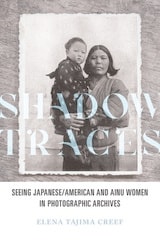
Shadow Traces
Seeing Japanese/American and Ainu Women in Photographic ArchivesElena Tajima Creef
University of Illinois Press, 2022
Innovative and engaging, Shadow Traces illuminates how photographs shape the history of marginalized people and outlines a method for using such materials in interdisciplinary research.

Shadow of My Shadow
Jennifer Doyle
Duke University Press, 2024

Shadow of the Hunter
Richard K. Nelson
University of Chicago Press, 1983
Shadow of the New Deal
The Victory of Public BroadcastingJosh Shepperd
University of Illinois Press, 2023
- Winner of the 2024 BEA Book Award
- Runner-up in the History Division of the Association for Education in Journalism and Mass Communication (AEJMC)
- Runner-up for the AJHA Book of the Year (American Journalism Historians Association).
Despite uncertain beginnings, public broadcasting emerged as a noncommercial media industry that transformed American culture. Josh Shepperd looks at the people, institutions, and influences behind the media reform movement and clearinghouse the National Association of Educational Broadcasters (NAEB) in the drive to create what became the Public Broadcasting Service and National Public Radio.
Founded in 1934, the NAEB began as a disorganized collection of undersupported university broadcasters. Shepperd traces the setbacks, small victories, and trial and error experiments that took place as thousands of advocates built a media coalition premised on the belief that technology could ease social inequality through equal access to education and information. The bottom-up, decentralized network they created implemented a different economy of scale and a vision of a mass media divorced from commercial concerns. At the same time, they transformed advice, criticism, and methods adopted from other sectors into an infrastructure that supported public broadcasting in the 1960s and beyond.
Shadowed Dreams
Women's Poetry of the Harlem RenaissanceMcKay, Nellie
Rutgers University Press, 2006
The first edition of Shadowed Dreams was a groundbreaking anthology that brought to light the contributions of women poets to the Harlem Renaissance. This revised and expanded version contains twice the number of poems found in the original, many of them never before reprinted, and adds eighteen new voices to the collection to once again strike new ground in African American literary history. Also new to this edition are nine period illustrations and updated biographical introductions for each poet.
Shadowed Dreams features new poems by Gwendolyn Bennett, Anita Scott Coleman, Mae Cowdery, Blanche Taylor Dickinson, Alice Dunbar-Nelson, Jessie Fauset, Angelina Weld Grimké, Gladys Casely Hayford (a k a Aquah Laluah), Virginia Houston, Georgia Douglas Johnson, Helene Johnson, Effie Lee Newsome, Esther Popel, and Anne Spencer, as well as writings from newly discovered poets Carrie Williams Clifford, Edythe Mae Gordon, Alvira Hazzard, Gertrude Parthenia McBrown, Beatrice Murphy, Lucia Mae Pitts, Grace Vera Postles, Ida Rowland, and Lucy Mae Turner, among others.
Covering the years 1918 through 1939 and ranging across the period’s major and minor journals, as well as its anthologies and collections, Shadowed Dreams provides a treasure trove of poetry from which to mine deeply buried jewels of black female visions in the early twentieth century.
Shadowed Ground
America’s Landscapes of Violence and TragedyBy Kenneth E. Foote
University of Texas Press, 2003
Winner, John Brinckerhoff Jackson Prize, Association of American Geographers, 1997
Shadowed Ground explores how and why Americans have memorialized—or not—the sites of tragic and violent events spanning three centuries of history and every region of the country. For this revised edition, Kenneth Foote has written a new concluding chapter that looks at the evolving responses to recent acts of violence and terror, including the destruction of the Branch Davidian compound at Waco, Texas, the Oklahoma City bombing, the Columbine High School massacre, and the terrorist attacks of 9/11.
Shadows Over Sunnyside
An Arkansas Plantation in Transition, 1830-1945Jeannie M. Whayne
University of Arkansas Press, 1993
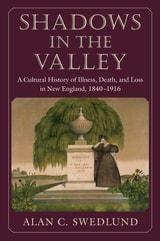
Shadows in the Valley
A Cultural History of Illness, Death, and Loss in New England, 1840-1916Alan Swedlund
University of Massachusetts Press, 2010
How does the experience of sickness, death, and loss change over time? We know that the incidence and virulence of particular diseases have varied from one period to another, as has their medical treatment. But what was it like for the individuals who suffered and died from those illnesses, for the health practitioners and institutions that attended to them, and for the families who buried and mourned them?
In Shadows in the Valley, Alan Swedlund addresses these questions by closely examining the history of mortality in several small communities in western Massachusetts from the mid-nineteenth to the early twentieth century—from just before the acceptance of the germ theory of disease through the early days of public health reform in the United States. This was a time when most Americans lived in rural areas or small towns rather than large cities. It was also a time when a wide range of healing practices was available to the American public, and when the modern form of Western medicine was striving for dominance and authority. As Swedlund shows, this juncture of competing practices and ideologies provides a rich opportunity for exploring the rise of modern medicine and its impact on the everyday lives of ordinary Americans.
To indicate how individuals in different stages of their lives were exposed to varying assaults on their health, the book is structured in a way that superimposes what the author calls “life-course time” onto chronological time. Thus the early chapters look at issues of infancy and childhood in the 1840s and 1850s and the last chapters at the problems of old age after 1900. The reader becomes familiar with specific individuals and families as they cope with the recurrent loss of children, struggle to understand the causes of new contagions, and seek to find meaning in untimely death. By using a broad time frame and a narrow geographical lens, Swedlund is able to engage with both the particularities and generalities of evolving medical knowledge and changing practice, and to highlight the differences in personal as well as collective responses to illness and loss.

Shadows of Empire
Colonial Discourse and Javanese TalesLaurie J. Sears
Duke University Press, 1996
Though Javanese shadow theater (wayang) has existed for hundreds of years, our knowledge of its history, performance practice, and role in Javanese society only begins with Dutch documentation and interpretation in the nineteenth century. Analyzing the Mahabharata and Ramayana tales in relation to court poetry, Islamic faith, Dutch scholarship, and nationalist journals, Sears shows how the shadow theater as we know it today must be understood as a hybrid of Javanese and Dutch ideas and interests, inseparable from a particular colonial moment. In doing so, she contributes to a re–envisioning of European histories that acknowledges the influence of Asian, African, and New World cultures on European thought—and to a rewriting of colonial and postcolonial Javanese histories that questions the boundaries and content of history and story, myth and allegory, colonialism and culture.
Shadows on the Past
Studies in the Historical Fiction FilmLeger Grindon
Temple University Press, 1994
Studying popular Hollywood films from Gone With the Wind to Reds and such distinguished European films as La Marseillaise and The Rise to Power of Louis XIV, Leger Grindon examines how historical fiction films interpret the present through a representation of the past.
The historical fiction film is characterized by a set of motives and, Grindon argues, deserves to be considered a genre unto itself. Appropriation of historical events can insinuate a film's authority of its subject, veil an intention, provide an escape into nostalgia, or direct a search for knowledge and origins. Utilizing the past as a way of responding to social conflicts in the present, Grindon shows how the genre promotes a political agenda, superseding the influence of scholarship on the public's perception and interpretation of history.
In the series Culture and the Moving Image, edited by Robert Sklar.
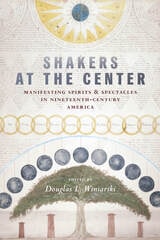
Shakers at the Center
Manifesting Spirits & Spectacles in Nineteenth-Century AmericaEdited by Douglas L. Winiarski
University of Massachusetts Press, 2026
Exploring the theological, social, and cultural dimensions of one of America’s most ambitious prophetic movements
The Shakers’ Era of Manifestations ranks among the most astounding events in American religious history. During the 1840s, members of the United Society of Believers in Christ’s Second Appearing embarked on an audacious project of receiving visions, revelations, and other manifestations from the spirit world and convincing both themselves and the world’s people of their reality. Gifted Shakers known as “instruments” surrendered their bodies to possessing spirits and celestial beings who, in turn, provided the Believers with an unimaginable number of revelatory communications that collapsed time and space, rewrote the Bible, and vastly expanded traditional Protestant beliefs and practices. The fruits of Shaker spiritualism would gain a permanent place in America’s public consciousness.
Hundreds of volumes and thousands of pages of inspired writings, music, and art from the New Era or period of Mother's Work, as the Shakers called it, crowd the shelves of a half dozen major research libraries. The archive is so vast, so extraordinary, so seemingly bizarre that few scholars have dared tackle it in its totality. The authors of this volume, specialists in nineteenth-century American religious studies, have collaborated to produce an extensive analysis of Mother Ann’s Work. They examine a fascinating range of topics: speaking with the dead; the spectacle of Shaker rituals; race, gender, and family life; and the material culture of physical and spiritual things; as well as manuscripts, books, songs, objects, and art produced during the New Era.
Shakers at the Center brings the sprawling elements of the Era of Manifestations together in a single volume. Written for students, scholars, and general readers alike, it will stand for years as the definitive history of the Shakers’ most fascinating and vexing historical period.
Contributors include the volume editor as well as Emily Suzanne Clark, Brett Malcolm Grainger, Sonia Hazard, Dana Logan, Carol Medlicott, Sally M. Promey, Erik R. Seeman, Ryan K. Smith, and David Walker.

Shakespeare at the Cineplex
The Kenneth Branagh EraSamuel Crowl
Ohio University Press, 2005
Samuel Crowl’s Shakespeare at the Cineplex: The Kenneth Branagh Era is the first thorough exploration of the fifteen major Shakespeare films released since the surprising success of Kenneth Branagh’s Henry V (1989). Crowl presents the rich variety of these films in the “long decade: between the fall of the Berlin Wall and the terrorist attacks on September 11, 2001.” The productions range from Hollywood-saturated films such as Franco Zeffirelli’s Hamlet and Michael Hoffman’s A Midsummer Night’s Dream to more modest, experimental offerings, such as Christine Edzard’s As You Like It. Now available in paperback, Shakespeare at the Cineplex will be welcome reading for fans, students, and scholars of Shakespeare in performance.

Shakespeare in Theory
The Postmodern Academy and the Early Modern TheaterStephen Bretzius
University of Michigan Press, 1997
Shakespeare the Illusionist
Magic, Dreams, and the Supernatural on FilmNeil Forsyth
Ohio University Press, 2019
In Shakespeare the Illusionist, Neil Forsyth reviews the history of Shakespeare’s plays on film, using the basic distinction in film tradition between what is owed to Méliès and what to the Lumière brothers. He then tightens his focus on those plays that include some explicit magical or supernatural elements—Puck and the fairies, ghosts and witches, or Prospero’s island, for example—and sets out methodically, but with an easy touch, to review all the films that have adapted those comedies and dramas, into the present day.
Forsyth’s aim is not to offer yet another answer as to whether Shakespeare would have written for the screen if he were alive today, but rather to assess what various filmmakers and TV directors have in fact made of the spells, haunts, and apparitions in his plays. From analyzing early camera tricks to assessing contemporary handling of the supernatural, Forsyth reads Shakespeare films for how they use the techniques of moviemaking to address questions of illusion and dramatic influence. In doing so, he presents a bold step forward in Shakespeare and film studies, and his fresh take is presented in lively, accessible language that makes the book ideal for classroom use.
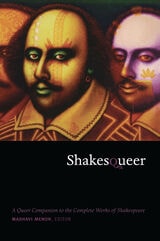
Shakesqueer
A Queer Companion to the Complete Works of ShakespeareMadhavi Menon, ed.
Duke University Press, 2011
Contributors. Matt Bell, Amanda Berry, Daniel Boyarin, Judith Brown, Steven Bruhm, Peter Coviello, Julie Crawford, Drew Daniel, Mario DiGangi, Lee Edelman, Jason Edwards, Aranye Fradenburg, Carla Freccero, Daniel Juan Gil, Jonathan Goldberg, Jody Greene, Stephen Guy-Bray, Ellis Hanson, Sharon Holland, Cary Howie, Lynne Huffer, Barbara Johnson, Hector Kollias, James Kuzner , Arthur L. Little Jr., Philip Lorenz, Heather Love, Jeffrey Masten, Robert McRuer , Madhavi Menon, Michael Moon, Paul Morrison, Andrew Nicholls, Kevin Ohi, Patrick R. O’Malley, Ann Pellegrini, Richard Rambuss, Valerie Rohy, Bethany Schneider, Kathryn Schwarz, Laurie Shannon, Ashley T. Shelden, Alan Sinfield, Bruce Smith, Karl Steel, Kathryn Bond Stockton, Amy Villarejo, Julian Yates
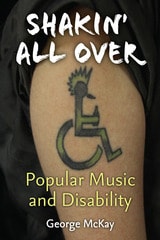
Shakin' All Over
Popular Music and DisabilityGeorge McKay
University of Michigan Press, 2013
Given the explosion in recent years of scholarship exploring the ways in which disability is manifested and performed in numerous cultural spaces, it’s surprising that until now there has never been a single monograph study covering the important intersection of popular music and disability. George McKay’s Shakin’ All Over is a cross-disciplinary examination of the ways in which popular music performers have addressed disability: in their songs, in their live performances, and in various media presentations.
By looking closely into the work of artists such as Johnny Rotten, Neil Young, Johnnie Ray, Ian Dury, Teddy Pendergrass, Curtis Mayfield, and Joni Mitchell, McKay investigates such questions as how popular music works to obscure and accommodate the presence of people with disabilities in its cultural practice. He also examines how popular musicians have articulated the experiences of disability (or sought to pass), or have used their cultural arena for disability advocacy purposes.
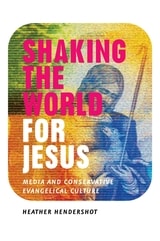
Shaking the World for Jesus
Media and Conservative Evangelical CultureHeather Hendershot
University of Chicago Press, 2004
Thousands of products promoting the Christian faith are sold to millions of consumers each year through the Web, mail order catalogs, and even national chains such as Kmart and Wal-Mart. Heather Hendershot explores in this book the vast industry of film, video, magazines, and kitsch that evangelicals use to spread their message. Focusing on the center of conservative evangelical culture—the white, middle-class Americans who can afford to buy "Christian lifestyle" products—she examines the industrial history of evangelist media, the curious subtleties of the products themselves, and their success in the religious and secular marketplace.
To garner a wider audience, Hendershot argues, evangelicals have had to carefully temper their message. But in so doing, they have painted themselves into a corner. In the postwar years, evangelical media wore the message of salvation on its sleeve, but as the evangelical media industry has grown, many of its most popular products have been those with heavily diluted Christian messages. In the eyes of many followers, the evangelicals who purvey such products are sellouts—hucksters more interested in making money than spreading the word of God.
Working to understand evangelicalism rather than pass judgment on it, Shaking the World for Jesus offers a penetrating glimpse into a thriving religious phenomenon.
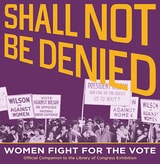
Shall Not Be Denied
Women Fight for the VoteLibrary of Library of Congress
Rutgers University Press, 2019
Official Companion to the Library of Congress Exhibition.
The campaign for women’s suffrage—considered the largest reform movement in American history—lasted more than seven decades. The struggle was not for the fainthearted. For years, determined women organized, lobbied, paraded, petitioned, lectured, picketed, and faced imprisonment in pursuit of the right to vote. Drawing from the Library’s extensive collections of photographs, personal papers, and the organizational records of such figures as Susan B. Anthony, Elizabeth Cady Stanton, Mary Church Terrell, Carrie Chapman Catt, the National Woman’s Party, and the National American Woman Suffrage Association, Shall Not Be Denied traces the movement leading to the women’s rights convention at Seneca Falls, the contributions of suffragists who worked to persuade women that they deserved the same rights as men, the divergent political strategies and internal divisions they overcame, the push for a federal women’s suffrage amendment, and the legacy of the movement.
A companion to the exhibition staged by the Library of Congress, which opened on June 4, 2019—the 100th anniversary of the US Senate’s passage of the suffrage amendment that would become the 19th amendment—Shall Not Be Denied: Women Fight for the Vote is part of the national commemoration of the 100th anniversary of women’s suffrage.
Published by Rutgers University Press in association with the Library of Congress.
Shaman, Priest, Practice, Belief
Materials of Ritual and Religion in Eastern North AmericaEdited by Stephen B. Carmody and Casey R. Barrier
University of Alabama Press, 2020
Archaeologists today are interpreting Native American religion and ritual in the distant past in more sophisticated ways, considering new understandings of the ways that Native Americans themselves experienced them. Shaman, Priest, Practice, Belief: Materials of Ritual and Religion in Eastern North America broadly considers Native American religion and ritual in eastern North America and focuses on practices that altered and used a vast array of material items as well as how physical spaces were shaped by religious practices.
Unbound to a single theoretical perspective of religion, contributors approach ritual and religion in diverse ways. Importantly, they focus on how people in the past practiced religion by altering and using a vast array of material items, from smoking pipes, ceremonial vessels, carved figurines, and iconographic images, to sacred bundles, hallucinogenic plants, revered animals, and ritual architecture. Contributors also show how physical spaces were shaped by religious practice, and how rock art, monuments, soils and special substances, and even land- and cityscapes were part of the active material worlds of religious agents.
Case studies, arranged chronologically, cover time periods ranging from the Paleoindian period (13,000–7900 BC) to the late Mississippian and into the protohistoric/contact periods. The geographical scope is much of the greater southeastern and southern Midwestern culture areas of the Eastern Woodlands, from the Central and Lower Mississippi River Valleys to the Ohio Hopewell region, and from the greater Ohio River Valley down through the Deep South and across to the Carolinas.
Contributors
Sarah E. Baires / Melissa R. Baltus / Casey R. Barrier / James F. Bates / Sierra M. Bow / James A. Brown / Stephen B. Carmody / Meagan E. Dennison / Aaron Deter-Wolf / David H. Dye / Bretton T. Giles / Cameron Gokee / Kandace D. Hollenbach / Thomas A. Jennings / Megan C. Kassabaum / John E. Kelly / Ashley A. Peles / Tanya M. Peres / Charlotte D. Pevny / Connie M. Randall / Jan F. Simek / Ashley M. Smallwood / Renee B. Walker / Alice P. Wright
Shamanism and Vulnerability on the North and South American Great Plains
Kathleen Bolling Lowrey
University Press of Colorado, 2020
The book reveals the various ways in which anthropologists, historians, folklorists, and other writers have often misrepresented indigenous shamanism and revitalization movements by unconsciously projecting ideologies and assumptions derived from modern ‘contract societies’ onto ethnographic and historical realities. Lowrey also provides alternative ways of understanding indigenous American communities and their long histories of interethnic relations with expanding colonial and national states in the Americas. A creative historical and ethnographical reevaluation of the last few decades of scholarship on shamanism, disability, and dependence, Shamanism and Vulnerability on the North and South American Great Plains will be of interest to scholars of North and South American anthropology, indigenous history, American studies, and feminism.

Shamanism, Colonialism, and the Wild Man
A Study in Terror and HealingMichael Taussig
University of Chicago Press, 1987
"This extraordinary book . . . will encourage ever more critical and creative explorations."—Fernando Coronil, [I]American Journal of Sociology[/I]
"Taussig has brought a formidable collection of data from arcane literary, journalistic, and biographical sources to bear on . . . questions of evil, torture, and politically institutionalized hatred and terror. His intent is laudable, and much of the book is brilliant, both in its discovery of how particular people perpetrated evil and others interpreted it."—Stehen G. Bunker, Social Science Quarterly
Shamanism, History, and the State
Nicholas Thomas and Caroline Humphrey, Editors
University of Michigan Press, 1994