Results by title
22279 books match the query 'Social Science' and 1635 start with s
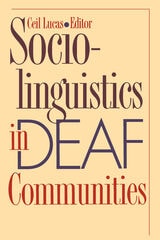
Sociolinguistics in Deaf Communities
Ceil Lucas
Gallaudet University Press, 1995
The first volume in the new Sociolinguistics in Deaf Communities series presents a rich collection of essays showcasing the breadth and depth of this exciting discipline. Topics of inquiry in the premiere volume include fingerspelling in Langue des Signes Quebecoise (LSQ) in Quebec, Canada; language used by a Navajo family with deaf children; language policy, classroom practice, and multiculturalism in deaf education; aspects of American Sign Language (ASL) discourse and of Filipino Sign Language discourse; and the nature and role of rhetorical language in Deaf social movements.
Among the noted contributors are Dominique Machabee, Arlene Blumenthal-Kelly, Jeffrey Davis, Melanie Metzger, Samuel Supalla, Barbara Gerner de Garcia, Liza B. Martinez, Kathy Jankowski, and also Ceil Lucas. Sociolinguistics in Deaf Communities affords an invaluable opportunity to assess up-to-date information on sign language linguistics worldwide and its impact on policy and planning in education, interaction with spoken languages, interpreting, and the issues of empowerment.
Sociologists, Economists, and Democracy
Brian Barry
University of Chicago Press, 1988
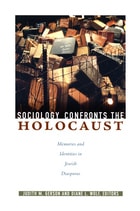
Sociology Confronts the Holocaust
Memories and Identities in Jewish DiasporasJudith M. Gerson and Diane L. Wolf, eds.
Duke University Press, 2007
Contributors explore diasporic Jewish identities in the post-Holocaust years; the use of sociohistorical analysis in studying the genocide; immigration and transnationalism; and collective action, collective guilt, and collective memory. In so doing, they illuminate various facets of the Holocaust, and especially post-Holocaust, experience. They investigate topics including heritage tours that take young American Jews to Israel and Eastern Europe, the politics of memory in Steven Spielberg’s collection of Shoah testimonies, and the ways that Jews who immigrated to the United States after the collapse of the Soviet Union understood nationality, religion, and identity. Contributors examine the Warsaw Ghetto Uprising of 1943 in light of collective action research and investigate the various ways that the Holocaust has been imagined and recalled in Germany, Israel, and the United States. Included in the commentaries about sociology and Holocaust studies is an essay reflecting on how to study the Holocaust (and other atrocities) ethically, without exploiting violence and suffering.
Contributors. Richard Alba, Caryn Aviv, Ethel Brooks, Rachel L. Einwohner, Yen Le Espiritu, Leela Fernandes, Kathie Friedman, Judith M. Gerson, Steven J. Gold , Debra R. Kaufman, Rhonda F. Levine , Daniel Levy, Jeffrey K. Olick, Martin Oppenheimer, David Shneer, Irina Carlota Silber, Arlene Stein, Natan Sznaider, Suzanne Vromen, Chaim Waxman, Richard Williams, Diane L. Wolf

Sociology Hesitant
Thinking with W. E. B. DuBois, Volume 27Ronald A. T. Judy, ed.
Duke University Press, 0
Spanning a wide array of disciplines, from German studies and sociology to literary criticism, philosophy, and anthropology, with contributions from some of the most outstanding scholars in these fields, Sociology Hesitant contributes to the recognition of DuBois as an important historical figure by focusing on the complexity of his theoretical work. These essays offer an extended interaction with the ideas and projects DuBois formulated in a series of essays written between 1887 and 1910 that take up intricate questions concerning the nature of methodology and the theory of knowledge. Using DuBois’s work as a point of departure, contributors explore current thinking about diverse subjects such as geopolitics and postcolonialism. Demonstrating that engaging the question of race requires rethinking the historical nature of theoretical understanding, this collection brings to light the notion that the struggle for equality is a struggle for freedom of thought in pursuit of truth.
Contributors. Kenneth Barkin, Nahum Chandler, Ronald Judy, David Krell, Charles Lemert, Sieglinde D. Lemke, Tommy Lott, Kevin Miles, Abdulkarim Mustapha, Ken Warren

Sociology and Architectural Design
John Zeisel
Russell Sage Foundation, 1975
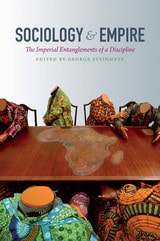
Sociology and Empire
The Imperial Entanglements of a DisciplineGeorge Steinmetz, ed.
Duke University Press, 2013
The collection has a threefold agenda: to trace an intellectual history of sociology as it pertains to empire; to offer empirical studies based around colonies and empires, both past and present; and to provide a theoretical basis for future sociological analyses that may take empire more fully into account. In the 1940s, the British Colonial Office began employing sociologists in its African colonies. In Nazi Germany, sociologists played a leading role in organizing the occupation of Eastern Europe. In the United States, sociology contributed to modernization theory, which served as an informal blueprint for the postwar American empire. This comprehensive anthology critiques sociology's disciplinary engagement with colonialism in varied settings while also highlighting the lasting contributions that sociologists have made to the theory and history of imperialism.
Contributors. Albert Bergesen, Ou-Byung Chae, Andy Clarno, Raewyn Connell, Ilya Gerasimov, Julian Go, Daniel Goh, Chandan Gowda, Krishan Kumar, Fuyuki Kurasawa, Michael Mann, Marina Mogilner, Besnik Pula, Anne Raffin, Emmanuelle Saada, Marco Santoro, Kim Scheppele, George Steinmetz, Alexander Semyonov, Andrew Zimmerman

Sociology and Its Publics
The Forms and Fates of Disciplinary OrganizationEdited by Terence C. Halliday and Morris Janowitz
University of Chicago Press, 1992
Sociology and the Field of Public Health
Edward Suchman
Russell Sage Foundation, 1963
Sociology and the Race Problem
THE FAILURE OF A PERSPECTIVEJames B. McKee
University of Illinois Press, 1993
"Masterful. . . . McKee transports the reader back to the intellectual world in which the early sociologists worked and does not simply treat them as evil racists. His approach is informed by the sociology of knowledge." -- Lewis M. Killian, author of The Impossible Revolution, Phase 2: Black Power and the American Dream
Sociology for the Twenty-first Century
Continuities and Cutting EdgesEdited by Janet L. Abu-Lughod
University of Chicago Press, 1999
The chapters in part 1 revise theory and methods to comprehend the economic and political institutions that increasingly dominate the lives of individuals and groups, arguing that these giants must be made more democratically accountable. Part 2 explores the social effects that growing globalization, transnationalization, and information technologies are having on politics, economics, and the environment. The final chapters compare how new immigrants from increasingly diversified backgrounds are being absorbed in Canada and the United States, exploring the impact that immigrants are having on preexisting ethnic minorities and on the dominant political culture.
While it is a major attempt to refocus the discipline of sociology, the book's clear, nontechnical style and its attention to issues of central concern to all citizens make it also highly accessible to nonspecialists.
Contributors are Janet L. Abu-Lughod, Tomas Almaguer, Giovanni Arrighi, Gilles Bourque, Randall Collins, Jules Duchastel, Joe Feagin, Harriet Friedmann, Pierre Hamel, Moon-Kie Jung, Joel Levine, Henri Lustiger-Thaler, Louis Maheu, Joel Perlmann, Saskia Sassen, Gideon Sjoberg, Dorothy Smith, Roger Waldinger, and Barry Wellman.
Sociology in America
A HistoryEdited by Craig Calhoun
University of Chicago Press, 2007
Though the word “sociology” was coined in Europe, the field of sociology grew most dramatically in America. Despite that disproportionate influence, American sociology has never been the subject of an extended historical examination. To remedy that situation—and to celebrate the centennial of the American Sociological Association—Craig Calhoun assembled a team of leading sociologists to produce Sociology in America.
Rather than a story of great sociologists or departments, Sociology in America is a true history of an often disparate field—and a deeply considered look at the ways sociology developed intellectually and institutionally. It explores the growth of American sociology as it addressed changes and challenges throughout the twentieth century, covering topics ranging from the discipline’s intellectual roots to understandings (and misunderstandings) of race and gender to the impact of the Depression and the 1960s.
Sociology in America will stand as the definitive treatment of the contribution of twentieth-century American sociology and will be required reading for all sociologists.
Contributors:
Andrew Abbott, Daniel Breslau, Craig Calhoun, Charles Camic, Miguel A. Centeno, Patricia Hill Collins, Marjorie L. DeVault, Myra Marx Ferree, Neil Gross, Lorine A. Hughes, Michael D. Kennedy, Shamus Khan, Barbara Laslett, Patricia Lengermann, Doug McAdam, Shauna A. Morimoto, Aldon Morris, Gillian Niebrugge, Alton Phillips, James F. Short Jr., Alan Sica, James T. Sparrow, George Steinmetz, Stephen Turner, Jonathan VanAntwerpen, Immanuel Wallerstein, Pamela Barnhouse Walters, Howard Winant

Sociology of the Future
Theory, Cases and Annotated BibliographyWendell Bell
Russell Sage Foundation, 1971
Sociology on Film
Postwar Hollywood's Prestige CommodityCagle, Chris
Rutgers University Press, 2016

Sociopolitical Aspects of Canal Irrigation in the Valley of Oaxaca
Susan H. Lees
University of Michigan Press, 1973

Soda Science
Making the World Safe for Coca-ColaSusan Greenhalgh
University of Chicago Press, 2024
The 1990s were tough times for the soda industry. In the United States, obesity rates were exploding. Public health critics pointed to sugary soda as a main culprit and advocated for soda taxes that might decrease the consumption of sweetened beverages—and threaten the revenues of the giant soda companies.
Soda Science tells the story of how industry leader Coca-Cola mobilized allies in academia to create a soda-defense science that would protect profits by advocating exercise, not dietary restraint, as the priority solution to obesity, a view few experts accept. Anthropologist and science studies specialist Susan Greenhalgh discovers a hidden world of science-making—with distinctive organizations, social networks, knowledge-making practices, and ethical claims—dedicated to creating industry-friendly science and keeping it under wraps. By tracing the birth, maturation, death, and afterlife of the science they made, Greenhalgh shows how corporate science has managed to gain such a hold over our lives.
Spanning twenty years, her investigation takes her from the US, where the science was made, to China, a key market for sugary soda. In the US, soda science was a critical force in the making of today’s society of step-counting, fitness-tracking, weight-obsessed citizens. In China, this distorted science has left its mark not just on national obesity policies but on the apparatus for managing chronic disease generally. By following the scientists and their ambitious schemes to make the world safe for Coke, Greenhalgh offers an account that is more global—and yet more human—than the story that dominates public understanding today.
Coke’s research isn’t fake science, Greenhalgh argues; it was real science, conducted by real and eminent scientists, but distorted by its aim. Her gripping book raises crucial questions about conflicts of interest in scientific research, the funding behind familiar messages about health, and the cunning ways giant corporations come to shape our diets, lifestyles, and health to their own needs.

Sodomy in Reformation Germany and Switzerland, 1400-1600
Helmut Puff
University of Chicago Press, 2003
Written with precision and meticulously researched, this revealing study will interest historians of gender, sexuality, and religion, as well as scholars of medieval and early modern history and culture.
Sodomy's Solicitations
A Right to QueernessJoseph J. Fischel
Temple University Press, 2025
The political stories narrated in Sodomy’s Solicitations are undoubtedly stories of racism, sexism, homophobia, and transphobia, but they are also stories of other political problems—and political possibilities. Fischel indicts U.S. sex offender regulatory regimes as state-sponsored sexual violence; offers a qualified defense for sexual expression in public; and argues that animal sexual abuse laws, with their exemptions for industrial agricultural practices, authorize the suffering they were enacted to deter. He also makes the case that laws criminalizing the exchange of sex for money are unconstitutional, and proposes that the best way to protect trans and queer children might just be to enfranchise them.
Sodomy’s Solicitations champions a right to queerness across rather than within identity formations—a right to relatively unpoliced gender, sexual, and intimate pluralism.
In the series Sexuality Studies
Soft Corruption
How Unethical Conduct Undermines Good Government and What To Do About ItSchluter, William E
Rutgers University Press, 2017
In this searing personal narrative, the former state senator recounts his fight to expose and reform these acts of government misconduct. Not afraid to cite specific cases of soft corruption in New Jersey politics, he paints a vivid portrait of public servants who care more about political power and personal gain than the public good. By recounting events that he witnessed firsthand in the Garden State, he provides dramatic illustrations of ills that afflict American politics nationwide.
As he identifies five main forms of soft corruption, Schluter diagnoses the state government’s ethical malaise, and offers concrete policy suggestions for how it might be cured. Not simply a dive through the muck of New Jersey politics, Soft Corruption is an important first step to reforming our nation’s political system, a book that will inspire readers to demand that our elected officials can and must do better.
Visit: www.softcorruption.com (http://www.softcorruption.com)
Soft Patriarchs, New Men
How Christianity Shapes Fathers and HusbandsW. Bradford Wilcox
University of Chicago Press, 2004
According to W. Bradford Wilcox, the divergent family ideologies of evangelical and mainline churches do not translate into large differences in family behavior between evangelical and mainline Protestant men who are married with children. Mainline Protestant men, he contends, are "new men" who take a more egalitarian approach to the division of household labor than their conservative peers and a more involved approach to parenting than men with no religious affiliation. Evangelical Protestant men, meanwhile, are "soft patriarchs"—not as authoritarian as some would expect, and given to being more emotional and dedicated to their wives and children than both their mainline and secular counterparts. Thus, Wilcox argues that religion domesticates men in ways that make them more responsive to the aspirations and needs of their immediate families.

Softimage
Towards a New Theory of the Digital ImageIngrid Hoelzl and Remi Marie
Intellect Books, 2015
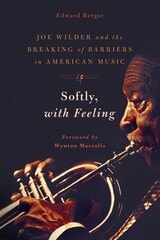
Softly, With Feeling
Joe Wilder and the Breaking of Barriers in American MusicEdward Berger
Temple University Press, 2014
"Joe Wilder set the table. His struggles made it easier for me and many others."--From the Foreword by Wynton Marsalis
Trumpeter Joe Wilder is distinguished for his achievements in both the jazz and classical worlds. He was a founding member of the Symphony of the New World, where he played first trumpet, and he performed as lead trumpet and soloist with Lionel Hampton, Jimmy Lunceford, Dizzy Gillespie, and Count Basie. Yet Wilder is also known as a pioneer who broke down racial barriers, the first African American to hold a principal chair in a Broadway show orchestra, and one of the first African Americans to join a network studio orchestra.
In Softly, with Feeling, Edward Berger tells Wilder's remarkable story-from his growing up in working-class Philadelphia to becoming one of the first 1,000 black Marines during World War II-with tremendous feeling and extensive reminiscences by Wilder and his colleagues, including renowned Philadelphia-area musicians Jimmy Heath and Buddy DeFranco. Berger also places Wilder's experiences within a broader context of American musical and social history.
Wilder's modesty and ability to perform in many musical genres may have prevented him from achieving popular recognition, but in Softly, with Feeling, his legacy and contributions to music and culture are assured.
Soil and Soul
How Russia’s Minority Communities Create Meaning and IdentityEdited by Yana Hashamova and Gulnaz Sharafutdinova
University of Wisconsin Press, 2027
By landmass, Russia is the world’s largest country, due largely to centuries of military expansion, imperial rule, and colonization. As a result, it contains people of many ethnicities, nationalities, religions, and languages. Yet Russia’s non-Russian, Indigenous, and minority communities have often been marginalized by state policy and underrepresented in scholarship. Soil and Soul explores how these communities sustain distinct forms of identity and belonging not only through discourse or state institutions but also through embodied relations with land, nature, and animals. These local practices complicate and unsettle state-centered narratives of Russian cultural superiority by showing how meaning and identity are created through relationships with the nonhuman world. Drawing on decolonial, anthropological, environmental, sociological, linguistic, and geographic approaches, this volume reframes minority agency as ecosocial practice embedded in local ecologies, everyday life, and postimperial power asymmetries.
Contributors: Megan Dixon, Yana Hashamova, Kristina Kovalskaya, Jesko Schmoller, Gulnaz Sharafutdinova, Laura Siragusa, Zoia Tarasova, Baasanjav Terbish
Soils, Climate and Society
Archaeological Investigations in Ancient AmericaJohn D. Wingard
University Press of Colorado, 2013
The volume traces the origins of agriculture, the transition to agrarian societies, the sociocultural implications of agriculture, agriculture's effects on population, and the theory of carrying capacity, considering the relation of agriculture to the profound social changes that it wrought in the New World. Soil science plays a significant, though varied, role in each case study, and is the common component of each analysis. Soil chemistry is also of particular importance to several of the studies, as it determines the amount of food that can be produced in a particular soil and the effects of occupation or cultivation on that soil, thus having consequences for future cultivators.
Soils, Climate and Society demonstrates that renewed investigation of agricultural production and demography can answer questions about the past, as well as stimulate further research. It will be of interest to scholars of archaeology, historical ecology and geography, and agricultural history.

Sojiji
Discipline, Compassion, and Enlightenment at a Japanese Zen TempleJoshua A. Irizarry
University of Michigan Press, 2022
Based on more than fifteen years of fieldwork, interviews, and archival research, Sōjiji: Discipline, Compassion, and Enlightenment at a Japanese Zen Temple immerses the reader in the lives and experiences of the different groups that comprise Sōjiji's contemporary religious community. Through clear and accessible prose, ethnographically-grounded analysis, and emotionally compelling stories, the reader will explore the rich pastiche of daily life and ritual activity at a major Japanese Zen temple in institutional, historical, and social context through the lived practices of its community of clergy, practitioners, parishioners, and visitors.
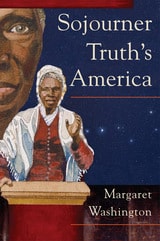
Sojourner Truth's America
Margaret Washington
University of Illinois Press, 2009
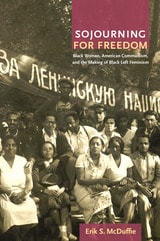
Sojourning for Freedom
Black Women, American Communism, and the Making of Black Left FeminismErik S. McDuffie
Duke University Press, 2011

Solarities
Seeking Energy JusticeAyesha After Oil Collective
University of Minnesota Press, 2022
A collective engages and mirrors the critical need for energy justice and transformation
Solarities considers the possibilities of organizing societies and economies around solar energy, and the challenges of a just and equitable transition away from fossil fuels. Far from presenting solarity as a utopian solution to the climate crisis, it critically examines the ambiguous potentials of solarities: plural, situated, and often contradictory.
Here, a diverse collective of activists, scholars, and practitioners critically engage a wide range of relationships and orientations to the sun. They consider the material and infrastructural dimensions of solar power, the decolonial and feminist promises of decentralized energy, solarian relations with more-than-human kin, and the problem of oppressive and weaponized solarities. Solarities imagines—and demands— possibilities for energy justice in this transition.
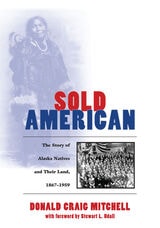
Sold American
The Story of Alaska Natives and Their Land 1867-1959Donald Craig Mitchell
University of Alaska Press, 2003
Don Mitchell's companion volume, Take My Land, Take My Life, concludes that story by describing the events that in 1971 resulted in Congress's enactment of the Alaska Native Claims Settlement Act, the most generous aboriginal land claims settlement in the nation's history. Insightful and drawn from years of painstaking research of primary source materials, Sold American and Take My Land, Take My Life are an indispensable resource for readers who are interested in the history of the nation's largest state and of the federal government's involvement with Alaska's indigenous peoples.
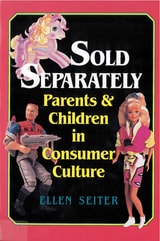
Sold Separately
Children and Parents in Consumer CultureSeiter, Ellen
Rutgers University Press, 1995
"A radical approach to children's TV. . . . Seiter argues cogently that watching Saturday cartoons isn't a passive activity but a tool by which even the very young decode and learn about their culture, and develop creative imagination as well. Bolstered by social, political, developmental, and media research, Seiter ties middle-class aversion to children's TV and mass-market toys to an association with the 'uncontrollable consumerism'––and hence supposed moral failure––of working class members, women, and 'increasingly, children.' . . . Positive guidance for parents uncertain of the role of TV and TV toys in their children's lives."––Kirkus Reviews
"Sold Separately is about television and toys, and the various roles that they play in the lives of children and parents. In particular, Seiter examines toy advertising, both in print media and on television; TV commercials; toy-based video for girls, with an in-depth look at "My Little Pony"; action TV for boys, using "Slimer and the Real Ghostbusters" as her case study; and the stores where toys are sold, both Toys "R" Us and the more upscale shops . . . contains many provocative observations."––Women's Review of Books
"Ellen Seiter has a holiday message for yuppie parents who feel guilty shopping at Toys "R" Us. The mass-produced toys that dominate the chain's shelves need not be the enemy of every right-thinking parent. "Ghostbuster" figurines and "My Little Pony" can share the toy chest with those sensible wooden blocks."––Chronicle of Higher Education
"Emphasizing problems of socioeconomic class, gender, and race stereotyping, this study acknowledges the usual parental complaints about toys like Barbie and G.I. Joe, but insists that they do play an important role in children's culture, especially for working class families. A thought-provoking analysis."––Wilson Library Journal
"In this thought provoking study, Seiter reasonably urges parents and others to put aside their own tastes and to understand that children's consumer culture promotes solidarity and sociability among youngsters."––Publishers Weekly
"An important book for those desiring an overview of the toy industry's impact on consumer culture . . . [it] presents a fair and well-balanced view of the industry."––Kathleen M. Carson, associate editor, Playthings
"A refreshing, thoughtful, and insightful investigation of an enormously important subject––consumer culture for kids. . . . I can't recommend it highly enough."––Janice Radway, Duke University, author of Reading the Romance
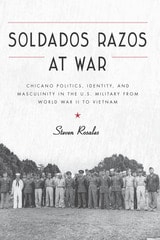
Soldados Razos at War
Chicano Politics, Identity, and Masculinity in the U.S. Military from World War II to VietnamSteven Rosales
University of Arizona Press, 2017
What were the catalysts that motivated Mexican American youth to enlist or readily accept their draft notices in World War II, Korea, or Vietnam? In Soldados Razos at War, historian and veteran Steven Rosales chronicles the experiences of Chicano servicemen who fought for the United States, explaining why these men served, how they served, and the impact of their service on their identity and political consciousness.
As a social space imbued with its own martial and masculine ethos, the U.S. military offers an ideal way to study the aspirations and behaviors that carried over into the civilian lives of these young men. A tradition of martial citizenship forms the core of the book. Using rich oral histories and archival research, Rosales investigates the military’s transformative potential with a particular focus on socioeconomic mobility, masculinity, and postwar political activism across three generations.
The national collective effort characteristic of World War II and Korea differed sharply from the highly divisive nature of American involvement in Vietnam. Thus, for Mexican Americans, military service produced a wide range of ideological reactions, with the ideals of each often in opposition to the others. Yet a critical thread connecting these diverse outcomes was a redefined sense of self and a willingness to engage in individual and collective action to secure first-class citizenship.
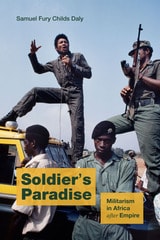
Soldier's Paradise
Militarism in Africa after EmpireSamuel Fury Childs Daly
Duke University Press, 2024

Soldiers' Stories
Military Women in Cinema and Television since World War IIYvonne Tasker
Duke University Press, 2011

Soldiers, Cities, and Civilians in Roman Syria
Nigel Pollard
University of Michigan Press, 2000
Nigel Pollard is currently a Research Assistant at the Institute of Archaeology, University of Oxford.
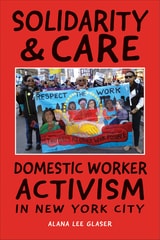
Solidarity & Care
Domestic Worker Activism in New York CityAlana Lee Glaser
Temple University Press, 2023
Solidarity & Care examines the political mobilization of diverse care workers who joined together and supported one another through education, protests, lobbying, and storytelling. Domestic work activists used narrative and emotional appeals to build a coalition of religious communities, employers of domestic workers, labor union members, and politicians to first pass and then to enforce the new law.
Through oral history interviews, as well as ethnographic observation during DWU meetings and protest actions, Glaser chronicles how these women fought (and continue to fight) to improve working conditions. She also illustrates how they endure racism, punitive immigration laws, on-the-job indignities, and unemployment that can result in eviction and food insecurity.
The lessons from Solidarity & Care along with the DWU’s precedent-setting legislative success have applications to workers across industries.
All royalties will go directly to the Domestic Workers United
Solidarity Cities
Confronting Racial Capitalism, Mapping TransformationMaliha Safri
University of Minnesota Press, 2025
Mapping the transformative effects of America’s urban solidarity economies
Solidarity economies, characterized by diverse practices of cooperation and mutual support, have long played pivotal but largely invisible roles in fostering shared survival and envisioning alternatives to racial capitalism globally and in the United States. This book maps the thriving existence of these cooperative networks in three differently sized American cities, highlighting their commitment to cooperation, democracy, and inclusion and demonstrating the desire—and the pressing need—to establish alternative foundations for social and economic justice.
Collectively authored by four social scientists, Solidarity Cities analyzes the deeply entrenched racial and economic divides from which cooperative networks emerge as they work to provide unmet basic needs, including food security, affordable housing, access to fair credit, and employment opportunities. Examining entities such as community gardens, credit unions, cooperatives, and other forms of economic solidarity, the authors highlight how relatively small yet vital interventions into public life can expand into broader movements that help bolster the overall well-being of their surrounding communities.
Bringing together insights from geography, political economy, and political science with mapping and spatial analysis methodologies, surveys, and in-depth interviews, Solidarity Cities illuminates the extensive footprints of solidarity economies and the roles they play in communities. The authors show how these initiatives act as bulwarks against gentrification, exploitation, and economic exclusion, helping readers see them as part of the past, present, and future of more livable and just cities.
Retail e-book files for this title are screen-reader friendly with images accompanied by short alt text and/or extended descriptions.
Solidarity and Fragmentation
Working People and Class Consciousness in Detroit, 1875-1900Richard Jules Oestreicher
University of Illinois Press, 1985
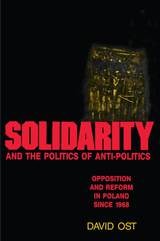
Solidarity and the Politics of Anti-Politics
Opposition and Reform in Poland since 1968David Ost
Temple University Press, 1991
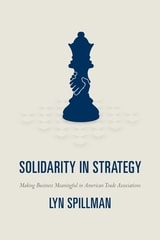
Solidarity in Strategy
Making Business Meaningful in American Trade AssociationsLyn Spillman
University of Chicago Press, 2012
Popular conceptions hold that capitalism is driven almost entirely by the pursuit of profit and self-interest. Challenging that assumption, this major new study of American business associations shows how market and non-market relations are actually profoundly entwined at the heart of capitalism.
In Solidarity in Strategy, Lyn Spillman draws on rich documentary archives and a comprehensive data set of more than four thousand trade associations from diverse and obscure corners of commercial life to reveal a busy and often surprising arena of American economic activity. From the Intelligent Transportation Society to the American Gem Trade Association, Spillman explains how business associations are more collegial than cutthroat, and how they make capitalist action meaningful not only by developing shared ideas about collective interests but also by articulating a disinterested solidarity that transcends those interests.
Deeply grounded in both economic and cultural sociology, Solidarity in Strategy provides rich, lively, and often surprising insights into the world of business, and leads us to question some of our most fundamental assumptions about economic life and how cultural context influences economic.
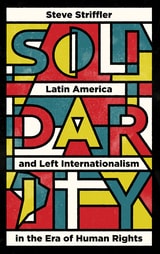
Solidarity
Latin America and the US Left in the Era of Human RightsSteve Striffler
Pluto Press, 2018
In Solidarity, Steve Striffler addresses these key questions, offering the first history of US-Latin American solidarity from the Haitian Revolution to the present day. Striffler traces the history of internationalism through the Cold War, exploring the rise of human rights as the dominant current of international solidarity. He also considers the limitations of a solidarity movement today that inherited its organisational infrastructure from the human rights movements.
Moving beyond conventionally ahistorical analyses of solidarity, here Striffler provides a distinctive intervention in the history of progressive politics in both the US and Latin America, the past and present of US imperialism and anti-imperialism, and the history of human rights and labour internationalism.
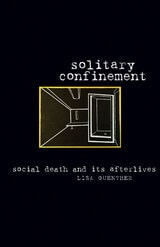
Solitary Confinement
Social Death and Its AfterlivesLisa Guenther
University of Minnesota Press, 2013
Prolonged solitary confinement has become a widespread and standard practice in U.S. prisons—even though it consistently drives healthy prisoners insane, makes the mentally ill sicker, and, according to the testimony of prisoners, threatens to reduce life to a living death. In this profoundly important and original book, Lisa Guenther examines the death-in-life experience of solitary confinement in America from the early nineteenth century to today’s supermax prisons. Documenting how solitary confinement undermines prisoners’ sense of identity and their ability to understand the world, Guenther demonstrates the real effects of forcibly isolating a person for weeks, months, or years.
Drawing on the testimony of prisoners and the work of philosophers and social activists from Edmund Husserl and Maurice Merleau-Ponty to Frantz Fanon and Angela Davis, the author defines solitary confinement as a kind of social death. It argues that isolation exposes the relational structure of being by showing what happens when that structure is abused—when prisoners are deprived of the concrete relations with others on which our existence as sense-making creatures depends. Solitary confinement is beyond a form of racial or political violence; it is an assault on being.
A searing and unforgettable indictment, Solitary Confinement reveals what the devastation wrought by the torture of solitary confinement tells us about what it means to be human—and why humanity is so often destroyed when we separate prisoners from all other people.
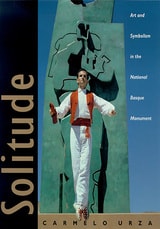
Solitude
Art And Symbolism In The National Basque MonumentCarmelo Urza
University of Nevada Press, 1993
Urza discusses the genesis of the National Basque Monument to the Basque Sheepherder that is located in Reno, Nevada. He also describes the competition held to determine the monument's design and the debates arising from the modern sculpture created by renowned Basque artist Nestor Basterrextea. Urza examines the arguments of those who favored the selection of a figurative, traditional symbol and those who preferred a modern, forward-looking symbol. He utilizes this discussion to explore the evolution of Basque ethnicity and its relationship to society.

Somalis Abroad
Clan and Everyday Life in FinlandStephanie R. Bjork
University of Illinois Press, 2017
Somalis in the Twin Cities and Columbus
Immigrant Incorporation in New DestinationsStephanie Chambers
Temple University Press, 2017
In the early 1990s, Somali refugees arrived in Minneapolis and St. Paul, Minnesota. Later in the decade, an additional influx of immigrants arrived in a second destination of Columbus, Ohio. These refugees found low-skill jobs in warehouses and food processing plants and struggled as social “outsiders,” often facing discrimination based on their religious traditions, dress, and misconceptions that they are terrorists. The immigrant youth also lacked access to quality educational opportunities.
In Somalis in the Twin Cities and Columbus, Stefanie Chambers provides a cogent analysis of these refugees in Midwestern cities where new immigrant communities are growing. Her comparative study uses qualitative and quantitative data to assess the political, economic, and social variations between these urban areas. Chambers examines how culture and history influenced the incorporation of Somali immigrants in the U.S., and recommends policy changes that can advance rather than impede incorporation.
Her robust investigation provides a better understanding of the reasons these refugees establish roots in these areas, as well as how these resettled immigrants struggle to thrive.

Somatic States
On Cartography, Geobodies, Bodily IntegrityFranck Billé
Duke University Press, 2025
Some Kind of Mirror
Creating Marilyn MonroeKonkle, Amanda
Rutgers University Press, 2019
Some Kind of Mirror offers the first extended scholarly analysis of Marilyn Monroe’s film performances, examining how they united the contradictory discourses about women’s roles in 1950s America. Amanda Konkle suggests that Monroe’s star persona resonated with audiences precisely because it engaged with the era’s critical debates regarding femininity, sexuality, marriage, and political activism. Furthermore, she explores how Monroe drew from the techniques of Method acting and finely calibrated her performances to better mirror her audience’s anxieties and desires.
Drawing both from Monroe’s filmography and from 1950s fan magazines, newspaper reports, and archived film studio reports, Some Kind of Mirror considers how her star persona was coauthored by the actress, the Hollywood publicity machine, and the fans who adored her. It is about why 1950s America made Monroe a star, but it is also about how Marilyn defined an era.

Some Nightmares Are Real
The Haunting Truth Behind Alabama’s Supernatural Talesby Kelly Kazek, illustrated by Sarah Cotton
University of Alabama Press, 2024
Southern writer and folklorist Kelly Kazek’s collection of eerie and enigmatic Alabama ghost stories
Dark secrets lurk beneath the sleepy surface of Alabama. Ghosts and grisly creatures haunt the towns and forests. In the great Southern ghost-story tradition, famed Alabama storyteller Kelly Kazek weaves a gothic tapestry of ten stories drawn from real people and legendary creatures, cursed places, and harrowing events.
Each story or legend takes readers to a different place in Alabama. Read about the bestial Wolf Woman who terrified Mobilians in the haunted old port city. In the northern city of Huntsville, visit the Dead Children’s Playground in gloomy Maple Hill Cemetery. In Jacksonville, feel the cold grip of the Old Mill Witch, rumored to protect the workers at the rickety cotton yarn mill. Hear about the mysterious green light that drifts along the Alabama River in the Black Belt hamlet of Gee’s Bend and learn about the role the Gee’s Bend Ferry played in the Civil Rights Movement.
Unlike most ghost-story collections, Some Nightmares Are Real includes an appendix of facts, historical resources, and information about how to visit the locations. These contemporary stories embrace a beloved Southern folkloric tradition for a new generation of young readers. The tales will terrify and ensnare ghost-story lovers of all ages. So settle in, pull the covers up tight, and maybe turn on the light, because the truth is: Some Nightmares Are Real.

Some Nightmares Are True
Ghosts of America's Deadliest Disastersby Kelly Kazek, illustrated by Sarah Cotton
University of Alabama Press, 2025
Digging up the eerie aftermath of America’s deadliest disasters—where ghost stories take root, history lingers in the shadows, and the past refuses to stay buried.
In this haunting follow-up to Some Nightmares Are Real: The Haunting Truth Behind Alabama’s Supernatural Tales, journalist and storyteller Kelly Kazek investigates supernatural folklore grounded in historical catastrophe. This time, she ventures far beyond Alabama, unearthing the eerie legends born from their aftermath of nine of America’s most infamous disasters. From the strangling suffocation of the Boston Molasses Flood and the terror of Galveston’s notorious Great Storm, to flames blasting from the Triangle Shirtwaist Factory disaster, Some Nightmares Are True examines ghost stories that have haunted communities long after the news headlines stopped.
Each spooky story blends vivid storytelling with meticulous research, connecting real events to the ghostly lore they inspired. Kazek explores not just the moment of disaster, but how grief, resilience, and remembrance shape the way stories live on—through newspaper archives, folklore, and generations of retelling.
With both wry Southern sensibility and journalistic rigor, Kazek explores how moments of tragedy like the Dixie Tornado Outbreak in Alabama, the capsizing of the SS Eastland in Chicago, and the haunting aftermath of the Schoolchildren’s Blizzard in Nebraska leave lasting imprints on generational memory. These sites of devastation become more than historical footnotes; they transform into hallowed grounds where grief lingers, legends remain, and the line between fact and folklore dissolves.
For ghost hunters, or simply those brave enough to follow their curiosity into learning more about the stories’ historical facts, Kazek has compiled a robust appendix that provides context, source materials, and location details, making this a perfect pick to toss in the car for that late-night road trip adventure. But remember, Some Nightmares Are True.

Some Other Amazonians
Perspectives on Modern AmazoniaEdited by Mark Harris and Stephen Nugent
University of London Press, 2004
Contributors include Rosa Elizabeth Acevedo Marin, Edna De Castro, and David McGrath (Nucleo de Altos Estudos Amazonicos, Federal University of Para, Brazil), Scott Anderson (Tide-Energy Project in the Amazon), Neide Esterci (Federal University of Rio de Janeiro), Deborah Lima (Fluminense Federal University), Raymundo Heraldo Maues (Federal University of Para, Brazil), and Gregory Prang (Wayne State University).
Some Things Don’t Burn
Art, Activism, and Arson at the Bugle AmericanAurore Sibley
Wisconsin Historical Society Press, 2026
A fierce, vibrant portrait of a newspaper that refused to go up in smoke.
From 1970 to 1978, the Bugle American wasn’t just an alternative newspaper―it was the sparkplug that propelled Milwaukee’s emergence as an influential cultural hub. With its incisive political coverage, razor-sharp cartoons, and in-depth reporting on the city’s explosive music scene, the Bugle American was a lifeline for artists, activists, and readers from Milwaukee to Madison hungry for independent journalism.
Then, on a cold night in February 1975, everything nearly ended. A firebomb ripped through the Bugle American offices, endangering the lives of staff and burning the building to the ground. The crime was never solved. But the paper didn’t die. Supported by a stunned but determined community―and high-profile allies including Leonard Cohen and George Reedy―the Bugle American rose from the ashes to publish the very next week.
In Some Things Don’t Burn: Art, Activism, and Arson at the Bugle American, author Aurore Sibley tells the full story of this influential underground paper: its founding ideals, its creative energy, its brushes with fame, and its lasting impact. With access to rare materials and family insights―her parents met at the Bugle American, and her father served as one of its editors―Sibley layers investigative research with personal narrative, exploring how revisiting the past helped her reconcile with her father’s complicated life and death.
Featuring dozens of photographs and illustrations, including cartoons and sketches by renowned underground artist and Bugle American co-founder Denis Kitchen, this book brings readers inside the quirky, passionate, and often chaotic world of a newsroom fighting to stay alive and independent.
A gripping story of art, activism, community, and resilience, Some Things Don’t Burn reminds us that while buildings can be destroyed, the ideals that ignite a movement are much harder to extinguish.
Some White Folks
The Interracial Politics of Sympathy, Suffering, and SolidarityJennifer Chudy
University of Chicago Press, 2024
A pioneering exploration of the unexamined roots and effect of racial sympathy within American politics.
There is racial inequality in America, and some people are distressed over it while others are not. This is a book about white people who feel that distress. For decades, political scientists have studied the effects of white racial prejudice, but Jennifer Chudy shows that white racial sympathy for Black Americans’ suffering is also a potent force in modern American politics. Grounded in the history of Black-white relations in America, racial sympathy is unique. It is not equivalent to a low level of racial prejudice or sympathy for other marginalized groups. Some White Folks reveals how racial sympathy shapes a significant number of white Americans’ opinions on policy areas ranging from the social welfare state to the criminal justice system. Under certain circumstances, it can also spur action—although effects on political behavior are weaker and less consistent, for reasons Chudy examines.
Drawing on diverse quantitative and qualitative evidence and integrating insights from multiple disciplines, Chudy explores the origins, importance, and complexity of racial sympathy, as well as the practical implications for political and movement leaders. A companion to the rich literature on prejudice, Some White Folks demonstrates the multifaceted role of race in American politics and public opinion.