Results by title
977 books match the query 'American literature' and 63 start with s
Stay Black and Die
On Melancholy and GeniusI. Augustus Durham
Duke University Press, 2023
Sticky Rice
A Politics of Intraracial DesireCynthia Wu
Temple University Press, 2018
Cynthia Wu’s provocative Sticky Rice examines representations of same-sex desires and intraracial intimacies in some of the most widely read pieces of Asian American literature. Analyzing canonical works such as John Okada’s No-No Boy, Monique Truong’s The Book of Salt, H. T. Tsiang’s And China Has Hands, and Lois-Ann Yamanaka’s Blu’s Hanging, as well as Philip Kan Gotanda’s play, Yankee Dawg You Die, Wu considers how male relationships in these texts blur the boundaries among the homosocial, the homoerotic, and the homosexual in ways that lie beyond our concepts of modern gay identity.
The “sticky rice” of Wu’s title is a term used in gay Asian American culture to describe Asian American men who desire other Asian American men. The bonds between men addressed in Sticky Rice show how the thoughts and actions founded by real-life intraracially desiring Asian-raced men can inform how we read the refusal of multiple normativities in Asian Americanist discourse. Wu lays bare the trope of male same-sex desires that grapple with how Asian America’s internal divides can be resolved in order to resist assimilation.
Stories Through Theories/ Theories Through Stories
North American Indian Writing, Storytelling, and CritiqueGordon D. Henry Jr.
Michigan State University Press, 2009
Stories Through Theories/Theories Through Stories explores the uneasy relations—often contentious, sometimes complicit—between American Indian Literature and literary theory. Some of the essays in this book open American Indian narratives to theoretical critique based on "western depth models." Others work from a very different direction, finding critique in storytelling and processes of narrative production, thereby exposing dimensions of literary theory that grow from the indigenous ground of Native stories themselves.
This collection of essays—sometimes playfully but always insistently—changes our readings of Native works and challenges our roles as intellectual guides until we step deeper into the ambiguous territories where writer, listener, reader, and critic intersect.
Taken together, these essays provide compelling evidence for looking at primary Native cultures, authors, and histories as enrichments of Native literature.
Strange Future
Pessimism and the 1992 Los Angeles RiotsMin Hyoung Song
Duke University Press, 2005
Song considers works that address the riots and often the traumatic place of the Korean American community within them: the independent documentary Sa-I-Gu (Korean for April 29, the date the riots began), Chang-rae Lee’s novel Native Speaker, the commercial film Strange Days, and the experimental drama of Anna Deavere Smith, among many others. He describes how cultural producers have used the riots to examine the narrative of national decline, manipulating language and visual elements, borrowing and refashioning familiar tropes, and, perhaps most significantly, repeatedly turning to metaphors of bodily suffering to convey a sense of an unraveling social fabric. Song argues that these aesthetic experiments offer ways of revisiting the traumas of the past in order to imagine more survivable futures.
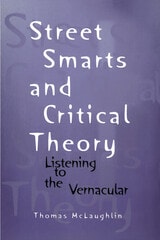
Street Smarts and Critical Theory
Listening to the VernacularThomas McLaughlin
University of Wisconsin Press, 1996
Everybody’s got a theory . . . or do they?
Thomas McLaughlin argues that critical theory—raising serious, sustained questions about cultural practice and ideology—is practiced not only by an academic elite but also by savvy viewers of sitcoms and TV news, by Elvis fans and Trekkies, by labor organizers and school teachers, by the average person in the street.
Like academic theorists, who are trained in a tradition of philosophical and political skepticism that challenges all orthodoxies, the vernacular theorists McLaughlin identifies display a lively and healthy alertness to contradiction and propaganda. They are not passive victims of ideology but active questioners of the belief systems that have power over their lives. Their theoretical work arises from the circumstances they confront on the job, in the family, in popular culture. And their questioning of established institutions, McLaughlin contends, is essential and healthy, for it energizes other theorists who clarify the purpose and strategies of institutions and justify the existence of cultural practices.
Street Smarts and Critical Theory leads us through eye-opening explorations of social activism in the Southern Christian anti-pornography movement, fan critiques in the ‘zine scene, New Age narratives of healing and transformation, the methodical manipulations of the advertising profession, and vernacular theory in the whole-language movement. Emphasizing that theory is itself a pervasive cultural practice, McLaughlin calls on academic institutions to recognize and develop the theoretical strategies that students bring into the classroom.
“This book demystifies the idea of theory, taking it out of the hands of a priestly caste and showing it as the democratic endowment of the people.”—Daniel T. O’Hara, Temple University, author of Radical Parody: American Culture and Critical Agency after Foucault and Lionel Trilling: The Work of Liberation.
“McLaughlin takes seriously the critical and theoretical activity of everyday people and does so in a way that will empower these very populations to take seriously their own activities as theorists. . . . A manifesto that is sure to be heard by the younger generation of thinkers in American cultural studies.”—Henry Jenkins, MIT, author of Textual Poachers: Television Fans and Participatory Culture
Subject to Delusions
Narcissism, Modernism, GenderCaroline Rupprecht
Northwestern University Press, 2006
Because "the other," or the object, is constructed, Rupprecht finds in narcissism the possibility of rewriting notions of identity. She then pursues this possibility through modern literary texts in which narcissism acts as a structuring principle—works by the expressionist poet Henriette Hardenberg, the American avant-garde novelist Djuna Barnes, and the surrealist writer Unica Zürn—reading each within the critical framework of the evolution of the idea of narcissism in psychoanalytic theory. All written by women, these works also raise questions of gender and sexuality. Moreover, because each of these authors belonged to or was influenced by a particular literary movement, Rupprecht's analysis advances our understanding of the poetics of these movements and of the movement of modernism itself. Underlying all is a deep engagement with psychoanalytic theory. Drawing on Freud, his contemporaries and rivals, Jacques Lacan, Melanie Klein, and many other theorists, Rupprecht interrogates preconceived notions of identity and subjectivity through her readings of the "transgressive potential" of narcissism as it is enacted in the texts under study. Bringing the works of literary modernism and psychoanalysis together in an innovative and provocative way, her book succeeds in enhancing our sense of both, and in clarifying the complex role of narcissism in our cultural narrative.
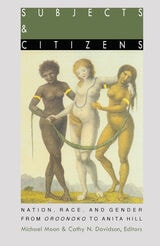
Subjects and Citizens
Nation, Race, and Gender from Oroonoko to Anita HillMichael Moon and Cathy N. Davidson, eds.
Duke University Press, 1995
Defining the landscape of the New American literary history, these essays are united by three interrelated concerns: ideas of origin (where does "American literature" begin?), ideas of nation (what does "American literature" mean?), and ideas of race and gender (what does "American literature" include and exclude and how?). Work by writers as diverse as Aphra Behn, James Fenimore Cooper, Edgar Allan Poe, Frances Harper, Harriet Beecher Stowe, Herman Melville, William Faulkner, Harriet Jacobs, Frederick Douglass, Abraham Lincoln, Bharati Mukherjee, Booker T. Washington, Mark Twain, Kate Chopin, Américo Paredes, and Toni Morrison are discussed from several theoretical perspectives, using a variety of methodologies. Issues of the "frontier" and the "border" as well as those of coloniality and postcoloniality are explored. In each case, these essays emphasize the ideological nature of national identity and, more specifically, the centrality of race and gender to our concept of nationhood.
Collected from recent issues of American Literature, with three new essays added, Subjects and Citizens charts the new directions being taken in American literary studies.
Contributors. Daniel Cooper Alarcón, Lori Askeland, Stephanie Athey, Nancy Bentley, Lauren Berlant, Michele A. Birnbaum, Kristin Carter-Sanborn, Russ Castronovo, Joan Dayan, Julie Ellison, Sander L. Gilman, Karla F. C. Holloway, Annette Kolodny, Barbara Ladd, Lora Romero, Ramón Saldívar, Maggie Sale, Siobhan Senier, Timothy Sweet, Maurice Wallace, Elizabeth Young
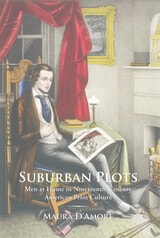
Suburban Plots
Men at Home in Nineteenth-Century American Print CultureMaura D'Amore
University of Massachusetts Press, 2014
In Suburban Plots, Maura D'Amore explores how Henry David Thoreau, Henry Ward Beecher, Donald Grant Mitchell, Nathaniel Hawthorne, Nathaniel Parker Willis, and others utilized the pen to plot opportunities for a new sort of male agency grounded, literarily and spatially, in a suburbanized domestic landscape. D'Amore uncovers surprising narratives that do not fit easily into standard critical accounts of midcentury home life. Taking men out of work spaces and locating them in the domestic sphere, these writers were involved in a complex process of portraying men struggling to fulfill fantasies outside of their professional lives, in newly emerging communities. These representations established the groundwork for popular conceptions of suburban domestic life that remain today.
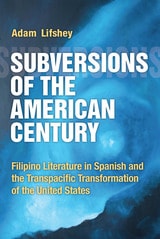
Subversions of the American Century
Filipino Literature in Spanish and the Transpacific Transformation of the United StatesAdam Lifshey
University of Michigan Press, 2016
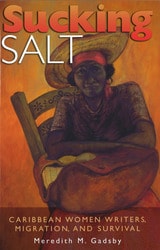
Sucking Salt
Caribbean Women Writers, Migration, and SurvivalMeredith M. Gadsby
University of Missouri Press, 2006
Sum of the Parts
The Mathematics and Politics of Region, Place, and WritingKent C Ryden
University of Iowa Press, 2011
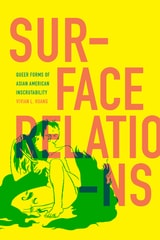
Surface Relations
Queer Forms of Asian American InscrutabilityVivian L. Huang
Duke University Press, 2022

Surviving Literary Suicide
Jeffrey Berman
University of Massachusetts Press, 1999
An exploration of the relationship between literature and life, this study examines the effect on readers of “suicidal literature”—novels and poems that depict, and sometimes glorify, the act of suicide. Beginning with a discussion of the growing incidence of suicide in American culture, Jeffrey Berman investigates the portrayal of suicide in the works of four authors who later took their own lives—Virginia Woolf, Ernest Hemingway, Sylvia Plath, and Anne Sexton— and two who did not—Kate Chopin and William Styron. In each case Berman discusses the writer's shifting attitude toward suicide, the tendency of critics to romanticize fictional suicide, and the impact of writing about suicide on the artist's own life. At the same time, Berman draws on his experiences as a teacher of these writings, analyzing student reactions to “literary suicide” as recorded in class diaries—responses ranging from grief and confusion to anger and guilt. By looking at the connection between real and imagined suicide, Berman seeks to shed fresh light on a subject long enshrouded in silence, fear, and mystery.