3071 books match the query 'Business & Economics' and 189 start with s

cover of Shopping: Material Culture Perspectives

Shopping

Material Culture Perspectives

Deborah C. Andrews

University of Delaware Press, 2015

The degree to which shopping, or, more broadly, consumerism, is both critiqued and defended in American society confirms the role that commercial goods play in our daily lives. This collection of essays provides case studies depicting selected aspects of this engaging activity. The authors include several historians with diverging specialties: an art historian, an anthropologist, an environmental journalist, a geographer and urban planner, and practicing artists. Each author demonstrates how a material culture perspective—a focus on the relationship between people and their things—can illuminate a specific corner of consumption. Connecting the essays are concerns about the spaces in which shopping occurs; about the experience of shopping itself, both individual and social; and about its economic, environmental, and personal downsides. Collectively, these essays demonstrate how a material culture perspective on shopping yields insights into multiple aspects of American culture.

Published by University of Delaware Press. Distributed worldwide by Rutgers University Press.

 
[more]
cover of Shortcut or Piecemeal: Economic Development Strategies and Structural Change

Shortcut or Piecemeal

Economic Development Strategies and Structural Change

Jan Winiecki

Central European University Press, 2016

Alternative strategies of economic development have received little attention in the literature. Academics rarely compare certain strategic features or assess the performance of different strategies in terms of outcomes. This book seeks to address that gap and to provide a theoretical background to the shift from industry to human capital-intensive services as the engine of economic growth. Pioneering studies reveal interesting trends and patterns that point to the growing importance of intangible capital for the level of GDP. They also indicate a much greater role of economic freedom in bringing about this second great structural change than was the case with industrialization. With this perspective on structural change and the role of freedom, Shortcut or Piecemeal also provides an extensive assessment of four key developing countries: Brazil, Russia, India, and China. Subjects: 1. Central planning—History. 2. Economic development—History
[more]
cover of Shoveling Smoke: Advertising and Globalization in Contemporary India

Shoveling Smoke

Advertising and Globalization in Contemporary India

William Mazzarella

Duke University Press, 2003

A leading Bombay advertising agency justifies as traditionally Indian the highly eroticized images it produces to promote the KamaSutra condom brand. Another agency struggles to reconcile the global ambitions of a cellular-phone service provider with the ambivalently local connotations of the client’s corporate brand. When the dream of the 250 million-strong “Indian middle class” goes sour, Indian advertising and marketing professionals search for new ways to market “the Indian consumer”—now with added cultural difference—to multinational clients.

An examination of the complex cultural politics of mass consumerism in a globalized marketplace, Shoveling Smoke is a pathbreaking and detailed ethnography of the contemporary Indian advertising industry. It is also a critical and innovative intervention into current theoretical debates on the intersection of consumerist globalization, aesthetic politics, and visual culture. William Mazzarella traces the rise in India during the 1980s of mass consumption as a self-consciously sensuous challenge to the austerities of state-led developmentalism. He shows how the decisive opening of Indian markets to foreign brands in the 1990s refigured established models of the relationship between the local and the global and, ironically, turned advertising professionals into custodians of cultural integrity.

[more]
cover of Shut Down the Business School: What's Wrong with Management Education

Shut Down the Business School

What's Wrong with Management Education

Martin Parker

Pluto Press, 2018

Even as higher education is under attack, one area is thriving: business schools. Shut Down the Business School explains why—and builds a convincing case that they are pernicious and should be closed. Martin Parker writes his polemic from the inside, drawing on his experience as a professor of management, and showing us that business schools are little more than loudspeakers for neoliberal capitalism, designed to produce unreflective managers whose primary focus is on their own personal rewards. If we believe that universities have responsibilities to society, Parker argues, then we must challenge the very foundation of the business school and its emphasis on the market above all else.
[more]
cover of Sick Planet: Corporate Food and Medicine

Sick Planet

Corporate Food and Medicine

Stan Cox

Pluto Press, 2008

Neoliberals often point to improvements in public health and nutrition as examples of globalisation's success, but this book argues that the corporate food and medicine industries are destroying environments and ruining living conditions across the world.

Scientist Stan Cox expertly draws out the strong link between Western big business and environmental destruction. This is a shocking account of the huge damage that drug manufacturers and large food corporations are inflicting on the health of people and crops worldwide. Companies discussed include Wal-Mart, GlaxoSmithKline, Tyson Foods and Monsanto. On issues ranging from the poisoning of water supplies in South Asia to natural gas depletion and how it threatens global food supplies, Cox shows how the demand for profits is always put above the public interest.

While individual efforts to "shop for a better world" and conserve energy are laudable, Cox explains that they need to be accompanied by an economic system that is grounded in ecological sustainability if we are to find a cure for our Sick Planet.
[more]
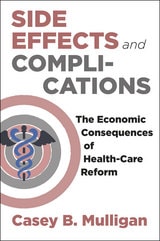
cover of Side Effects and Complications: The Economic Consequences of Health-Care Reform

Side Effects and Complications

The Economic Consequences of Health-Care Reform

Casey B. Mulligan

University of Chicago Press, 2015

The Affordable Care Act will have a dangerous effect on the American economy. That may sound like a political stance, but it’s a conclusion directly borne out by economic forecasts.  In Side Effects and Complications, preeminent labor economist Casey B. Mulligan brings to light the dire economic realities that have been lost in the ideological debate over the ACA, and he offers an eye-opening, accessible look at the price American citizens will pay because of it.

Looking specifically at the labor market, Mulligan reveals how the costs of health care under the ACA actually create implicit taxes on individuals, and how increased costs to employers will be passed on to their employees. Mulligan shows how, as a result, millions of workers will find themselves in a situation in which full-time work, adjusted for the expense of health care, will actually pay less than part-time work or even not working at all. Analyzing the incentives—or lack thereof—for people to earn more by working more, Mulligan offers projections on how many hours people will work and how productively they will work, as well as how much they will spend in general. Using the powerful tools of economics, he then illustrates the detrimental consequences on overall employment in the near future.

Drawing on extensive knowledge of the labor market and the economic theories at its foundation, Side Effects and Complications offers a crucial wake-up call about the risks the ACA poses for the economy. Plainly laying out the true costs of the ACA, Mulligan’s grounded and thorough predictions are something that workers and policy makers cannot afford to ignore.
[more]
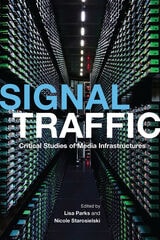
cover of Signal Traffic: Critical Studies of Media Infrastructures

Signal Traffic

Critical Studies of Media Infrastructures

Edited by Lisa Parks and Nicole Starosielski

University of Illinois Press, 2015

The contributors to Signal Traffic investigate how the material artifacts of media infrastructure--transoceanic cables, mobile telephone towers, Internet data centers, and the like--intersect with everyday life. Essayists confront the multiple and hybrid forms networks take, the different ways networks are imagined and engaged with by publics around the world, their local effects, and what human beings experience when a network fails.

Some contributors explore the physical objects and industrial relations that make up an infrastructure. Others venture into the marginalized communities orphaned from the knowledge economies, technological literacies, and epistemological questions linked to infrastructural formation and use. The wide-ranging insights delineate the oft-ignored contrasts between industrialized and developing regions, rich and poor areas, and urban and rural settings, bringing technological differences into focus.

Contributors include Charles R. Acland, Paul Dourish, Sarah Harris, Jennifer Holt and Patrick Vonderau, Shannon Mattern, Toby Miller, Lisa Parks, Christian Sandvig, Nicole Starosielski, Jonathan Sterne, and Helga Tawil-Souri.

[more]
cover of Signaling Goodness: Social Rules and Public Choice

Signaling Goodness

Social Rules and Public Choice

Phillip J. Nelson and Kenneth V. Greene

University of Michigan Press, 2003

Political, intellectual, and academic discourse in the United States has been awash in political correctness, which has itself been berated and defended -- yet little understood. As a corrective, Nelson and Greene look at a more general process: adopting political positions to enhance one's reputation for trustworthiness both to others and to oneself.
Phillip Nelson and Kenneth Greene are Professors of Economics in the Department of Economics at the State University of New York, Binghamton.
[more]
cover of Signs in America's Auto Age: Signatures of Landscape and Place

Signs in America's Auto Age

Signatures of Landscape and Place

John A. & Keith A. Jakle & Sculle

University of Iowa Press, 2004

Signs orient, inform, persuade, and regulate. They help give meaning to our natural and human-built environment, to landscape and place. In Signs in America’s Auto Age, cultural geographer John Jakle and historian Keith Sculle explore the ways in which we take meaning from outdoor signs and assign meaning to our surroundings—the ways we “read” landscape. With an emphasis on how the use of signs changed as the nation’s geography reorganized around the coming of the automobile, Jakle and Sculle consider the vast array of signs that have evolved since the beginning of the twentieth century.
[more]
cover of Silent Looms: Women and Production in a Guatemalan Town

Silent Looms

Women and Production in a Guatemalan Town

By Tracy Bachrach Ehlers

University of Texas Press, 2000

Based on new fieldwork in 1997, Tracy Bachrach Ehlers has updated her classic study of the effects of economic development on the women weavers of San Pedro Sacatepéquez. Revisiting many of the women she interviewed in the 1970s and 1980s and revising her earlier hopeful assessment of women's entrepreneurial opportunities, Ehlers convincingly demonstrates that development and commercial growth in the region have benefited men at the expense of women.

[more]
cover of Silver “Thieves," Tin Barons, and Conquistadors: Small-Scale Mineral Production in Southern Bolivia

Silver “Thieves," Tin Barons, and Conquistadors

Small-Scale Mineral Production in Southern Bolivia

Mary Van Buren

University of Arizona Press, 2024

The Spanish conquest of Peru was motivated by the quest for precious metals, a search that resulted in the discovery of massive silver deposits in what is now southern Bolivia. The enormous flow of specie into the world economy is usually attributed to the Spanish imposition of a forced labor system on the Indigenous population as well as the introduction of European technology. This narrative omits the role played by thousands of independent miners, often working illegally, who at different points in history generated up to 30 percent of the silver produced in the region. In this work, Mary Van Buren examines the long-term history of these workers, the technology they used, and their relationship to successive large-scale mining.

The methods of historian Bertell Ollman, particularly a dialectical approach and “doing history backwards,” are used to examine small-scale mineral production in Porco, Bolivia. The research is based on nine seasons of archaeological fieldwork and historical research, with a particular focus on labor and technology. Van Buren argues that artisanal mineral production must be understood in relation to large-scale mining rather than as a traditional practice and that the Bolivian case is a culturally specific instantiation of a broader economic phenomenon that began under colonial regimes.

[more]
cover of Singular Europe: Economy and Polity of the European Community after 1992

Singular Europe

Economy and Polity of the European Community after 1992

William James Adams, Editor

University of Michigan Press, 1994
Singular Europe: Economy and Polity of the European Community after 1992 offers a thorough, multidisciplinary analysis of the sweeping changes and enduring challenges that faced the European Community in the wake of its ambitious 1992 integration project. Sponsored by the Chicago Council on Foreign Relations and drawing on the insights of leading economists, political scientists, and policymakers, this volume examines the economic, legal, and political forces that would shape Europe’s future at the end of the twentieth century.Taking its cue from the landmark “Project 1992”—the drive to create a single market for goods, services, capital, and people—the book begins by exploring the transformative view of a Europe no longer defined by its declining “Old Continent” image, but as a dynamic, populous, and increasingly prosperous global actor. Through three thematic parts, contributors address critical questions about the meaning and limits of integration: What steps remain for true political and economic union? How has European integration redefined competition, corporate strategy, social policy, and regulation? What are the external implications, and will the so-called “Fortress Europe” change global economic relations?With essays covering legitimacy and democracy after Maastricht, German reunification, the challenges of monetary union, competition policy, the social welfare state, telecommunications, banking, and international trade, Singular Europe blends scholarly rigor and policy relevance. The volume is a vital resource for anyone seeking to understand the ambitions and anxieties of a pivotal moment in Europe’s integration—and the ongoing debate over the balance between unity and diversity within the continent.
[more]
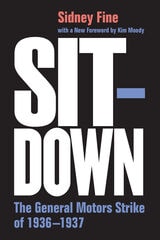
cover of Sit-Down: The General Motors Strike of 1936-1937

Sit-Down

The General Motors Strike of 1936-1937

Sidney Fine

University of Michigan Press, 2020

In this classic study, Sidney Fine portrays the dramatic events of the 1936–37 Flint Sit-down Strike against General Motors, which catapulted the UAW into prominence and touched off a wave of sit-down strikes across the United States. Basing his account on an impressive variety of manuscript sources, Fine analyzes the strategy and tactics of GM and the UAW, describes the life of the workers in the occupied plants, and examines the troubled governmental and public reaction to the alleged breakdown of law and order in the strikes. In addition, Fine provides vivid portraits of the major figures on both sides of the conflict: Governor Frank Murphy; Alfred Sloan, Jr.; William Knudsen; Robert Travis; Roy, Victor, and Walter Reuther; Homer Martin; and Wyndham Mortimer. The GM sit-down strike marks the close of one era of labor-management relations in the United States and the beginning of another. A half century after its initial publication, Fine’s work remains the definitive account of that momentous conflict. A new foreword by Kim Moody’s revisits Sit-Down in order to demonstrate its continued relevance to today’s unions, workers, and activists.
[more]
cover of Sitting with Elephants: Lessons in Humility from the African Bush, Enhanced and Expanded Second Edition

Sitting with Elephants

Lessons in Humility from the African Bush, Enhanced and Expanded Second Edition

Ronald Dulek, Illustrations by Abbey Ndlovu

University of Alabama Press, 2026

A professor of communication and strategy reveals deep lessons from life in the African bush.

Sitting with Elephants is a heartfelt memoir that follows a middle-aged American professor and his wife as they trade suburban life for a remote bush house in South Africa. What begins as a spontaneous decision becomes a life-changing experience—one shaped by lions at the backdoor, baboons in the rafters, and above all, a herd of elephants who frequent their yard like neighbors.

Told through a series of emails to their adult children and brought to life by vivid illustrations from Abbey Ndlovu, Ronald Dulek’s narrative explores the profound lessons nature teaches: patience, humility, and deep respect for the wild. As the couple learns to communicate with elephants and navigate the rhythms of bush life, they also reflect on the unexpected beauty of slowing down and embracing the unknown.

Blending lighthearted anecdotes with moments of quiet insight, Sitting with Elephants invites readers into a story of transformation—both personal and environmental. This second edition includes expanded content with new stories and reflections, offering a deeper look into the couple’s unforgettable time in the African bush.

[more]
cover of Slaughterhouse: Chicago's Union Stock Yard and the World It Made

Slaughterhouse

Chicago's Union Stock Yard and the World It Made

Dominic A. Pacyga

University of Chicago Press, 2015

From the minute it opened—on Christmas Day in 1865—it was Chicago’s must-see tourist attraction, drawing more than half a million visitors each year. Families, visiting dignitaries, even school groups all made trips to the South Side to tour the Union Stock Yard. There they got a firsthand look at the city’s industrial prowess as they witnessed cattle, hogs, and sheep disassembled with breathtaking efficiency. At their height, the kill floors employed 50,000 workers and processed six hundred animals an hour, an astonishing spectacle of industrialized death.
Slaughterhouse tells the story of the Union Stock Yard, chronicling the rise and fall of an industrial district that, for better or worse, served as the public face of Chicago for decades. Dominic A. Pacyga is a guide like no other—he grew up in the shadow of the stockyards, spent summers in their hog house and cattle yards, and maintains a long-standing connection with the working-class neighborhoods around them. Pacyga takes readers through the packinghouses as only an insider can, covering the rough and toxic life inside the plants and their lasting effects on the world outside. He shows how the yards shaped the surrounding neighborhoods and controlled the livelihoods of thousands of families. He looks at the Union Stock Yard’s political and economic power and its sometimes volatile role in the city’s race and labor relations. And he traces its decades of mechanized innovations, which introduced millions of consumers across the country to an industrialized food system.
Once the pride and signature stench of a city, the neighborhood is now home to Chicago’s most successful green agriculture companies. Slaughterhouse is the engrossing story of the creation and transformation of one of the most important—and deadliest—square miles in American history.

[more]
cover of Slaves to Fashion: Poverty and Abuse in the New Sweatshops

Slaves to Fashion

Poverty and Abuse in the New Sweatshops

Robert J. S. Ross

University of Michigan Press, 2004

"A brilliant and beautiful book, the mature work of a lifetime, must reading for students of the globalization debate."
---Tom Hayden

"Slaves to Fashion is a remarkable achievement, several books in one: a gripping history of sweatshops, explaining their decline, fall, and return; a study of how the media portray them; an analysis of the fortunes of the current anti-sweatshop movement; an anatomy of the global traffic in apparel, in particular the South-South competition that sends wages and working conditions plummeting toward the bottom; and not least, a passionate declaration of faith that humanity can find a way to get its work done without sweatshops. This is engaged sociology at its most stimulating."
---Todd Gitlin

". . . unflinchingly portrays the reemergence of the sweatshop in our dog-eat-dog economy."
---Los Angeles Times


Just as Barbara Ehrenreich's Nickel and Dimed uncovered the plight of the working poor in America, Robert J. S. Ross's Slaves to Fashion exposes the dark side of the apparel industry and its exploited workers at home and abroad. It's both a lesson in American business history and a warning about one of the most important issues facing the global capital economy-the reappearance of the sweatshop.

Vividly detailing the decline and tragic rebirth of sweatshop conditions in the American apparel industry of the twentieth century, Ross explains the new sweatshops as a product of unregulated global capitalism and associated deregulation, union erosion, and exploitation of undocumented workers. Using historical material and economic and social data, the author shows that after a brief thirty-five years of fair practices, the U.S. apparel business has once again sunk to shameful abuse and exploitation.

Refreshingly jargon-free but documented in depth, Slaves to Fashion is the only work to estimate the size of the sweatshop problem and to systematically show its impact on apparel workers' wages. It is also unique in its analysis of the budgets and personnel used in enforcing the Fair Labor Standards Act.

Anyone who is concerned about this urgent social and economic topic and wants to go beyond the headlines should read this important and timely contribution to the rising debate on low-wage factory labor.

 
Robert J.S. Ross is Professor of Sociology, Clark University. He is an expert in the area of sweatshops and globalization. He is an activist academic who travels and lectures extensively and has published numerous related articles.


[more]
cover of Slaves, Spices and Ivory in Zanzibar: Integration of an East African Commercial Empire into the World Economy, 1770–1873

Slaves, Spices and Ivory in Zanzibar

Integration of an East African Commercial Empire into the World Economy, 1770–1873

Abdul Sheriff

Ohio University Press, 1987

The rise of Zanzibar was based on two major economic transformations. Firstly slaves became used for producing cloves and grains for export. Previously the slaves themselves were exported.

Secondly, there was an increased international demand for luxuries such as ivory. At the same time the price of imported manufactured gods was falling. Zanzibar took advantage of its strategic position to trade as far as the Great Lakes.

However this very economic success increasingly subordinated Zanzibar to Britain, with its anti-slavery crusade and its control over the Indian merchant class.

Professor Sheriff analyses the early stages of the underdevelopment of East Africa and provides a corrective to the dominance of political and diplomatic factors in the history of the area.

[more]
cover of Sloan Rules: Alfred P. Sloan and the Triumph of General Motors

Sloan Rules

Alfred P. Sloan and the Triumph of General Motors

David Farber

University of Chicago Press, 2002

Alfred P. Sloan Jr. became the president of General Motors in 1923 and stepped down as its CEO in 1946. During this time, he led GM past the Ford Motor Company and on to international business triumph by virtue of his brilliant managerial practices and his insights into the new consumer economy he and GM helped to produce. Bill Gates has said that Sloan's 1964 management tome, My Years with General Motors, "is probably the best book to read if you want to read only one book about business." And if you want to read only one book about Sloan, that book should be historian David Farber's Sloan Rules.

Here, for the first time, is a study of both the difficult man and the pathbreaking executive. Sloan Rules reveals the GM genius as not only a driven manager of men, machines, money, and markets but also a passionate and not always wise participant in the great events of his day. Sloan, for example, reviled Franklin Roosevelt and the New Deal; he firmly believed that politicians, government bureaucrats, and union leaders knew next to nothing about the workings of the new consumer economy, and he did his best to stop them from intervening in the private enterprise system. He was instrumental in transforming GM from the country's largest producer of cars into the mainstay of America's "Arsenal of Democracy" during World War II; after the war, he bet GM's future on renewed American prosperity and helped lead the country into a period of economic abundance. Through his business genius, his sometimes myopic social vision, and his vast fortune, Sloan was an architect of the corporate-dominated global society we live in today.

David Farber's story of America's first corporate genius is biography of the highest order, a portrait of an extraordinarily compelling and skillful man who shaped his era and ours.

[more]
cover of Sloss Furnaces and the Rise of the Birmingham District: An Industrial Epic

Sloss Furnaces and the Rise of the Birmingham District

An Industrial Epic

W. David Lewis

University of Alabama Press, 1994

"A masterpiece that deserves to be ranked with such seminal and influential works as Cash’s Mind of the South." —Edwin T. Layton Jr., author of The Revolt of the Engineers: Social Responsibility and the American Profession

This pathbreaking book tells the dramatic story of a unique manufacturing complex and the city that it helped to create. The events recounted and  interpreted by W. David Lewis are of more than local or regional significance. The rise of Sloss furnaces and Birmingham epitomized the emergence of the United States as the world's foremost economic power.  Similarly, the closing of a once-profitable ironmaking installation amid social and technological changes that convulsed Birmingham nine decades after the city's founding typified challenges that were facing America at the dawn of the postindustrial age.

Above all,  Sloss Furnaces resonates with the class of competition and the frenetic energy with which southerners joined other Americans in a rush to transform a continent after a fratricidal drive for independence had failed. The sweeping narrative that Lewis has produced amply justifies its subtitle, An Industrial Epic.
[more]
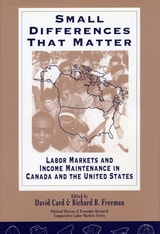
cover of Small Differences That Matter: Labor Markets and Income Maintenance in Canada and the United States

Small Differences That Matter

Labor Markets and Income Maintenance in Canada and the United States

Edited by David Card and Richard B. Freeman

University of Chicago Press, 1993

This volume, the first in a new series by the National Bureau of Economic Research that compares labor markets in different countries, examines social and labor market policies in Canada and the United States during the 1980s. It shows that subtle differences in unemployment compensation, unionization, immigration policies, and income maintenance programs have significantly affected economic outcomes in the two countries.

For example:

-Canada's social safety net, more generous than the American one, produced markedly lower poverty rates in the 1980s.
 
-Canada saw a smaller increase in earnings inequality than the United States did, in part because of the strength of Canadian unions, which have twice the participation that U.S. unions do.

-Canada's unemployment figures were much higher than those in the United States, not because the Canadian economy failed to create jobs but because a higher percentage of nonworking time was reported as unemployment.

These disparities have become noteworthy as policy makers cite the experiences of the other country to support or oppose particular initiatives.

[more]
cover of Small Is Necessary: Shared Living on a Shared Planet

Small Is Necessary

Shared Living on a Shared Planet

Anitra Nelson

Pluto Press, 2018

Does small mean less? Not necessarily. In an era of housing crises, environmental unsustainability and social fragmentation, the need for more sociable, affordable and sustainable housing is vital. The answer? Shared living - from joint households to land-sharing, cohousing and ecovillages.

Using successful examples from a range of countries, Anitra Nelson shows how 'eco-collaborative housing' - resident-driven low impact living with shared facilities and activities - can address the great social, economic and sustainability challenges that householders and capitalist societies face today. Sharing living spaces and facilities results in householders having more amenities and opportunities for neighbourly interaction.

Small is Necessary places contemporary models of 'alternative' housing and living at centre stage arguing that they are outward-looking, culturally rich, with low ecological footprints and offer governance techniques for a more equitable and sustainable future.
[more]
cover of Small Privatization: The Transformation of Retail Trade and Consumer Services in the Czech Republic, Hungary and Poland

Small Privatization

The Transformation of Retail Trade and Consumer Services in the Czech Republic, Hungary and Poland

Roman Frydman

Central European University Press, 1994

The authors of this treatise attempt to provide a deeper understanding of the economic and political transformations now taking place in Poland, Hungary and the Czech Republic. They build up a detailed picture of the privatization process in the retail trade, catering and more general services. Not only are these sectors strongly relevant to consumers in these countries, but they also offer attractive possibilities for property ownership on a mass scale, as well as for the fostering of the small enterprises and entrepreneurial spirit that will be so important in the future.
[more]
cover of Small and Medium-Sized Enterprises in the Global Economy

Small and Medium-Sized Enterprises in the Global Economy

Zoltan J. Acs and Bernard Yeung, Editors

University of Michigan Press, 1999

Entrepreneurship and globalization are two much-examined forces as we enter the new millennium--yet very little has been published on the intersection of small and medium-sized enterprises (SMEs) and the global economy. To close the gap, this volume delves into the intricate roles and consequences of such businesses on both global and domestic economies.
The first part of the volume provides an overview of the phenomenon of globalization, arguing that entrepreneurial discovery and technological change lead to globalization, which in turn leads to further opportunity for entrepreneurial discovery--no less for SMEs than for multinational corporations. In part two, the essays examine the role of SMEs in the global economy and why they are thriving. Part three reviews the roles of SMEs and innovators and examines their roles in direct foreign investment. Part four explores the role of technological diversity and knowledge spillovers as a way to explain the superior innovative performance of SMEs. Part five looks at the role of SMEs in technology transfer. Finally, part six examines the theoretical and policy implications of the international activities of SMEs, suggesting that policies should aim to reduce the costs in international expansion for SMEs.
This volume will provide the foundation for further study in SMEs and globalization. It will appeal to scholars and students in both international business and economics.
Zoltan J. Acs is Professor of Economics and Finance, University of Baltimore. Bernard Yin Yeung is Professor of International Business, University of Michigan.
[more]
cover of Smart Governance: Governing the Global Knowledge Society

Smart Governance

Governing the Global Knowledge Society

Helmut Willke

Campus Verlag, 2007

In the wake of globalization, national governments are becoming increasingly interdependent, and knowledge is arguably becoming the most valuable form of capital. Helmut Willke’s Smart Governance offers a new perspective on global governance from the vantage point of a global knowledge society.

Employing a case study of the global financial system and an analysis of several governance regimes, Willke contends that markets, legal systems, and morality must evolve to cope with uncertainty, build capacities, and achieve resilience. Smart Governance will change the way economists, historians, and political scientists view international cooperation.

 

[more]
cover of Smartland Korea: Mobile Communication, Culture, and Society

Smartland Korea

Mobile Communication, Culture, and Society

Dal Yong Jin

University of Michigan Press, 2017

The dramatic advancement of cellphone technology has fundamentally changed our daily lives. Smartphones and their applications have created new capital for information and communication technology corporations and changed the way people communicate. Because of an interesting awareness of the significance for digital economy and people’s daily culture, many countries, from the U.S. to China, have massively invested in the smartphone industries since the early 21st century. Among them, South Korea has become one of the centers for technology development and digital culture, although the country was once lagging behind in the penetration of the phones and their apps. Yet within the last few years, the country has taken a big step toward their goal of becoming a ‘mobile game wonderland’ by appropriating smartphones and it now exists as a curious test-bed for the future of smartphone technology. Smartland Korea, as the first attempt to comprehensively analyze mobile communication in the context of Korean smartphones, looks into a largely neglected focus of inquiry, a localized mobile landscape, with particular reference to young Koreans’ engagement with their devices and applications. Dal Yong Jin focuses not only on the celebratory achievement of technological advancement, but also the significance of social milieu in the development of the smartphones. He situates the emergence of smartphones within the growth of mobile technologies and overall telecommunications industries embedded in Korea’s information and communication technologies. The book examines the technology’s innovation and the evolution, the digital economy through the lens of political economy, and the youth culture embedded in the Korean smartphone context.

[more]
cover of So Great Was the Slaughter: Market Hunters, Sportsmen, and Wildlife Conservation in Arkansas

So Great Was the Slaughter

Market Hunters, Sportsmen, and Wildlife Conservation in Arkansas

Buckley T. Foster

University of Alabama Press, 2025

Winner of the 2026 J.G. Ragsdale Book Award

So Great Was the Slaughter reveals the untold story of Arkansas conservation pioneers who saved the state’s game and fish populations. As Arkansas entered the twentieth century, the national demand for meat combined with the ability to ship millions of animals to hungry cities like New Orleans, Memphis, and Chicago had driven many species, including bison and passenger pigeons, to extinction in Arkansas. Many others, including deer, bear, turkey, quail, and fish, were in danger of disappearing.

In response, an unlikely coalition of Arkansas sportsmen, hunters, and conservationists created a vision for conservation legislation, game laws, and the establishment of fish hatcheries and wildlife refuges. With support from influential outsiders like E. A. McIlhenny and the United States Biological Survey, they waged a long battle against entrenched political and commercial interests.

Buckley Foster’s meticulous research reveals how these pioneers fought to save the state’s wildlife resources from destruction and laid the foundations for sustainable, modern wildlife management in Arkansas. So Great Was the Slaughter will fascinate hunters, conservationists, historians, and those interested in the history of wildlife conservation and conflicts between market hunters and sportsmen in the United States and the American South.
[more]
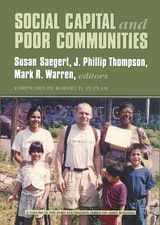
cover of Social Capital and Poor Communities

Social Capital and Poor Communities

Susan Saegert

Russell Sage Foundation, 2001
Neighborhood support groups have always played a key role in helping the poor survive, but combating poverty requires more than simply meeting the needs of day-to-day subsistence. Social Capital and Poor Communities shows the significant achievements that can be made through collective strategies, which empower the poor to become active partners in revitalizing their neighborhoods. Trust and cooperation among residents and local organizations such as churches, small businesses, and unions form the basis of social capital, which provides access to resources that would otherwise be out of reach to poor families. Social Capital and Poor Communities examines civic initiatives that have built affordable housing, fostered small businesses, promoted neighborhood safety, and increased political participation. At the core of each initiative lie local institutions—church congregations, parent-teacher groups, tenant associations, and community improvement alliances. The contributors explore how such groups build networks of leaders and followers and how the social power they cultivate can be successfully transferred from smaller goals to broader political advocacy. For example, community-based groups often become platforms for leaders hoping to run for local office. Church-based groups and interfaith organizations can lobby for affordable housing, job training programs, and school improvement. Social Capital and Poor Communities convincingly demonstrates why building social capital is so important in enabling the poor to seek greater access to financial resources and public services. As the contributors make clear, this task is neither automatic nor easy. The book's frank discussions of both successes and failures illustrate the pitfalls—conflicts of interest, resistance from power elites, and racial exclusion—that can threaten even the most promising initiatives. The impressive evidence in this volume offers valuable insights into how goal formation, leadership, and cooperation can be effectively cultivated, resulting in a remarkable force for change and a rich public life even for those communities mired in seemingly hopeless poverty. A Volume in the Ford Foundation Series on Asset Building
[more]
cover of Social Class: How Does It Work?

Social Class

How Does It Work?

Annette Lareau

Russell Sage Foundation, 2008
Class differences permeate the neighborhoods, classrooms, and workplaces where we lead our daily lives. But little is known about how class really works, and its importance is often downplayed or denied. In this important new volume, leading sociologists systematically examine how social class operates in the United States today. Social Class argues against the view that we are becoming a classless society. The authors show instead the decisive ways social class matters—from how long people live, to how they raise their children, to how they vote. The distinguished contributors to Social Class examine how class works in a variety of domains including politics, health, education, gender, and the family. Michael Hout shows that class membership remains an integral part of identity in the U.S.—in two large national surveys, over 97 percent of Americans, when prompted, identify themselves with a particular class. Dalton Conley identifies an intangible but crucial source of class difference that he calls the "opportunity horizon"—children form aspirations based on what they have seen is possible. The best predictor of earning a college degree isn't race, income, or even parental occupation—it is, rather, the level of education that one's parents achieved. Annette Lareau and Elliot Weininger find that parental involvement in the college application process, which significantly contributes to student success, is overwhelmingly a middle-class phenomenon. David Grusky and Kim Weeden introduce a new model for measuring inequality that allows researchers to assess not just the extent of inequality, but also whether it is taking on a more polarized, class-based form. John Goldthorpe and Michelle Jackson examine the academic careers of students in three social classes and find that poorly performing students from high-status families do much better in many instances than talented students from less-advantaged families. Erik Olin Wright critically assesses the emphasis on individual life chances in many studies of class and calls for a more structural conception of class. In an epilogue, journalists Ray Suarez, Janny Scott, and Roger Hodge reflect on the media's failure to report hardening class lines in the United States, even when images on the nightly news—such as those involving health, crime, or immigration—are profoundly shaped by issues of class. Until now, class scholarship has been highly specialized, with researchers working on only one part of a larger puzzle. Social Class gathers the most current research in one volume, and persuasively illustrates that class remains a powerful force in American society.
[more]
cover of Social Dimensions of U.S. Trade Policies

Social Dimensions of U.S. Trade Policies

Alan V. Deardorff and Robert M. Stern, Editors

University of Michigan Press, 2000

The contributors to this volume include numerous members of the trade policy community who analyze and discuss the salient social dimensions of U.S. trade policies. These issues include the effects of trade on wage inequality; trade and immigration policy; U.S. trade adjustment assistance policies; the effects of NAFTA on environmental quality; the role of labor standards in U.S. trade policies; the economics of labor standards and the GATT; issues of child labor; and the role of interest groups in the design and implementation of U.S. trade policies.
Chapter authors are Kyle Bagwell, Claude Barfield, George J. Borjas, Drusilla K. Brown, Alan V. Deardorff, Nancy Dunne, Gary S. Fields, John Kirton, Mike Jendrzejczyk, Phyllis Shearer Jones, Edward E. Leamer, Robert Naiman, Gregory K. Schoepfle, Robert W. Staiger, and Robert M. Stern.
Commenters are Steve Beckman, Jagdish Bhagwati, Alan V. Deardorff, Avinash Dixit, Pharis Harvey, David van Hoogstraten, John H. Jackson, Lawrence Mishel, Jack Otero, J. David Richardson, Dani Rodrik, Mark Silbergeld, and T. N. Srinivasan.
Alan V. Deardorff and Robert M. Stern are Professors of Economics and Public Policy, University of Michigan.
[more]
cover of Social Exchange: Barter as Economic and Cultural Activism in Medellín, Colombia

Social Exchange

Barter as Economic and Cultural Activism in Medellín, Colombia

Brian J. Burke

Rutgers University Press, 2022
Money occupies a powerful place in our lives – it is a problem, a goal, and motivator, a measure of self-worth and national progress, and even an influence on how we relate to each other and to nature – but what happens when communities start to reinvent money and markets? Over the last twenty-five years, grassroots activists in Medellín, Colombia, have used barter markets and community currencies as one strategy to re-weave a social fabric shredded by violence and to establish an economy founded on respect and reciprocity rather than exploitation. In Social Exchange, Brian J. Burke provides a deep ethnographic investigation of this activism and its effects. This story draws us into the cultural and material effects of capitalism and narco-violence, while also helping us understand what new radical imaginations look like and how people bring them to life. The result is an intimate glimpse of urban life in Latin America, as well as a broader analysis of non-capitalist or post-capitalist possibility.
[more]
cover of Social Inequality

Social Inequality

Kathryn Neckerman

Russell Sage Foundation, 2004
Inequality in income, earnings, and wealth has risen dramatically in the United States over the past three decades. Most research into this issue has focused on the causes—global trade, new technology, and economic policy—rather than the consequences of inequality. In Social Inequality, a group of the nation's leading social scientists opens a wide-ranging inquiry into the social implications of rising economic inequality. Beginning with a critical evaluation of the existing research, they assess whether the recent run-up in economic inequality has been accompanied by rising inequality in social domains such as the quality of family and neighborhood life, equal access to education and health care, job satisfaction, and political participation. Marcia Meyers and colleagues find that many low-income mothers cannot afford market-based child care, which contributes to inequality both at the present time—by reducing maternal employment and family income—and through the long-term consequences of informal or low-quality care on children's educational achievement. At the other end of the educational spectrum, Thomas Kane links the growing inequality in college attendance to rising tuition and cuts in financial aid. Neil Fligstein and Taek-Jin Shin show how both job security and job satisfaction have decreased for low-wage workers compared with their higher-paid counterparts. Those who fall behind economically may also suffer diminished access to essential social resources like health care. John Mullahy, Stephanie Robert, and Barbara Wolfe discuss why higher inequality may lead to poorer health: wider inequality might mean increased stress-related ailments for the poor, and it might also be associated with public health care policies that favor the privileged. On the political front, Richard Freeman concludes that political participation has become more stratified as incomes have become more unequal. Workers at the bottom of the income scale may simply be too hard-pressed or too demoralized to care about political participation. Social Inequality concludes with a comprehensive section on the methodological problems involved in disentangling the effects of inequality from other economic factors, which will be of great benefit to future investigators. While today's widening inequality may be a temporary episode, the danger is that the current economic divisions may set in motion a self-perpetuating cycle of social disadvantage. The most comprehensive review of this quandary to date, Social Inequality maps out a new agenda for research on inequality in America with important implications for public policy.
[more]
cover of Social Norms and Economic Institutions

Social Norms and Economic Institutions

Kenneth J. Koford and Jeffrey B. Miller, Editors

University of Michigan Press, 1991

Economists, philosophers, and legal scholars come together in Social Norms and Economic Institutions to examine how economists' rational decision-making models are influenced by ethical values and social norms.   Economists find it difficult to include considerations of ethical values and social norms in their behavioral models, for these factors are neither goods nor constraints in the usual sense. And, while custom and social norms influence individual behavior, economists have not determined how they affect aggregate economic outcomes. Editors Kenneth J. Koford and Jeffrey B. Miller argue persuasively that these powerful societal and cultural forces influence decision making in important ways that cannot be captured by models that take into account only self-interested behavior.   The contributors address such questions as how norms change, how a common sense of fairness can survive in a world of heterogeneous values, how such principles can help to determine appropriate penalties for corporate misconduct, and how fairness can be an important element in determining a "fair" bargaining equilibrium in contract negotiations.   Sociologists, philosophers, business ethicists, legal scholars, and economists alike will appreciate the value of this volume in enriching their understanding of how ethical values and social norms can be incorporated in standard behavioral models.
[more]
cover of Social Protection vs. Economic Flexibility: Is There a Tradeoff?

Social Protection vs. Economic Flexibility

Is There a Tradeoff?

Edited by Rebecca M. Blank

University of Chicago Press, 1994

As the Clinton administration considers major overhauls in health insurance, welfare, and labor market regulation, it is important for economists and policymakers to understand the impact of social and welfare programs on employment rates. This volume explores how programs such as social security, income transfers, and child care in Western Europe, the United States, and Japan have affected labor market flexibility—the ability of workers to adjust to fast-growing segments of the economy.

Does tying health insurance to employment limit job mobility? Do housing policies inhibit workers from moving to new jobs in different areas? What are the effects of daycare and maternity leave policies on working mothers? The authors explore these and many other questions in an effort to understand why European unemployment rates are so high compared with the U.S. rate. Through an examination of diverse data sets across different countries, the authors find that social protection programs do not strongly affect labor market flexibility.

A valuable comparison of labor markets and welfare programs, this book demonstrates how social protection policies have affected employment rates around the globe.
[more]
cover of Social Responsibilities of the Businessman

Social Responsibilities of the Businessman

Howard R. Bowen

University of Iowa Press, 2013

Corporate social responsibility (CSR) expresses a fundamental morality in the way a company behaves toward society. It follows ethical behavior toward stakeholders and recognizes the spirit of the legal and regulatory environment. The idea of CSR gained momentum in the late 1950s and 1960s with the expansion of large conglomerate corporations and became a popular subject in the 1980s with R. Edward Freeman's Strategic Management: A Stakeholder Approach and the many key works of Archie B. Carroll, Peter F. Drucker, and others. In the wake of the financial crisis of 2008–2010, CSR has again become a focus for evaluating corporate behavior.

First published in 1953, Howard R. Bowen’s Social Responsibilities of the Businessman was the first comprehensive discussion of business ethics and social responsibility. It created a foundation by which business executives and academics could consider the subjects as part of strategic planning and managerial decision-making. Though written in another era, it is regularly and increasingly cited because of its relevance to the current ethical issues of business operations in the United States. Many experts believe it to be the seminal book on corporate social responsibility.

This new edition of the book includes an introduction by Jean-Pascal Gond, Professor of Corporate Social Responsibility at Cass Business School, City University of London, and a foreword by Peter Geoffrey Bowen, Daniels College of Business, University of Denver, who is Howard R. Bowen's eldest son.
[more]
cover of Social Science Knowledge and Economic Development: An Institutional Design Perspective

Social Science Knowledge and Economic Development

An Institutional Design Perspective

Vernon W. Ruttan

University of Michigan Press, 2003

Ruttan advances a model of institutional change, which creates an environment where resource and cultural endowments and technical change can take place. The disequilibria resulting from such changes create opportunities for the design of more efficient institutional arrangements. The design perspective employed in the book stands in sharp contrast to organic or evolutionary perspectives.
With its emphasis on interdisciplinarity, Social Science Knowledge and Economics Developmentis important reading for social scientists, development economists, and in the development studies classroom.
Vernon W. Ruttan is Regents Professor Emeritus in the Department of Applied Economics at the University of Minnesota.
[more]
cover of Social Science and Policy-Making: A Search for Relevance in the Twentieth Century

Social Science and Policy-Making

A Search for Relevance in the Twentieth Century

David L. Featherman and Maris A. Vinovskis, Editors

University of Michigan Press, 2001

This collection of essays examines how the social sciences in America were developed as a means of social reform and later, especially after World War II, as a tool in federal policymaking and policy analysis. It also uses arenas of policymaking, such as early childhood education and welfare and its reform, as case studies in which social research was used, in policy decisions or in setting and evaluating policy goals. The book is written to aid students of public policy to appreciate the complex relationship of information--principally, of social science research--to policymaking at the federal level.
David L. Featherman is Professor of Sociology and Psychology, Director and Senior Research Scientist, Institute for Social Research, University of Michigan. Maris A. Vinovskis is Bentley Professor of History, Senior Research Scientist, Institute for Social Research, Faculty member, School of Public Policy, University of Michigan.
[more]
cover of Social Science in the Making: Essays on the Russell Sage Foundation, 1907-1972

Social Science in the Making

Essays on the Russell Sage Foundation, 1907-1972

David C. Hammack

Russell Sage Foundation, 1994

"Together, the historical essays in this volume provide the best account of how the Foundation moved away from its roots as a policy think tank.... This book of essays is the only extended treatment of the Foundation's history that includes both its distinguished early years and its emergence after World War II as the principal private foundation devoted to strengthening basic research in the social sciences." —ERIC WANNER, president of the Russell Sage Foundation, in his foreword to the volume
[more]
cover of Social Security Pension Reform in Europe

Social Security Pension Reform in Europe

Edited by Martin Feldstein and Horst Siebert

University of Chicago Press, 2002

Social Security in the United States and in Europe is at a critical juncture. Through the essays assembled in Social Security Pension Reform in Europe, Martin Feldstein and Horst Siebert, along with a number of distinguished contributors, discuss the challenges facing Social Security reform in the aging societies of Europe. A remarkable range of European nations—Germany, France, Finland, the Netherlands, Poland, Romania, Italy, Sweden, the United Kingdom, and Hungary—have implemented or are about to implement mixed Social Security systems that combine a traditional defined benefit of the pay-as-you-go system with an individual retirement account defined contribution of a capital-funded system.

The essays here highlight the problems that the European pension reform process faces and how it differs from that of the United States. This timely volume will significantly enrich the debate on pension reform worldwide.

[more]
cover of Social Security Policy in a Changing Environment

Social Security Policy in a Changing Environment

Edited by Jeffrey R. Brown, Jeffrey B. Liebman, and David A. Wise

University of Chicago Press, 2009

Social Security Policy in a Changing Environment analyzes the changing economic and demographic environment in which social insurance programs that benefit elderly households will operate.  It also explores how these ongoing trends will affect future beneficiaries, under both the current social security program and potential reform options.    In this volume, an esteemed group of economists probes the challenge posed to Social Security by an aging population.  The researchers examine trends in private sector retirement saving and health care costs, as well as the uncertain nature of future demographic, economic, and social trends—including marriage and divorce rates and female participation in the labor force. Recognizing the ambiguity of the environment in which the Social Security system must operate and evolve, this landmark book explores factors that policymakers must consider in designing policies that are resilient enough to survive in an economically and demographically uncertain society.
 
 
[more]
cover of Social Security Programs and Retirement Around the World: Pension Reforms and the Health Distribution of Retirees

Social Security Programs and Retirement Around the World

Pension Reforms and the Health Distribution of Retirees

Edited by Axel Börsch-Supan and Courtney C. Coile

University of Chicago Press, 2027

A wide-ranging comparative analysis of the effects of pension reforms on health outcomes among retirees.

Pension reforms enacted in many developed economies since the late 1990s have raised statutory retirement ages and reduced benefit generosity, prompting concerns that working longer, especially in physically demanding jobs, could widen health disparities among retirees. Social Security Programs and Retirement Around the World: Pension Reforms and the Health Distribution of Retirees examines whether these reforms have altered the distribution of health outcomes in nine countries—Belgium, Canada, Denmark, Germany, Italy, Japan, the Netherlands, Spain, and the United States. Drawing on harmonized longitudinal data spanning roughly two decades and measuring health along five dimensions—functional, diagnosed, comprehensive, mental, and cognitive—the country studies find a remarkably consistent picture: in every country but the United States, health inequality among retirees has not increased significantly over the period in which benefits fell and retirement ages rose. The United States, in contrast to the other nations, shows rising inequality in functional and comprehensive health, particularly among women. The findings suggest that in most countries, pension reforms have not so far come at the cost of a widening health gap between richer and poorer retirees, although noisy data and the still-short observation window admit the possibility of effects that have yet to fully emerge.

[more]
cover of Social Security Programs and Retirement Around the World: The Effects of Pension Reforms on the Income Distribution of Retirees

Social Security Programs and Retirement Around the World

The Effects of Pension Reforms on the Income Distribution of Retirees

Edited by Axel Börsch-Supan and Courtney C. Coile

University of Chicago Press, 0

A wide-ranging comparative analysis of the effects of pension reforms on the income distribution among retirees.

Pension reforms enacted in many developed economies since the late 1990s increased labor force participation among older workers. Did they also generate greater inequality in retirement income? Social Security Programs and Retirement Around the World: The Effects of Pension Reforms on the Income Distribution of Retirees examines whether these reforms redistributed social security wealth in ways that disproportionately benefited or harmed retirees at different points in the income distribution. The chapters present country-specific analyses for Belgium, Canada, Denmark, France, Germany, Italy, Japan, the Netherlands, Spain, and the United Kingdom. Using microdata and counterfactual simulations, they find a quite varied picture: in six of the ten countries studied, pension reform reduced income inequality among retirees, while in three countries the reforms expanded it. Across countries, benefit-level changes, rather than behavioral responses to altered retirement incentives, account for most of the redistributive impact. In countries that cut benefits uniformly, lower-income retirees suffered more than higher-income retirees due to shorter life expectancies. When new programs supplemented across-the-board cuts with support for lower earners, however, inequality declined.

[more]
cover of Social Security Programs and Retirement around the World: Disability Insurance Programs and Retirement

Social Security Programs and Retirement around the World

Disability Insurance Programs and Retirement

Edited by David A. Wise

University of Chicago Press, 2015

Even as life expectancy in many countries has continued to increase, social security and similar government programs can provide strong incentives for workers to leave the labor force when they reach the age of eligibility for benefits. Disability insurance programs can also play a significant role in the departure of older workers from the labor force, with many individuals in some countries relying on disability insurance until they are able to enter into full retirement.      
           
The sixth stage of an ongoing research project studying the relationship between social security programs and labor force participation, this volume draws on the work of an eminent group of international economists to consider the extent to which differences in labor force participation across countries are determined by the provisions of disability insurance programs. Presented in an easily comparable way, their research covers twelve countries, including Canada, Japan, and the United States, and considers the requirements of disability insurance programs, as well as other pathways to retirement.
[more]
cover of Social Security Programs and Retirement around the World: Fiscal Implications of Reform

Social Security Programs and Retirement around the World

Fiscal Implications of Reform

Edited by Jonathan Gruber and David A. Wise

University of Chicago Press, 2007

The future of Social Security is troubled, both in the United States and in most other developed countries with aging populations. As improvements in health care and changes in life styles enable retirees to live longer than ever before, the stress on national budgets will increase substantially. In Social Security Programs and Retirement around the World, Jonathan Gruber, David A. Wise, and experts in many countries examine the consequences of reforming retirement benefits in a dozen nations.

Drawing on the work of an international group of noted economists, the editors argue that social security programs provide strong incentives for workers to leave the labor force by retiring and taking the benefits to which they are entitled. By penalizing work, social security systems magnify the increased financial burden caused by aging populations, thus contributing to the insolvency of the system.  This book is a model of comparative analysis that evaluates the effects of illustrative policies for countries facing the impending rapid growth of social security benefits. Its insights will help inform one of the most pressing debates.

[more]
cover of Social Security Programs and Retirement around the World: Historical Trends in Mortality and Health, Employment, and Disability Insurance Participation and Reforms

Social Security Programs and Retirement around the World

Historical Trends in Mortality and Health, Employment, and Disability Insurance Participation and Reforms

Edited by David A. Wise

University of Chicago Press, 2012

In nearly every industrialized country, large aging populations and increased life expectancy have placed enormous pressure on social security programs—and, until recently, the pressure has been compounded by a trend toward retirement at an earlier age. With a larger fraction of the population receiving benefits, in coming decades social security in many countries may have to be reformed in order to remain financially viable.

This volume offers a cross-country analysis of the effects of disability insurance programs on labor force participation by older workers. Drawing on measures of health that are comparable across countries, the authors explore the extent to which differences in the labor force are determined by disability insurance programs and to what extent disability insurance reforms are prompted by the circumstances of a country’s elderly population.

[more]
cover of Social Security Programs and Retirement around the World: Reforms and Retirement Incentives

Social Security Programs and Retirement around the World

Reforms and Retirement Incentives

Edited by Axel Börsch-Supan and Courtney C. Coile

University of Chicago Press, 2021

This ninth phase of the International Social Security project, which studies the experiences of twelve developed countries, examines the effects of public pension reform on employment at older ages. In the past two decades, men’s labor force participation at older ages has increased, reversing a long-term pattern of decline; participation rates for older women have increased dramatically as well. While better health, more education, and changes in labor-supply behavior of married couples may have affected this trend, these factors alone cannot explain the magnitude of the employment increase or its large variation across countries.

The studies in this volume explore how financial incentives to work at older ages have evolved as a result of public pension reforms since 1980 and how these changes have affected retirement behavior. Utilizing a common template to analyze the developments across countries, the findings suggest that social security reforms have strengthened the financial returns to working at older ages and that these enhanced financial incentives have contributed to the rise in late-life employment.

[more]
cover of Social Security Programs and Retirement around the World: The Capacity to Work at Older Ages

Social Security Programs and Retirement around the World

The Capacity to Work at Older Ages

Edited by David A. Wise

University of Chicago Press, 2017

In recent years, the retirement age for public pensions has increased across many countries, and additional increases are in progress or under discussion in many more. The seventh stage of an ongoing research project studying the relationship between social security programs and labor force participation, Social Security Programs and Retirement around the World: The Capacity to Work at Older Ages explores people’s capacity to work beyond the current retirement age. It brings together an international team of scholars from twelve countries—Belgium, Canada, Denmark, France, Germany, Italy, Japan, the Netherlands, Spain, Sweden, the United Kingdom, and the United States—to analyze this issue. Contributors find that many—but not all—individuals have substantial capacity to work at older ages. However, they also consider how policymakers might divide gains in life expectancy between years of work and retirement, as well as the main impediments to longer work life. They consider factors that influence the demand for older workers, as well as the evolution of health and disability status, which may affect labor supply from the older population.
 
[more]
cover of Social Security Programs and Retirement around the World: The Effects of Reforms on Retirement Behavior

Social Security Programs and Retirement around the World

The Effects of Reforms on Retirement Behavior

Edited by Axel Börsch-Supan and Courtney C. Coile

University of Chicago Press, 2025

A global analysis of the effects of social security reforms on the retirement incentives and labor force trends of older workers.

Employment among older men and women has increased dramatically in recent years, reversing a downward trend in the closing decades of the twentieth century. Social Security Programs and Retirement around the World examines how changing retirement incentives have reshaped labor force participation trends among older workers. The chapters feature country-specific analyses for Belgium, Canada, Denmark, France, Germany, Italy, Japan, Netherlands, Spain, Sweden, the United Kingdom, and the United States. They find that while there is significant heterogeneity across countries, the reforms of recent decades have generally reduced the implicit tax on work at older ages. These changes correlate positively with labor force participation. The studies exploit the variation in the timing and extent of reforms of retirement incentives and employ microeconometric methods to investigate whether this correlation reflects a causal relationship. Policy changes appear to have contributed to rising labor force activity, but other factors like the role of women in the labor force, improved health, and changes in private pensions likely also play important roles.
[more]
cover of Social Security Programs and Retirement around the World: The Relationship to Youth Employment

Social Security Programs and Retirement around the World

The Relationship to Youth Employment

Edited by Jonathan Gruber and David A. Wise

University of Chicago Press, 2010
Many countries have social security systems that are currently financially unsustainable. Economists and policy makers have long studied this problem and identified two key causes. First, as declining birth rates raise the share of older persons in the population, the ratio of retirees to benefits-paying employees increases. Second, as falling mortality rates increase lifespans, retirees receive benefits for longer than in the past. Further exacerbating the situation, the provisions of social security programs often provide strong incentives to leave the labor force.
Social Security Programs and Retirement around the World offers comparative analysis from twelve countries and examines the issue of age in the labor force. A notable group of contributors analyzes the relationship between incentives to retire and the proportion of older persons in the workforce, the effects that reforming social security would have on the employment rates of older workers, and how extending labor force participation will affect program costs. Dispelling the myth that employing older workers takes jobs away from the young, this timely volume challenges a raft of existing assumptions about the relationship between old and young people in the workforce.
[more]
cover of Social Security Programs and Retirement around the World: Working Longer

Social Security Programs and Retirement around the World

Working Longer

Edited by Courtney C. Coile, Kevin Milligan, and David A. Wise

University of Chicago Press, 2019

In developed countries, men’s labor force participation at older ages has increased in recent years, reversing a decades-long pattern of decline. Participation rates for older women have also been rising. What explains these patterns, and the differences in them across countries? The answers to these questions are pivotal as countries face fiscal and retirement security challenges posed by longer life-spans.
 
This eighth phase of the International Social Security project, which compares the social security and retirement experiences of twelve developed countries, documents trends in participation and employment and explores reasons for the rising participation rates of older workers. The chapters use a common template for analysis, which facilitates comparison of results across countries. Using within-country natural experiments and cross-country comparisons, the researchers study the impact of improving health and education, changes in the occupation mix, the retirement incentives of social security programs, and the emergence of women in the workplace, on labor markets. The findings suggest that social security reforms and other factors such as the movement of women into the labor force have played an important role in labor force participation trends.
[more]
cover of Social Security and Retirement around the World

Social Security and Retirement around the World

Edited by Jonathan Gruber and David A. Wise

University of Chicago Press, 1998

What accounts for the striking decline in labor force participation at increasingly younger ages? Social Security and Retirement around the World examines one explanation: social security programs actually provide incentives for early retirement. This volume houses a set of remarkable papers that present information on the social security systems, and labor force participation patterns, in Belgium, Canada, France, Germany, Italy, Japan, the Netherlands, Spain, Sweden, the United Kingdom, and the United States.
[more]