Results by title
1832 books match the query 'Essays' and 137 start with s
Signs and Images
Writings on Art, Cinema and PhotographyRoland Barthes
Seagull Books, 2016
Roland Barthes was a restless, protean thinker. A constant innovator—often as a daring smuggler of ideas from one discipline to another—he first gained an audience with his pithy essays on mass culture and then went on to produce some of the most suggestive and stimulating cultural criticism of the late twentieth century, including Empire of Signs, The Pleasure of the Text, and Camera Lucida. In 1976, this one-time structuralist outsider was elected to a chair at France’s preeminent Collège de France, where he chose to style himself as a professor of literary semiology until his death in 1980.
The greater part of Barthes’s published writings has been available to a French audience since 2002, but now, translator Chris Turner presents a collection of essays, interviews, prefaces, book reviews, and other journalistic material for the first time in English and divided into five themed volumes. Volume four, Signs and Images, gathers pieces related to his central concerns—semiotics, visual culture, art, cinema, and photography—and features essays on Marthe Arnould, Lucien Clergue, Daniel Boudinet, Richard Avedon, Bernard Faucon, and many more.
Signs and Signals from Vietnam
Essays on Contemporary ArtEdited by Pamela N. Corey, Nora A. Taylor, and Do Tuong Linh
National University of Singapore Press, 2026
The first English-language volume on Vietnamese contemporary art.
Contemporary art in Vietnam is a dynamic field shaped by memory, history, and experimentation. Over the last thirty years, Vietnamese artists have come to command international recognition, even as a growing domestic market for contemporary art fosters alternative infrastructures of collection and exhibition. Signs and Signals from Vietnam brings together artists, curators, and academics to examine artistic practice and contemporary art histories in Vietnam today.
Moving beyond familiar North-South or diasporic-national divides, the essays represent the perspectives of Vietnamese, Vietnamese diasporic, and non-Vietnamese writers of different generations, affiliations, and positionalities. Contributors trace the inventive ways artists work with language, narrative, performance, and archival practice to communicate through their art. Key themes running through the volume represent the predominant concerns of Vietnamese artists over the past three decades, including the enduring impact of socialist paradigms in contemporary art, gender, diaspora, memory, and the environment. Together, these essays demonstrate how contemporary art can convey lesser-known histories, contested narratives, and personal perspectives.
Silence and Power
A Reevaluation of Djuna BarnesEdited by Mary Lynn Broe. Afterword by Catharine Stimpson
Southern Illinois University Press, 1991
Roughly chronological, these essays explore Barnes’ early work in the New York newspaper world of the ‘teens, proceed through the 1954 publication of The Antiphon, and include several approaches to such works as Ryder, Ladies Almanack, and Nightwood. This judicious mix of essays—many of them illustrated by photographs and drawings—presents a comprehensive picture of the creative imagination of Djuna Barnes.
Essayists include Mary Lynn Broe, Nancy J. Levine, Ann Larabee, Joan Retallack, Carolyn Allen, Carolyn Burke, Sheryl Stevenson, Marie Ponsot, Frances M. Doughty, Susan Sniader Lanser, Frann Michel, Karla Jay, Jane Marcus, Judith Lee, Julie L. Abraham, Meryl Altman, Lynda Curry, Louise A. DeSalvo, and Catharine Stimpson. Individuals sharing personal recollections of Barnes are Ruth Ford, James B. Scott, Alex Gildzen, Hank O’Neal, Chester Page, Andrew Field, and Frances McCullough. Janice Thom and Kevin Engel provide an updated bibliography.
From The Book of Repulsive Women to The Antiphon, Barnes challenged old gender dichotomies as she shaped radical sociopolitical views. Her textual methods celebrated a multiplicity of voices, heterodox forms, and genres, transgressing those tenets of modernism that privilege the “high art” of a single, unified textual identity or a discrete discourse. These essays offer various critical approaches and sinuous readings of the full range of Barnes’ achievement. Interwoven through the essays and reminiscences is a lively commentary from Barnes’ friends and contemporaries as well as Barnes herself.
Simple Things
Lessons from the Family FarmJerry Apps
Wisconsin Historical Society Press, 2018
Sing by the Burying Ground
EssaysMarianne Boruch
Northwestern University Press, 2024
In her fourth essay collection, award-winning author Marianne Boruch explores the possibilities of hope even in darkness. Through poetry, the silence of Trappist monks, the pandemic moment, the Wright brothers’ quirky stab at flight, treasured knickknacks, and more, this book celebrates the weird, the mundane, the overlooked, and the promise of a future. Though each essay is distinct, foraging fresh ways into Louise Glück, W. H. Auden, Elizabeth Bishop, Robert Frost, Marianne Moore, Sylvia Plath, John Berryman, Langston Hughes, and more, they are all connected through the thread of Emily Dickinson’s comment that her fate was to “sing, as a Boy does by the Burying Ground . . .” Even in times filled with horror, we find beauty. Maybe we can sing in the blackest of nights.
Thoughtful and expressive, this collection provides solace and humor for readers in a world where both are often in short supply.
Singing Stone
Thomas L Fleischner
University of Utah Press, 1999
Integrating personal narrative and natural history, Fleischner presents what he calls a "guide to understanding" the relatively unknown landscape of the Grand Staircase-Escalante National Monument.
Like a bright blue seam incised deep in solid rock, the Escalante River binds the fir forests of Utah’s High Plateau with the barren deserts of the canyonlands region in the newly designed Grand Staircase-Escalante National Monument. To this wild landscape, naturalist Thomas Fleischner brings both emotional engagement and a wealth of knowledge. With unabashed passion and patient and learned observations Fleischner presents this relatively unknown landscape.
Singing Stone is ideal for curious visitors to the national monument as well as students of environmental studies. Fleischner’s background as a conservation biologist and former park ranger, a professor of environmental studies, and a naturalist in the Escalante Region for almost twenty years has provided him with a deep reservoir of experience and knowledge.
The book’s first three chapters survey the unique geology, flora and fauna, and human history of the region. Chapters four and five trace the more recent impacts of human activities—grazing and wilderness recreation—and explore the shifts in cultural values and public policy that have occurred as a result. Examining these topics in the context of a specific landscape offers a lens through which these changes, now the topic of examination and controversy throughout the New West, can be clearly seen and, hopefully, re-evaluated.
Sir John's Vision
What Do We Know? What Is There to Learn?Davies
Templeton Press, 2018
This volume is a result of that meeting—a collection of thirteen essays written by experts in fields that most fascinated Sir John. The contributors assess the Foundation’s fidelity to its founder’s intent, chart promising avenues for future grantmaking, and champion Sir John’s contrarian mission of unlocking life’s deepest mysteries.
The members of the John Templeton Foundation are the custodians of Sir John’s vision—bold in its aspiration; humble in its approach—charged with using the tools of science to advance the frontiers of the spirit. May the essays collected here serve as inspiration as we carry that vision forward.
Sites of Writing
Essays in Honor of Anne Ruggles GereJames Edward Beitler
University Press of Colorado, 2026
Sites of Writing builds upon the multiple contributions of Anne Ruggles Gere across a long and highly productive career. The chapters in this edited collection, written by leading scholars (including some of Gere’s former students) to track her major contributions to writing studies, situate those contributions within the broader landscape of field development, and draw on those findings to assess important trends and project productive pathways for the future. The contributors to the collection consider disciplinary history, language and literacy, writing across the curriculum, digital rhetoric, writing’s extracurriculum, assessment, and English education, among other areas. Connecting these multiple fields of activity, Sites of Writing affirms Gere’s view of writing as a powerful social and cultural activity and of literacy, broadly conceived, as enabling cultural transformations and, in the process, transforming writing studies and other fields.
Skeptical Music
Essays on Modern PoetryDavid Bromwich
University of Chicago Press, 2001
The two general essays that frame Skeptical Music make Bromwich's aesthetic commitments clear. In "An Art without Importance," published here for the first time, Bromwich underscores the trust between author and reader that gives language its subtlety and depth, and makes the written word adequate to the reality that poetry captures. For Bromwich, understanding the work of a poet is like getting to know a person; it is a kind of reading that involves a mutual attraction of temperaments. The controversial final essay, "How Moral Is Taste?," explores the points at which aesthetic and moral considerations uneasily converge. In this timely essay, Bromwich argues that the wish for excitement that poetry draws upon is at once primitive and irreducible.
Skeptical Music most notably offers incomparable readings of individual poets. An essay on the complex relationship between Hart Crane and T. S. Eliot shows how the delicate shifts of tone and shading in their work register both affinity and resistance. A revealing look at W. H. Auden traces the process by which the voice of a generation changed from prophet to domestic ironist. Whether discussing heroism in the poetry of Wallace Stevens, considering self-reflection in the poems of Elizabeth Bishop, or exploring the battle between the self and its images in the work of John Ashbery, Skeptical Music will make readers think again about what poetry is, and even more important, why it still matters.

Slavic Excursions
Essays on Russian and Polish LiteratureDonald Davie
University of Chicago Press, 1991
Slow Cures and Bad Philosophers
Essays on Wittgenstein, Medicine, and BioethicsCarl Elliott, ed.
Duke University Press, 2001
As Elliott explains in his introduction, Wittgenstein’s philosophy runs against the grain of most contemporary bioethics scholarship, which all too often ignores the context in which moral problems are situated and pays little attention to narrative, ethnography, and clinical case studies in rendering bioethical judgments. Such anonymous, impersonal, rule-writing directives in which health care workers are advised how to behave is what this volume intends to counteract. Instead, contributors stress the value of focusing on the concrete particulars of moral problems and write in the spirit of Wittgenstein’s belief that philosophy should be useful. Specific topics include the concept of “good dying,” the nature of clinical decision making, the treatment of neurologically damaged patients, the moral treatment of animals, and the challenges of moral particularism.
Inspired by a philosopher who deplored “professional philosophy,” this work brings some startling insights and clarifications to contemporary ethical problems posed by the realities of modern medicine.
Contributors. Larry Churchill, David DeGrazia, Cora Diamond, James Edwards, Carl Elliott, Grant Gillett, Paul Johnston, Margaret Olivia Little, James Lindemann Nelson, Knut Erik Tranoy
Small Creatures and Ordinary Places
Essays on NatureAllen M. Young
University of Wisconsin Press, 2000
Small Creatures and Ordinary Places reveals to us the beauty and value of hornets, bats, katydids, mice, cicadas, and other tiny dwellers in our own backyards. Young, a renowned expert on butterflies and cicadas of the American tropics, records in these charming essays his keen observations of the natural world as he walks through an urban woods near the Lake Michigan shore, or sits on his deck facing his backyard, or gazes at a field of corn stubble in autumn. He invites us to venture into our own yards, neighborhood parks, fields, and forests and pause there . . . to look and to listen.
Small creatures have unique and interesting stories to tell us, Young points out. Their brief life cycles illustrate the intricate workings of a bigger clock driving the seasons, and they dominate the larger web of life in which humans are but a strand. Far too often they are ignored, taken for granted, reviled, or misunderstood. Even now, Young writes, as we move into a new millennium as a species and the technological pace of our existence further quickens, we can gain much from appreciating nature close at hand, despite how steadily it is being pushed aside.
Snapshot Versions of Life
Richard Chalfen
University of Wisconsin Press, 1987
Chalfen’s “Polaroid People” are recognizable—if ironically viewed—relatives, uncles, aunts, and All-American kids. As members of “Kodak Culture” they watch home movies, take pictures of newborn babies, and even, in their darker moments, scratch out the faces of disliked relatives in group photographs. He examines who shoots these photos and why, as well as how they think (or don’t) of planning, editing, and exhibiting their shots. Chalfen’s analysis reveals the culturally structured behavior underlying seemingly spontaneous photographic activities.
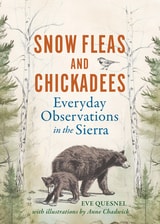
Snow Fleas and Chickadees
Everyday Observations in the SierraEve Quesnel
University of Nevada Press, 2025
Quesnel embraces the notion that to simply walk in one’s neighborhood is to familiarize oneself with the local flora and fauna, drawing attention to everyday things too often neglected. She argues that we can be complacent with what surrounds us, but with careful observation and research, we become acutely aware—and in awe of—nature’s everyday activities. The black bear’s hibernation techniques and mountain chickadee’s caching methods reveal just two of nature’s wily ways. Quesnel chases other curiosities as well, asking, “How does a spider create an orb web?” or, “How does a boulder the size of a small car end up alone in the woods?” In the introduction, she writes, “It is this ‘un-peeling’ of layers in nature that opens up our world.”
For anyone interested in nature writing, whether an armchair explorer, outdoor enthusiast, or science aficionado, Snow Fleas and Chickadees provides an entertaining and engaging discovery of the picturesque Sierra Nevada.
So Ask
Essays, Conversations, and InterviewsPhilip Levine
University of Michigan Press, 2002
So What, or How to Make Films with Words
Alexander García Düttmann
Northwestern University Press, 2023
Images, whether filmic or not, cannot be replaced by words. Yet words can make images. This is the general thesis underlying So What, a collection of essays on canonical filmmakers like Luchino Visconti and Orson Welles; more experimental directors, such as Marguerite Duras and Albert Serra; and visual artists, including Hollis Frampton and Agnes Martin. Alexander García Düttmann aims to make their films as if they did not precede his text, capturing their idea and experience.
If the relationship between filmic image and text is a heterogeneous one, then this heterogeneity must leave a trace. This is why the book’s chapters are organized not according to historical periods or on the basis of film theories but rather by single concepts that function like dictionary entries. The chapters adopt different forms, blurring the lines between art and philosophy. So What is a practical exercise in “making films with words,” inviting readers to draw out insights from its conceptual play.
So What compiles previously untranslated and hard-to-find essays into a single volume, one that represents the absorbing and singular thought process of a major contemporary philosopher.
Social Action Stories
Impact Tales for the School and CommunityKevin D. Cordi, Ph.D., Kirstin J. Milks, PhD., Rebecca Van Tassell
Parkhurst Brothers, Inc., 2022
Social Science as Civic Discourse
Essays on the Invention, Legitimation, and Uses of Social TheoryRichard Harvey Brown
University of Chicago Press, 1989
Social Science in the Making
Essays on the Russell Sage Foundation, 1907-1972David C. Hammack
Russell Sage Foundation, 1994
Social Theory and the Study of Israelite Religion
Essays in Retrospect and ProspectSaul M. Olyan
SBL Press, 2012
Socialism and War
Essays, Documents, ReviewsF. A. Hayek
University of Chicago Press, 1997
Opening with Hayek's arguments against market socialism, the volume continues with his writings on the economics of war, many in response to the proposals made in John Maynard Keynes's famous pamphlet, How to Pay for the War. The last section presents articles that anticipated The Road to Serfdom, Hayek's classic meditation on the dangers of collectivism. An appendix contains a number of topical book reviews written by Hayek during this crucial period, and a masterful introduction by the volume editor, Bruce Caldwell, sets Hayek's work in context.
Socialism and War will interest not just fans of The Road to Serfdom, but anyone concerned with the ongoing debates over the propriety of government intervention in the economy.
"When he wrote The Road to Serfdom, [Hayek's] was a voice in the wilderness. Now the fight [has] been taken up by people all over the world, by institutions and movements, and the ideas that seemed so strange to many in 1944 can be found from scholarly journals to television programs."—Thomas Sowell, Forbes
"Intellectually [Hayek] towers like a giant oak in a forest of saplings."—Chicago Tribune
"Each new addition to The Collected Works of F. A. Hayek, the University of Chicago's painstaking series of reissues and collections, is a gem."—Liberty on Volume IX of The Collected Works of F. A. Hayek

Socially Engaged Creative Practice
Contemporary Case StudiesEdited by Jess Moriarty and Kate Aughterson
Intellect Books, 2024
Each chapter of Socially Engaged Creative Practice focuses on an individual or group’s mode of working and methodological practice of performance across a range of modes, disciplines, and media, from community opera to online queer performance; from anti-racist classroom pedagogy to 1980s cabaret in nightclubs; from community art projects in schools to community writing projects in transport interchanges. The performers, writers, and creators represented here engage and grapple with contemporary performance as a situated practice and as a problem.
The personal perspective of each performer—as directors, librettists, producers, and writers—is explicitly located in a community, and the book offers a series of case studies detailing socially engaged work that aligns with concepts of performance and community.
Society as Text
Essays on Rhetoric, Reason, and RealityRichard Harvey Brown
University of Chicago Press, 1987
Sociology Hesitant
Thinking with W. E. B. DuBois, Volume 27Ronald A. T. Judy, ed.
Duke University Press, 0
Spanning a wide array of disciplines, from German studies and sociology to literary criticism, philosophy, and anthropology, with contributions from some of the most outstanding scholars in these fields, Sociology Hesitant contributes to the recognition of DuBois as an important historical figure by focusing on the complexity of his theoretical work. These essays offer an extended interaction with the ideas and projects DuBois formulated in a series of essays written between 1887 and 1910 that take up intricate questions concerning the nature of methodology and the theory of knowledge. Using DuBois’s work as a point of departure, contributors explore current thinking about diverse subjects such as geopolitics and postcolonialism. Demonstrating that engaging the question of race requires rethinking the historical nature of theoretical understanding, this collection brings to light the notion that the struggle for equality is a struggle for freedom of thought in pursuit of truth.
Contributors. Kenneth Barkin, Nahum Chandler, Ronald Judy, David Krell, Charles Lemert, Sieglinde D. Lemke, Tommy Lott, Kevin Miles, Abdulkarim Mustapha, Ken Warren
Some Write to the Future
Essays on Contemporary Latin American FictionAriel Dorfman
Duke University Press, 1991
Praise for Ariel Dorfman
“One of the most important voices coming out of Latin America.”—Salman Rushdie
“A remarkable writer . . . writing out of a very different cultural perspective from comfortable American readers.”—Digby Diehl, Los Angeles Herald Examiner
“One of the six greatest Latin American novelists.”—Jacobo Timmerman, Newsweek
Somebody Told Me
The Newspaper Stories of Rick BraggRick Bragg
University of Alabama Press, 2000
Over the past twenty years, writer Rick Bragg has earned legions of fans with his award-winning newspaper stories and with his critically aclaimed memoir All Over but the Shoutin'. His unique storytelling talent and his sympathy for the day-to-day struggles of everyday people set him apart from journalists who focus on political intrigue and the foibles of the rich and famous.
This collection showcases Bragg's talent for turning seemingly ordinary situations into extraordinary stories by bringing together more than sixty of his most recent feature articles, most of them written for the New York Times. Bragg explores such questions as: What happens to someone released from prison for a crime he didn't commit? Who takes care of the graves of poor people? What keeps an elderly woman from selling her land for a tidy profit? Bragg's curiosity often leads him to society's margins, where he wins the confidence of those who have good reason to mistrust others.
Bragg has reported on some of the most newsworthy tragedies in the nation, and his unfolding coverage of events such as the Oklahoma City bombing and the Susan Smith child murders is included here. Once again, though, his special ability to connect with people allows him accesss and perspectives that many other reporters do not achieve.
Whether he's profiling the sheriff who broke the Smith case or relating the efforts of Alabama churchgoers to understand a Sunday morning tornado strike, Bragg writes with genuine compassion and sentiment but without being sensationalist. He looks where others don’t and gets behind the headlines to the people standing there stunned and often, until he finds them, voiceless. When asked how he came up with his remarkable stories, Bragg has his answer down pat: “Somebody told me.”
Something I Said?
Innuendo and Out the OtherMichael Feldman
University of Wisconsin Press, 2004
What we have here is another mighty slim volume from Michael Feldman, best known (when known at all) for his public radio show "Whad'ya Know" (sic). Feldman, who spouts off about things he knows "not much" about weekly, here writes them down:
· how to get your own radio show and what you can do with it once you do
· paranoia
· marriage (or as Feldman likes to refer to it, "a long-term bad relationship")
· Hitler
· SUVs
· child-rearing (although it sounds like it's the author who is being reared)
· a number of short pieces on places he and his crew have visited for their "remote possibilities"
· more references to "gentiles" than absolutely necessary (seems to be an issue for Feldman, although he is tickled with the
notion that, to a Mormon, he is one)
· some attempts to misrepresent scientific or social research for humorous purposes
· many personal revelations that prove the examined life is not necessarily worth living either
· and pages and pages of fluff.
Mr. Feldman has not been compared, to our knowledge, to S. J. Perlman.
But here is some of what Michael Feldman says in Something I Said:
"The paranoid no longer is: paranoia has outlived its usefulness when everybody is out to get us."
"Take the phrase 'no problem': I can use it, although it is the very opposite of my two-word world view ('Nothing works')."
"Whatever latitude beauty may have in the eye of the beholder, funny is not readily apparent to all, and, who knows, they may be right. More importantly, they may be bigger."
Includes a music CD by Michael Feldman and John Sieger.
Somos Tejanas!
Chicana Identity and Culture in TexasEdited by Jody A. Marín and Norma E. Cantú
University of Texas Press, 2025
2026 Outstanding Book Award for Non-Fiction, National Association for Chicana and Chicano Studies (NACCS) Tejas Foco
2026 Silver Medal for the Dolores Huerta Best Cultural & Community Themed Book – English, Conference on Latin American History (CLAH)
An expansive volume on Tejana identity and Tejanidad told through personal narratives, poetry, and essays.
Being Tejanx is different than just being from Texas. Being Tejanx means you are a border subject. Being Tejanx means living in and from a certain history of oppression, possibility, activism, and cultural-linguistic hybridity arising within the US-Mexico borderland that is home. And being Tejanx means something in particular if you are a woman.
In ¡Somos Tejanas!, editors Norma E. Cantú and Jody A. Marín assemble contemporary Tejanx writers who provide firsthand accounts of their experience of identity, enriching the field of Tejanx studies through an encounter with gender and sexuality. The contributions, including personal and scholarly essays, poems, criticism, and artworks, explore the heterogeneity of Tejana identity and the sociopolitical movements, stories, dances, music, and athletic feats that mark Tejanidad. Authors contemplate the history and memory of segregation in Texas, the struggles of surviving the unnatural disaster and blackouts of 2021 amid the global pandemic of COVID-19, and the drug-war violence and ever-tightening immigration restrictions that strangle a transborder way of life shared by millions. An unrepentant act of expression from women under attack by state policymakers, this collection dispels the silence imposed by colonial erasure.
Sonata
By Charles Bowden; foreword by Alfredo Corchado
University of Texas Press, 2020
"I believe every sunrise and I remember the smell of wet grass, the color of robins, and rustle of leaves on the big oaks that outlive nations, all this comes with each sunrise."
Sonata marks the sixth and final installment of Charles Bowden’s towering “Unnatural History of America” series. While his earlier volumes were suffused with violence and war, Bowden offers here a celebration of rebirth and regrowth. Rendered in Bowden's inimitable style, more prose poetry than reportage, he evokes panoramas that contain the potential for respite and offer a state of grace all but lost in the endless wars of man.
Bowden travels back in time to the worlds of artists Francisco Goya and Vincent van Gogh, the latter painting furiously against encroaching madness. “Van Gogh tries to dream a life of color,” writes Bowden. “Powder blue sheds, yellow stubble, pink skies—but the fears and dark things drag him down.” As Bowden’s vivid prose wrestles with the madness of the world, van Gogh’s paintings represent an act of resistance, ultimately unsuccessful, against depression and suicide.
Moving from the vibrant hues of van Gogh’s painted gardens to America’s southern border, Bowden returns once more to the Mexican asylum run by "El Pastor," Jose Antonio Galvan, who was first introduced to readers of the sextet in Jericho. Here, too, is the dream of a garden that will be planted in the desert, a promise of regeneration in a world gone mad. Poetic, elegiac, and elliptical, Sonata is the final, captivating book of Bowden’s monumental career.
Song and Self
A Singer's Reflections on Music and PerformanceIan Bostridge
University of Chicago Press, 2023
Like so many performers, renowned tenor Ian Bostridge spent much of 2020 and 2021 unable to take part in live music. The enforced silence of the pandemic led him to question an identity that was previously defined by communicating directly with audiences in opera houses and concert halls. It also allowed him to delve deeper into many of the classical works he has encountered over the course of his career, such as Claudio Monteverdi’s seventeenth-century masterpiece Il Combattimento di Tancredi e Clorinda and Robert Schumann’s popular song cycle Frauenliebe und Leben. In lucid and compelling prose, Bostridge explores the ways Monteverdi, Schumann, and Britten employed and disrupted gender roles in their music; questions colonial power and hierarchy in Ravel’s Songs of Madagascar; and surveys Britten’s reckoning with death in works from the War Requiem to his final opera, Death in Venice.
As a performer reconciling his own identity and that of the musical text he delivers on stage, Bostridge unravels the complex history of each piece of music, showing how today’s performers can embody that complexity for their audiences. As readers become privy to Bostridge’s unique lines of inquiry, they are also primed for the searching intensity of his interpretations, in which the uncanny melding of song and self brings about moments of epiphany for both the singer and his audience.
Songs of Degrees
Essays on Contemporary Poetry and PoeticsJohn Taggart
University of Alabama Press, 1994
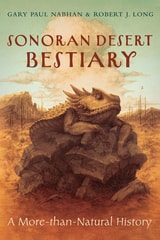
Sonoran Desert Bestiary
A More-than-Natural HistoryText by Gary Paul Nabhan; Illustrations by Robert J. Long
University of Arizona Press, 2026
The Sonoran Desert has many marvelous and well-known creatures such as the javelina and the coyote, often found on postcards and lawn ornaments. But what about the lesser-known creatures—the ones that are underfoot yet unseen, that lurk only in the shadows and in our imaginations? In this collection of essays, prose poems, and illustrations, naturalist Gary Paul Nabhan and artist Robert J. Long team up to celebrate these unsung beings of the Sonoran Desert.
This desert bestiary includes creatures whose existence lies largely in traditional story and belief, as well as creatures whose life cycles are so cryptic they seem mythic, such as the walking catfish and the carbunco. Positioned at the dynamic intersection of folklore and natural history, the book reflects on the reasons why human imaginations over the ages have reached into this realm of seldom seen but often intuited animals. Focusing on small animals and charismatic mini-fauna, Nabhan expands our understanding of the natural world by delightfully describing the interactions between animals and plants.
This more-than-natural history is for anyone who finds joy in the marvels of the natural world.
Sonoran Desert Journeys
Ecology and Evolution of Its Iconic SpeciesTheodore H. Fleming
University of Arizona Press, 2022
In Sonoran Desert Journeys ecologist Theodore H. Fleming discusses two remarkable journeys. First, Fleming offers a brief history of our intellectual and technical journey over the past three centuries to understand the evolution of life on Earth. Next, he applies those techniques on a journey of discovery about the evolution and natural history of some of the Sonoran Desert’s most iconic animals and plants. Fleming details the daily lives of a variety of reptiles, birds, mammals, and plants, describing their basic natural and evolutionary histories and addressing intriguing issues associated with their lifestyles and how they cope with a changing climate. Finally, Fleming discusses the complexity of Sonoran Desert conservation.
This book explores the evolution and natural history of iconic animals and plants of the northern Sonoran Desert through the eyes of a curious naturalist and provides a model of how we can coexist with the unique species that call this area home.
Soundtrack Available
Essays on Film and Popular MusicPamela Robertson Wojcik and Arthur Knight, eds.
Duke University Press, 2001
With a cross-cultural emphasis, the contributors focus on movies that use popular songs from a variety of genres, including country, bubble-gum pop, disco, classical, jazz, swing, French cabaret, and showtunes. The films discussed range from silents to musicals, from dramatic and avant-garde films to documentaries in India, France, England, Australia, and the United States. The essays examine both “nondiegetic” music in film—the score playing outside the story space, unheard by the characters, but no less a part of the scene from the perspective of the audience—and “diegetic” music—music incorporated into the shared reality of the story and the audience. They include analyses of music written and performed for films, as well as the now common practice of scoring a film with pre-existing songs. By exploring in detail how musical patterns and structures relate to filmic patterns of narration, character, editing, framing, and mise-en-scene, this volume demonstrates that pop music is a crucial element in the film experience. It also analyzes the life of the soundtrack apart from the film, tracing how popular music circulates and acquires new meanings when it becomes an official soundtrack.
Contributors. Rick Altman, Priscilla Barlow, Barbara Ching, Kelley Conway, Corey Creekmur, Krin Gabbard, Jonathan Gill, Andrew Killick, Arthur Knight, Adam Knee, Jill Leeper, Neepa Majumdar, Allison McCracken, Murray Pomerance, Paul Ramaeker, Jeff Smith, Pamela Robertson Wojcik, Nabeel Zuberi
Southern Marches of Imperial Ethiopia
Essays in History and Social AnthropologyDonald L. Donham
Ohio University Press, 2002
This pioneering book, first published to wide acclaim in 1986, traces the way the Ethiopian center and the peripheral regions of the country affected each other. It looks specifically at the expansion of the highland Ethiopian state into the western and southern lowlands from the 1890s up to 1974.
Sown in Earth
Essays of Memory and BelongingFred Arroyo
University of Arizona Press, 2020
In Sown in Earth, Arroyo often roots his thoughts and feelings in place, expressing a deep connection to the small homes he inhabited in his childhood, his warm and hazy memories of his grandmother’s kitchen in Puerto Rico, the rivers and creeks he fished, and the small cafés in Madrid that inspired writing and reflection in his adult years. Swirling in romantic moments and a refined love for literature, Arroyo creates a sense of belonging and appreciation for his life despite setbacks and complex anxieties along the way.
By crafting a written journey through childhood traumas, poverty, and the impact of alcoholism on families, Fred Arroyo clearly outlines how his lived experiences led him to become a writer. Sown in Earth is a shocking yet warm collage of memories that serves as more than a memoir or an autobiography. Rather, Arroyo recounts his youth through lyrical prose to humanize and immortalize the hushed lives of men like his father, honoring their struggle and claiming their impact on the writers and artists they raised.
Space Syntax
Selected Papers by Bill HillierEdited by Laura Vaughan, John Peponis, and Ruth Dalton
University College London, 2025
Few scholars have reshaped our understanding of architecture and urban design as profoundly as Bill Hillier. Space Syntax compiles the most influential works from his career, spanning over half a century, to showcase the evolution of his innovative theories on the spatial structure of cities and the social functions of built environments.
Including his early explorations of architecture as a research discipline and his later theories on how spatial configurations influence human movement and urban vitality, this collection provides a definitive overview of Hillier’s intellectual legacy. Featuring newly redrawn figures, rare texts, and expert introductions from leading theorists and practitioners, the volume offers fresh viewpoints on the continued relevance of space syntax in contemporary research and practice.
Relevant to subjects ranging from archaeology to physics, Space Syntax cements Hillier’s place as a revolutionary thinker whose ideas continue to shape how we design and understand space.
Speak to Me Words
Essays on Contemporary American Indian PoetryEdited by Dean Rader and Janice Gould
University of Arizona Press, 2003
Speak to Me Words is a stimulating blend of classic articles and original pieces that reflect the energy of modern American Indian literary studies. Highlighting various aspects of poetry written by American Indians since the 1960s, it is a wide-ranging collection that balances the insights of Natives and non-Natives, men and women, old and new voices. Included here are such landmark articles as "Answering the Deer" by Paula Gunn Allen, "Herbs of Healing" by Carter Revard, and "Song, Poetry and Language—Expression and Perception" by Simon Ortiz—all pieces that have shaped how we think about Native poetry. Among the contributions appearing for the first time are Elaine Jahner writing on Paula Gunn Allen's use of formal structures; Robert Nelson addressing pan-Indian tropes of emergence, survival, return, and renewal; and Janet McAdams focusing on Carter Revard's "angled mirrors." Although many Native writers may disregard distinctions between genres, together these writings help readers see the difference between American Indian poetry and other forms of Native literature.
These essays are as broad, encompassing, and provocative as Native poetry itself, branching off from and weaving back into one another. In showing how American Indian poetry redefines our social order and articulates how Indian communities think about themselves, these writers establish a new foundation for the study—and enjoyment—of this vital art.
Speaking of America
Great Conversations at the Library of CongressDavid M. Rubenstein
Duke University Press, 2026
Featuring interviews with eminent historians, journalists, and writers, Speaking of America brings together nineteen wide-ranging conversations from philanthropist and financier David M. Rubenstein’s long-running Congressional Dialogues series of interviews at the Library of Congress. Highlights include Ken Burns on documenting American history, Stacy Schiff on Samuel Adams, Manisha Sinha on Reconstruction, and David McCullough on the American frontier.
Published in association with the Library of Congress
Featuring interviews with eminent historians, journalists, and writers, Speaking of America brings together nineteen wide-ranging conversations from philanthropist and financier David M. Rubenstein’s long-running Congressional Dialogues series of interviews at the Library of Congress. Rubenstein and his guests bring to life notable figures, events, and trends drawn from American history and culture and beyond.
Highlights include Ken Burns on bringing American history to life, Stacy Schiff on Samuel Adams, Manisha Sinha on Reconstruction, David McCullough on the American frontier, Beverly Gage on J. Edgar Hoover, Chris Wallace on the presidential election of 1960, Evan Thomas on Justice Sandra Day O’Connor, Eric Schmidt on artificial intelligence, Arthur Brooks on happiness, and David Grann on The Wager, his best-selling story of shipwreck and mutiny. Taken together, the conversations in Speaking of America all build toward the same shared message of dialogue, cooperation, and the importance of knowledge and reflection, highlighting how the study of history can enrich our understanding of current-day challenges in politics and policy.
Speculate This!
Uncertain Commons
Duke University Press, 2013
Speculation, Now
Essays and ArtworkVyjayanthi Venuturupalli Rao, with Prem Krishnamurty and Carin Kuoni, eds.
Duke University Press, 2014
Artists and essayists include William Darity Jr., Filip De Boeck, Boris Groys, Hans Haacke, Darrick Hamilton, Laura Kurgan, Lin + Lam, Gary Lincoff, Lize Mogel, Christina Moon, Stefania Pandolfo, Satya Pemmaraju, Mary Poovey, Walid Raad, Sherene Schostak, Robert Sember, and Srdjan Jovanović Weiss.
Published by Duke University Press and the Vera List Center for Art and Politics at The New School
Spencer Kimball's Record Collection
Essays on Mormon MusicMichael Hicks
Signature Books, 2020
Spirit Things
Lara Messersmith-Glavin
University of Alaska Press, 2022
“Spirit things” are those mundane objects that offer new insights into the world on closer consideration—fishing nets, a favorite knife, and the bioluminescent gleam of seawater in a twilight that never truly grows dark. Spirit Things recounts stories of fishing, family, synesthesia, storytelling, gender, violence, and meaning. Each essay takes an object and follows it through histories: personal, material, and scientific, drawing together the delicate lines that link things through their making and use, their genesis and evolution, and the ways they gain significance in an individual’s life.
A contemplative take on everything from childcare to neurodivergence, comfort foods to outlaws, Spirit Things uses experiences from the human world and locates them on the edges of nature. Contact with wilderness, with wildness, be it twenty-foot seas in the ocean off Alaska’s coast or chairs flying through windows of a Kodiak bar, provides an entry point for meditations on the ways in which patterns, magic, and wonder overlap.
Spirit Things
Lara Messersmith-Glavin
University of Alaska Press, 2022
“Spirit things” are those mundane objects that offer new insights into the world on closer consideration—fishing nets, a favorite knife, and the bioluminescent gleam of seawater in a twilight that never truly grows dark. Spirit Things recounts stories of fishing, family, synesthesia, storytelling, gender, violence, and meaning. Each essay takes an object and follows it through histories: personal, material, and scientific, drawing together the delicate lines that link things through their making and use, their genesis and evolution, and the ways they gain significance in an individual’s life.
A contemplative take on everything from childcare to neurodivergence, comfort foods to outlaws, Spirit Things uses experiences from the human world and locates them on the edges of nature. Contact with wilderness, with wildness, be it twenty-foot seas in the ocean off Alaska’s coast or chairs flying through windows of a Kodiak bar, provides an entry point for meditations on the ways in which patterns, magic, and wonder overlap.
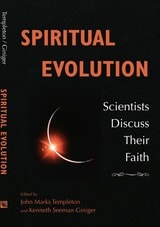
Spiritual Evolution
Scientists Discuss Their BeliefsJohn Marks Templeton
Templeton Press, 1998
Spiritual Evolution: Scientists Discuss Their Beliefs describes the intellectual and emotional journeys traveled by esteemed scientists worldwide. Authors share the personal steps they have taken to blend an understanding of the Divine with their scientific perspectives.
Charles Birch, S. Jocelyn Bell Burnell, Larry Dossey, Owen Gingerich, Peter E. Hodgson, Stanley L. Jaki, Arthur Peacocke, John Polkinghorne, Russell Stannard, and Carl Friedrich von Weizsäcker offer accounts of their spirituality and scientific inquiry. Noting the impact of religious upbringing, academic and spiritual mentors, personal devotional practice, and study, these authors make a compelling case for the blending of both scientific and spiritual worlds. They share insights that keep them attending church, engaging in prayer, and continuing the search to understand the Infinite.
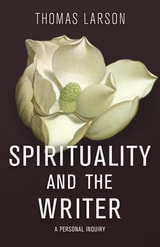
Spirituality and the Writer
A Personal InquiryThomas Larson
Ohio University Press, 2019
Today, the surprisingly elastic form of the memoir embraces subjects that include dying, illness, loss, relationships, and self-awareness. Writing to reveal the inner self—the pilgrimage into one’s spiritual and/or religious nature—is a primary calling. Contemporary memoirists are exploring this field with innovative storytelling, rigorous craft, and new styles of confessional authorship. Now, Thomas Larson brings his expertise as a critic, reader, and teacher to the boldly evolving and improvisatory world of spiritual literature.
In his book-length essay Spirituality and the Writer, Larson surveys the literary insights of authors old and new who have shaped religious autobiography and spiritual memoir—from Augustine to Thomas Merton, from Peter Matthiessen to Cheryl Strayed. He holds them to an exacting standard: they must render transcendent experience in the writing itself. Only when the writer’s craft prevails can the fleeting and profound personal truths of the spirit be captured. Like its predecessor, Larson’s The Memoir and the Memoirist,Spirituality and the Writer will find a home in writing classrooms and book groups, and be a resource for students, teachers, and writers who seek guidance with exploring their spiritual lives.
Sport and Exercise Science
ESSAYS IN THE HISTORY OF SPORTS MEDICINEEdited by Jack W. Berryman and Roberta J. Parks
University of Illinois Press, 1992
athlete's heart, exercise physiology, physical activity and sport for females, women's
health, physical culture and quackery, diet, and more.
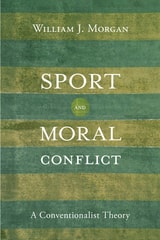
Sport and Moral Conflict
A Conventionalist TheoryWilliam J.Morgan
Temple University Press, 2020
What is the purpose of sport, and how are ethical conceptions of sport shaped by the answers to this question? In Sport and Moral Conflict, William Morgan investigates, examining sport as a moral crucible that puts athletes in competitive, emotionally charged situations where fairness and equality are contested alongside accomplishment.
Morgan looks at the modern Olympics—from 1906 Athens to 1924 Paris, when the Games reached international prestige — in order to highlight the debate about athletic excellence and the amateur-professional divide. Whereas the Americans emphasized winning, the Europeans valued a love of the game. Morgan argues that the existing moral theories of sport—formalism and broad internalism (aka interpretivism), which rely on rules and general principles—fall short when confronted with such a dispute as the transition from amateur to professional sport. As such, he develops a theory of conventionalism, in which the norms at work in athletic communities determine how players should ethically acquit themselves. Presenting his case for an ethical theory of sport, Morgan provides insights regarding the moral controversies and crises that persist today.
Sport and the Law
Historical and Cultural IntersectionsSamuel O. Regalado
University of Arkansas Press, 2014
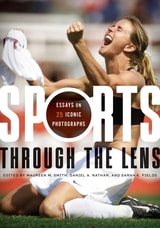
Sports through the Lens
Essays on 25 Iconic PhotographsEdited by Maureen M. Smith, Daniel A. Nathan, and Sarah K. Fields
University of Texas Press, 2024
2025 Anthology Award, North American Society for Sport History
The stories behind and legacies of important sports photos from the last 130 years.
Ever since photography and professional sports originated in the nineteenth century, photographers have shaped how we perceive sports. Sports through the Lens collects essays by twenty-five historians that consider what it means to capture and revisit a moment of cultural significance in sports, looking at each photo’s creation, its contexts, and how its meaning has shifted over time. Some essays provide fresh perspectives on such iconic images as Muhammad Ali standing over Sonny Liston at their 1965 rematch and Michael Jordan soaring at the 1988 NBA All-Star Game slam dunk competition; others introduce readers to the lesser-known stories of the first woman to officially run the Boston Marathon or the inaugural World Indigenous Games. The authors examine the photos' legacies alongside the artistry of both the athletes and the photographers. Reflecting on images of athletes from around the world engaged in sports from baseball to horse-racing to hockey, Sports through the Lens provides a wide-ranging meditation on the visual, historical, and cultural meaning of sports photographs.