Results by title
527 books match the query 'Feminism & Feminist Theory' and 66 start with s
Skeptical Feminism
Activist Theory, Activist PracticeCarolyn Dever
University of Minnesota Press, 2003
A clarion call for a new approach to feminist thought
In this major work, Carolyn Dever considers the ambivalence or outright hostility many feminists feel toward theory, arguing that a fundamental skepticism toward abstraction has been vital to the development of the movement.
Dever analyzes the politics of feminist theory by looking at its popular, activist, and academic modes, from the liberation movements of the 1970s to gender and queer studies now. Using key moments in the history of modern feminism-consciousness-raising, best-selling books like Sexual Politics by Kate Millett and The Women’s Room by Marilyn French, and media representations of women’s struggle for equality—Dever outlines heated debates over psychoanalysis, sexuality, and activism. The abstract and the grounded converge in discussions about the relationship between the feminist mind and the feminist body and in the preoccupation, both uneasy and utopian, with lesbian sexuality. Powerful, illuminating, and galvanizing, Skeptical Feminism traces the strategies the women’s movement has used to make theory matter—and points toward a new, politically engaged approach to feminist thought.
Sleep with Spectators
Feminist Performance and PracticeDanielle Drees
University of Minnesota Press, 2026
A rejuvenating look at sleep’s integral role in feminist practice, critique, and imagination
Inequality is notoriously exhausting to confront, but through theater, performance art, and theory, feminist artists and thinkers have explored a radical counter to this exhaustion: sleep. Centering creative work on this restorative practice, Sleep with Spectators is a refreshing and visionary counterhistory of feminism that offers sleep as a tool for imagining new ways of living—ones that prioritize not only rest but also care and interdependence.
Taking performance as a unique means of perceiving private and unconscious aspects of daily life, Danielle Drees draws from opera, plays, and avant-garde theater to find instances of sleep and sleeplessness as novel embodiments of core feminist concerns. Among her subjects are Sarah Kane’s free verse text 4.48 Psychosis; María Irene Fornés’s queer drama of racial–sexual transformation, Enter THE NIGHT; and Regina José Galindo’s America’s Family Prison, in which Galindo, her partner, and their baby spent twenty-four hours in a “family-sized” cell rented from a private prison outfitter. Adeptly engaging this fascinating collection of international archival material through the lenses of Marxist feminism, trans and queer studies, and disability studies, Sleep with Spectators illuminates how sleep performances reveal and critique inequalities rooted in gender, sexuality, race, class, and disability.
Idiosyncratic and interdisciplinary, Sleep with Spectators charts an original path through the feminist performance archive, presenting new ways of indexing injustice and interrogating the political conditions of rest.
Retail e-book files for this title are screen-reader friendly.
So Much Wasted
Hunger, Performance, and the Morbidity of ResistancePatrick Anderson
Duke University Press, 2010
Socialist Feminism
A New ApproachFrieda Afary
Pluto Press, 2022
What is socialist feminism and why is it needed to fight the global rise of authoritarianism and fascism?
Frieda Afary brings the insights gained through her study of feminist philosophy, her international activism, and her work in community education as a public librarian in Los Angeles, offering a bold new vision of an alternative to capitalism, racism, sexism, heterosexism, and alienation.
Socialist Feminism: A New Approach reclaims theories of women’s oppression through a return to humanism, enriched by social reproduction theories, Black feminist intersectionality, abolitionism, queer theories, Marxist-Humanism, and the author’s own experiences as an Iranian American feminist, scholar, and activist.
She looks at global developments in gender relations since the 1980s, the impact of the Covid-19 pandemic, the distinct features of twenty-first-century authoritarianism, and current struggles against it, drawing out lessons for revolutionary theorizing, organizing, and international solidarity including the #MeToo and Black Lives Matter movements.
This book also contains a study guide that transforms it into a useful pedagogical tool for teachers and activists.

Socialist Feminism
A New ApproachFrieda Afary
Pluto Press, 2022
A new take on a powerful and revolutionary movement.
What is socialist feminism and why is it needed to fight the global rise of authoritarianism and fascism?
Frieda Afary brings the insights gained through her study of feminist philosophy, her international activism, and her work in community education as a public librarian in Los Angeles, offering a bold new vision of an alternative to capitalism, racism, sexism, heterosexism, and alienation.
Socialist Feminism: A New Approach reclaims theories of women’s oppression through a return to humanism, enriched by social reproduction theories, Black feminist intersectionality, abolitionism, queer theories, Marxist-Humanism, and the author’s own experiences as an Iranian American feminist, scholar, and activist.
She looks at global developments in gender relations since the 1980s, the impact of the Covid-19 pandemic, the distinct features of twenty-first-century authoritarianism, and current struggles against it, drawing out lessons for revolutionary theorizing, organizing, and international solidarity including the #MeToo and Black Lives Matter movements.
Contains a study guide that transforms it into a useful pedagogical tool for teachers and activists.
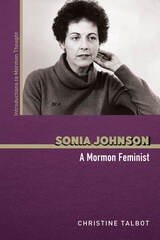
Sonia Johnson
A Mormon FeministChristine Talbot
University of Illinois Press, 2024
Few figures in the history of the Church of Jesus Christ of Latter-day Saints provoke such visceral responses as Sonia Johnson. Her unrelenting public support of the Equal Rights Amendment (ERA) made her the face of LDS feminism while her subsequent excommunication roiled the faith community.
Christine Talbot tells the story of Sonia’s historic confrontation with the Church within the context of the faith’s first large-scale engagement with the feminist movement. A typical if well-educated Latter-day Saints homemaker, Sonia was moved to action by the all-male LDS leadership’s opposition to the ERA and a belief the Church should stay out of politics. Talbot uses the activist’s experiences and criticisms to explore the ways Sonia’s ideas and situation sparked critical questions about LDS thought, culture, and belief. She also illuminates how Sonia’s excommunication shaped LDS feminism, the Church’s antagonism to feminist critiques, and the Church itself in the years to come.
A revealing and long-overdue account, Sonia Johnson explores the life, work, and impact of the LDS feminist.
Spectacles Of Realism
Gender, Body, GenreMargaret Cohen
University of Minnesota Press, 1995
A rethinking of realism that reveals its relevance to sexual and cultural politics.
Despite rumors of its demise in literary theory and practice, realism persists. Why this is, and how realism is relevant to current interdisciplinary debates in gender studies and cultural studies, are the questions underlying Spectacles of Realism. With particular reference to nineteenth-century French culture, the contributors explore the role realism has played in the social construction of gender and sexuality. Among their subjects are nineteenth-century physiologies, photographs, caricatures, and Balzac’s Comédie humaine; the ethnographic claims of Goncourt’s naturalism and the historical claims of Zola’s; and the allure of exotica displayed at new museums and international expositions.
Contributors: April Alliston, Princeton U; Emily Apter, UCLA; Charles Bernheimer, U of Pennsylvania; Rhonda Garelick; Judith Goldstein, Vassar; Anne Higonnet, Wellesley; Roger Huss, Queen Mary and Westfield College; Dorothy Kelly, Boston U; Diana Knight, U of Nottingham; Jann Matlock, Harvard U; Linda Nochlin, NYU; Patrick O’Donovan, King’s College; Vanessa Schwartz, American U; Naomi Segal, U of Reading; Barbara Vinken, NYU.
Spill
Scenes of Black Feminist FugitivityAlexis Pauline Gumbs
Duke University Press, 2016
Splattered Ink
Postfeminist Gothic Fiction and Gendered ViolenceSarah E Whitney
University of Illinois Press, 2016
Sarah E. Whitney explores the genre's challenge to postfeminist assumptions of women's equality and empowerment. The authors she examines--Patricia Cornwell, Jodi Picoult, Susanna Moore, Sapphire, and Alice Sebold--construct narratives around socially invisible and physically broken protagonists who directly experience consequences of women's ongoing disempowerment. Their works ask readers to inhabit women's suffering and to face the uncomfortable, all-too-denied fact that today's women must navigate lives fraught with risk. Whitney's analysis places the authors within a female gothic tradition that has long given voice to women's fears of their own powerlessness. But she also reveals the paradox that allows the genre to powerfully critique postfeminism's often sunshiney outlook while uneasily coexisting within the same universe.

Stamford '76
A True Story of Murder, Corruption, Race, and Feminism in the 1970sJoeAnn Hart
University of Iowa Press, 2019
Looking back at what might have happened in 1976, the author discovers a Bicentennial year steeped in recession, racism, and unrelenting violence. It was also a time of flourishing second-wave feminism, when young women were encouraged to do anything, if only they knew how. Stamford was in the midst of urban renewal, destroying historically black neighborhoods to create space for corporations escaping a bankrupt and dangerous New York City, just forty miles away. Organized crime followed the money, infiltrating Stamford at all levels. The author reveals how racism, misogyny, the economy, and corruption affected the young people’s daily lives, and helped lead Margo and Howie to their deaths.

Stateswomen
A Centennial History of Arkansas Women Legislators, 1922-2022Lindsley Armstrong Smith
University of Arkansas Press, 2022
The first comprehensive study dedicated to these trailblazing Arkansas legislators, Stateswomen will surely inspire history buffs, community-minded citizens, and political hopefuls alike.
Staying with the Trouble
Making Kin in the ChthuluceneDonna J. Haraway
Duke University Press, 2016

Suffragettes in the Land of the Tsars
Jessie Kenney’s Diary of Revolutionary RussiaLee Farrow
Central European University Press, 2026
Sylvia Pankhurst
Suffragette, Socialist and Scourge of EmpireKatherine Connelly
Pluto Press, 2013
From militant suffragette at the beginning of the twentieth century to campaigner against colonialism in Africa after the Second World War, Sylvia Pankhurst dedicated her life to fighting oppression and injustice.
In this vivid biography Katherine Connelly examines Pankhurst’s role at the forefront of significant developments in the history of radical politics. She guides us through Pankhurst's construction of a suffragette militancy which put working-class women at the heart of the struggle, her championing of the Bolshevik Revolution and her clandestine attempts to sabotage the actions of the British state, as well as her early identification of the dangers of Fascism.
The book explores the dilemmas, debates and often painful personal consequences faced by Pankhurst which were played out in her art, writings and activism. It argues that far from being an advocate of disparate causes, Pankhurst’s campaigns were united by an essential continuity which hold vital lessons for achieving social change. This lively and accessible biography presents Pankhurst as a courageous and inspiring campaigner, of huge relevance to those engaged in social movements today.

Sylvia Plath and the Mythology of Women Readers
Janet Badia
University of Massachusetts Press, 2011
Janet Badia investigates the evolution of this narrative, tracing its origins, exposing the gaps and elisions that have defined it, and identifying it as a bullying mythology whose roots lie in a long history of ungenerous, if not outright misogynistic, rhetoric about women readers that has gathered new energy from the backlash against contemporary feminism.
More than just an exposé of our cultural biases against women readers, Badia's research also reveals how this mythology has shaped the production, reception, and evaluation of Plath's body of writing, affecting everything from the Hughes family's management of Plath's writings to the direction of Plath scholarship today. Badia discusses a wide range of texts and issues whose significance has gone largely unnoticed, including the many book reviews that have been written about Plath's publications; films and television shows that depict young Plath readers; editorials and fan tributes written about Plath; and Ted and (daughter) Frieda Hughes's writings about Plath's estate and audience.
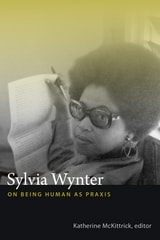
Sylvia Wynter
On Being Human as PraxisKatherine McKittrick, ed.
Duke University Press, 2015