Results by title
5448 books match the query 'History and criticism' and 403 start with s
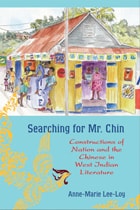
Searching for Mr. Chin
Constructions of Nation and the Chinese in West Indian LiteratureAuthored by Anne-Marie Lee-Loy
Temple University Press, 2010
What do twentieth-century fictional images of the Chinese reveal about the construction of nationhood in the former West Indian colonies? In her groundbreaking interdisciplinary work, Searching for Mr. Chin, Anne-Marie Lee-Loy seeks to map and understand a cultural process of identity formation: “Chineseness” in the West Indies.
Reading behind the stereotypical image of the Chinese in the West Indies, she compares fictional representations of Chinese characters in Jamaica, Trinidad, and Guyana to reveal the social and racial hierarchies present in literature by popular authors such as V.S. Naipaul and Samuel Selvon, as well as lesser known writers and hard to access literary texts.
Using historical, discursive, and theoretical frameworks for her literary analysis, Lee-Loy shows how the unstable and ambiguous “belonging” afforded to this “middleman minority” speaks to the ways in which narrative boundaries of the nation are established. In addition to looking at how Chinese have been viewed as “others,” Lee-Loy examines self-representations of “Chineseness” and how they complicate national narratives of belonging.
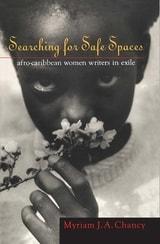
Searching for Safe Spaces
Afro-Caribbean Women Writers in ExileMyriam Chancy
Temple University Press, 1997
Understanding exile as flight from political persecution or types of oppression that single out women, Chancy concentrates on diasporic writers and filmmakers who depict the vulnerability of women to poverty and exploitation in their homelands and their search for safe refuge. These Afro-Caribbean feminists probe the complex issues of race, nationality, gender, sexuality, and class that limit women's lives. They portray the harsh conditions that all too commonly drive women into exile, depriving them of security and a sense of belonging in their adopted countries -- the United States, Canada, or England.
As they rework traditional literary forms, artists such as Joan Riley, Beryl Gilroy, M. Noubese Philip, Dionne Brand, Makeda Silvera, Audre Lorde, Rosa Guy, Michelle Cliff, and Mari Chauvet give voice to Åfro-Caribbean women's alienation and longing to return home. Whether their return is realized geographically or metaphorically, the poems, fiction, and film considered in this book speak boldly of self-definition and transformation.
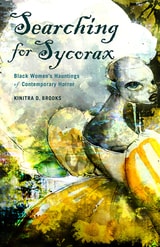
Searching for Sycorax
Black Women's Hauntings of Contemporary HorrorBrooks, Kinitra D
Rutgers University Press, 2018

Seasoned Authors for a New Season
The Search for Standards in Popular WritingEdited by Louis Filler
University of Wisconsin Press, 1980
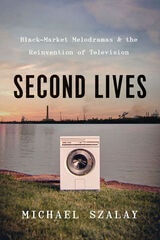
Second Lives
Black-Market Melodramas and the Reinvention of TelevisionMichael Szalay
University of Chicago Press, 2023
In Second Lives, Michael Szalay defines a new television genre that has driven the breathtaking ascent of TV as a cultural force over the last two decades: the black-market melodrama. Exemplified by the likes of The Sopranos and Breaking Bad, the genre moves between a family’s everyday life and its secret second life, which may involve illegal business, espionage, or even an alternate reality. Second lives allow characters (and audiences) to escape what feels like endless work into a revanchist vision of the white middle class family. But there is for this grimly resigned genre no meaningful way back to the Fordist family wage for which it longs. In fact, Szalay argues, black-market melodramas lament the very economic transformations that untethered TV viewing from the daily rhythms of the nine-to-five job and led, ultimately, to prestige TV.
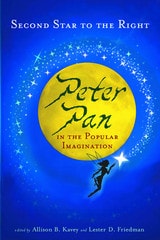
Second Star to the Right
Peter Pan in the Popular ImaginationFriedman, Lester D
Rutgers University Press, 2008
Since 2003 the characters from this story have had a highly visible presence in nearly every genre of popular culture: two major films, a literary sequel to the original adventures, a graphic novel featuring a grown-up Wendy Darling, and an Argentinean novel about a children's book writer inspired by J. M. Barrie. Simultaneously, Barrie surfaced as the subject of two major biographies and a feature film. The engaging essays in Second Star to the Right approach Pan from literary, dramatic, film, television, and sociological perspectives and, in the process, analyze his emergence and preservation in the cultural imagination.
Secondhand China
Spain, the East, and the Politics of TranslationCarles Prado-Fonts
Northwestern University Press, 2022
Uncovering an eclectic and surprising archive, Prado-Fonts draws on diverse cultural artifacts from popular literature, journalism, and early cinema to offer a rich account of how China was seen across the West between 1880 and 1930. Enrique Gaspar, Luis de Oteyza, Vicente Blasco Ibáñez, and lesser-known authors writing in Spanish and Catalan put themselves in dialogue with Leo Tolstoy, John Dewey, W. Somerset Maugham, Bertrand Russell, Pearl Buck, and André Malraux, as well as stereotypical figures from popular culture like Fu Manchu and Charlie Chan. Throughout, Prado-Fonts exposes translation as a technology of cultural hegemony and China as an appealing object for representation. A timely contribution to our understanding of how we create and consume knowledge about the world, Secondhand China is essential reading for scholars and students of Orientalism, postcolonial studies, translation studies, comparative literature, and cultural studies.
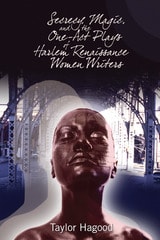
Secrecy, Magic, and the One-Act Plays of Harlem Renaissance Women Writers
Taylor Hagood
The Ohio State University Press, 2010
Exploring secrecy from the standpoints of poststructuralist language theory and game theory as well as dramatic performance, Taylor Hagood argues that the secret—a thing visible for its very invisibility—is a fundamental cog in the machinery of society, employed as a tool for both oppression and subversion. The many facets of secrecy have been particularly salient in African American culture, informing everything from the Underground Railroad to the subtle coding of Signifying. Most devastatingly, people on both sides of the color line are caught within a web of secrecy that is the result of centuries of distrust, doubt, and fear, a fact that is powerfully manifest not only in these one-act plays but in the reader’s/spectator’s interactions with them.
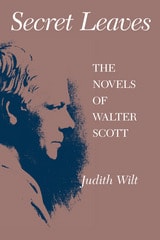
Secret Leaves
The Novels of Walter ScottJudith Wilt
University of Chicago Press, 1985

Secret Sharers in Italian Comedy
From Machiavelli to GoldoniJackson I. Cope
Duke University Press, 1996
Though outwardly similar to New Comedy with its characteristically harmonious closure, this essentially anti-Plautine form employs a secret—known by the audience but unequally shared among the players—to introduce a radical discrepancy between simultaneous stories unfolding in a single action doubly understood. The result is a plot that is misleading at the surface, contingent and unfinished at its end. The audience, in a position of enforced collusion with regard to the secret, becomes a formal ingredient in the production. The play, more cynical than carnivalesque, opens onto vistas of disruption and deception rather than closing on a note of renewed social harmony.
Cope’s close and original readings of both classic and lesser-known plays by Machiavelli, Ruzante, Cecchi, Grazzini, Fagiuoli, Maggi, and others follow this peculiarly Italian, anti-Plautine paradigm through variations across three centuries to its masterful and complex culmination in Carlo Goldoni’s villeggiatura trilogy. Establishing a new comedic canon that demands a revision of Italian dramatic history and the history of European dramatic theory, Secret Sharers in Italian Comedy makes an important contribution to Italian studies and will also attract readers among theater scholars in English, comparative literature, and drama.
Seeing MAD
Essays on MAD Magazine's Humor and LegacyJudith Yaross Lee
University of Missouri Press, 2021
Mad magazine stands near the heart of post-WWII American humor, but at the periphery in scholarly recognition from American cultural historians, including humor specialists. This book fills that gap, with perceptive, informed, engaging, but also funny essays by a variety of scholars. The chapters, written by experts on humor, comics, and popular culture, cover the genesis of Mad; its editors and prominent contributors; its regular features and departments and standout examples of their contents; perspectives on its cultural and political significance; and its enduring legacy in American culture.
Seeing Red
Anger, Sentimentality, and American IndiansCari M. Carpenter
The Ohio State University Press, 2008
Seeing Red—Hollywood's Pixeled Skins
American Indians and FilmLeAnne Howe
Michigan State University Press, 2013
Seeing Sarah Bernhardt
Performance and Silent FilmVictoria Duckett
University of Illinois Press, 2015
Seeing Sodomy in the Middle Ages
Robert Mills
University of Chicago Press, 2015
In Seeing Sodomy in the Middle Ages, Robert Mills explores the relationship between sodomy and motifs of vision and visibility in medieval culture, on the one hand, and those categories we today call gender and sexuality, on the other. Challenging the view that ideas about sexual and gender dissidence were too confused to congeal into a coherent form in the Middle Ages, Mills demonstrates that sodomy had a rich, multimedia presence in the period—and that a flexible approach to questions of terminology sheds new light on the many forms this presence took. Among the topics that Mills covers are depictions of the practices of sodomites in illuminated Bibles; motifs of gender transformation and sex change as envisioned by medieval artists and commentators on Ovid; sexual relations in religious houses and other enclosed spaces; and the applicability of modern categories such as “transgender,” “butch” and “femme,” or “sexual orientation” to medieval culture.
Taking in a multitude of images, texts, and methodologies, this book will be of interest to all scholars, regardless of discipline, who engage with gender and sexuality in their work.
Seeming Human
Artificial Intelligence and Victorian Realist CharacterMegan Ward
The Ohio State University Press, 2018
In Seeming Human, Megan Ward contends that mid-twentieth-century versions of artificial intelligence (AI) offer a theory of verisimilitude omitted by traditional histories of character, which often focus on the development of interiority and the shift from “flat” to “round” characters in the Victorian era. Instead, by reading character through AI, Megan Ward’s Seeming Human argues that routinization, predictability, automation, and even flatness are all features of realist characters.
Early artificial intelligence movements such as cybernetics, information theory, and the Turing test define ways of seeming—rather than being—human. Using these theories of verisimilitude to read Victorian novelists such as Elizabeth Gaskell, Margaret Oliphant, Anthony Trollope, Thomas Hardy, and Henry James, Seeming Human argues that mechanicity has been perceived as anti-realist because it is the element that we least want to identify as human. Because AI produces human-like intelligence, it makes clear that we must actually turn to machines in order to understand what makes realist characters seem so human.
Seems Like Murder Here
Southern Violence and the Blues TraditionAdam Gussow
University of Chicago Press, 2002
Seems Like Murder Here offers a revealing new account of the blues tradition. Far from mere laments about lost loves and hard times, the blues emerge in this provocative study as vital responses to spectacle lynchings and the violent realities of African American life in the Jim Crow South. With brilliant interpretations of both classic songs and literary works, from the autobiographies of W. C. Handy, David Honeyboy Edwards, and B. B. King to the poetry of Langston Hughes and the novels of Zora Neale Hurston, Seems Like Murder Here will transform our understanding of the blues and its enduring power.
Selected Writings of John V. Kelleher on Ireland and Irish America
John V. Kelleher. Edited by Charles Fanning
Southern Illinois University Press, 2002
A collection of eighteen critical essays and twenty-six translations spanning the career of one of the founding intellects of Irish Studies, the Selected Writings of John V. Kelleher on Ireland and Irish America consists of five accessible sections. The first gathers Kelleher’s essays on the most widely known Irish cultural phenomenon—the literary renaissance of the early twentieth century. Part two contains his judicious assessments of Irish literature in its post-Revolutionary phase. The third section includes Kelleher’s insightful essays on the experience of the Irish in America. The fourth section contains essays that examine early Irish literature and culture, opening with a benchmark essay for Irish Studies, “Early Irish History and Pseudo-History,” which was read at the inaugural meeting of the American Conference for Irish Studies in 1961. The collection concludes with Kelleher’s translations and adaptations of poems in Old, Middle, and Modern Irish, illustrating his command of the language at every stage.
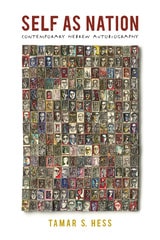
Self as Nation
Contemporary Hebrew AutobiographyTamar S. Hess
Brandeis University Press, 2016
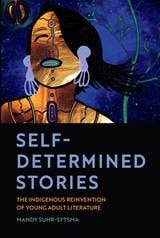
Self-Determined Stories
The Indigenous Reinvention of Young Adult LiteratureMandy Suhr-Sytsma
Michigan State University Press, 2018
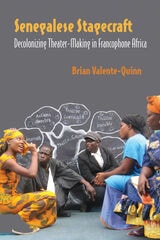
Senegalese Stagecraft
Decolonizing Theater-Making in Francophone AfricaBrian Valente-Quinn
Northwestern University Press, 2021
Through a study of the innovative work of Senegalese theater-makers from the 1930s onward, Senegalese Stagecraft explores a wide range of historical contexts and themes, including French colonial education, cultural Pan‑Africanism, West African Sufism, uses of television and mass media, and popular theater and activism. Using a multidisciplinary approach that includes field, archival, and literary methods, Valente‑Quinn offers a fresh look at performance cultures of West Africa and the Global South in a book that will interest students and scholars in African, Francophone, and performance studies.
Senses of Style
Poetry before InterpretationJeff Dolven
University of Chicago Press, 2017
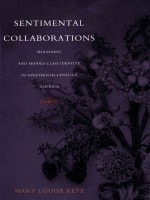
Sentimental Collaborations
Mourning and Middle-Class Identity in Nineteenth-Century AmericaMary Louise Kete
Duke University Press, 2000
Many scholars have written about the sentimental novel as a primarily female genre and have stressed its negative ideological aspects. Kete finds that in fact many men—from writers to politicians—participated in nineteenth-century sentimental culture. Importantly, she also recovers the utopian dimension of the phenomenon, arguing that literary sentimentality, specifically in the form of poetry, is the written trace of a broad cultural discourse that Kete calls “sentimental collaboration”—an exchange of sympathy in the form of gifts that establishes common cultural or intellectual ground. Kete reads the work of Ralph Waldo Emerson, Henry Wadsworth Longfellow, Mark Twain, Harriet Beecher Stowe, and Lydia Huntley Sigourney with an eye toward the deployment of sentimentality for the creation of Americanism, as well as for political and abolitionist ends. Finally, she locates the origins of sentimental collaboration in the activities of ordinary people who participated in mourning rituals—writing poetry, condolence letters, or epitaphs—to ease their personal grief.
Sentimental Collaborations significantly advances prevailing scholarship on Romanticism, antebellum culture, and the formation of the American middle class. It will be of interest to scholars of American studies, American literature, cultural studies, and women’s studies.
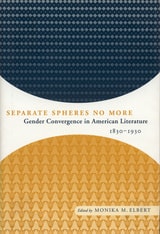
Separate Spheres No More
Gender Convergence in American Literature, 1830-1930Monika Elbert
University of Alabama Press, 2000
Examines the intersection of male and female spheres in American literature
Although they wrote in the same historical milieu as their male counterparts, women writers of the 19th- and early 20th-centuries have generally been "ghettoized" by critics into a separate canonical sphere. These original essays argue in favor of reconciling male and female writers, both historically and in the context of classroom teaching.
While some of the essays pair up female and male authors who write in a similar style or with similar concerns, others address social issues shared by both men and women, including class tensions, economic problems, and the Civil War experience. Rather than privileging particular genres or certain well-known writers, the contributors examine writings ranging from novels and poetry to autobiography, utopian fiction, and essays. And they consider familiar figures like Harriet Beecher Stowe, Emily Dickinson, and Ralph Waldo Emerson alongside such lesser-known writers as Melusina Fay Peirce, Susie King Taylor, and Mary Gove Nichols.
Each essay revises the binary notions that have been ascribed to males and females, such as public and private, rational and intuitive, political and domestic, violent and passive. Although they do not deny the existence of separate spheres, the contributors show the boundary between them to be much more blurred than has been assumed until now.
Sergei Dovlatov and His Narrative Masks
Jekaterina Young
Northwestern University Press, 2012
This book provides an introduction to Sergei Dovlatov (1941–1990) that is closely attentive to the details of his life and work, their place in the history of Soviet society and literature, and of émigré culture during this turbulent period. A journalist, newspaper editor, and prose writer, Dovlatov is most highly regarded for his short stories, which draw heavily on his experiences in Russia before 1979, when he was forced out of the country. During compulsory military service, before becoming a journalist, he worked briefly as a prison camp guard—an experience that gave him a unique perspective on the operations of the Soviet state. After moving to New York, Dovlatov published works (in the New Yorker and elsewhere) that earned him considerable renown in America and back in Russia. Young’s book presents a valuable critical overview of the prose of a late twentieth-century master within the context of the prevailing Russian and larger literary culture.

Sergei Paradjanov
Shadows of Forgotten AncestorsJoshua First
Intellect Books, 2016
This book is the first full-length companion to the film. In addition to a synopsis of the plot and a close analysis of the many levels of symbolism in the film, it offers a history of the film’s legendarily troubled production process (which included Paradjanov challenging a cinematographer to a duel). The book closes with an account of the film’s reception by critics, ordinary viewers, and Soviet officials, and the numerous controversies that have kept it a subject of heated debate for decades. An essential companion to a fascinating, complicated work of cinema art, this book will be invaluable to students, scholars, and regular film buffs alike.
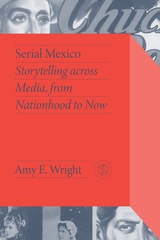
Serial Mexico
Storytelling across Media, from Nationhood to NowAmy E. Wright
Vanderbilt University Press, 2023
Honorable Mention, Premio al Mejor Libro en Humanidades, Latin American Studies Association–Mexico Section, 2025
No book until now has tied in two centuries of Mexican serial narratives—tales of glory, of fame, and of epic characters, grounded in oral folklore—with their subsequent retelling in comics, radio, and television soap operas. Wright’s multidisciplinary Serial Mexico delves into this storytelling tradition: examining the nostalgic tales reimagined in novelas, radionovelas, telenovelas and onwards, and examining the foundational figures who have been woven into society.
This panorama shows the Mexican experience of storytelling from the country’s early days until now, showcasing protagonists that mock authority, make light of hierarchy, and embrace the hybridity and mestizaje of Mexico. These tales reflect on and respond to crucial cultural concerns such as family, patriarchy, gender roles, racial mixing, urbanization, modernization, and political idealism. Serial Mexico thus examines how serialized storytelling’s melodrama and sensationalism reveals key political and cultural messaging.
In a detailed yet accessible style, Wright describes how these stories have continued to morph with current times’ concerns and social media. Will tropes and traditions carry on in new and reimagined serial storytelling forms? Only time will tell. Stay tuned for the next episode.
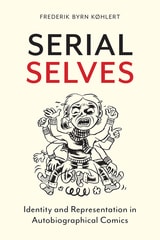
Serial Selves
Identity and Representation in Autobiographical ComicsFrederik Byrn Køhlert
Rutgers University Press, 2019
As the first comparative study of how comics artists from a wide range of backgrounds use the form to write and draw themselves into cultural visibility, Serial Selves will be of interest to anyone interested in the current boom in autobiographical comics, as well as issues of representation in comics and visual culture more broadly.
Seriously Mad
Mental Distress and the Broadway MusicalAleksei Grinenko
University of Michigan Press, 2023
Theatermakers in the United States have long been drawn to madness as a source of dramatic spectacle. During the Broadway musical’s golden age in the mid-twentieth century, creative teams used the currently in-vogue psychoanalytic ideas about mental life to construct troubled characters at odds with themselves and their worlds. As the clinical and cultural profile of madness transformed over the twentieth century, musicals continued to delve into the experience of those living with mental pain, trauma, and unhappiness.
Seriously Mad offers a dynamic account of stage musicals’ engagement with historically significant theories about mental distress, illness, disability, and human variance in the United States. By exploring who is considered mad and what constitutes madness at different moments in U.S. history, Aleksei Grinenko shows how, in attempts to bring the musicals closer to highbrow sophistication, theater dramatized serious medical conditions and social problems. Among the many Broadway productions discussed are Next to Normal, A Strange Loop, Sweeney Todd, Man of La Mancha, Gypsy, Oklahoma!, and Lady in the Dark.
Setting Plato Straight
Translating Ancient Sexuality in the RenaissanceTodd W. Reeser
University of Chicago Press, 2015
In Setting Plato Straight, Todd W. Reeser undertakes the first sustained and comprehensive study of Renaissance textual responses to Platonic same-sex sexuality. Reeser mines an expansive collection of translations, commentaries, and literary sources to study how Renaissance translators transformed ancient eros into non-erotic, non-homosexual relations. He analyzes the interpretive lenses translators employed and the ways in which they read and reread Plato’s texts. In spite of this cleansing, Reeser finds surviving traces of Platonic same-sex sexuality that imply a complicated, recurring process of course-correction—of setting Plato straight.
Settling the Score
Music and the Classical Hollywood FilmKathryn Kalinak
University of Wisconsin Press, 1992
Beginning with the earliest experiments in musical accompaniment carried out in the Edison Laboratories, Kathryn Kalinak uses archival material to outline the history of American music and film. Focusing on the scores of several key composers of the sound era, including Erich Wolfgang Korngold’s Captain Blood, Max Steiner’s The Informer, Bernard Herrmann’s The Magnificent Ambersons, and David Raksin’s Laura, Kalinak concludes that classical scoring conventions were designed to ensure the dominance of narrative exposition. Her analyses of contemporary work such as John Williams’ The Empire Strikes Back and Basil Poledouris’ RoboCop demonstrate how the traditions of the classical era continue to influence scoring practices today.

Seven American Women Writers of the Twentieth Century
An IntroductionMaureen Howard, Editor
University of Minnesota Press, 1977
Seven American Women Writers of the Twentieth Century was first published in 1977. Minnesota Archive Editions uses digital technology to make long-unavailable books once again accessible, and are published unaltered from the original University of Minnesota Press editions.
Seven Faces
Brazilian Poetry Since ModernismCharles A. Perrone
Duke University Press, 1996
Perrone introduces the most important poetic themes of the second half of this century with a look back at Brazilian modernismo and the avant-garde legacy of poets of the 1920s and 30s. Brazilian poets, the author reveals, have long drawn inspiration from the other arts, experimenting with the inclusion of music, graphic arts, and other nontraditional elements within lyric forms. Relating aesthetic concerns to cultural issues, Perrone elucidates the major poetic movements in Brazil since modernismo: concretism and vanguard poetry, politically committed verse of the 60s, youth poetry of the 70s, the lyricism of Brazil’s renowned popular music, and the rethinking of poetry through postmodernism in the final decades of this century.
Providing a window on the ways in which poetry reflects a national spirit and offers a measure of the status of culture in a consumer society, Seven Faces is the only book-length study in English of contemporary Brazilian poetry. It will be welcomed by students and scholars of Latin American literature as well as by general readers interested in poetry and its influence on culture and society.
Seven Stories of Threatening Speech
Women's Suffrage Meets Machine CodeRuth A. Miller
University of Michigan Press, 2012
This book thus represents a radical methodological initiative not just for scholars of history and language but for specialists in law, political theory, political science, gender studies, semiotics, and science and technology studies. It takes posthumanist scholarship to an exciting and essential, if sometimes troubling, conclusion.
“It is an erudite work by a scholar of enormous talent, who advances a thesis that is richly insightful and deeply provocative.”—Mary Hawkesworth, Rutgers University
Seventeenth-Century Opera and the Sound of the Commedia dell’Arte
Emily Wilbourne
University of Chicago Press, 2016
Wilbourne considers a series of case studies structured around the most important and widely explored operas of the period: Monteverdi’s lost L’Arianna, as well as his Il Ritorno d’Ulisse and L’incoronazione di Poppea; Mazzochi and Marazzoli’s L’Egisto, ovvero Chi soffre speri; and Cavalli’s L’Ormindo and L’Artemisia. As she demonstrates, the sound-in-performance aspect of commedia dell’arte theater—specifically, the use of dialect and verbal play—produced an audience that was accustomed to listening to sonic content rather than simply the literal meaning of spoken words. This, Wilbourne suggests, shaped the musical vocabularies of early opera and facilitated a musicalization of Italian theater.
Highlighting productive ties between the two worlds, from the audiences and venues to the actors and singers, this work brilliantly shows how the sound of commedia performance ultimately underwrote the success of opera as a genre.
Sex Changes with Kleist
Katrin Pahl
Northwestern University Press, 2019
Focusing on the theatricality of Kleist’s interventions in the performance of gender, sexuality, and emotion and examining how his dramatic texts unhinge major tenets of classical European theater, Sex Changes with Kleist is vital reading for anyone interested in queer studies, feminist studies, performance studies, literary studies, or emotion studies. This book changes our understanding of Kleist and breathes new life into queer thought.
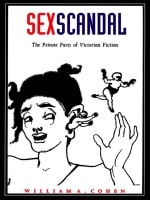
Sex Scandal
The Private Parts of Victorian FictionWilliam A. Cohen
Duke University Press, 1996
Scandal, then as now, makes public the secret indiscretions of prominent people, engrossing its audience in salacious details that violate the very code of propriety it aims to enforce. In narratives ranging from Great Expectations to the Boulton and Park sodomy scandal of 1870–71, from Eliot’s and Trollope’s novels about scandalous women to Oscar Wilde’s writing and his trials for homosexuality, Cohen shows how, in each instance, sexuality appears couched in coded terms. He identifies an assortment of cunning narrative techniques used to insinuate sex into Victorian writing, demonstrating that even as such narratives air the scandalous subject, they emphasize its unspeakable nature.
Written with an eye toward the sex scandals that still whet the appetites of consumers of news and novels, this work is suggestive about our own modes of imagining sexuality today and how we arrived at them. Sex Scandal will appeal to scholars and general readers interested in Victorian literature, the history of sexuality, gender studies, nineteenth-century Britain, and gay, lesbian, and queer studies.
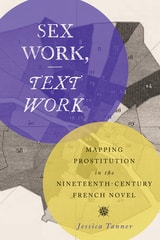
Sex Work, Text Work
Mapping Prostitution in the Nineteenth-Century French NovelJessica Tanner
Northwestern University Press, 2027
While prostitutes in nineteenth-century Paris were subject to municipal laws that policed their bodies and movements, writers of the era enlisted them to stake their own claims on both the city and the novel as literary territory. Sex Work, Text Work: Mapping Prostitution in the Nineteenth-Century French Novel explores how prostitutes depicted by Émile Zola, Joris-Karl Huysmans, Edmond de Goncourt, Adolphe Tabarant, and Charles-Louis Philippe “write back,” confounding civil and literary efforts to contain them in space and in narrative.
In city-regulated brothels, brasseries à femmes, Haussmannian boulevards, and the novel itself, working-class prostitutes served to reinforce the boundaries of social inclusion and exclusion. And yet, Jessica Tanner contends, even the novels that most explicitly aligned with the disciplinary logic of regulated prostitution make space for a distinctly literary form of resistance: these women elude or disrupt the mapping that would claim them as literary territory, revealing their authors’ failure to secure their narratives as property. Tanner pushes back against the critical tendency to attribute agency only to courtesans who became published authors and forwards a new framework for understanding the political work novels engage in as they circulate. Observing that debates about the regulation of prostitution surfaced in tandem with racialized anxieties about the boundaries of the French nation, Tanner ultimately expands that framework to the history of French colonialism and the politics of immigration in the current day. This book shows that while sex workers have been recruited to mark the borders of civic and moral life, prostitution can also make space for more inclusive forms of community, both in the novel and in the world beyond its bounds.
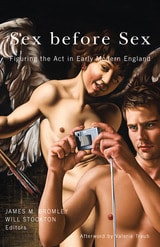
Sex before Sex
Figuring the Act in Early Modern EnglandJames M. Bromley
University of Minnesota Press, 2013
What is sex exactly? Does everyone agree on a definition? And does that definition hold when considering literary production in other times and places? Sex before Sex makes clear that we cannot simply transfer our contemporary notions of what constitutes a sex act into the past and expect them to be true for the people who were then reading literature and watching plays. The contributors confront how our current critical assumptions about definitions of sex restrict our understanding of representations of sexuality in early modern England.
Drawing attention to overlooked forms of sexual activity in early modern culture, from anilingus and interspecies sex to “chin-chucking” and convivial drinking, Sex before Sex offers a multifaceted view of what sex looked like before the term entered history. Through incisive interpretations of a wide range of literary texts, including Romeo and Juliet, The Comedy of Errors, Paradise Lost, the figure of Lucretia, and pornographic poetry, this collection queries what might constitute sex in the absence of a widely accepted definition and how a historicized concept of sex affects the kinds of arguments that can be made about early modern sexualities.
Contributors: Holly Dugan, George Washington U; Will Fisher, CUNY–Lehman College; Stephen Guy-Bray, U of British Columbia; Melissa J. Jones, Eastern Michigan U; Thomas H. Luxon, Dartmouth College; Nicholas F. Radel, Furman U; Kathryn Schwarz, Vanderbilt U; Christine Varnado, U of Buffalo–SUNY.
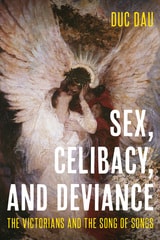
Sex, Celibacy, and Deviance
The Victorians and the Song of SongsDuc Dau
The Ohio State University Press, 2024
Sex, Celibacy, and Deviance is the first major study to explore the Song of Songs (or Song of Solomon) in Victorian literature and art. As the Bible’s only erotic poem, the Song of Songs is the canonical Judeo-Christian book about love, furnishing the Victorians with an authoritative and literary language for love, marriage, sex, mourning, and religious celibacy.
Duc Dau adopts a queer and feminist lens to consider how Victorians employed and interpreted the Song of Songs in their work. How did writers and artists fashion and, most importantly, challenge the norms of gender, romantic love, and marriage? Spanning the early Victorian era through the first two decades of the twentieth century, Sex, Celibacy, and Deviance considers the works of Charlotte Brontë, Thomas Hardy, Christina Rossetti, John Gray, Michael Field, Edward Burne-Jones, and Simeon Solomon alongside two lesser-known figures: Irish-born Scottish artist Phoebe Anna Traquair and the Catholic religious leader Augusta Theodosia Drane. By addressing the relevance of the Song of Songs in light of shifting and conflicting religious and social contexts, Dau provides a fresh perspective on Victorian literature, religion, and culture.
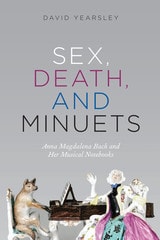
Sex, Death, and Minuets
Anna Magdalena Bach and Her Musical NotebooksDavid Yearsley
University of Chicago Press, 2019
Sex, Death, and Minuets offers the first in-depth study of these notebooks and their owner, reanimating Anna Magdalena as a multifaceted historical subject—at once pious and bawdy, spirited and tragic. In these pages, we follow Magdalena from young and flamboyant performer to bereft and impoverished widow—and visit along the way the coffee house, the raucous wedding feast, and the family home. David Yearsley explores the notebooks’ more idiosyncratic entries—like its charming ditties on illicit love and searching ruminations on mortality—against the backdrop of the social practices and concerns that women shared in eighteenth-century Lutheran Germany, from status in marriage and widowhood, to fulfilling professional and domestic roles, money, fashion, intimacy and sex, and the ever-present sickness and death of children and spouses. What emerges is a humane portrait of a musician who embraced the sensuality of song and the uplift of the keyboard, a sometimes ribald wife and oft-bereaved mother who used her cherished musical notebooks for piety and play, humor and devotion—for living and for dying.
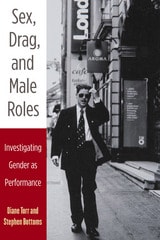
Sex, Drag, and Male Roles
Investigating Gender as PerformanceDiane Torr and Stephen Bottoms
University of Michigan Press, 2010
"Few books blend the critical and creative approaches to drag performance this provocatively and engagingly, and none provides both the historical and the personal perspectives so effectively. Torr and Bottoms fundamentally challenge many long-standing ideas about drag kings and the performance of masculinity."
---Sarah Bay-Cheng, University at Buffalo
"This book brings the reader inside an artist's creative imagination and intellect, showing us Diane Torr's work in a detailed, thoughtful, and engaging way. We discover how Torr uses different physical disciplines to explore how gender is constructed, interpreted, and expressed. Along the way---by taking us into various venues in which she performed---she evokes the lively, dynamic scene in New York in the '80s and '90s."
---Alisa Solomon, Columbia University
Why would women want to perform as men? Why is gender crossing so compelling, whether it happens onstage or in everyday life? What can drag performance teach, and what aesthetic, political, and personal questions does it raise?
Performance artist Diane Torr has been experimenting with the performance of gender for thirty years---exploring everything from feminist go-go dancing to masculine power play. One of the key pioneers of "drag king" performance, Torr has been celebrated internationally for her gender transformation workshops, in which she has taught hundreds of ordinary women how to pass as men on city streets around the world. This cultural subterfuge appeals to participants for many different reasons: personal confidence-building, sexual frisson, gender subversion, trans-curiosity, or simply the appeal of disguise and role play.
Sex, Drag, and Male Roles documents the evolution of Torr's work by blending first-person memoir and commentary from Torr with critical reflections and contextualization from leading performance critic Stephen J. Bottoms. The book includes a consideration of the long cultural history of female-to-male cross-dressing and concludes with Torr's "Do-It-Yourself" guide to becoming a "Man for a Day."
Diane Torr developed her cross-disciplinary art in the downtown New York art scene from 1976 to 2002. Now living in Scotland, Torr has earned an international reputation for her performances and gender transformation workshops (featured on HBO, BBC, and This American Life on NPR, among others). Her work is the focus of a feature film, Man for a Day.
Stephen J. Bottoms is Wole Soyinka Professor of Drama and Theatre Studies at the University of Leeds. His books include Playing Underground: A Critical History of the 1960s Off-Off-Broadway Movement and Small Acts of Repair: Performance, Ecology, and Goat Island.
Cover: Diane Torr walks the streets of London, 1995. Photo by Debbie Humphreys.
Sexual Textualities
Essays on Queer/ing Latin American WritingBy David William Foster
University of Texas Press, 1997
Since the 1991 publication of his groundbreaking book Gay and Lesbian Themes in Latin American Writing, David William Foster has proposed a series of theoretical and critical principles for the analysis of Latin American culture from the perspectives of the queer. This book continues that project with a queer reading of literary and cultural aspects of Latin American texts.
Moving beyond its predecessor, which provided an initial inventory of Latin American gay and lesbian writing, Sexual Textualities analyzes questions of gender representation in Latin American cultural productions to establish the interrelationships, tensions, and irresolvable conflicts between heterosexism and homoeroticism. The topics that Foster addresses include Eva Peron as a cultural/sexual icon, feminine pornography, Luis Humberto Hermosillo's classic gay film Doña Herlinda y su hijo, homoerotic writing and Chicano authors, Matias Montes Huidobro's Exilio and the representation of gay identity, representation of the body in Alejandra Pizarnik's poetry, and the crisis of masculinity in Argentine fiction from 1940 to 1960.

Shadow and Sound
The Historical Thought of a Sumatran PeopleJames Siegel
University of Chicago Press, 1979
Siegel traces the Atjehnese treatment of history through two epics and a folktale. In his interpretation he goes beyond the idea tht texts such as these are semi-accurate historical documents to show tht tempo, rhythm, rhyme, and melody replace the significance of the content. Furthermore, he uncovers which Atjehnese frameworks - native genres ranging from dream interpretation to conventions of braggadocio
- illuminate their own sense of history.
Siegel first translates one of the important remaining epics on a historical topic, the Hikajat Potjoet Moehamat, and provides an analysis based on the narratve, prosodic structure and his observation of the recitation of epics. He then translates and analyzes two other pieces: a tale entitled Si Meuseukin's Wedding and another epic, the last popular one, Hikajat Prang Sabil. Finally he indicates how a similar treatment of history continues in present-day Atjeh. The analyses demonstrate that in the context of centuries of violence and disruption the Atjehnese have maintained an ability to speak of the past in such ways that it is turned into triumph, not by dwelling on heroic victories but by controlling language.
Siegel's way of looking at the relationship between history and literature will be valuable not only in anthropology but in literary history and comparative studies in literature and politics as well.
Shadows of Empire
Colonial Discourse and Javanese TalesLaurie J. Sears
Duke University Press, 1996
Though Javanese shadow theater (wayang) has existed for hundreds of years, our knowledge of its history, performance practice, and role in Javanese society only begins with Dutch documentation and interpretation in the nineteenth century. Analyzing the Mahabharata and Ramayana tales in relation to court poetry, Islamic faith, Dutch scholarship, and nationalist journals, Sears shows how the shadow theater as we know it today must be understood as a hybrid of Javanese and Dutch ideas and interests, inseparable from a particular colonial moment. In doing so, she contributes to a re–envisioning of European histories that acknowledges the influence of Asian, African, and New World cultures on European thought—and to a rewriting of colonial and postcolonial Javanese histories that questions the boundaries and content of history and story, myth and allegory, colonialism and culture.
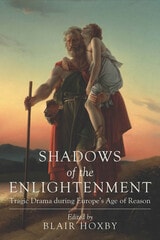
Shadows of the Enlightenment
Tragic Drama during Europe’s Age of ReasonEdited by Blair Hoxby
The Ohio State University Press, 2022
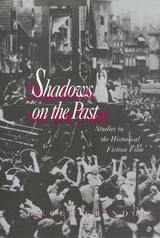
Shadows on the Past
Studies in the Historical Fiction FilmLeger Grindon
Temple University Press, 1994
Studying popular Hollywood films from Gone With the Wind to Reds and such distinguished European films as La Marseillaise and The Rise to Power of Louis XIV, Leger Grindon examines how historical fiction films interpret the present through a representation of the past.
The historical fiction film is characterized by a set of motives and, Grindon argues, deserves to be considered a genre unto itself. Appropriation of historical events can insinuate a film's authority of its subject, veil an intention, provide an escape into nostalgia, or direct a search for knowledge and origins. Utilizing the past as a way of responding to social conflicts in the present, Grindon shows how the genre promotes a political agenda, superseding the influence of scholarship on the public's perception and interpretation of history.
In the series Culture and the Moving Image, edited by Robert Sklar.
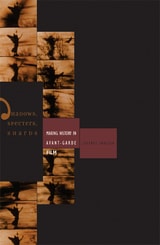
Shadows, Specters, Shards
Making History in Avant-Garde FilmJeffrey Skoller
University of Minnesota Press, 2005
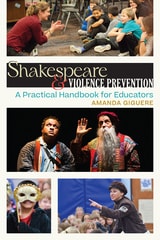
Shakespeare & Violence Prevention
A Practical Handbook for EducatorsAmanda Giguere
University of Wyoming Press, 2025
Framed by examples from Giguere’s work with the Shakespeare & Violence Prevention program, an interdisciplinary outreach project for K–12 schools developed at the University of Colorado Boulder, the text offers helpful entry points, digestible research, and practical exercises to align a violence-prevention curriculum with Shakespeare’s plays. It provides a condensed overview of key findings from violence prevention, clear synopses of the plays, and practicable strategies to implement the program. Guided by firsthand experience with a tried-and-true school program that reaches thousands of K–12 students annually, Giguere shares the Colorado Shakespeare Festival method, which focuses on “upstander” roleplays to practice violence-prevention strategies. Using a clear distillation of Shakespeare studies and violence-prevention research, she shows how the two fields naturally reinforce the concepts of teamwork, empathy, change, and hope.
Shakespeare and Violence Prevention is a new spin on these classic texts that empowers teachers and community leaders to use these tools to create research-guided university engagement programs, theatre company outreach programs, and K–12 student engagement with Shakespeare, even for those without expertise in violence prevention or Shakespeare.
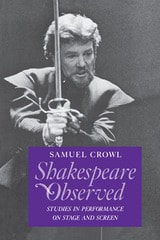
Shakespeare Observed
Studies in Performance on Stage and ScreenSamuel Crowl
Ohio University Press, 1993
Crowl’s study demonstrates the surprising resonances between Roman Polanski's 1971 film of Macbeth and Adrian Noble's heralded recent production of the play for The Royal Shakespeare Company; argues that Orson Welles's films of Othello and Cabins at Midnight are not only brilliant remaining of Shakespeare in another art form but make a powerful contribution to our contemporary understanding of performance as interpretation; and chronicles the impact of Peter Hall's creation of the Royal Shakespeare Company in 1960 on performance approaches to Shakespeare in the past thirty years.
Shakespeare Observed provides full interpretative readings of key recent Shakespeare productions in England and includes an intimate behind-the-scenes glimpse into the rehearsal process which produced Ron Daniels's emotionally charged version of Romeo and Juliet for the RSC in 1980. The final chapter uses Kenneth Branagh's highly successful film of Henry V as a summary example of the trends and influences Crowl's study traces, seeing the film as gathering its interpretative energies from both Olivier's famous film version of the play and Adrian Noble's stage production featuring Branagh as the king.
Written in a style which places a premium on capturing the vivid and often dazzling moments of stage and film performances of Shakespeare, Crowl's study will be of interest to the avid film and theatergoer as well as to the scholar and student. Shakespeare Observed joins a growing list of recent critical works which have significantly expanded and redefined the boundaries of Shakespeare studies in our time.