Results by title
1488 books match the query 'Media Studies' and 106 start with s
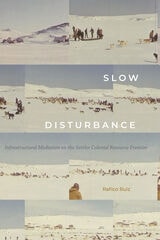
Slow Disturbance
Infrastructural Mediation on the Settler Colonial Resource FrontierRafico Ruiz
Duke University Press, 2021
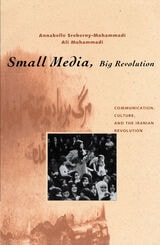
Small Media, Big Revolution
Communication, Culture, and the Iranian RevolutionAnnabelle Sreberny-Mohammadi
University of Minnesota Press, 1994
Reveals how small media (leaflets and audio cassettes) played an important role in the revolution that deposed the Shah of Iran.
To most Westerners, the Iranian revolution was a shocking spectacle, a distant mass upheaval suddenly breaking into the daily news. It was, in fact, a revolution of the television era, as these authors book clearly demonstrate. The first account of the role of culture and communication in the Iranian revolution, this is also the first book to consider revolution as communication in the modern world.
Coauthored by participants in the revolutionary upheaval, this study reflects an unusual breadth and depth of perspective. Drawing on ten years of research, the authors vividly show how the processes and products of modernization were used to undermine the very foundation of modernity in Iran. Their work reveals how deeply embedded cultural modes of communication coupled with crucial media technologies were able to mobilize a population within a repressive political context. Tracing the use of small media (audio cassettes and leaflets) to disseminate the revolution, the authors challenge much of the theory that has dominated international communication studies-and, in doing so, question the credibility of the established media. They also examine the dilemmas of cultural policy making based on Islamic principles in a media-saturated domestic and international environment.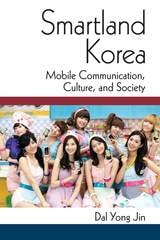
Smartland Korea
Mobile Communication, Culture, and SocietyDal Yong Jin
University of Michigan Press, 2017

Smut and Sandwiches
A History of Stag FilmRussell Sheaffer
Duke University Press, 2027
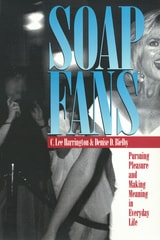
Soap Fans
Pursuing Pleasure and Making Meaning in Everyday LifeC. Lee Harrington and Denise D. Bielby
Temple University Press, 1995
Do soap opera fans deserve their reputation as lonely people, hopeless losers, or bored housewives? No, according to C. Lee Harrington and Denise D. Bielby. These authors—soap fans themselves—argue that soap fans are normal individuals who translate their soap watching into a broad range of public and private experience. People who cut across all categories of age, gender, race, ethnicity, income, education, and ideology incorporate a love of the soaps into their day-to-day leisure activities.
Interviews with soap opera viewers, actors, writers, producers, directors, the daytime press, and fan club staff members reveal fascinating details about the inside world of fandom and the multitude of outlets for fan expression—clubs, newsletters, electronic bulletin boards, and public events. Numerous examples illustrate the pleasure fans derive from critiquing characters, speculating on plot twists, and swapping memorabilia.
Examining the experiences that shape fan culture, Harrington and Bielby analyze the narrative structure and various aspects of the production of the soaps. Their examination reveals that the "meaning" of soaps is complex, individualized, and not simply a reflection of the narrative content of the stories. The authors show fans who actively contemplate what it means to be a fan, and who adjust their level of involvement accordingly.
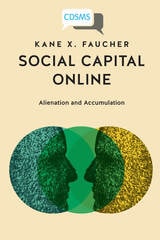
Social Capital Online
Alienation and AccumulationKane X. Faucher
University of Westminster Press, 2018
What is ‘social capital’? The enormous positivity surrounding it conceals the instrumental economic rationality underpinning the notion as corporations silently sell consumer data for profit. Status chasing is just one aspect of a process of transforming qualitative aspects of social interactions into quantifiable metrics for easier processing, prediction, and behavioural shaping.
A work of critical media studies, Social Capital Online examines the idea within the new ‘network spectacle’ of digital capitalism via the ideas of Marx, Veblen, Debord, Baudrillard and Deleuze. Explaining how such phenomena as online narcissism and aggression arise, Faucher offers a new theoretical understanding of how the spectacularisation of online activity perfectly aligns with the value system of neoliberalism and its data worship. Even so, at the centre of all, lie familiar ideas – alienation and accumulation – new conceptions of which he argues are vital for understanding today’s digital society.
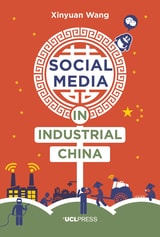
Social Media in Industrial China
Xinyuan Wang
University College London, 2016
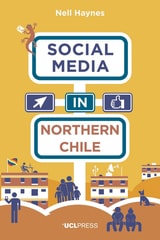
Social Media in Northern Chile
Posting the Extraordinarily OrdinaryNell Haynes
University College London, 2016
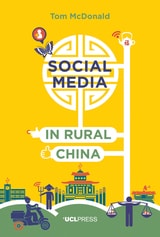
Social Media in Rural China
Social Networks and Moral FrameworksTom McDonald
University College London, 2016
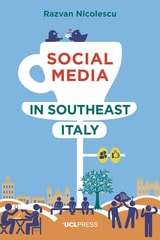
Social Media in Southeast Italy
Crafting IdealsRazvan Nicolescu
University College London, 2016
Why is social media in southeast Italy so predictable when it is used by such a range of different people?
This book describes the impact of social media on the population of a town in the southern region of Puglia, Italy. Razvan Nicolescu spent 15 months living among the town’s residents, exploring what it means to be an individual on social media. Why do people from this region conform on platforms that are designed for personal expression?
Nicolescu argues that social media use in this region of the world is related to how people want to portray themselves. He pays special attention to the ability of users to craft their appearance in relation to collective ideals, values, and social positions, and how this feature of social media has, for the residents of the town, become a moral obligation: they are expected to be willing to adapt their appearance to suit their different audiences at the same time, which is crucial in a town where religion and family are at the heart of daily life.
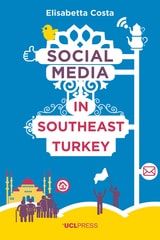
Social Media in Southeast Turkey
Love, Kinship and PoliticsElisabetta Costa
University College London, 2016
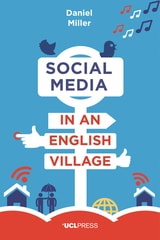
Social Media in an English Village
(Or how to keep people at just the right distance)Daniel Miller
University College London, 2016
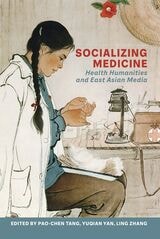
Socializing Medicine
Health Humanities and East Asian MediaEdited by Pao-chen Tang, Yuqian Yan, and Ling Zhang
Hong Kong University Press, 2025
Socializing Medicine explores the intersections of medicine, health, and East Asian media. Interweaving archival research, audiovisual analyses, and theoretical insights from the emerging field of Health Humanities, the contributors reveal the multifaceted ways in which mass media—including photography, film, television, and live streaming—has been deployed as a tool for controlling medicine and health, privileging those with power and authority since the early twentieth century. Adopting anti-colonial and anti-capitalist perspectives, the contributors in this volume challenge the dominant mediations of health against the backdrop of imperialism, Cold War geopolitical tensions, and neoliberal capitalism. Collectively, they advocate for alternative understandings of medical culture through media productions that envision accessible and equitable healthcare practices.
Sociology on Film
Postwar Hollywood's Prestige CommodityCagle, Chris
Rutgers University Press, 2016

Softimage
Towards a New Theory of the Digital ImageIngrid Hoelzl and Remi Marie
Intellect Books, 2015
Some Kind of Mirror
Creating Marilyn MonroeKonkle, Amanda
Rutgers University Press, 2019
Some Kind of Mirror offers the first extended scholarly analysis of Marilyn Monroe’s film performances, examining how they united the contradictory discourses about women’s roles in 1950s America. Amanda Konkle suggests that Monroe’s star persona resonated with audiences precisely because it engaged with the era’s critical debates regarding femininity, sexuality, marriage, and political activism. Furthermore, she explores how Monroe drew from the techniques of Method acting and finely calibrated her performances to better mirror her audience’s anxieties and desires.
Drawing both from Monroe’s filmography and from 1950s fan magazines, newspaper reports, and archived film studio reports, Some Kind of Mirror considers how her star persona was coauthored by the actress, the Hollywood publicity machine, and the fans who adored her. It is about why 1950s America made Monroe a star, but it is also about how Marilyn defined an era.
Some Things Don’t Burn
Art, Activism, and Arson at the Bugle AmericanAurore Sibley
Wisconsin Historical Society Press, 2026
A fierce, vibrant portrait of a newspaper that refused to go up in smoke.
From 1970 to 1978, the Bugle American wasn’t just an alternative newspaper―it was the sparkplug that propelled Milwaukee’s emergence as an influential cultural hub. With its incisive political coverage, razor-sharp cartoons, and in-depth reporting on the city’s explosive music scene, the Bugle American was a lifeline for artists, activists, and readers from Milwaukee to Madison hungry for independent journalism.
Then, on a cold night in February 1975, everything nearly ended. A firebomb ripped through the Bugle American offices, endangering the lives of staff and burning the building to the ground. The crime was never solved. But the paper didn’t die. Supported by a stunned but determined community―and high-profile allies including Leonard Cohen and George Reedy―the Bugle American rose from the ashes to publish the very next week.
In Some Things Don’t Burn: Art, Activism, and Arson at the Bugle American, author Aurore Sibley tells the full story of this influential underground paper: its founding ideals, its creative energy, its brushes with fame, and its lasting impact. With access to rare materials and family insights―her parents met at the Bugle American, and her father served as one of its editors―Sibley layers investigative research with personal narrative, exploring how revisiting the past helped her reconcile with her father’s complicated life and death.
Featuring dozens of photographs and illustrations, including cartoons and sketches by renowned underground artist and Bugle American co-founder Denis Kitchen, this book brings readers inside the quirky, passionate, and often chaotic world of a newsroom fighting to stay alive and independent.
A gripping story of art, activism, community, and resilience, Some Things Don’t Burn reminds us that while buildings can be destroyed, the ideals that ignite a movement are much harder to extinguish.
Somebody Told Me
The Newspaper Stories of Rick BraggRick Bragg
University of Alabama Press, 2000
Over the past twenty years, writer Rick Bragg has earned legions of fans with his award-winning newspaper stories and with his critically aclaimed memoir All Over but the Shoutin'. His unique storytelling talent and his sympathy for the day-to-day struggles of everyday people set him apart from journalists who focus on political intrigue and the foibles of the rich and famous.
This collection showcases Bragg's talent for turning seemingly ordinary situations into extraordinary stories by bringing together more than sixty of his most recent feature articles, most of them written for the New York Times. Bragg explores such questions as: What happens to someone released from prison for a crime he didn't commit? Who takes care of the graves of poor people? What keeps an elderly woman from selling her land for a tidy profit? Bragg's curiosity often leads him to society's margins, where he wins the confidence of those who have good reason to mistrust others.
Bragg has reported on some of the most newsworthy tragedies in the nation, and his unfolding coverage of events such as the Oklahoma City bombing and the Susan Smith child murders is included here. Once again, though, his special ability to connect with people allows him accesss and perspectives that many other reporters do not achieve.
Whether he's profiling the sheriff who broke the Smith case or relating the efforts of Alabama churchgoers to understand a Sunday morning tornado strike, Bragg writes with genuine compassion and sentiment but without being sensationalist. He looks where others don’t and gets behind the headlines to the people standing there stunned and often, until he finds them, voiceless. When asked how he came up with his remarkable stories, Bragg has his answer down pat: “Somebody told me.”
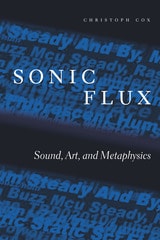
Sonic Flux
Sound, Art, and MetaphysicsChristoph Cox
University of Chicago Press, 2018
Through the philosophical analysis of works by John Cage, Maryanne Amacher, Max Neuhaus, Christian Marclay, and many others, Sonic Flux contributes to the development of a materialist metaphysics and poses a challenge to the prevailing positions in cultural theory, proposing a realist and materialist aesthetics able to account not only for sonic art but for artistic production in general.
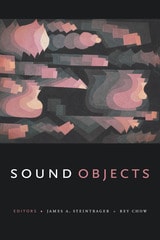
Sound Objects
James A. Steintrager and Rey Chow, editors
Duke University Press, 2019
Contributors. Georgina Born, Michael Bull, Michel Chion, Rey Chow, John Dack, Veit Erlmann, Brian Kane, Jairo Moreno, John Mowitt, Pooja Rangan, Gavin Steingo, James A. Steintrager, Jonathan Sterne, David Toop
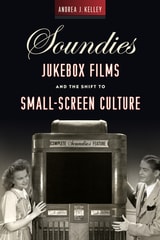
Soundies Jukebox Films and the Shift to Small-Screen Culture
Kelley, Andrea J
Rutgers University Press, 2018
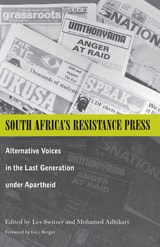
South Africa’s Resistance Press
Alternative Voices in the Last Generation under ApartheidLes Switzer
Ohio University Press, 2000
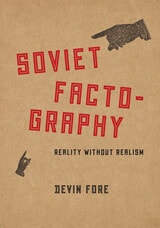
Soviet Factography
Reality without RealismDevin Fore
University of Chicago Press, 2024
This is the first major English-language study of factography, an avant-garde movement of 1920s modernism. Devin Fore charts this style through the work of its key figures, illuminating factography’s position in the material culture of the early Soviet period and situating it as a precursor to the genre of documentary that arose in the 1930s. Factographers employed photography and film practices in their campaign to inscribe facts and to chronicle modernization as it transformed human experience and society. Fore considers factography in light of the period’s explosion of new media technologies—including radio broadcasting, sound in film, and photo-media innovations—that allowed the press to transform culture on a massive scale.
This theoretically driven study uses material from Moscow archives and little-known sources to highlight factography as distinct from documentary and Socialist Realism and to establish it as one of the major twentieth-century avant-garde forms. Fore covers works of photography, film, literature, and journalism together in his considerations of Soviet culture, the interwar avant-gardes, aesthetics, and the theory of documentary.

Space Monkeys!
Remembering the Nonhuman Astronauts in US Space ExplorationJohn A. Lynch
University of Alabama Press, 2026
Exposes how emotion, memory, and national pride shape the stories we tell about science, animals, and the history of the “race to space”
Before humans ever left Earth’s atmosphere, a handful of primates paved the way—earning fame and fascination but leaving behind a complicated and often highly debated legacy. As the Cold War intensified, the US space program turned to monkeys—Able, Baker, Ham, and Enos—to test and explore the limits of human survival in space. These animals became media sensations, museum exhibits, and symbols of American ingenuity, even as their suffering was often overlooked.
With insight and empathy, Lynch unpacks the stories we tell about these primates and how they are remembered through culture and time, both modern and historically. Lynch argues that the public memory of these animals often justifies their use in the name of scientific progress. Sometimes they are portrayed as tools, other times as human stand-ins, and frequently as objects of sympathy—but rarely as subjects of critique.
Lynch shows how feelings—compassion, cuteness, patriotism, and the technological sublime—shape the stories we tell about these animals and the ethical frameworks we build around them. Each chapter focuses on a different genre of memory-making, from newspaper and photojournalism to museum exhibits, children’s literature, and fictional films.
By reframing these animal pioneers, Lynch uncovers the ethical and emotional narratives that shape how we remember science. Space Monkeys! is a vital reflection on memory, identity, and the more-than-human costs of progress.
Spanish Cinema of the New Millennium
And the Winner Is...Thomas G. Deveny
Intellect Books, 2019
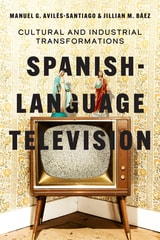
Spanish-Language Television
Cultural and Industrial TransformationsManuel G. Avilés-Santiago and Jillian M. Báez
University of Texas Press, 2025
How Spanish-language television networks continue to thrive in a rapidly changing media landscape.
The US television industry has suffered blow after blow amid media convergence and the rise of streaming. Those legacy broadcasters that survive are much diminished and highly dependent on live programming—the last redoubt of old media. There is an exception, though: Spanish-language television is thriving.
Spanish-Language Television surveys the Latinx media landscape to better appreciate why Univision and Telemundo have flourished while others faltered. Manuel G. Avilés-Santiago and Jillian M. Báez show that the major Spanish-language networks are unusually flexible and open to innovation in hopes of reaching new demographics. Univision and Telemundo were early to streaming. To appeal to “billennial” audiences—bilingual millennials—who threatened to stray from TV, they rebuilt the telenovela, which now features social commentary, diverse characters, and genre crossovers. Today’s reality programs defy old norms of linguistic correctness, and the airwaves are becoming less hospitable to racism and sexism, resulting in rising ratings and ad revenues. The first book-length treatment of reception patterns in Latinx TV, Spanish-Language Television deepens our understanding of new media in a moment of transformation and possibility.
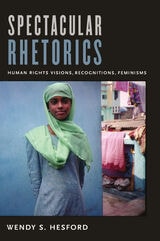
Spectacular Rhetorics
Human Rights Visions, Recognitions, FeminismsWendy S. Hesford
Duke University Press, 2011

Spoiler Alert
A Critical GuideAaron Jaffe
University of Minnesota Press, 2019
All of this information at our fingertips—and we might not need any of it
Concurrent with the compulsory connectivity of the digital age is the rise of the spoiler. The inevitability of information has changed the critical quality of modernity, leaving us with acute vertigo—a feeling that nothing new is left out there. Encompassing memes and trigger warnings, Vilem Flusser and Thomas Pynchon, Spoiler Alert wrangles with the state of surprise in post-historical times. Aaron Jaffe delivers a timely corrective to post-critical modes of reading that demonstrates the dangers of forfeiting critical suspicion.
Forerunners: Ideas First
Short books of thought-in-process scholarship, where intense analysis, questioning, and speculation take the lead

Spring in My Hometown
Andrew David Jackson
Lever Press, 2026
The inaugural volume of the Cinemas of Asia series, this book offers a fresh perspective on South Korean director Lee Kwang-mo’s 1998 film Spring in My Hometown (아름다운 시절). Written and directed by Lee, the intensely personal film tells the story of his grandfather’s relationship with his ten-year-old father during the Korean War. This volume examines the industrial context in which Lee attempted to bring his film into production, the cinematic cycle from which it emerged, and the unique style that captivated festival juries but divided audiences. Jackson’s book offers a rare, historical insight into an important Asian cinematic industry on the verge of commercial transformation at the end of the last century.
Cinemas of Asia is the first series dedicated to the cinemas of South, Southeast, East, Central Asia, and global Asian diasporas. Each volume provides a critical analysis and interpretation of a notable film from Asian cinema and consists of thematic chapters, accessible writing, and screenshots and illustrations. Authors analyze each film from a variety of angles, including film, literary, historical, gender, post-/decolonial studies, and each volume is accessibly written, informative, and appeals to academics, students, cinephiles, and non-experts alike.
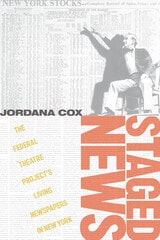
Staged News
The Federal Theatre Project’s Living Newspapers in New YorkJordana Cox
University of Massachusetts Press, 2023
Finalist for the 2023 Frank Luther Mott - Kappa Tau Alpha Journalism and Mass Communication Research Award
In 1935, a group of journalists and theater artists embarked on an unusual collaboration. With funds from the Federal Theatre Project (FTP), a Depression-era employment initiative established by President Roosevelt’s New Deal, they set out to produce news for the theatrical stage. Over the next four years, the New York–based team created six productions, known as the Living Newspapers. Covering a variety of public issues that included affordable housing, the plight of Dust Bowl farmers, the Tennessee Valley Authority, and labor law, Living Newspaper productions would reach hundreds of thousands of spectators and inspire adaptations across the country.
Staged News interprets the Living Newspaper’s process and repertoire amid journalists’ changing conceptions of their profession. Jordana Cox spotlights marginalized “newsmakers,” particularly Black artists, who challenged the parameters of public knowledge and assumptions surrounding newsworthiness. This timely analysis reveals how a vital theatrical form sprouted from a changing news landscape and reimagined what journalism could do for people seeking democratic change.

Staging Memories
Hou Hsiao-hsien's A City of SadnessAbé Mark Nornes and Emilie Yueh-yu Yeh
Michigan Publishing Services, 2015
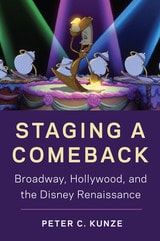
Staging a Comeback
Broadway, Hollywood, and the Disney RenaissancePeter C. Kunze
Rutgers University Press, 2023
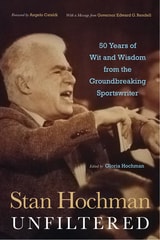
Stan Hochman Unfiltered
50 Years of Wit and Wisdom from the Groundbreaking SportswriterGloria Hochman
Temple University Press, 2020
The late Philadelphia Daily News sportswriter Stan Hochman was known for his many zingers, such as “Harry Litwack, the stoic Temple coach, stalks the sidelines like a blind man at a nudist colony.” As a reporter, he was more interested in how athletes felt, what their values were, how they lived their lives, or what made them tick than he was about how many runs they scored or punches they landed.
In Stan Hochman Unfiltered, his wife Gloria collects nearly 100 of his best columns from the Daily News about baseball, horse racing, boxing, football, hockey, and basketball (both college and pro), as well as food, films, and even Liz Taylor. Each section is introduced by a friend or colleague, including Garry Maddox, Bernie Parent, Larry Merchant, and Ray Didinger, among others.
Hochman penned a candid, cantankerous column about whether Pete Rose belongs in the Baseball Hall of Fame; wrote a graphic account of the Muhammad Ali and Joe Frazier fight of the century; and skewered Norman “Bottom Line” Braman, the one-time owner of the Eagles. He also wrote human-interest stories, including features about the importance of kids with special needs playing sports.
In addition to being a beloved writer, Hochman was also known for his stint on WIP’s radio as the Grand Imperial Poobah, where he would settle callers’ most pressing debates. Hochman long earned the respect and admiration of his subjects, peers, and readers throughout his career, and Stan Hochman Unfiltered is a testament to his enduring legacy.
Star Wars after Lucas
A Critical Guide to the Future of the GalaxyDan Golding
University of Minnesota Press, 2019
Politics, craft, and cultural nostalgia in the remaking of Star Wars for a new age
A long time ago, in a galaxy far, far away—way back in the twenty-first century’s first decade—Star Wars seemed finished. Then in 2012 George Lucas shocked the entertainment world by selling the franchise, along with Lucasfilm, to Disney. This is the story of how, over the next five years, Star Wars went from near-certain extinction to what Wired magazine would call “the forever franchise,” with more films in the works than its first four decades had produced.
Focusing on The Force Awakens (2015), Rogue One (2016), The Last Jedi (2017), and the television series Rebels (2014–18), Dan Golding explores the significance of pop culture nostalgia in overcoming the skepticism, if not downright hostility, that greeted the Star Wars relaunch. At the same time he shows how Disney, even as it tapped a backward-looking obsession, was nonetheless creating genuinely new and contemporary entries in the Star Wars universe.
A host of cultural factors and forces propelled the Disney-engineered Star Wars renaissance, and all figure in Golding’s deeply informed analysis: from John Williams’s music in The Force Awakens to Peter Cushing’s CGI face in Rogue One, to Carrie Fisher’s passing, to the rapidly changing audience demographic. Star Wars after Lucas delves into the various responses and political uses of the new Star Wars in a wider context, as in reaction videos on YouTube and hate-filled, misogynistic online rants. In its granular textual readings, broad cultural scope, and insights into the complexities of the multimedia galaxy, this book is as entertaining as it is enlightening, an apt reflection of the enduring power of the Star Wars franchise.
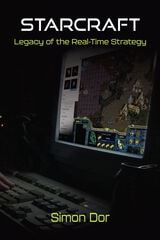
StarCraft
Legacy of the Real-Time StrategySimon Dor
University of Michigan Press, 2024
Apart from the game’s clear landmark status, StarCraft offers a unique insight into changes in gaming culture and, more broadly, the marketability and profit of previously niche areas of interest. The book places StarCraft in the history of real-time strategy games in the 1990s—Dune II, Command & Conquer, Age of Empires—in terms of visual style, narrative tropes, and control. It shows how design decisions, technological infrastructures, and a strong contribution from its gaming community through Battle.net and its campaign editor were necessary conditions for the flexibility it needed to grow its success. In exploring the fanatic clusters of competitive players who formed the first tournaments and professionalized gaming, StarCraft shows that the game was key to the transition towards foreseeing play and essential to competitive gaming and e-sports.
Stardust Monuments
The Saving and Selling of HollywoodAlison Trope
Dartmouth College Press, 2012
Stay Tuned
Listening to the Network EraPatrick Sullivan
Rutgers University Press, 2026
Since the 1950s, television flooded the American soundscape with not just pictures but sounds, a constant aural stream infiltrating domestic life. In Stay Tuned, Patrick Sullivan treats network-era television sound not as background noise or auxiliary signal but as a formative texture of aesthetic life in postwar America. He theorizes how television’s sonic forms—asynchronous audiovisuals, noises, affective rhythms, what he collectively terms “network aurality”—trouble traditional aesthetic theory. Stay Tuned takes up critiques of television sound and repurposes them as evidence of a deeper philosophical discomfort: Namely, that television sound does something to aesthetic categories that they weren’t built to handle. From the laugh track to the cartoon “boinks,” from noises to the jingle, Sullivan reads television sounds not as cultural detritus but as formal interventions—forcing a redefinition of what aesthetics means when form is mass-produced, commercial, and built for syndication. What emerges is not just a new theory and history of television sound but a reimagined account of aesthetic experience itself—expanded, recalibrated, and a little wacky.
Stellar Transformations
Movie Stars of the 2010sSteven Rybin
Rutgers University Press, 2022
Stephanie Dinkins
On Love & DataSrimoyee Mitra
University of Michigan Press, 2024
Stephanie Dinkins: On Love & Data brings together nationally renowned curators and theorists who draw from methodologies of art criticism, social practice, new media theory, and critical studies to offer an in-depth analysis of key installations in Dinkins’s survey exhibition. The book also includes an important essay by Stephanie Dinkins on her concept of Afro-now-ism in which she expands on her theoretical framework and positionality as a Black new media artist in the 21st century. Dinkins’s artistic research transcends the boundaries of visual art to challenge and expose the bias and inequities of caste, race, and gender, which are encoded within digital systems on which governance, healthcare, and security infrastructures in the United States are based.
Stephen King on the Small Screen
Mark Browning
Intellect Books, 2011
In this follow up to Stephen King on the Big Screen, Mark Browning turns his critical eye to the much-neglected subject of the best-selling author’s work in television, examining what it is about King’s fiction that makes it particularly suitable for the small screen.
By focusing on this body of work, from the highly successful The Stand and The Night Flier to the lesser-known TV films Storm of the Century, Rose Red, Kingdom Hospital, and the 2004 remake of Salem’s Lot, Browning is able to articulate how these adaptations work and, in turn, suggest new ways of viewing them. This book is the first written by a film specialist to consider King’s television work in its own right, and it rejects previous attempts to make the films and books fit rigid thematic categories. Browning examines what makes a written or visual text successful at evoking fear on a case-by-case basis, in a highly readable and engaging way. He also considers the relationship between the big and small screen. Why, for instance, are some TV versions more effective than movie adaptations and vice versa? In the process, Stephen King on the Small Screen is able to shed new light on what it is that makes King’s novels so successful and reveal the elements of style and approach that have helped make King one of the world’s best-selling authors.
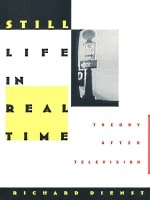
Still Life in Real Time
Theory After TelevisionRichard Dienst
Duke University Press, 1994
Five theoretical projects provide Still Life in Real Time with its framework: the cultural studies tradition of Raymond Williams; Marxist political economy; Heideggerian existentialism; Derridean deconstruction; and a Deleuzian anatomy of images. Drawing lessons from television programs like Twin Peaks and Crime Story, television events like the Gulf War, and television personalities like Madonna, Dienst produces a remarkable range of insights on the character of the medium and on the theories that have been affected by it.
From the earliest theorists who viewed television as a new metaphor for a global whole, a liberal technology empty of ideological or any other content, through those who saw it as a tool for consumption, making time a commodity, to those who sense television’s threat to being and its intimate relation to power, Dienst exposes the rich pattern of television’s influence on philosophy, and hence on the deepest levels of contemporary experience.
A book of theory, Still Life in Real Time will compel the attention of all those with an interest in the nature of the ever present, ever shifting medium and its role in the thinking that marks our time.
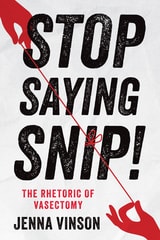
Stop Saying Snip!
The Rhetoric of VasectomyJenna Vinson
Rutgers University Press, 2026
In the US, the most common contraceptive methods rely on women’s time, labor, and vulnerability to risk. Comparatively few people rely on vasectomies as a means of preventing pregnancies. Something is happening rhetorically—through meaning-making symbols and the material practices they manifest—that sustains a collective disinterest in vasectomies. Jenna Vinson draws from her feminist rhetorical study of thirty-seven television and film representations, health insurance policies, and interviews with seventeen people who have experienced vasectomy, surfacing barriers to vasectomy uptake, including problematic tropes and practices that keep vasectomy unappealing, out of mind, and inaccessible. Stop Saying Snip! also illustrates tactics and circumstances that lead people to get a vasectomy, sharing real vasectomy stories and showing that women often play an important (and until now unheeded or pathologized) role in this communication process. This book intervenes in the misogynistic cultural expectation that it is women’s responsibility to endure the pain, labor, and risks of managing fertility by identifying the rhetorics that make men’s reproductive bodies seem unnatural sites for pregnancy prevention work. Fostering a persuasive vision of vasectomy is an urgent project that contributes to the movement toward reproductive justice.
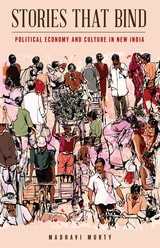
Stories That Bind
Political Economy and Culture in New IndiaMadhavi Murty
Rutgers University Press, 2022
Moving between mediascapes to create an archive of popular culture, Murty advances our understanding of political economy through material that is often seen as inconsequential, namely the popular cultural story. These stories stoke our desires (e.g. for wealth), scaffold our instincts (e.g. for a strong leadership) and shape our values.
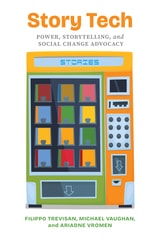
Story Tech
Power, Storytelling, and Social Change AdvocacyFilippo Trevisan, Michael Vaughan, and Ariadne Vromen
University of Michigan Press, 2025
Story Tech explores the increasingly influential impact of technologies—such as databases, algorithms, and digital story banks—that are usually invisible to the public. It shows that hidden “story tech” enables political organizations to treat stories as data that can be queried for storylines and used to intervene in news and information cycles in real time. In particular, the authors review successful story-centered campaigns that helped change dominant narratives on disability rights, marriage equality, and essential workers’ rights in the United States and Australia. They compare the use of storytelling advocacy across different types of organizations including volunteer grassroots groups, large national advocacy coalitions, and trade unions, and examine how trends differ for storytellers, organizers, and their technology partners. As political stories shift to being “on demand,” they reshape power relationships in key public debates in ways that produce moments of tension as well as positive narrative change. Story Tech examines these trends and illustrates how storytelling success can—and should—be achieved in conjunction with personal dignity, privacy, and empowerment for storytellers and their communities, particularly marginalized ones.
Storytelling In Daily Life
Performing NarrativeKristin M. Langellier and Eric E. Peterson
Temple University Press, 2004
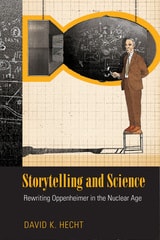
Storytelling and Science
Rewriting Oppenheimer in the Nuclear AgeDavid K. Hecht
University of Massachusetts Press, 2015
No single figure embodies Cold War science more than the renowned physicist J. Robert Oppenheimer. Although other scientists may have been more influential in establishing the institutions and policies of the nuclear age, none has loomed larger in the popular imagination than the “father of the atomic bomb.” Americans have been drawn to the story of the Manhattan Project Oppenheimer helped lead and riveted by the McCarthy-era politics that caught him in its crosshairs. Journalists and politicians, writers and artists have told Oppenheimer's story in many different ways since he first gained notoriety in 1945. In Storytelling and Science, David K. Hecht examines why they did so, and what they hoped to achieve through their stories.
From the outset, accounts of Oppenheimer's life and work were deployed for multiple ends: to trumpet or denigrate the value of science, to settle old scores or advocate new policies, to register dissent or express anxieties. In these different renditions, Oppenheimer was alternately portrayed as hero and villain, establishment figure and principled outsider, “destroyer of worlds” and humanist critic. Yet beneath the varying details of these stories, Hecht discerns important patterns in the way that audiences interpret, and often misinterpret, news about science. In the end, he argues, we find that science itself has surprisingly little to do with how its truths are assimilated by the public. Instead its meaning is shaped by narrative traditions and myths that frame how we think and write about it.
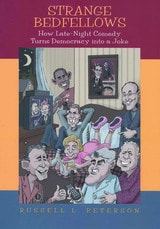
Strange Bedfellows
How Late-Night Comedy Turns Democracy into a JokePeterson, Russell
Rutgers University Press, 2008
It is no coincidence that presidential candidates have been making it a point to add the late-night comedy circuit to the campaign trail in recent years. In 2004, when John Kerry decided it was time to do his first national television interview, he did not choose CBS’s 60 Minutes, ABC’s Nightline, or NBC Nightly News. Kerry picked Comedy Central’s The Daily Show. When George W. Bush was lagging in the polls, his appearance on the David Letterman Show gave him a measurable boost. Candidates for the 2008 presidential election began their late-night bookings almost as soon as they launched their campaigns.
How can this be? The reason is that polls have been consistently finding that a significant number of Americans—and an even larger proportion of those under the age of thirty—get at least some of their “news” about politics and national affairs from comedy shows. While this trend toward what some have called “infotainment” seems to herald the descent of our national discourse—the triumph of entertainment over substance—the reality, according to Russell L. Peterson, is more complex. He explains that this programming is more than a mere replacement for traditional news outlets; it plays its own role in shaping public perception of government and the political process.
From Johnny Carson to Jon Stewart, from Chevy Chase’s spoofing of President Ford on Saturday Night Live to Stephen Colbert’s roasting of President Bush at the White House Correspondents Dinner, Strange Bedfellows explores what Americans have found so funny about our political institutions and the people who inhabit them, and asks what this says about the health of our democracy. Comparing the mainstream network hosts—Jay, Dave, Conan, and Johnny before them—who have always strived to be “equal opportunity offenders” to the newer, edgier crop of comedians on cable networks, Peterson shows how each brand of satire plays off a different level of Americans’ frustrations with politics.
Streaming Music, Streaming Capital
Eric Drott
Duke University Press, 2024

Street Fight
Mean America and the War on Sesame StreetMichael Davis
Rutgers University Press, 2027
Street Fight is muscularly reported journalism trained on the people and events that shaped Sesame Street from the 1990s to the present. Expanding from Street Gang, Michael Davis’s acclaimed origin story of the series, this revelatory new book probes deeply into the decisions made by Sesame Workshop, the New York-based corporate non-profit that has weathered political and financial storms, all while upholding aspirational values instilled in the late-1960s.
Hundreds of eyewitnesses provide on-the-record recollections of the show’s evolution in the narrative and a series of chapter-ending oral histories.
Interwoven are passages of time-tested alliances, courtships and marriages, the back stories of the artists who provided the show’s melodies and lyrics. That, plus plenty of dish about the performers behind Muppets of Sesame Street, and how Jim Henson, decades after his shocking passing in 1990, is a spectral figure quite powerful in spirit.
Laughter and tears – in equal measure – await readers.
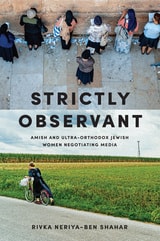
Strictly Observant
Amish and Ultra-Orthodox Jewish Women Negotiating MediaRivka Neriya-Ben Shahar
Rutgers University Press, 2024
The Amish and ultra-Orthodox Jewish communities have typically been associated with strict religious observance, a renunciation of worldly things, and an obedience of women to men. Women’s relationship to media in these communities, however, betrays a more nuanced picture of the boundaries at play and women’s roles in negotiating them.
Strictly Observant presents a compelling ethnographic study of the complex dynamic between women in both the Pennsylvanian Old Order Amish and Israeli ultra-Orthodox Jewish communities and contemporary media technologies. These women regularly establish valuable social, cultural, and religious capital through the countless decisions for use and nonuse of media that they make in their daily lives, and in ways that challenge the gender hierarchies of each community. By exhibiting a deep awareness of how media can be managed to increase their social and religious reputations, these women prompt us to reconsider our outmoded understanding of the Amish and ultra-Orthodox Jewish communities, the role that women play in these communities as agents of change, and our own relationship to media today.