Results by title
914 books match the query 'Medieval' and 60 start with s
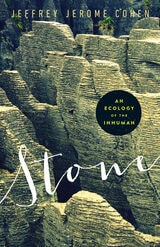
Stone
An Ecology of the InhumanJeffrey Jerome Cohen
University of Minnesota Press, 2015
Stone maps the force, vivacity, and stories within our most mundane matter, stone. For too long stone has served as an unexamined metaphor for the “really real”: blunt factuality, nature’s curt rebuke. Yet, medieval writers knew that stones drop with fire from the sky, emerge through the subterranean lovemaking of the elements, tumble along riverbeds from Eden, partner with the masons who build worlds with them. Such motion suggests an ecological enmeshment and an almost creaturely mineral life.
Although geological time can leave us reeling, Jeffrey Jerome Cohen argues that stone’s endurance is also an invitation to apprehend the world in other than human terms. Never truly inert, stone poses a profound challenge to modernity’s disenchantments. Its agency undermines the human desire to be separate from the environment, a bifurcation that renders nature “out there,” a mere resource for recreation, consumption, and exploitation.
Written with great verve and elegance, this pioneering work is notable not only for interweaving the medieval and the modern but also as a major contribution to ecotheory. Comprising chapters organized by concept —“Geophilia,” “Time,” “Force,” and “Soul”—Cohen seamlessly brings together a wide range of topics including stone’s potential to transport humans into nonanthropocentric scales of place and time, the “petrification” of certain cultures, the messages fossils bear, the architecture of Bordeaux and Montparnasse, Yucca Mountain and nuclear waste disposal, the ability of stone to communicate across millennia in structures like Stonehenge, and debates over whether stones reproduce and have souls.
Showing that what is often assumed to be the most lifeless of substances is, in its own time, restless and forever in motion, Stone fittingly concludes by taking us to Iceland⎯a land that, writes the author, “reminds us that stone like water is alive, that stone like water is transient.”
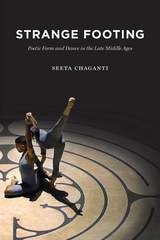
Strange Footing
Poetic Form and Dance in the Late Middle AgesSeeta Chaganti
University of Chicago Press, 2018
Exploring the complex relationship between medieval dance and medieval poetry, Strange Footing argues that the intersection of texts and dance produced an experience of poetic form based in disorientation, asymmetry, and even misstep. Medieval dance guided audiences to approach poetry not in terms of the body’s regular marking of time and space, but rather in the irregular and surprising forces of virtual motion around, ahead of, and behind the dancing body. Reading medieval poems through artworks, paintings, and sculptures depicting dance, Seeta Chaganti illuminates texts that have long eluded our full understanding, inviting us to inhabit their strange footings askew of conventional space and time.
Strange Footing deploys the motion of dance to change how we read medieval poetry, generating a new theory of poetic form for medieval studies and beyond.
Strong Voices, Weak History
Early Women Writers and Canons in England, France, and ItalyPamela J Benson and Victoria Kirkham, Editors
University of Michigan Press, 2005
Studies in Medieval Philosophy
John F. Wippel
Catholic University of America Press, 2018
Studies in Medieval and Renaissance History
Volume 13Joel T. Rosenthal
Arizona Center for Medieval and Renaissance Studies, 2018
Studies in Medieval and Renaissance History
Volume 14Edited by Joel T. Rosenthal and Paul E. Szarmach
Arizona Center for Medieval and Renaissance Studies, 2019
Studies on the Illuminated Chronicle
János M. Bak
Central European University Press, 2018
The present volume of studies—a joint publication with the National Széchényi Library, Budapest—is the first Subsidium of the Central European Medieval Text series, accompanying CEMT vol. IX on the Illuminated Chronicle, composed in the fourteenth century at the royal court of Louis I of Hungary. The large size of the volume, with the text and its annotations, did not permit the inclusion of a detailed scholarly introduction, unlike other CEMT items, so it is here printed separately.
The first essays analyze the text and the illuminations of the Illuminated Chronicle (formerly called the Vienna Chronicle) from literary-historical, art historical and heraldic perspectives. They also summarize the literature on the chronicle for the past two hundred years. Additional studies address the narrative. Since the chronicle starts with the history of the Huns, the imaginary ancestors of the Hungarians, one essay addresses the Attila tradition in Hungarian historiography. Others devote attention to the dynastic struggles of the eleventh century, placing them in the context of amicitia and deditio, and to the image of St. Ladislas I as the “ideal king”. The final essays examine the fate of the fourteenth-century chronicle texts over the subsequent centuries, their appearance in legal texts, and their reception abroad.
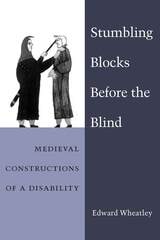
Stumbling Blocks Before the Blind
Medieval Constructions of a DisabilityEdward Wheatley
University of Michigan Press, 2010
"Bold, deeply learned, and important, offering a provocative thesis that is worked out through legal and archival materials and in subtle and original readings of literary texts. Absolutely new in content and significantly innovative in methodology and argument, Stumbling Blocks Before the Blind offers a cultural geography of medieval blindness that invites us to be more discriminating about how we think of geographies of disability today."
---Christopher Baswell, Columbia University
"A challenging, interesting, and timely book that is also very well written . . . Wheatley has researched and brought together a leitmotiv that I never would have guessed was so pervasive, so intriguing, so worthy of a book."
---Jody Enders, University of California, Santa Barbara
Stumbling Blocks Before the Blind presents the first comprehensive exploration of a disability in the Middle Ages, drawing on the literature, history, art history, and religious discourse of England and France. It relates current theories of disability to the cultural and institutional constructions of blindness in the eleventh through fifteenth centuries, examining the surprising differences in the treatment of blind people and the responses to blindness in these two countries. The book shows that pernicious attitudes about blindness were partially offset by innovations and ameliorations---social; literary; and, to an extent, medical---that began to foster a fuller understanding and acceptance of blindness.
A number of practices and institutions in France, both positive and negative---blinding as punishment, the foundation of hospices for the blind, and some medical treatment---resulted in not only attitudes that commodified human sight but also inhumane satire against the blind in French literature, both secular and religious. Anglo-Saxon and later medieval England differed markedly in all three of these areas, and the less prominent position of blind people in society resulted in noticeably fewer cruel representations in literature.
This book will interest students of literature, history, art history, and religion because it will provide clear contexts for considering any medieval artifact relating to blindness---a literary text, a historical document, a theological treatise, or a work of art. For some readers, the book will serve as an introduction to the field of disability studies, an area of increasing interest both within and outside of the academy.
Edward Wheatley is Surtz Professor of Medieval Literature at Loyola University, Chicago.
Stylistic and Narrative Structures in the Middle English Romances
By Susan Wittig
University of Texas Press, 1978
This volume provides a generic description, based on a formal analysis of narrative structures, of the Middle English noncyclic verse romances. As a group, these poems have long resisted generic definition and are traditionally considered to be a conglomerate of unrelated tales held together in a historical matrix of similar themes and characters. As single narratives, they are thought of as random collections of events loosely structured in chronological succession. Susan Wittig, however, offers evidence that the romances are carefully ordered (although not always consciously so) according to a series of formulaic patterns and that their structures serve as vehicles for certain essential cultural patterns and are important to the preservation of some community-held beliefs.
The analysis begins on a stylistic level, and the same theoretical principles applied to the linguistic formulas of the poems also serve as a model for the study of narrative structures. The author finds that there are laws that govern the creation, selection, and arrangement of narrative materials in the romance genre and that act to restrict innovation and control the narrative form.
The reasons for this strict control are to be found in the functional relationship of the genre to the culture that produced it. The deep structure of the romance is viewed as a problem-solving pattern that enables the community to mediate important contradictions within its social, economic, and mythic structures. Wittig speculates that these contradictions may lie in the social structures of kinship and marriage and that they have been restructured in the narratives in a “practical” myth: the concept of power gained through the marriage alliance, and the reconciliation of the contradictory notions of marriage for power’s sake and marriage for love’s sake.
This advanced, thorough, and completely original study will be valuable to medieval specialists, classicists, linguists, folklorists, and Biblical scholars working in oral-formulaic narrative structure.

Sumerian Economic Texts from the Third Ur Dynasty
Tom B. Jones, , , and
University of Minnesota Press, 1961
Sumerian Economic Texts from the Third Ur Dynasty was first published in 1961. Minnesota Archive Editions uses digital technology to make long-unavailable books once again accessible, and are published unaltered from the original University of Minnesota Press editions.
This is a study and catalogue of some 350 hitherto unpublished Sumerian cuneiform documents, nearly all economic in nature. The authors describe the transliterate each document and present viewpoints regarding certain important classes of the texts. The findings of the study may lead to renewed interest in the third Ur Dynasty, which scholars have long regarded as relatively unimportant because its history is the swan song of Sumerian autonomy and culture.