Results by title
754 books match the query 'Native American Studies' and 56 start with s
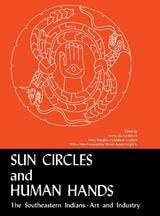
Sun Circles and Human Hands
The Southeastern Indians Art and IndustriesEdited by Emma Lila Fundaburk and Mary Douglass Fundaburk Foreman
University of Alabama Press, 2001
This classic compendium of ancient Indian artifacts from the entire southeastern United States remains an indispensable reference source for professionals and enthusiasts alike.
From utilitarian arrowheads to beautiful stone effigy pipes to ornately-carved shell disks, the photographs and drawings in Sun Circles and Human Hands present the archaeological record of the art and native crafts of the prehistoric southeastern Indians. Painstakingly compiled in the 1950s by two sisters who traveled the eastern United States interviewing archaeologists and collectors and visiting the major repositories, Sun Circles and Human Hands is remarkable for its breadth of illustration of Indian-made artifacts and its comprehensive documentation. Although research over the last 50 years has disproven many of the early theories reported in the text—which were not the editors' theories but those of the archaeologists of the day—the excellent illustrations of objects no longer available for examination have more than validated the lasting worth of this popular book.
Broadly acclaimed when it first appeared, this new printing has the added value of Knight's foreword, which places the work in its proper context. Useful to museums, state and national parks, school libraries, gift stores, archaeological agencies, and private collections, Sun Circles and Human Hands is a rich pictorial survey accessible to anyone interested in early American Indian culture.

Sundancers and River Demons
Essays on Landscape and RitualConger Beasley Jr.
University of Arkansas Press, 1990
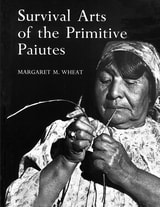
Survival Arts of the Primitive Paiutes
Margaret M. Wheat
University of Nevada Press, 1977
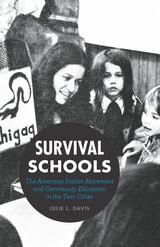
Survival Schools
The American Indian Movement and Community Education in the Twin CitiesJulie L. Davis
University of Minnesota Press, 2013
In the late 1960s, Indian families in Minneapolis and St. Paul were under siege. Clyde Bellecourt remembers, “We were losing our children during this time; juvenile courts were sweeping our children up, and they were fostering them out, and sometimes whole families were being broken up.” In 1972, motivated by prejudice in the child welfare system and hostility in the public schools, American Indian Movement (AIM) organizers and local Native parents came together to start their own community school. For Pat Bellanger, it was about cultural survival. Though established in a moment of crisis, the school fulfilled a goal that she had worked toward for years: to create an educational system that would enable Native children “never to forget who they were.”
While AIM is best known for its national protests and political demands, the survival schools foreground the movement’s local and regional engagement with issues of language, culture, spirituality, and identity. In telling of the evolution and impact of the Heart of the Earth school in Minneapolis and the Red School House in St. Paul, Julie L. Davis explains how the survival schools emerged out of AIM’s local activism in education, child welfare, and juvenile justice and its efforts to achieve self-determination over urban Indian institutions. The schools provided informal, supportive, culturally relevant learning environments for students who had struggled in the public schools. Survival school classes, for example, were often conducted with students and instructors seated together in a circle, which signified the concept of mutual human respect. Davis reveals how the survival schools contributed to the global movement for Indigenous decolonization as they helped Indian youth and their families to reclaim their cultural identities and build a distinctive Native community.
The story of these schools, unfolding here through the voices of activists, teachers, parents, and students, is also an in-depth history of AIM’s founding and early community organizing in the Twin Cities—and evidence of its long-term effect on Indian people’s lives.
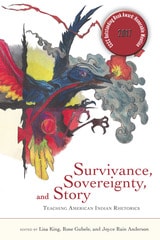
Survivance, Sovereignty, and Story
Teaching American Indian RhetoricsLisa King
Utah State University Press, 2015
Focusing on the importance of discussions about sovereignty and of the diversity of Native American communities, Survivance, Sovereignty, and Story offers a variety of ways to teach and write about indigenous North American rhetorics.
These essays introduce indigenous rhetorics, framing both how and why they should be taught in US university writing classrooms. Contributors promote understanding of American Indian rhetorical and literary texts and the cultures and contexts within which those texts are produced. Chapters also supply resources for instructors, promote cultural awareness, offer suggestions for further research, and provide examples of methods to incorporate American Indian texts into the classroom curriculum.
Survivance, Sovereignty, and Story provides a decolonized vision of what teaching rhetoric and writing can be and offers a foundation to talk about what rhetoric and pedagogical practice can mean when examined through American Indian and indigenous epistemologies and contemporary rhetorics.
Contributors include Joyce Rain Anderson, Resa Crane Bizzaro, Qwo-Li Driskill, Janice Gould, Rose Gubele, Angela Haas, Jessica Safran Hoover, Lisa King, Kimberli Lee, Malea D. Powell, Andrea Riley-Mukavetz, Gabriela Raquel Ríos, and Sundy Watanabe.

Surviving in Two Worlds
Contemporary Native American VoicesBy Lois Crozier-Hogle and Darryl Babe Wilson
University of Texas Press, 1997
Surviving in Two Worlds brings together the voices of twenty-six Native American leaders. The interviewees come from a variety of tribal backgrounds and include such national figures as Oren Lyons, Arvol Looking Horse, John Echohawk, William Demmert, Clifford Trafzer, Greg Sarris, and Roxanne Swentzell.
Their interviews are divided into five sections, grouped around the themes of tradition, history and politics, healing, education, and culture. They take readers into their lives, their dreams and fears, their philosophies and experiences, and show what they are doing to assure the survival of their peoples and cultures, as well as the earth as a whole. Their analyses of the past and present, and especially their counsels for the future, are timely and urgent.