Results by title
1095 books match the query 'Rhetoric' and 70 start with s
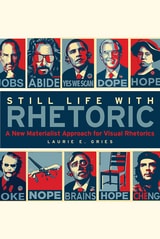
Still Life with Rhetoric
A New Materialist Approach for Visual RhetoricsLaurie Gries
Utah State University Press, 2015
In Still Life with Rhetoric, Laurie Gries forges connections among new materialism, actor network theory, and rhetoric to explore how images become rhetorically active in a digitally networked, global environment. Rather than study how an already-materialized “visual text” functions within a specific context, Gries investigates how images often circulate and transform across media, genre, and location at viral rates. A four-part case study of Shepard Fairey’s now iconic Obama Hope image elucidates how images reassemble collective life as they actualize in different versions, enter into various relations, and spark a firework of activity across the globe.
While intent on tracking the rhetorical life of a single, multiple image, Still Life with Rhetoric is most concerned with studying rhetoric in motion. To account for an image’s widespread circulation and emergent activities, Gries introduces iconographic tracking—a digital research method for tracing an image’s divergent rhetorical becomings. Yet Gries also articulates a dynamic set of theoretical principles for studying rhetoric as a distributed, generative, and unforeseeable event that is applicable beyond the study of visual rhetoric. With an eye toward futurity—the strands of time beyond a thing’s initial moment of production and delivery—Still Life with Rhetoric intends to be taken up by those interested in visual rhetoric, research methods, and theory.
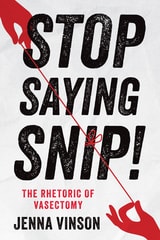
Stop Saying Snip!
The Rhetoric of VasectomyJenna Vinson
Rutgers University Press, 2026
In the US, the most common contraceptive methods rely on women’s time, labor, and vulnerability to risk. Comparatively few people rely on vasectomies as a means of preventing pregnancies. Something is happening rhetorically—through meaning-making symbols and the material practices they manifest—that sustains a collective disinterest in vasectomies. Jenna Vinson draws from her feminist rhetorical study of thirty-seven television and film representations, health insurance policies, and interviews with seventeen people who have experienced vasectomy, surfacing barriers to vasectomy uptake, including problematic tropes and practices that keep vasectomy unappealing, out of mind, and inaccessible. Stop Saying Snip! also illustrates tactics and circumstances that lead people to get a vasectomy, sharing real vasectomy stories and showing that women often play an important (and until now unheeded or pathologized) role in this communication process. This book intervenes in the misogynistic cultural expectation that it is women’s responsibility to endure the pain, labor, and risks of managing fertility by identifying the rhetorics that make men’s reproductive bodies seem unnatural sites for pregnancy prevention work. Fostering a persuasive vision of vasectomy is an urgent project that contributes to the movement toward reproductive justice.
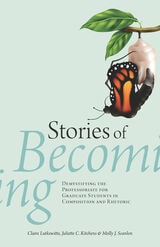
Stories of Becoming
Demystifying the Professoriate for Graduate Students in Composition and RhetoricClaire Lutkewitte
Utah State University Press, 2021
Using data from the study, the authors offer six specific strategies—including how to manage time, how to create a work/life balance, and how to collaborate with others—that readers can use to prepare for the composition and rhetoric job market and to begin their careers as full-time faculty members. Readers will learn about the possible responsibilities they may take on as new faculty, particularly those that go beyond teaching, research, service, and administration to include navigating the politics of higher education and negotiating professional identity construction. And they will also engage in activities and answer questions designed to deepen their understanding of the field and help them identify their own values and desired career trajectory.
Stories of Becoming demystifies the professoriate, compares what current new faculty have to say of their job expectations with the realities that students might face when on the job, and brings to light the invisible, behind-the-scenes work done by new faculty. It will be invaluable to graduate students, those who teach graduate students, new faculty, and hiring administrators in composition and rhetoric.
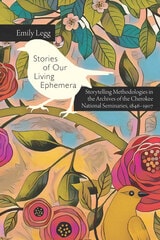
Stories of Our Living Ephemera
Storytelling Methodologies in the Archives of the Cherokee National Seminaries, 1846-1907Emily Legg
Utah State University Press, 2023
Emily Legg turns to the Cherokee medicine wheel and cardinal directions as a Cherokee rhetorical discipline of knowledge making in the archives, an embodied and material practice that steers knowledge through the four cardinal directions around all relations. Going beyond historiography, Legg delineates educational practices that are intertwined with multiple strands of traditional Cherokee stories that privilege Indigenous and matriarchal theoretical lenses. Stories of Our Living Ephemera synthesizes the connections between contemporary and nineteenth-century academic experiences to articulate the ways that colonial institutions and research can be Indigenized by centering Native American sovereignty.
By undoing the erasure of Cherokee literacy and educational practices, Stories of Our Living Ephemera celebrates the importance of storytelling, especially for those who are learning about Indigenous histories and rhetorics. This book is of cultural importance and value to academics interested in composition and pedagogy, the Cherokee Nation, and a general audience seeking to learn about Indigenous rhetorical devices and Cherokee history.
Storytelling in Alcoholics Anonymous
A Rhetorical AnalysisGeorge H. Jensen
Southern Illinois University Press, 2000
Based on an ethnographic study spanning four years, George H. Jensen’s Storytelling in Alcoholics Anonymous: A Rhetorical Analysis calls upon Bakhtinian theory to analyze storytelling in AA.
Jensen introduces his study with an analysis of “Bill W.’s Story” as it appears in the first chapter of AA’s central text, Alcoholics Anonymous. Drawing on Walter Ong’s work on orality and literacy, he argues that “Bill W.’s Story” as it appears in print cannot fully capture the oral tradition of storytelling as it occurs in AA meetings.
In his first section, Jensen discusses storytelling as practiced by the Washingtonians, a temperance organization much like AA. He also discusses the influence of the Oxford Group’s (an international and interdenominational religious movement seeking to recapture the enthusiasm and dedication of first-century Christianity) spiritual program to the development of AA’s Twelve Steps. The remainder of the first section serves as an introduction of the culture of AA to outsiders.
In the second section, Jensen covers Bakhtin’s theory of the relationship between the author and the hero of a text, using Lillian Roth’s autobiographies as counterexamples of AA talks. He devotes an entire chapter in this section to explaining how AA meetings provide an example of what Bakhtin meant by carnival, a process through which humor, irony, and parody supply a mechanism for questioning commonly held beliefs. He shows how newcomers to AA move away from their egocentric personae as practicing alcoholics to adopt a new identity within AA. Drawing further on Bakhtin, he examines the autobiographical moments of AA talks, stressing that these moments never become fully autobiographical. AA talks, Jensen argues, are fragmented, yet achieve coherence through the interweaving of two important chronotopes. Finally, using Bakhtin’s discussion of heroes in autobiography, Jensen discusses the kinds of heroes one typically finds in AA talks.
Strains of Dissent
Popular Music and Everyday Resistance in WWII France, 1940 - 1945Kelly Jakes
Michigan State University Press, 2019
Strange Gourmets
Sophistication, Theory, and the NovelJoseph Litvak
Duke University Press, 1997
Though commonly thought of as a kind of worldliness at its best and an elitist snobbery at its worst, sophistication, Litvak reminds us, remains tied to its earlier, if forgotten, meaning of "perversion"—a perversion whose avatars are the homosexual and the intellectual. Proceeding with his investigations from a specifically gay academic perspective, Litvak presents thoroughly inventive readings of novels by Austen, Thackeray, and Proust, and of theoretical works by Adorno and Barthes, each text epitomizing sophistication in one of its more familiar modes. Among the issues he explores are the ways in which these texts teach sophistication, the embarrassment that sophistication causes the sophisticated, and how the class politics of sophistication are inseparable from its sexual politics. Helping gay, queer, feminist, and other provocative critics to make the most of their bad publicity, Litvak mindfully celebrates sophistication’s economy of taste and pleasure.
Strangely Rhetorical
Composing Differently With Novelty Devicesby Jimmy Butts
Utah State University Press, 2022
Using a new theoretical framework—that strangeness is inherent within all rhetorical interactions and is potentially useful—Butts demonstrates how rhetoric is always already coming from an Other, offering an ethical context for how defamiliarized texts work with different audiences. Applying examples of seven figures for composing in and across written, aural, visual, electronic, and spatial texts (the WAVES of media), Butts shows how divergence is possible in all sorts of refigured multimodal ways.
Strangely Rhetorical rethinks what exactly rhetoric is and does, considering the ways that strange compositions help rhetors connect across a broad range of networks in a world haunted by distance. This is a book about strange rhetoric for makers and creatives, for students and teachers, and for composers of all sorts.
Strategies for Academic Writing
A Guide for College StudentsIrvin Y. Hashimoto, Barry M. Kroll, and John C. Schafer
University of Michigan Press, 1982
Style and Story
Literary Methods for Writing NonfictionStephen J. Pyne
University of Arizona Press, 2018
Style and Story is for those who wish to craft nonfiction texts that do more than simply relay facts and arguments. Pyne explains how writers can employ literary tools and strategies to have art and craft add value to their theme. With advice gleaned from nearly a dozen years of teaching writing to graduate students, Pyne offers pragmatic guidance on how to create powerful nonfiction, whether for an academic or popular audience.
Each chapter offers samples that span genres, showcasing the best kinds of nonfiction writing. Pyne analyzes these examples that will help writers understand how they can improve their nonfiction through their choice of voice, words, structure, metaphors, and narrative. Pyne builds on his previous guide, Voice and Vision, expanding the range of topics to include openings and closings, humor and satire, historical writing, setting scenes, writing about technical matters and deep details, long and short narration, reading for craft, and thoughts on writing generally. He also includes in this volume a set of exercises to practice writing techniques.
Style and Story will be treasured by anyone, whether novice or expert, who seeks guidance to improve the power of their nonfiction writing.

Style as Argument
Contemporary American NonfictionChirs Anderson
Southern Illinois University Press, 1987
Taking the position that style has a value in its own right, that language forms a major component of the story a nonfiction writer has to tell, Anderson analyzes the work of America’s foremost practitioners of New Journalism—Tom Wolfe, Truman Capote, Norman Mailer, and Joan Didion.
Anderson does for nonfiction what insightful critics have long been doing for fiction and poetry. His approach is rhetorical, and his message is that the rhetoric of Wolfe, Capote, Mailer, and Didion is a direct response to the problem of trying to convey to a general audience the sublime, inexplicable, or private and intuitive experiences that conventional rhetoric cannot evoke.
The emphasis in this book is on style, not genre, and the analysis characterizes the distinctive styles of four American writers, showing how the richness and complexity of their prose discloses an important argument about the value of language itself. Their prose is complex, nuanced, layered, affecting, always aware of itself as style. This self-consciousness, Anderson contends, prepares the reader to regard style as argument, a “tacit but powerful statement about the value of form as form, style as style.”
Style
Toward Clarity and GraceJoseph M. Williams
University of Chicago Press, 1990
"Buy Williams's book. And dig out from storage your dog-eared old copy of The Elements of Style. Set them side by side on your reference shelf."—Barbara Walraff, Atlantic
"Let newcoming writers discover this, and let their teachers and readers rejoice. It is a practical, disciplined text that is also a pleasure to read."—Christian Century
"An excellent book....It provides a sensible, well-balanced approach, featuring prescriptions that work."—Donald Karzenski, Journal of Business Communication
"Intensive fitness training for the expressive mind."—Booklist
Stylistic and Narrative Structures in the Middle English Romances
By Susan Wittig
University of Texas Press, 1978
This volume provides a generic description, based on a formal analysis of narrative structures, of the Middle English noncyclic verse romances. As a group, these poems have long resisted generic definition and are traditionally considered to be a conglomerate of unrelated tales held together in a historical matrix of similar themes and characters. As single narratives, they are thought of as random collections of events loosely structured in chronological succession. Susan Wittig, however, offers evidence that the romances are carefully ordered (although not always consciously so) according to a series of formulaic patterns and that their structures serve as vehicles for certain essential cultural patterns and are important to the preservation of some community-held beliefs.
The analysis begins on a stylistic level, and the same theoretical principles applied to the linguistic formulas of the poems also serve as a model for the study of narrative structures. The author finds that there are laws that govern the creation, selection, and arrangement of narrative materials in the romance genre and that act to restrict innovation and control the narrative form.
The reasons for this strict control are to be found in the functional relationship of the genre to the culture that produced it. The deep structure of the romance is viewed as a problem-solving pattern that enables the community to mediate important contradictions within its social, economic, and mythic structures. Wittig speculates that these contradictions may lie in the social structures of kinship and marriage and that they have been restructured in the narratives in a “practical” myth: the concept of power gained through the marriage alliance, and the reconciliation of the contradictory notions of marriage for power’s sake and marriage for love’s sake.
This advanced, thorough, and completely original study will be valuable to medieval specialists, classicists, linguists, folklorists, and Biblical scholars working in oral-formulaic narrative structure.
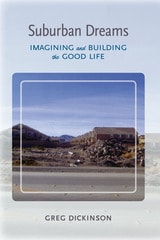
Suburban Dreams
Imagining and Building the Good LifeGreg Dickinson
University of Alabama Press, 2014
2016 CHOICE OUTSTANDING ACADEMIC TITLE AND JANE JACOBS URBAN COMMUNICATION BOOK AWARD FINALIST
Explores how the suburban imaginary, composed of the built environment and imaginative texts, functions as a resource for living out the “good life”
Starting with the premise that suburban films, residential neighborhoods, chain restaurants, malls, and megachurches are compelling forms (topos) that shape and materialize the everyday lives of residents and visitors, Greg Dickinson’s Suburban Dreams offers a rhetorically attuned critical analysis of contemporary American suburbs and the “good life” their residents pursue.
Dickinson’s analysis suggests that the good life is rooted in memory and locality, both of which are foundations for creating a sense of safety central to the success of suburbs. His argument is situated first in a discussion of the intersections among buildings, cities, and the good life and the challenges to these relationships wrought by the twentieth and twenty-first centuries. The argument then turns to rich, fully-embodied analyses of suburban films and a series of archetypal suburban landscapes to explore how memory, locality, and safety interact in constructing the suburban imaginary. Moving from the pastoralism of residential neighborhoods and chain restaurants like Olive Garden and Macaroni Grill, through the megachurch’s veneration of suburban malls to the mixed-use lifestyle center’s nostalgic invocation of urban downtowns, Dickinson complicates traditional understandings of the ways suburbs situate residents and visitors in time and place.
The analysis suggests that the suburban good life is devoted to family. Framed by the discourses of consumer culture, the suburbs often privilege walls and roots to an expansive vision of worldliness. At the same time, developments such as farmers markets suggest a continued striving by suburbanites to form relationships in a richer, more organic fashion.
Dickinson’s work eschews casually dismissive attitudes toward the suburbs and the pursuit of the good life. Rather, he succeeds in showing how by identifying the positive rhetorical resources the suburbs supply, it is in fact possible to engage with the suburbs intentionally, thoughtfully, and rigorously. Beyond an analysis of the suburban imaginary, Suburban Dreams demonstrates how a critical engagement with everyday places can enrich daily life. The book provides much of interest to students and scholars of rhetoric, communication studies, public memory, American studies, architecture, and urban planning.

Superchurch
The Rhetoric and Politics of American FundamentalismJonathan J. Edwards
Michigan State University Press, 2015
Supporting International Writing Studies Research
Cultivating Capacity through International ExchangesTiane Donahue
University Press of Colorado, 2025
Shedding light on international and transnational writing studies, this edited collection addresses the complexities of research and writing across global contexts. Based on the observation that knowledge-making transcends national borders and is contingent upon the interplay of local cultures and practices, the contributors to the volume contradict the notion that knowledge circulates freely in a “flat world.” Presenting diverse perspectives on writing research, they showcase the need for mutual understanding across borders and reflect the rich tapestry of writing research traditions worldwide, emphasizing interconnectedness and collective insight rather than hierarchical models of knowledge dissemination. Supporting International Writing Studies Research encourages readers and researchers to engage with and respect scholarship beyond English-language contexts, advocates for collaborative global dialogues in writing education, and underscores the importance of continued efforts to incorporate diverse scholarly voices and methodologies in the evolving landscape of writing studies.
Surrender
Feminist Rhetoric and Ethics in Love and IllnessJessica Restaino
Southern Illinois University Press, 2019
One of Library Journal's Top 20 Best-Selling Language Titles of 2019
In an ethnographic study spanning the last years of research collaborator and friend Susan Lundy Maute’s life with terminal breast cancer, author Jessica Restaino argues the interpretative challenges posed by research and writing amid illness and intimacy demand a methodological break from accepted genres and established practices of knowledge making. Restaino searches their experiences—recorded in interviews, informal writings, and correspondence—to discover a rhetoric of love and illness. She encourages a synthesis of methods and the acceptance of a reversal of roles—researcher and researched, writer and written-about—and emphasizes the relevancy of methodological diversity, the necessity of the personal, and the analytical richness of unpredictability and risk in being who we are in our scholarship at any given moment.
Bringing together critical analysis, qualitative-style research methods, close reading, Surrender: Feminist Rhetoric and Ethics inLove and Illness resists traditional ideas about academic writing and invites others to pursue collaborations that subvert accepted approaches to representation, textual production, and subjectivity. Restaino demonstrates a way of writing—the rendering of the academic text itself—that suggests how we do our work has resonance for what we produce. She offers framing questions for use by others interested in doing similar kinds of scholarship that may frighten, overwhelm, or confound. This book deepens our understanding of subjectivity and the gains made by feminist resistance to conventional concepts of objectivity in research collaborations.
Survivance, Sovereignty, and Story
Teaching American Indian RhetoricsLisa King
Utah State University Press, 2015
Focusing on the importance of discussions about sovereignty and of the diversity of Native American communities, Survivance, Sovereignty, and Story offers a variety of ways to teach and write about indigenous North American rhetorics.
These essays introduce indigenous rhetorics, framing both how and why they should be taught in US university writing classrooms. Contributors promote understanding of American Indian rhetorical and literary texts and the cultures and contexts within which those texts are produced. Chapters also supply resources for instructors, promote cultural awareness, offer suggestions for further research, and provide examples of methods to incorporate American Indian texts into the classroom curriculum.
Survivance, Sovereignty, and Story provides a decolonized vision of what teaching rhetoric and writing can be and offers a foundation to talk about what rhetoric and pedagogical practice can mean when examined through American Indian and indigenous epistemologies and contemporary rhetorics.
Contributors include Joyce Rain Anderson, Resa Crane Bizzaro, Qwo-Li Driskill, Janice Gould, Rose Gubele, Angela Haas, Jessica Safran Hoover, Lisa King, Kimberli Lee, Malea D. Powell, Andrea Riley-Mukavetz, Gabriela Raquel Ríos, and Sundy Watanabe.

Sweet Reason
Rhetoric and the Discourses of ModernitySusan Wells
University of Chicago Press, 1996
Susan Wells is associate professor of English at Temple University.
Systems Shift
Creating and Navigating Change in Rhetoric and Composition AdministrationGenesea M. Carter
University Press of Colorado, 2024