Results by title
2194 books match the query 'Women's Studies' and 186 start with s

Seventeen Syllables and Other Stories
Yamamoto, Hisaye
Rutgers University Press, 2001
In addition to the contents of the original volume, this edition brings back into print the following works:
- Death Rides the Rails to Poston
- Eucalyptus
- A Fire in Fontana
- Florentine Gardens

Sex Exposed
Sexuality and the Pornography DebateMcIntosh, Mary
Rutgers University Press, 1993
This provocative collection, by well-known feminists, surveys these arguments, and in particular asks why recent feminist debates about sexuality keep reducing to questions of pornography.

Sex Exposed
Sexuality and the Pornography DebateMcIntosh, Mary
Rutgers University Press, 1993
Over the past twenty years debates about pornography have raged within feminism and beyond. Throughout the 1970s feminists increasingly addressed the problem of men's sexual violence against women, and many women reduced the politics of men's power over women to questions about sexuality. By the 1980s these questions had become more and more focused on the issue of pornography––now a metaphor for the menace of male power. Collapsing feminist politics into sexuality and sexuality into pornography has not only caused some of the deepest splits between feminists, but made it harder to think clearly about either sexuality or pornography––indeed, about feminist politics more generally.
This provocative collection, by well-known feminists on both sides of the Atlantic, surveys these arguments, and in particular asks why recent feminist debates about sexuality keep reducing to questions of pornography. The authors open up the debate by looking at such topics as the improbable alliance between the right and pro-censorship feminists, the displacement of heterosexual desire and its discontents onto pornography, Andrea Dworkin's novel Mercy, psychoanalytic reflections on fantasy, censorship in relation to AIDS work, the new lesbian and bisexual pornography, the controversy over Robert Mapplethorpe's supposed racism in his photos of black nudes, Mae West as sexual icon and her brushes with the law, and the female nude in "high" art.
In addition to the editors, the contributors are Elizabeth Cowie, Harriett Gilbert, Robin Gorna, Marybeth Hamilton, Loretta Loach, Anne McClintock, Kobena Mercer, Jane Mills, Mandy Merck, Lynda Nead, Gillian Rodgerson, Carol Smart, Carole S. Vance, Linda Williams, and Elizabeth Wilson.
Sex Goes to School
Girls and Sex Education before the 1960sSusan K. Freeman
University of Illinois Press, 2007

Sex Itself
The Search for Male and Female in the Human GenomeSarah S. Richardson
University of Chicago Press, 2013

Sex Radicals and the Quest for Women's Equality
Joanne E. Passet
University of Illinois Press, 2003
In charting the growth of the sex radical movement, Joanne E. Passet draws on a host of documents from the period -- letters, periodicals, lectures, and pamphlets -- to establish a strong link between the rise of print culture and the freedom of citizens, especially women, to build geographically dispersed communities of ideas. She also advances models of sexuality that challenge the restrictive mores of society at large and shows that the majority of correspondents who participated in the sex radical movement resided in the Midwest and the Great Plains states, where ideas of individual freedom and sovereignty resonated particularly strongly.
Passet vividly demonstrates how this sex radical movement laid the foundations upon which later generations of women’s rights crusaders and feminists would build, placing discussions of sex and sexuality squarely in the public arena.

Sex Testing
Gender Policing in Women's SportsLindsay Pieper
University of Illinois Press, 2016
Ranging from Cold War tensions to gender anxiety to controversies around doping, Lindsay Parks Pieper explores sex testing in sport from the 1930s to the early 2000s. Pieper examines how the IOC in particular insisted on a misguided binary notion of gender that privileged Western norms. Testing evolved into a tool to identify--and eliminate--athletes the IOC deemed too strong, too fast, or too successful. Pieper shows how this system punished gifted women while hindering the development of women's athletics for decades. She also reveals how the flawed notions behind testing--ideas often sexist, racist, or ridiculous--degraded the very idea of female athleticism.

Sex Tourism in Bahia
Ambiguous EntanglementsErica Lorraine Williams
University of Illinois Press, 2013

Sex Trafficking, Scandal, and the Transformation of Journalism, 1885-1917
Gretchen Soderlund
University of Chicago Press, 2013

Sex Workers, Psychics, and Numbers Runners
Black Women in New York City's Underground EconomyLaShawn Harris
University of Illinois Press, 2016
Sex and Disability
Robert McRuer and Anna Mollow, eds.
Duke University Press, 2012
Contributors. Chris Bell, Michael Davidson, Lennard J. Davis, Michel Desjardins, Lezlie Frye, Rachael Groner, Kristen Harmon, Michelle Jarman, Alison Kafer, Riva Lehrer, Nicole Markotić, Robert McRuer, Anna Mollow, Rachel O’Connell, Russell Shuttleworth, David Serlin, Tobin Siebers, Abby L. Wilkerson

Sex and Scientific Inquiry
Edited by Sandra Harding and Jean F. O'Barr
University of Chicago Press, 1987

Sex, Race, and Merit
Debating Affirmative Action in Education and EmploymentFaye J. Crosby and Cheryl VanDeVeer, Editors
University of Michigan Press, 2000

Sexting Panic
Rethinking Criminalization, Privacy, and ConsentAmy Adele Hasinoff
University of Illinois Press, 2015

Sexual Exploitation of Teenagers
Adolescent Development, Discrimination, and Consent LawJennifer Ann Drobac
University of Chicago Press, 2016
When it comes to sexual relationships, adolescents pose a particular problem. Few teenagers possess all of the emotional and intellectual tools needed to navigate these threats, including the all too real advances made by supervisors, teachers, and mentors. In Sexual Exploitation of Teenagers, Jennifer Drobac explores the shockingly common problem of maturing adolescents who are harassed and exploited by adults in their lives. Reviewing the neuroscience and psychosocial evidence of adolescent development, she explains why teens are so vulnerable to adult harassers. Even today, in an age of increasing public awareness, criminal and civil law regarding the sexual abuse of minors remains tragically inept and irregular from state to state. Drobac uses six recent cases of teens suffering sexual harassment to illuminate the flaws and contradictions of this system, skillfully showing how our current laws fail to protect youths, and offering an array of imaginative legal reforms that could achieve increased justice for adolescent victims of sexual coercion.

Sexual Fields
Toward a Sociology of Collective Sexual LifeEdited by Adam Isaiah Green
University of Chicago Press, 2013
To build on the sexual fields framework, Green has gathered a distinguished group of scholars who together make a strong case for sexual field theory as the first systematic theoretical innovation since queer theory in the sociology of sexuality. Expanding on the work of Bourdieu, Green and contributors develop this distinctively sociological approach for analyzing collective sexual life, where much of the sexual life of our society resides today. Coupling field theory with the ethnographic and theoretical expertise of some of the most important scholars of sexual life at work today, Sexual Fields offers a game-changing approach that will revolutionize how sociologists analyze and make sense of contemporary sexual life for years to come.
Sexual Violence against Jewish Women during the Holocaust
Edited by Sonja M. Hedgepeth and Rochelle G. Saidel
Brandeis University Press, 2010

Sexuality and Abortion in Interwar Poland
Maternity in Times of CrisisElisa-Maria Hiemer
Central European University Press, 2026

Shadow Bodies
Black Women, Ideology, Representation, and PoliticsJordan-Zachery, Julia S.
Rutgers University Press, 2018
Grounded in Black feminist thought, Julia S. Jordan-Zachery looks at the functioning of scripts ascribed to Black women’s bodies in the framing of HIV/AIDS, domestic abuse, and mental illness and how such functioning renders some bodies invisible in Black politics in general and Black women’s politics specifically.

Shall Not Be Denied
Women Fight for the VoteLibrary of Library of Congress
Rutgers University Press, 2019
Official Companion to the Library of Congress Exhibition.
The campaign for women’s suffrage—considered the largest reform movement in American history—lasted more than seven decades. The struggle was not for the fainthearted. For years, determined women organized, lobbied, paraded, petitioned, lectured, picketed, and faced imprisonment in pursuit of the right to vote. Drawing from the Library’s extensive collections of photographs, personal papers, and the organizational records of such figures as Susan B. Anthony, Elizabeth Cady Stanton, Mary Church Terrell, Carrie Chapman Catt, the National Woman’s Party, and the National American Woman Suffrage Association, Shall Not Be Denied traces the movement leading to the women’s rights convention at Seneca Falls, the contributions of suffragists who worked to persuade women that they deserved the same rights as men, the divergent political strategies and internal divisions they overcame, the push for a federal women’s suffrage amendment, and the legacy of the movement.
A companion to the exhibition staged by the Library of Congress, which opened on June 4, 2019—the 100th anniversary of the US Senate’s passage of the suffrage amendment that would become the 19th amendment—Shall Not Be Denied: Women Fight for the Vote is part of the national commemoration of the 100th anniversary of women’s suffrage.
Published by Rutgers University Press in association with the Library of Congress.
Shapeshifters
Black Girls and the Choreography of CitizenshipAimee Meredith Cox
Duke University Press, 2015

Shaping Global Cultures through Screenwriting
Women Who Write Our WorldsEdited by Rose Ferrell and Rosanne Welch
Intellect Books, 2025
Shaping Global Culture through Screenwriting is a powerful testament to the undeniable impact of an international collection of female screenwriters. Spanning film, television, virtual reality, games, and digital media, these case studies showcase instances when women filmmakers used screenwriting to challenge injustice and give voice to communities around the world.
Divided into sections that seek to overcome global disparities in wealth and power, the book views screenwriting as activism, shifting attitudes, and altering lived experiences. Whether about gender and race or war and colonization, each chapter exposes the deep connections between storytelling and social change. More than just a study of the craft, this book is a celebration of the women writers who use their artistic lens to educate and empower others. Geared toward readers interested in screenwriting, media studies, sociology, women’s studies, and a wide range of humanities subjects, including history and population studies, Shaping Global Culture through Screenwriting brings long-overdue attention to the vital role women take in shaping the global cultural landscape.
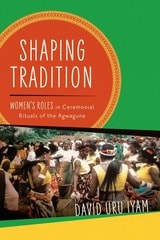
Shaping Tradition
Women's Roles in Ceremonial Rituals of the AgwaguneDavid Uru Iyam
University of Wisconsin Press, 2021
Using this community as a case study, David Uru Iyam asserts that these women are not stereotypically submissive, oppressed, or passive. Agwagune women participate in male ceremonies by pretending to be unaware of them, concealing their authority under a veneer of secrecy. Instead of focusing on obvious male political power, Iyam highlights the overlooked domestic and public contributions of women that uphold—and change—entire social systems.

Shaw's Daughters
Dramatic and Narrative Constructions of GenderJ. Ellen Gainor
University of Michigan Press, 1992

She Devils at the Door
Eliza Smith Brown
Carnegie Mellon University Press, 2023
Sometimes troublemakers emerge from the most unlikely of places. This true story follows the lives of two daughters of the Gilded Age—Lucy and Eliza Kennedy—who were educated at Vassar College and became leaders of the suffrage movement. Then, after the Nineteenth Amendment was passed in 1920, they spent the next forty years fighting corruption in politics and government.
Tenacious, smart, and witty, they captivated crowds, disarmed their opponents, and instilled particular dread among the corrupt politicians who were the unfortunate targets of their nonpartisan crusade. Their entry across the threshold of Pittsburgh’s City-County Building would reportedly invoke a flurry of hushed warnings through the halls: “The She Devils are at the door!” Together, Lucy and Eliza fought for the vote, empowered women to use it wisely, forced a mayor out of office in disgrace, took control of the city budget, exposed a series of scandals, spearheaded police reform, and launched a campaign that would eventually clear Pittsburgh of its smoky veil.
Featuring the true story of two powerful women, this book comes at a propitious time, reminding us how far women have come and how vigilant we must remain.

She's Got a Gun
Nancy Floyd
Temple University Press, 2008
Sympathetic but unsentimental, Floyd presents gun-toting women young and old, including an eleven-year-old girl competing in her first gun competition, a woman whose grandmother was killed by an intruder, and a war veteran who experienced firefights while stationed in Iraq. Whatever you might think about gun-toting women before you open this book, your preconceptions are sure to be shattered by the end.

Shelf Life
Essays, Memoirs, and an InterviewThom Gunn
University of Michigan Press, 1993
Gunn’s criticism communicates his own enthusiasm for poetry. He tries to show his readers how to get a first foothold into the work of some of his favorite poets, whether Wyatt or Whitman, Mina Loy or Robert Creeley.
Shifting The Blame
How Victimization Became a Criminal DefenseWestervelt, Saundra D
Rutgers University Press, 1998
More than just a study of legal history, Shifting the Blame looks at the "abuse excuse" defense as an indicator of broad social change in cultural understandings of victimization, responsibility, and womanhood. The introduction of victimization as an exculpatory condition within the context of a criminal defense tells the story of a society that has accepted victimization as a new way of explaining and excusing misbehavior.
Through case law analysis, the book documents the initial development of the strategy in three different types of cases in the 1970s - "rotten social background", brainwashing, and battered women's self-defense cases. Since its initial acceptance in battered women's cases in the early 1980s, the use of the strategy has expanded to a variety of offenders in different types of relationships arguing different defenses. In lively, readable prose, Westervelt examines each form of expansion, revealing that while the expansion of the strategy has been fairly extensive, it has also been limited in some important ways. Her research shows readers that only certain types of "victims," particularly victims of physical abuse, have successfully used this defense. Shifting the Blame exposes the ways in which the acceptance of this new defense strategy illuminates a cultural shift in understandings of individual responsibility and shows how the law plays a role in defining who can be an acceptable victim.
Saundra D. Westervelt is an assistant professor in the Sociology Department at the University of North Carolina at Greensboro.
Shifting The Blame
How Victimization Became a Criminal DefenseWestervelt, Saundra D
Rutgers University Press, 1996
More than just a study of legal history, Shifting the Blame looks at the "abuse excuse" defense as an indicator of broad social change in cultural understandings of victimization, responsibility, and womanhood. The introduction of victimization as an exculpatory condition within the context of a criminal defense tells the story of a society that has accepted victimization as a new way of explaining and excusing misbehavior.
Through case law analysis, the book documents the initial development of the strategy in three different types of cases in the 1970s - "rotten social background", brainwashing, and battered women's self-defense cases. Since its initial acceptance in battered women's cases in the early 1980s, the use of the strategy has expanded to a variety of offenders in different types of relationships arguing different defenses. In lively, readable prose, Westervelt examines each form of expansion, revealing that while the expansion of the strategy has been fairly extensive, it has also been limited in some important ways. Her research shows readers that only certain types of "victims," particularly victims of physical abuse, have successfully used this defense. Shifting the Blame exposes the ways in which the acceptance of this new defense strategy illuminates a cultural shift in understandings of individual responsibility and shows how the law plays a role in defining who can be an acceptable victim.
Saundra D. Westervelt is an assistant professor in the Sociology Department at the University of North Carolina at Greensboro.
Shooting Women
Behind the Camera, Around the WorldHarriet Margolis, Alexis Krasilovsky and Julia Stein
Intellect Books, 2015

Short Leash
A Memoir of Dog Walking and DeliveranceJanice Gary
Michigan State University Press, 2013
Janice Gary never walked alone without a dog - a big dog. Once, she was an adventurer, a girl who ran off to California with big dreams and hopes of leaving her past behind. But after a brutal rape, her youthful bravado vanished, replaced by a crippling need for safety. When she rescues a gangly Lab-Rottweiler pup,Gary is sure she’s found her biggest protector yet. But after Barney is attacked by a vicious dog, he becomes a clone of his attacker, trying to kill any dog that comes near him. Walking with Barney is impossible. Yet walking without him is unthinkable.
After years of being exiled by her terror and Barney’s defensiveness, Janice risks taking her dog to a park near the Chesapeake Bay. There, she begins the messy, lurching process of walking into her greatest fears. As the leash of the past unravels, Barney sheds the defensive behaviors that once shackled him and Gary steps out of the self-imposed isolation that held her captive for three decades. Beautifully written, Short Leash is much more than a “dog story” or a book about recovering from trauma. It is a moving tale of love and loss, the journey of a broken soul finding itsway toward wholeness.
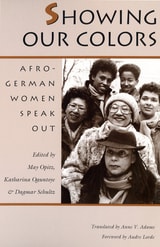
Showing Our Colors
Afro-German Women Speak OutMay Optiz
University of Massachusetts Press, 1992
Showing Our Colors: Afro-German Women Speak Out is an English translation of the German book Farbe bekennen, edited by author May Ayim, Katharina Oguntoye, and Dagmar Schultz. It is the first published book by Afro-Germans. It is the first written use of the term Afro-German.
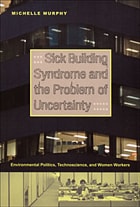
Sick Building Syndrome and the Problem of Uncertainty
Environmental Politics, Technoscience, and Women WorkersM. Murphy
Duke University Press, 2006
Sick building syndrome embodied a politics of uncertainty that continues to characterize contemporary American environmental debates. Murphy explores the production of uncertainty by juxtaposing multiple histories, each of which explains how an expert or lay tradition made chemical exposures perceptible or imperceptible, existent or nonexistent. They show how uncertainty emerged from a complex confluence of feminist activism, office worker protests, ventilation engineering, toxicology, popular epidemiology, corporate science, and ecology. In an illuminating case study, she reflects on EPA scientists’ efforts to have their headquarters recognized as a sick building. Murphy brings all of these histories together in what is not only a thorough account of an environmental health problem but also a much deeper exploration of the relationship between history, materiality, and uncertainty.

Sick Work
Exhaustion, Labor, and Invisible IllnessEmily Lim Rogers
Duke University Press, 2026

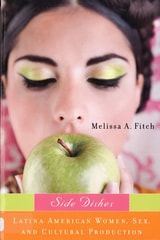
Side Dishes
Latina American Women, Sex, and Cultural ProductionFitch, Melissa A
Rutgers University Press, 2009
Side Dishes considers feminist pornography and literary representations of masturbation, bisexuality, lesbianism, and sexual fantasies; the treatment of lust in stand-up comedy and science fiction; critical issues in leading feminist journals; and portrayals of sexuality in four contemporary Latin American films. Melissa A. Fitch concludes with a look at the rise of women's and gender studies programs in Latin America.
Side Dishes
Latina American Women, Sex, and Cultural ProductionFitch, Melissa A
Rutgers University Press, 2009
Side Dishes considers feminist pornography and literary representations of masturbation, bisexuality, lesbianism, and sexual fantasies; the treatment of lust in stand-up comedy and science fiction; critical issues in leading feminist journals; and portrayals of sexuality in four contemporary Latin American films. Melissa A. Fitch concludes with a look at the rise of women's and gender studies programs in Latin America.

Sierra Leone's Settler Women Traders
Women on the Afro-European FrontierE. Frances White
University of Michigan Press, 1987
Sightlines
Race, Gender, and Nation in Contemporary Australian TheatreHelen Gilbert
University of Michigan Press, 1998
Signs
Journal of Women in Culture and Society, volume 45 number 2 (Winter 2020)The University of Chicago Press
University of Chicago Press Journals, 2020

Signs
Journal of Women in Culture and Society, volume 45 number 3 (Spring 2020)The University of Chicago Press
University of Chicago Press Journals, 2020
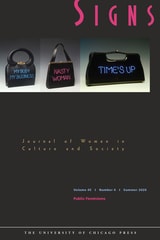
Signs
Journal of Women in Culture and Society, volume 45 number 4 (Summer 2020)The University of Chicago Press
University of Chicago Press Journals, 2020

Signs
Journal of Women in Culture and Society, volume 46 number 1 (Autumn 2020)The University of Chicago Press
University of Chicago Press Journals, 2020

Signs
Journal of Women in Culture and Society, volume 46 number 2 (Winter 2021)The University of Chicago Press
University of Chicago Press Journals, 2021
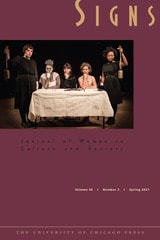
Signs
Journal of Women in Culture and Society, volume 46 number 3 (Spring 2021)The University of Chicago Press
University of Chicago Press Journals, 2021
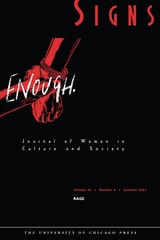
Signs
Journal of Women in Culture and Society, volume 46 number 4 (Summer 2021)The University of Chicago Press
University of Chicago Press Journals, 2021
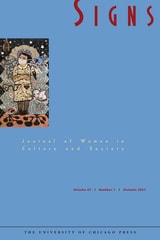
Signs
Journal of Women in Culture and Society, volume 47 number 1 (Autumn 2021)The University of Chicago Press
University of Chicago Press Journals, 2021
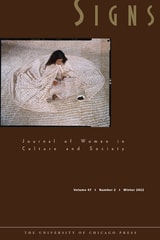
Signs
Journal of Women in Culture and Society, volume 47 number 2 (Winter 2022)The University of Chicago Press
University of Chicago Press Journals, 2022
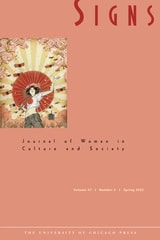
Signs
Journal of Women in Culture and Society, volume 47 number 3 (Spring 2022)The University of Chicago Press
University of Chicago Press Journals, 2022
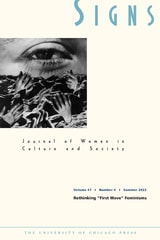
Signs
Journal of Women in Culture and Society, volume 47 number 4 (Summer 2022)The University of Chicago Press
University of Chicago Press Journals, 2022
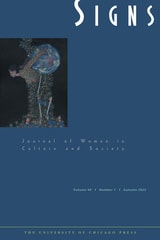
Signs
Journal of Women in Culture and Society, volume 48 number 1 (Autumn 2022)The University of Chicago Press
University of Chicago Press Journals, 2022