Results by title
1296 books match the query 'Women authors' and 100 start with s
Soft Canons
American Women WritersKaren L. Kilcup
University of Iowa Press, 1999
Softly Undercover
Hanae Jonas
The Ohio State University Press, 2024
Solidarity with the Other Beings on the Planet
Alice Walker, Ecofeminism, and Animals in LiteraturePamela B. June
Northwestern University Press, 2020
Grounded in ecofeminist theory, this literary analysis examines Walker’s evolving views on animals in relation to her discussions of other oppressed groups. Pamela B. June argues that Walker’s fiction can help readers understand and perhaps challenge American culture’s mistreatment of nonhuman animals. Walker has withstood criticism for her decision to abandon vegetarianism, and this book also problematizes the slippery territory of viewing writers as moral guides. Solidarity with the Other Beings on the Planet will appeal to readers in literary studies, ecofeminist studies, African American studies, and critical animal studies.
Someone Else's Hunger
Isabella DeSendi
Four Way Books, 2025
The expansive mercy of DeSendi's breath-taking images is never more apparent than the moment they turn, as when she heralds the avian frenzy "in the moment right after a purge": "always the miracle of birds arriving," "a messy flurry…curious if any piece of me could be salvaged, was still good enough to be taken home to the other starlings to eat." This speaker's ability to see the tenacious tenderness that drives the scavenger, to recognize its creative intelligence for nourishment, belies the resuscitative artistry that never abandons her as she turns carrion into continuance, coming alive again. Someone Else's Hunger subverts the revenge to recovery plot, arguing that the truest testament to the speaker's inner strength is the resilience it took to survive. DeSendi formally moves between restraint and excess, illustrating the great courage required to relinquish the control she won back when she became the master of her suffering. But the reward of risking exposure, daring to open herself to the world and let herself feed off it? Abundance. The arrival of spring and "with it the audacious dirt," this realization that "sometimes / in the breaking I am bettering / and in the bettering I am free."
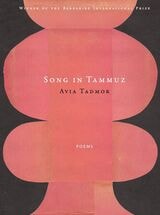
Song in Tammuz
Avia Tadmor
Tupelo Press, 2026
Winner of the International Berkshire Prize, this collection draws from an incredible range of literary forms, from familiar couplets and tercets to footnotes, dictionary definitions, and luminous lyric fragments.
While stylistically daring, even virtuosic, Avia Tadmor’s stunning debut is unified by its enduring engagement with questions of language and alterity. What does it mean to be othered by and through language? What happens when grammar, syntax, and the concepts of identity housed within them are at odds? Does a revolutionary message demand new forms of discourse? “I can say it through the distance of this other tongue,” Tadmor writes.
Indeed, she considers the role of language—from conceptual framework to vast storehouse of history, culture, and inheritance—in shaping the self, ultimately revealing our agency within a grammar and syntax we did not choose. As Tadmor writes, “Her pen is a stronghold, a lighthouse / flickering late in July.”
Song of the Cicadas
Anne Mong-Lan Pham
University of Massachusetts Press, 2001
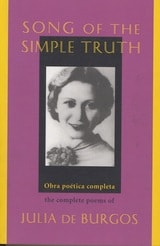
Song of the Simple Truth
The Complete Poems of Julia de BurgosJulia de Burgos
Northwestern University Press, 1995
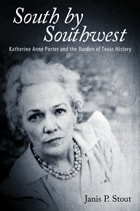
South by Southwest
Katherine Anne Porter and the Burden of Texas HistoryJanis P. Stout
University of Alabama Press, 2013
An interdisciplinary study of Katherine Anne Porter’s troubled relationship to her Texas origins and southern roots, South by Southwest offers a fresh look at this ever-relevant author.
Today, more than thirty years after her death, Katherine Anne Porter remains a fascinating figure. Critics and biographers have portrayed her as a strikingly glamorous woman whose photographs appeared in society magazines. They have emphasized, of course, her writing— particularly the novel Ship of Fools, which was made into an award-winning film, and her collection Pale Horse, Pale Rider, which cemented her role as a significant and original literary modernist. They have highlighted her dramatic, sad, and fragmented personal life. Few, however, have addressed her uneasy relationship to her childhood in rural Texas.
Janis P. Stout argues that throughout Porter’s life she remained preoccupied with the twin conundrums of how she felt about being a woman and how she felt about her Texas origins. Her construction of herself as a beautiful but unhappy southerner sprung from a plantation aristocracy of reduced fortunes meant she construed Texas as the Old South. The Texas Porter knew and re-created in her fiction had been settled by southerners like her grandparents, who brought slaves with them. As she wrote of this Texas, she also enhanced and mythologized it, exaggerating its beauty, fertility, and gracious ways as much as the disaffection that drove her to leave. Her feelings toward Texas ran to both extremes, and she was never able to reconcile them.
Stout examines the author and her works within the historical and cultural context from which she emerged. In particular, Stout emphasizes four main themes in the history of Texas that she believes are of the greatest importance in understanding Porter: its geography and border location (expressed in Porter’s lifelong fascination with marginality, indeterminacy, and escape); its violence (the brutality of her first marriage as well as the lawlessness that pervaded her hometown); its racism (lynchings were prevalent throughout her upbringing); and its marginalization of women (Stout draws a connection between Porter’s references to the burning sun and oppressive heat of Texas and her life with her first husband).
Southern Women Playwrights
New Essays in History and CriticismEdited by Robert McDonald and Linda Rohrer Paige
University of Alabama Press, 2001
This timely collection addresses the neglected state of scholarship on southern women dramatists by bringing together the latest criticism on some of the most important playwrights of the 20th century.
Coeditors Robert McDonald and Linda Rohrer Paige attribute the neglect of southern women playwrights in scholarly criticism to "deep historical prejudices" against drama itself and against women artists in general, especially in the South. Their call for critical awareness is answered by the 15 essays they include in Southern Women Playwrights, considerations of the creative work of universally acclaimed playwrights such as Beth Henley, Marsha Norman, and Lillian Hellman (the so-called "Trinity") in addition to that of less-studied playwrights, including Zora Neale Hurston, Carson McCullers, Alice Childress, Naomi Wallace, Amparo Garcia, Paula Vogel, and Regina Porter.
This collection springs from a series of associated questions regarding the literary and theatrical heritage of the southern woman playwright, the unique ways in which southern women have approached the conventional modes of comedy and tragedy, and the ways in which the South, its types and stereotypes, its peculiarities, its traditions-both literary and cultural-figure in these women's plays. Especially relevant to these questions are essays on Lillian Hellman, who resisted the label "southern writer," and Carson McCullers, who never attempted to ignore her southernness.
This book begins by recovering little-known or unknown episodes in the history of southern drama and by examining the ways plays assumed importance in the lives of southern women in the early 20th century. It concludes with a look at one of the most vibrant, diverse theatre scenes outside New York today-Atlanta.

Sovereignty
A PlayMary Kathryn Nagle
Northwestern University Press, 2020
A powerful meditation of the echoes of history and the never-ending struggle for sovereignty
Sovereignty unfolds over two parallel timelines. In present-day Oklahoma, a young Cherokee lawyer, Sarah Ridge Polson, and her colleague Jim Ross defend the inherent jurisdiction of Cherokee Nation in the U.S. Supreme Court when a non-Indian defendant challenges the Nation’s authority to prosecute non-Indian perpetrators of domestic violence. Their collaboration is juxtaposed with scenes from 1835, when Cherokee Nation was eight hundred miles to the east in the southern Appalachians. That year, Sarah’s and Jim’s ancestors, historic Cherokee rivals, were bitterly divided over a proposed treaty with the administration of Andrew Jackson, the Treaty of New Echota, which led to the nation’s removal to Oklahoma on the infamous Trail of Tears.
A direct descendant of nineteenth-century Cherokee leaders John Ridge and Major Ridge, Mary Kathryn Nagle has penned a play that twists and turns from violent outbursts to healing monologues, illuminating a provocative double meaning for the sovereignty of both tribal territory and women’s bodies. Taking as its point of departure the story of one lawyer’s passionate defense of the rights of her people to prosecute non-natives who commit crimes on reservations, Sovereignty opens up into an expansive exploration of the circular continuity of history, human memory, and the power of human relationships.
Spanish American Women's Use of the Word
Colonial through Contemporary NarrativesStacey Schlau
University of Arizona Press, 2001
Spanish Women Writers and the Essay
Gender, Politics, and the SelfKathleen M. Glenn and Mercedes Mazquirán de Rodríguez
University of Missouri Press, 1998
Never before has a book examined Spanish women and their mastery of the essay. In the groundbreaking collection Spanish Women Writers and the Essay, Kathleen M. Glenn and Mercedes Mazquiarán de Rodríguez help to rediscover the neglected genre, which has long been considered a "masculine" form. Taking a feminist perspective, the editors examine why Spanish women have been so drawn to the essay through the decades, from Concepción Arenal's nineteenth-century writings to the modern works of Rosa Montero.
Spanish women, historically denied a public voice, have discovered an outlet for their expression via the essay. As essayists, they are granted the authority to address subjects they personally deem important, discuss historical and sociopolitical issues, and denounce female subordination. This genre, which attracts a different audience than does the novel or poem, allows Spanish women writers to engage in a direct dialogue with their readers.
Featuring twelve critical investigations of influential female essayists, Spanish Women Writers and the Essay illustrates Spanish women writers' command of the genre, their incorporation of both the ideological and the aesthetic into one concise form, and their skillful use of various strategies for influencing their readers. This fascinating study, which provides English translations for all quotations, will appeal to anyone interested in nineteenth- and twentieth-century Spanish literature, comparative literature, feminist criticism, or women's studies.
Speaking Our Selves
New Plays by African WomenAsiimwe Deborah Kawe and Robert H. Vorlicky, Editors
University of Michigan Press, 2025
The plays within Speaking Our Selves confront a range of ideas and issues, including women embracing the potential of agency in often contested subject positions; confronting their historical object positions in worlds of devastating patriarchal authority; resisting toxic masculinity and persistent, oppressive binaries of gender roles; finding power in communities of women; increasing their acumen in financial, business, and economic spheres; facing tensions between traditional religious tenets and efforts toward secularization; living with perpetual acts of violence toward their bodies; and the rising mental health issues among girls and women across the continent. Readers and audiences are challenged by these plays not to be passive witnesses by observing from safe vantage points, but rather to be active participants in the stories being told.
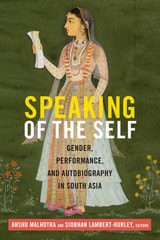
Speaking of the Self
Gender, Performance, and Autobiography in South AsiaAnshu Malhotra and Siobhan Lambert-Hurley, editors
Duke University Press, 2015
Contributors: Asiya Alam, Afshan Bokhari, Uma Chakravarti, Kathryn Hansen, Siobhan Lambert-Hurley, Anshu Malhotra, Ritu Menon, Shubhra Ray, Shweta Sachdeva Jha, Sylvia Vatuk

Spinoza in Her Youth
Norma Cole
Omnidawn, 2002
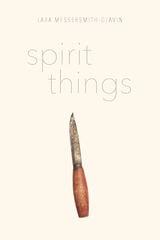
Spirit Things
Lara Messersmith-Glavin
University of Alaska Press, 2022
“Spirit things” are those mundane objects that offer new insights into the world on closer consideration—fishing nets, a favorite knife, and the bioluminescent gleam of seawater in a twilight that never truly grows dark. Spirit Things recounts stories of fishing, family, synesthesia, storytelling, gender, violence, and meaning. Each essay takes an object and follows it through histories: personal, material, and scientific, drawing together the delicate lines that link things through their making and use, their genesis and evolution, and the ways they gain significance in an individual’s life.
A contemplative take on everything from childcare to neurodivergence, comfort foods to outlaws, Spirit Things uses experiences from the human world and locates them on the edges of nature. Contact with wilderness, with wildness, be it twenty-foot seas in the ocean off Alaska’s coast or chairs flying through windows of a Kodiak bar, provides an entry point for meditations on the ways in which patterns, magic, and wonder overlap.
Spirit Things
Lara Messersmith-Glavin
University of Alaska Press, 2022
“Spirit things” are those mundane objects that offer new insights into the world on closer consideration—fishing nets, a favorite knife, and the bioluminescent gleam of seawater in a twilight that never truly grows dark. Spirit Things recounts stories of fishing, family, synesthesia, storytelling, gender, violence, and meaning. Each essay takes an object and follows it through histories: personal, material, and scientific, drawing together the delicate lines that link things through their making and use, their genesis and evolution, and the ways they gain significance in an individual’s life.
A contemplative take on everything from childcare to neurodivergence, comfort foods to outlaws, Spirit Things uses experiences from the human world and locates them on the edges of nature. Contact with wilderness, with wildness, be it twenty-foot seas in the ocean off Alaska’s coast or chairs flying through windows of a Kodiak bar, provides an entry point for meditations on the ways in which patterns, magic, and wonder overlap.

Spiritual Writings of Sister Margaret of the Mother of God (1635-1643)
Margaret Van Noort
Iter Press, 2015
In 1635, as directed by her confessor so that he might understand “the state of her soul,” Margaret Van Noort, a lay sister of the royal convent of Discalced Carmelite nuns in Brussels, composed her spiritual autobiography. This text was followed by two diaries in 1636 and 1637 recording the workings of her inner life and relation to God, and reflecting the cosmopolitan Catholic tradition of her homeland. Now gathered in this volume, these works illustrate Margaret’s development from a troubled young lay sister into a woman of spiritual experience and authority.
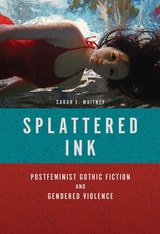
Splattered Ink
Postfeminist Gothic Fiction and Gendered ViolenceSarah E Whitney
University of Illinois Press, 2016
Sarah E. Whitney explores the genre's challenge to postfeminist assumptions of women's equality and empowerment. The authors she examines--Patricia Cornwell, Jodi Picoult, Susanna Moore, Sapphire, and Alice Sebold--construct narratives around socially invisible and physically broken protagonists who directly experience consequences of women's ongoing disempowerment. Their works ask readers to inhabit women's suffering and to face the uncomfortable, all-too-denied fact that today's women must navigate lives fraught with risk. Whitney's analysis places the authors within a female gothic tradition that has long given voice to women's fears of their own powerlessness. But she also reveals the paradox that allows the genre to powerfully critique postfeminism's often sunshiney outlook while uneasily coexisting within the same universe.
Spoiling the Stories
The Rise of Israeli Women's FictionTamar Merin
Northwestern University Press, 2016
Spring and a Thousand Years (Unabridged)
PoemsJudy Halebsky
University of Arkansas Press, 2020
A translator’s notebook, an almanac, an ecological history, Judy Halebsky’s Spring and a Thousand Years (Unabridged) moves between multiple intersections and sign systems connected in a long glossary poem that serves as the book’s guide to what is lost, erased, or disrupted in transition both from experience to written word and from one language, location, and time period to another.
Writers Li Bai, Matsuo Bashō, Sei Shōnagon, and Du Fu make frequent appearances in centuries ranging from the eighth to the twenty-first, and appear in conversation with Grace Paley, Donald Hall, and Halebsky herself, as the poet explores subjects ranging from work and marriage to environmental destruction. Asking what would happen if these poets—not just their work—appeared in California, the poems slip between different geographies, syntaxes, times, and cultural frameworks.
The role of the literary translator is to bring text from one language into another, working to at once shift and retain the context of the original—from one alphabet to another, one point in time to another. These are poems in homage to translation; they rely on concepts that can bridge time and space, and as a result are as likely to find meaning in donuts or Zumba as they are to find it in the ocean. Spring and a Thousand Years (Unabridged) finds reasons for hope not in how the world should be, but in how it has always been.
Squander
Elena Karina Byrne
Omnidawn, 2016
Stardust Media
Christina Pugh
University of Massachusetts Press, 2020
Christina Pugh's fifth book of poems explores the technologies both ancient and new that inhabit our contemporary cultural moment. Mapping an uncanny journey through the clusters of media we encounter daily but seldom stop to contemplate, Pugh's focused descriptions, contrasting linguistic textures, and acute poetic music become multifarious sources of beauty, disruption, humor, and hurt. Here, Netflix and YouTube share space with eighteenth-century paintings, Italian graffiti, ballet, Kurt Cobain's recordings, and even a collection of rocks. Whether technology is a vessel for joy or grief in these poems, it is always an expression of our continuing desire to invent and to mediate. At once personal archive and cultural barometer, Stardust Media traces the moving constellations of life in the distant twenty-first century, “a kaleidoscope / . . . half-filled with sky-blue glass-cut blossoming, / then labored to crystallize.”

Stars at Noon
Poems from the Life of Jacqueline CochranEnid Shomer
University of Arkansas Press, 2001
These poems give voice to the life of the first woman to fly faster than the speed of sound. While Jacqueline Cochran was alive, no man or woman in the world could match her records for speed, distance, and altitude flying. Founder and director of the Women’s Airforce Service Pilots (WASP) during World War II, Cochran continued to fly competitively until she was sixty, owned and operated her own line of designer cosmetics for three decades, ran for Congress, and generally placed herself on the path of history. Having begun life as a foundling in the crushing poverty of a lumber company town of the Florida panhandle, she described her life as “a passage from sawdust to stardust.” Yet after her death she has barely been remembered.
Poet Enid Shomer brings back this mercurial, dazzling, powerful woman. These poems speak in her voice and in the voices of her mother, teachers, husband, confidants, and political opponents, shaped by Shomer’s consummate formal control and stunning lyricism.
Status Pending
Adrian Blevins
Four Way Books, 0
Story Hour
Sara Henderson Hay
University of Arkansas Press, 1998
Strange Attractors
Lives Changed by ChanceEdie Meidav
University of Massachusetts Press, 2019
Has a stunning surprise or lucky encounter ever propelled you in an unanticipated direction? Are you doing what you always thought you would be doing with your life or has some unseen magnetism changed your course? And has that redirection come to seem inevitable? Edie Meidav and Emmalie Dropkin asked leading contemporary writers to consider these questions, which they characterize through the metaphor of “the strange attractor,” a scientific theory describing an inevitable occurrence that arises out of chaos. Meidav's introduction and the thirty-five pieces collected here offer imaginative, arresting, and memorable replies to this query, including guidance from a yellow fish, a typewriter repairman, a cat, a moose, a bicycle, and a stranger on a train. Absorbing and provocative, this is nonfiction to be read in batches and bursts and returned to again and again.
Strange Bodies
Gender and Identity in the Novels of Carson McCullersSarah Gleeson-White
University of Alabama Press, 2003
Adapts Mikhail Bakhtin's theory of the grotesque, as well as the latest in gender and psychoanalytic theory, to the major works of acclaimed southern writer Carson McCullers.
This innovative reconsideration of the themes of Carson McCullers's fiction argues that her work has heretofore suffered under the pall of narrow gothic interpretations, obscuring a more subversive agenda. By examining McCullers’s major novels—The Heart is a Lonely Hunter, Reflections in a Golden Eye, The Member of the Wedding, and The Ballad of the Sad Café—Gleeson-White locates a radical and specific form of the grotesque in the author's fiction: the liberating and redemptive possibilities of errant gender roles and shifting sexuality. She does this by employing Bakhtin's theory of the grotesque, which is both affirming and revolutionary, and thereby moves McCullers's texts beyond the 'gloom and doom' with which they have been charged for over fifty years.
The first chapter explores female adolescence by focusing on McCullers's tomboys in the context of oppressive southern womanhood. The second chapter analyzes McCullers's fascinating struggle to depict homosexual desire outside of traditional stereotypes. Gleeson-White then examines McCullers's portrayals of feminine and masculine gender through the tropes of cross-dressing, transvestism, and masquerade. The final chapter takes issue with earlier readings of androgyny in the texts to suggest a more useful concept McCullers herself called "the hybrid." Underpinning the whole study is the idea of a provocative, dynamic form of the grotesque that challenges traditional categories of normal and abnormal.
Because the characters and themes of McCullers's fiction were created in the 1940s and 1950s, a time of tension between the changing status of women and the southern ideal of womanhood, they are particularly fertile ground for a modern reexamination of this nature. Gleeson-White's study will be valued by scholars of American literature and gender and queer studies, by students of psychology, by academic libraries, and by readers of Carson McCullers. Strange Bodies is a thoughtful, highly credible analysis that adds dimension to the study of southern literature.

Strange Hymn
PoemsCarlene Kucharczyk
University of Massachusetts Press, 2025
Winner of the 2025 Vermont Book Award for Poetry!
“I’ll tell you everything I know. Though there might not be much to tell,” confesses the speaker in Strange Hymn by Carlene Kucharczyk, in a meticulously crafted lyrical journey exploring morality and humanity. The poems here grapple with understanding physical loss: “I wanted / to know at once and definitively our animal bodies / were not all we were. It is shameful to be this fragile.” They also engage with the more abstract slipping away of memory and time: “Since I was born, I have been forgetting. Forgetting what I have wanted to remember.” Kucharczyk’s insightful poems blur the lines between history and myth, love and grief, song and silence.
Caught between lamenting the passage of time and rejoicing in small beauties, she writes, “I tell you, I wish we could stay here longer / in this hotel of lost grandeur, this palace of interesting disarray, / and stay here with these pieces of the impersonal past / that have somehow not yet outlasted their small lights.” Each moment reflects on our ephemeral lives from musings on art and nature to reflections on the self, asking “Is a mirror a sort of glass house? / And, is there a way to see ourselves besides through the glass?”
As readers traverse this collection, they learn how the body sings, the many iterations of Mary, what sirens truly think of Odysseus, how a Morning Glory unfurls, and lessons in orthodontics, but most importantly, how to live with absence. Kucharczyk is a master of manipulating time and space through her dynamic use of form, creating a narrative that begs, “After I’m gone, don’t bury my body— / Burn it, and turn it into song.”
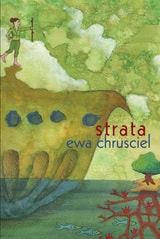
Strata
Ewa Chrusciel
Omnidawn, 2018
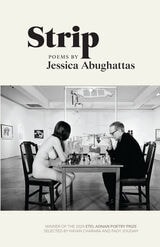
Strip
PoemsJessica Abughattas
University of Arkansas Press, 2020
“The mystery that Abughattas composes is always moving toward an impossible freeing of the self from its numerous frames. Yet frame by frame . . . she suspends our disbelief, catalogs those potentialities in an America always ready to shoot, direct, and produce the film of itself. Strip is ‘in love with possibility,’ ‘in praise of here I am, here I’ve been,’ USA style. Strip celebrates the body—its rise and fall, ebb and flow, in a carnival of parties—restlessly, shamelessly, searching for a way out…. Even as Abughattas claims that ‘I can’t believe sometimes I have a body,’ her poems teem with an awareness of the body’s unavoidable centrality in our lives—in how we view our lives, and how others view them; in how they progress, and how they end; in how they become meaningful, and how they are stripped of meaning. And no stripping escapes memory. Whether in terms of dispossession or sexuality, admiration or pity, Abughattas renders her treatment of the body with candor and poignancy. . . . The most startling moments in Abughattas’s poems, however, depend not on shocking or intimate details—but on the ‘I’ pulling away from the self, abandoning the ego, and gazing outward. She tries to see something else, to escape the body’s restraints.”
—Fady Joudah and Hayan Charara, from the Preface

Stripped and Script
Loyalist Women Writers of the American RevolutionKacy Dowd Tillman
University of Massachusetts Press, 2019
Strong Voices, Weak History
Early Women Writers and Canons in England, France, and ItalyPamela J Benson and Victoria Kirkham, Editors
University of Michigan Press, 2005
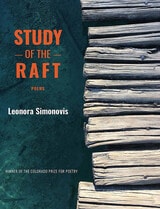
Study of the Raft
Leonora Simonovis
University Press of Colorado, 2021
In Study of the Raft, Leonora Simonovis’s poems weave the outer world of a failed political revolution in her native country, Venezuela, with an inner journey into the memories of migration and exile, of a home long gone, and of family relations, especially among womxn. The collection explores the consequences of colonization, starting with “Maps,” a poem that speaks of loss and uprootedness, recalling a time when indigenous lands were stolen and occupied, where stories were lost as new languages and beliefs were imposed on people. The politics of the present are also the politics of the past, not just in the Venezuelan context, but in many other Latin American and Caribbean countries. It is the reality of all indigenous people. Simonovis’s poems question the capacity of language to represent the complexity of lived experience, especially when it involves living from more than one language and culture. These poems wrestle with questions of life and death, of what remains after what and whom we know are no longer with us, and how we, as humans, constantly change and adjust in the face of uncertainty.
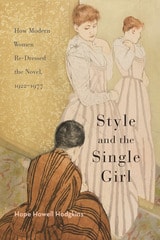
Style and the Single Girl
How Modern Women Re-Dressed the Novel, 1922–1977Hope Howell Hodgkins
The Ohio State University Press, 2016
Hodgkins delineates how in the 1920s and 1930s, popular novels by Dorothy Sayers and high-art fiction by Jean Rhys used dress to comment wittily and bitterly on gender relations. During World War II, changes in British Vogue and compromises made by the literary journal Horizon signaled the death of modernist styles, as Elizabeth Bowen’s gender-bent wartime stories show. Then demure and reserved postwar styles—Dior’s curvy New Look, the Movement’s understated literary irony—were intertwined in the fictions of Barbara Pym and Muriel Spark, who re-dressed the novel with a vengeance. Whether fashioning detective fiction, literary impressionism, or postwar comedy, these novelists used style in every sense to redefine that famous question, “What do women want?”
Subject to Delusions
Narcissism, Modernism, GenderCaroline Rupprecht
Northwestern University Press, 2006
Because "the other," or the object, is constructed, Rupprecht finds in narcissism the possibility of rewriting notions of identity. She then pursues this possibility through modern literary texts in which narcissism acts as a structuring principle—works by the expressionist poet Henriette Hardenberg, the American avant-garde novelist Djuna Barnes, and the surrealist writer Unica Zürn—reading each within the critical framework of the evolution of the idea of narcissism in psychoanalytic theory. All written by women, these works also raise questions of gender and sexuality. Moreover, because each of these authors belonged to or was influenced by a particular literary movement, Rupprecht's analysis advances our understanding of the poetics of these movements and of the movement of modernism itself. Underlying all is a deep engagement with psychoanalytic theory. Drawing on Freud, his contemporaries and rivals, Jacques Lacan, Melanie Klein, and many other theorists, Rupprecht interrogates preconceived notions of identity and subjectivity through her readings of the "transgressive potential" of narcissism as it is enacted in the texts under study. Bringing the works of literary modernism and psychoanalysis together in an innovative and provocative way, her book succeeds in enhancing our sense of both, and in clarifying the complex role of narcissism in our cultural narrative.
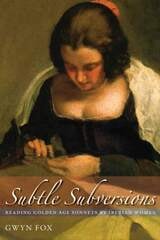
Subtle Subversions
Reading Golden Age Sonnets by Iberian WomenGwyn Fox
Catholic University of America Press, 2008
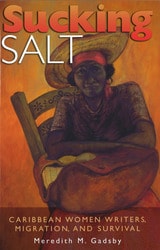
Sucking Salt
Caribbean Women Writers, Migration, and SurvivalMeredith M. Gadsby
University of Missouri Press, 2006
Sugar
Andrea Cohen
Four Way Books, 2026
About Sugar, David Orr has said: “Andrea Cohen’s ninth collection is elegantly precise—but this isn’t the precision of a meticulously arranged garden or tidy bookshelf. Rather, Cohen’s nimble, exacting lines are like guide ropes strung up the sides of an icy mountain: Her precision manages risk, and the risk leads to startling vistas. An entire relationship dynamic unfolds in the five monosyllables of ‘Proximity’: ‘She died / Of my wounds.’ In ‘Ghosting,’ the ambiguity of departure—the way in which lives and loves sometimes cease without concluding—is captured in all its shades of gray: ‘Any ghost will / tell you— // the last thing / we mean // to do / is leave you.’ We sometimes think of poems as recreating experience, but Cohen’s work reminds us that poetry, at its most patient and compassionate, is also a way of discerning. Sugar brings us a step closer to the sun; it helps us to orient ourselves, but more than that, it helps us to see.”
Supremely Tiny Acts
A Memoir of a DaySonya Huber
The Ohio State University Press, 2021
“I think we have to get to the real, to catch the facts we have, to hold on to what we see. . . .in this time where lies are currency,” Sonya Huber writes in her book-length essay Supremely Tiny Acts: A Memoir of a Day. On the theory that naming the truths of quotidian experience can counter the dangerous power of lies, she carefully recounts two anxiety-fueled days one fall. On the first, she is arrested as part of a climate protest in Times Square. On the other, she must make it to her court appearance while also finding time to take her son to get his learner's permit. Paying equal attention to minor details, passing thoughts, and larger political concerns around activism and parenting in the Trump-era United States, Huber asks: How can one simultaneously be a good mother, a good worker, and a good citizen? As she reflects on the meaning of protest and on whiteness and other forms of privilege within political activism, Huber offers a wry, self-aware, and stirring testament to the everyday as a seedbed for meaningful change.
Surrealist Women
An International AnthologyEdited by Penelope Rosemont
University of Texas Press, 1998
Beginning in Paris in the 1920s, women poets, essayists, painters, and artists in other media have actively collaborated in defining and refining surrealism's basic project—achieving a higher, open, and dynamic consciousness, from which no aspect of the real or the imaginary is rejected. Indeed, few artistic or social movements can boast as many women forebears, founders, and participants—perhaps only feminism itself. Yet outside the movement, women's contributions to surrealism have been largely ignored or simply unknown.
This anthology, the first of its kind in any language, displays the range and significance of women's contributions to surrealism. Letting surrealist women speak for themselves, Penelope Rosemont has assembled nearly three hundred texts by ninety-six women from twenty-eight countries. She opens the book with a succinct summary of surrealism's basic aims and principles, followed by a discussion of the place of gender in the movement's origins. She then organizes the book into historical periods ranging from the 1920s to the present, with introductions that describe trends in the movement during each period. Rosemont also prefaces each surrealist's work with a brief biographical statement.
Susanna Rowson
Sentimental Prophet of Early American LiteratureSteven Epley
Northwestern University Press, 2016
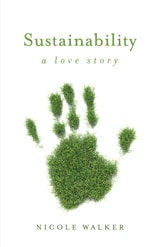
Sustainability
A Love StoryNicole Walker
The Ohio State University Press, 2018
This book is for the burnt-out environmentalist, the lazy environmentalist, the would-be environmentalist. It’s for those who believe the planet is dying. For those who believe they are dying. And for those who question what it means to live and love sustainably, and maybe even with hope.
Susto
Tommy Archuleta
University Press of Colorado, 2023
Swan Hammer
An Instructor’s Guide to MirrorsMaggie Graber
Michigan State University Press, 2022
Sweeping Beauty
Contemporary Women Poets Do HouseworkPamela Gemin
University of Iowa Press, 2005

Sweet Bells Jangled
Laura Redden Searing, A Deaf Poet RestoredJudy Yaeger Jones
Gallaudet University Press, 2003
Laura Redden Searing (1839-1923) defied critics of the time by establishing herself as a successful poet, a poet who was deaf. She began writing verse at the Missouri School for the Deaf in 1858, and, under the pseudonym Howard Glyndon, soon found herself catapulted into national prominence by her patriotic Civil War poems. Abraham Lincoln himself bought her books, the most critically acclaimed being Idylls of Battle and Poems of the Rebellion, published in 1864. Her poem “Belle Missouri” became the song of the Missouri Volunteers, and she was sent by the St. Louis Republican newspaper to Washington as a war correspondent.
Despite her success, detractors decried her poetry simply because she was deaf, asking how she could know anything of rhyme, rhythm, or musical composition. She quieted them with the simple elegance of her words and the sophistication of her allegorical themes. Readers can enjoy her work again in this volume, which features more than 70 of her finest poems. They also will learn her feelings about the constraints imposed on 19th-century women in her epic narrative of misunderstanding and lost love “Sweet Bells Jangled:”
Out of sight of the heated land
Over the breezy sea;
Into the reach of the solemn mist
Quietly drifted we.
Her restoration will be an event welcomed by poetry aficionados everywhere.
Sweet Repetition
Cynthia Cruz
University of Chicago Press, 2025
Integrating Lacanian and Freudian psychoanalysis, continental philosophy, and the works of other poets, this collection explores narrative through abstraction and considers how repetition holds both the power to constrain and to generate. Freud explains how what we repress—what we know but don’t want to acknowledge—reappears in our actions through repetition. Through slips of the tongue or selective memory, we engage with what our unconscious knows, finding knowledge through unknowing. The psychoanalytic session is centered on bringing forth repressed knowledge through acts of unknowing—speaking without thinking—which brings one closer to recognizing an obscured desire.
The poetry of Sweet Repetition works in ways akin to the psychoanalytic act. These pulsing poems follow the definitions of the word revolution—to revolve, change direction, unroll, unwind, happen again, repeat, orbit around. Images and words reappear in the motion of Cynthia Cruz’s poems, inviting us into their revolutionary, political, and cumulative effects.
Sylvia Plath and the Mythology of Women Readers
Janet Badia
University of Massachusetts Press, 2011
Janet Badia investigates the evolution of this narrative, tracing its origins, exposing the gaps and elisions that have defined it, and identifying it as a bullying mythology whose roots lie in a long history of ungenerous, if not outright misogynistic, rhetoric about women readers that has gathered new energy from the backlash against contemporary feminism.
More than just an exposé of our cultural biases against women readers, Badia's research also reveals how this mythology has shaped the production, reception, and evaluation of Plath's body of writing, affecting everything from the Hughes family's management of Plath's writings to the direction of Plath scholarship today. Badia discusses a wide range of texts and issues whose significance has gone largely unnoticed, including the many book reviews that have been written about Plath's publications; films and television shows that depict young Plath readers; editorials and fan tributes written about Plath; and Ted and (daughter) Frieda Hughes's writings about Plath's estate and audience.
solo/black/woman
scripts, interviews, and essaysEdited by E. Patrick Johnson and Ramón H. Rivera-Servera and with a foreword by D. Soyini Madison
Northwestern University Press, 2013